United Arab Emirates (UAE) Mirrors Market Summary
The united arab emirates (uae) mirrors market was estimated at USD 793 Million in 2025 and is projected to reach USD 1129 Million by 2032, growing at a CAGR of 6.0% from 2026 to 2032.
United Arab Emirates (UAE) Mirrors Market Year-wise Growth Rate and Key Drivers
This graph highlights how the United Arab Emirates (UAE) Mirrors Market has steadily grown over the past five years, supported by major growth factors.
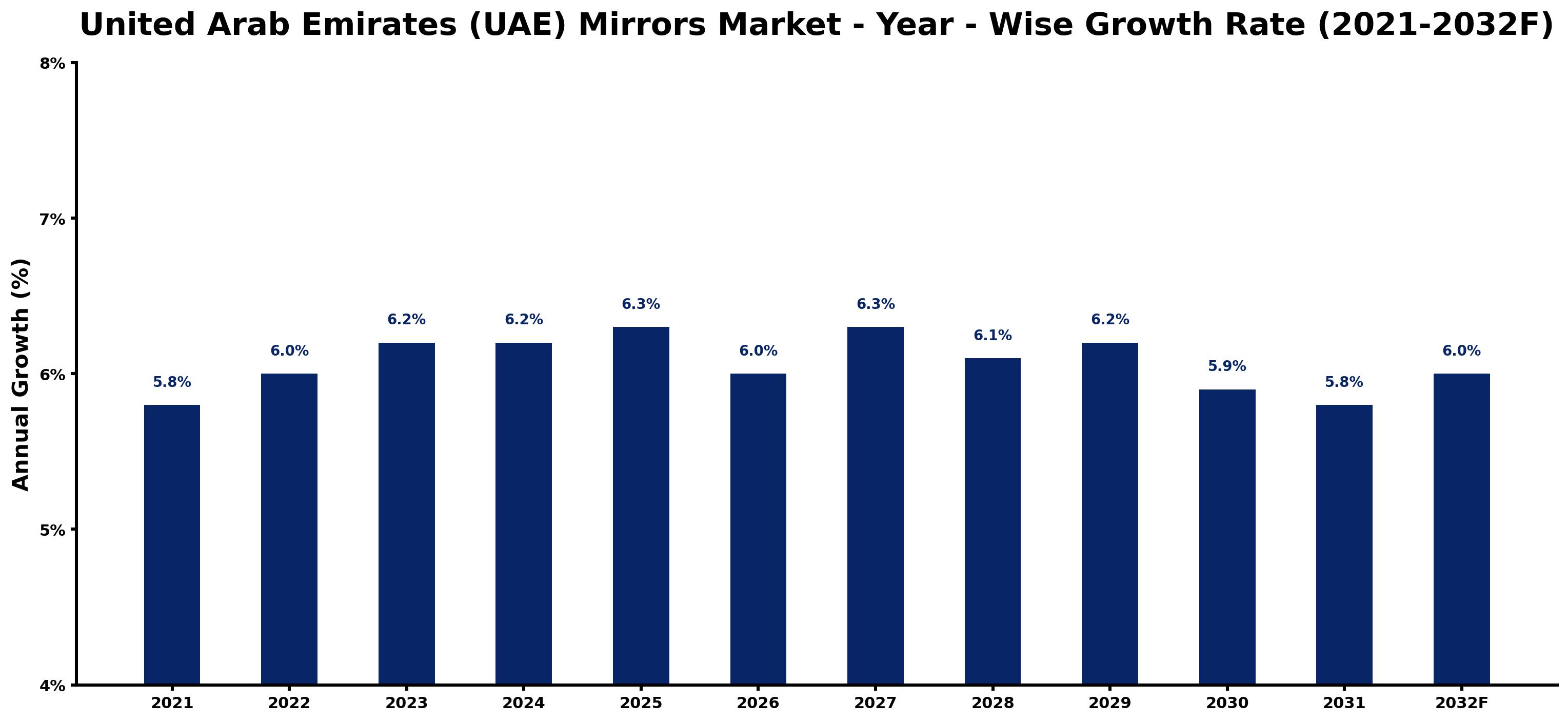
The table below presents the year wise growth rates along with the key drivers influencing the market
| Year | Growth Rate | Major Drivers |
| 2021 | 5.8% | Luxury home investments continue across the UAE, enhancing demand for designer mirrors. |
| 2022 | 6.0% | Regional tourism rebounds, increasing interest in decorative mirrors for hospitality sectors. |
| 2023 | 6.2% | E-commerce platforms expand, allowing consumers to access diverse mirror styles conveniently. |
| 2024 | 6.2% | Urbanization trends push for modern residential complexes featuring upscale bathroom fixtures. |
| 2025 | 6.3% | Sustainability becomes a focal point, driving interest in eco-friendly mirror production methods. |
| 2026 | 6.0% | Architectural innovation in commercial spaces requires custom mirror designs for aesthetics. |
| 2027 | 6.3% | Smart home technology integration encourages demand for mirrors with advanced functionalities. |
| 2028 | 6.1% | Cultural appreciation for art mirrors boosts local artisan craftsmanship in mirror designs. |
| 2029 | 6.2% | Retail sector diversifies, showcasing unique mirror collections in high-traffic shopping areas. |
| 2030 | 5.9% | Interior design trends favor open spaces, increasing mirror installations for visual expansion. |
| 2031 | 5.8% | Home automation systems promote the use of mirrors with integrated lighting solutions. |
| 2032 | 6.0% | Export opportunities grow as UAE manufacturers tap into neighboring GCC markets. |
Note - Market size estimations and growth projections presented in this report are based on 6Wresearch's advanced forecasting approach, validated with industry datasets as of June 2026.
United Arab Emirates (UAE) Mirrors Market Synopsis
The United Arab Emirates (UAE) Mirrors Market is projected to reach 6.0% and witness significant growth during the forecast period (2026-2032). This market encompasses the comprehensive production, distribution, and sale of a diverse range of mirrors across various sectors, including residential, commercial, and industrial applications. Recent years have shown a steady escalation in demand for mirrors, fueled by the rising trends in home decoration, architectural designs, automotive requirements, and manufacturing of optical instruments.
United Arab Emirates (UAE) Mirrors Market Growth Drivers
A multitude of factors are driving the growth of the mirrors market in the UAE. The rapid urbanization and extensive infrastructure development have significantly boosted construction activities across the region, creating a robust demand for mirrors in both residential and commercial properties. Additionally, the expansion of the automotive sector—marked by increasing automobile production and sales—has intensified the need for automotive mirrors, adding to the market's momentum. With the growing economy, the population's disposable income levels have also risen, enabling consumers to invest in higher-quality home decor items, including luxury mirrors.
- The UAE's construction boom has escalated the demand for decorative and functional mirrors in new buildings.
- As urban centers expand, the trend toward modern interior design has soared, further necessitating the use of mirrors.
- Growth in the automotive industry directly correlates with an increased need for rearview and side mirrors.
- The rising influence of social media on home decor trends stimulates the demand for beautifully designed mirrors.
- Technological advancements in mirror manufacturing offer opportunities for innovative products, such as smart mirrors.
United Arab Emirates (UAE) Mirrors Market Challenges and Restraints
Despite the positive outlook, the UAE mirrors market faces several challenges that could hinder its growth. Fluctuating prices of raw materials, specifically glass and metals used in mirror production, can significantly affect manufacturers' profit margins. Furthermore, mirrors compete with alternative reflective surfaces such as mirrored glass tiles and wall panels, which might divert consumer interest. The effects of global economic fluctuations can also indirectly impact market demand, particularly in the luxury segment as consumers may prioritize essential spending during downturns.
- The volatility of raw material costs could lead to unpredictable pricing strategies for manufacturers.
- Competition from alternative decorative materials poses a risk to traditional mirror sales.
- Economic uncertainties may hold back investment in luxury home goods, including high-end mirrors.
- Regulatory challenges related to manufacturing standards and environmental norms can impede market operations.
- Coping with the post-pandemic recovery phase may require adjustments in supply chain management and production capacity.
United Arab Emirates (UAE) Mirrors Market Government Investment and Initiatives
The UAE government plays a pivotal role in fostering the mirrors market through various investment initiatives and development plans. Public spending on infrastructure projects remains high, as the government prioritizes urban development and smart city initiatives. These projects often encompass significant construction endeavors where the need for mirrors is integral. Additionally, incentives aimed at boosting the local manufacturing sector encourage innovation and competition, further solidifying the industry's growth potential.
- Government initiatives aimed at developing smart cities foster demand for innovative mirror technologies and applications.
- Investment in infrastructure projects creates a sustained requirement for decorative and functional mirrors in new buildings.
- Local manufacturing policies are designed to encourage the use of domestically sourced materials in mirror production.
- Regulatory frameworks supporting sustainability will propel shifts towards eco-friendly mirror manufacturing processes.
- The government's focus on diversifying the economy bolsters ancillary industries related to construction and design.
United Arab Emirates (UAE) Mirrors Market Latest Developments (May 2025 - June 2026)
The period from May 2025 to June 2026 has been characterized by several notable developments in the United Arab Emirates (UAE) mirrors market. Manufacturers have increasingly adopted advanced technologies to enhance mirror functionalities, such as integrating smart features to cater to the evolving consumer preferences. The resurgence of the housing market post-COVID-19 has also been evident, as renovations and new constructions have seen a marked increase, leading to a revived demand for both decorative and functional mirrors. Sustainability has become a priority, with many manufacturers exploring eco-friendly materials and production processes to align with regional environmental goals.
- Integration of smart technologies into mirrors is becoming a prominent trend among manufacturers.
- Renovation projects have surged as households focus on home improvements following pandemic restrictions.
- Developers and architects are increasingly specifying mirrors as essential elements in modern design projects.
- Emerging preferences for sustainable materials are prompting innovation in eco-friendly mirror manufacturing.
- Collaborations with interior designers are expanding to tailor products that meet unique consumer demands.
United Arab Emirates (UAE) Mirrors Market - Key Attractiveness of the Report
- 10 Years of Market Numbers
- Historical Data Starting from 2022 to 2025
- Base Year: 2025
- Forecast Data until 2032
- Key Performance Indicators Impacting the Market
- Major Upcoming Developments and Projects
Key Highlights of the Report:
- United Arab Emirates (UAE) Mirrors Market Outlook
- Market Size of United Arab Emirates (UAE) Mirrors Market, 2025
- Forecast of United Arab Emirates (UAE) Mirrors Market, 2032
- Historical Data and Forecast of United Arab Emirates (UAE) Mirrors Revenues & Volume for the Period 2022-2032F
- United Arab Emirates (UAE) Mirrors Market Trend Evolution
- United Arab Emirates (UAE) Mirrors Market Drivers and Challenges
- United Arab Emirates (UAE) Mirrors Price Trends
- United Arab Emirates (UAE) Mirrors Porter's Five Forces
- United Arab Emirates (UAE) Mirrors Industry Life Cycle
- Historical Data and Forecast of United Arab Emirates (UAE) Mirrors Market Revenues & Volume By Types for the Period 2022-2032F
- Historical Data and Forecast of United Arab Emirates (UAE) Mirrors Market Revenues & Volume By Silver Mirror for the Period 2022-2032F
- Historical Data and Forecast of United Arab Emirates (UAE) Mirrors Market Revenues & Volume By Plated Mirror for the Period 2022-2032F
- Historical Data and Forecast of United Arab Emirates (UAE) Mirrors Market Revenues & Volume By Others for the Period 2022-2032F
- Historical Data and Forecast of United Arab Emirates (UAE) Mirrors Market Revenues & Volume By End-users for the Period 2022-2032F
- Historical Data and Forecast of United Arab Emirates (UAE) Mirrors Market Revenues & Volume By Bathroom for the Period 2022-2032F
- Historical Data and Forecast of United Arab Emirates (UAE) Mirrors Market Revenues & Volume By Make-up for the Period 2022-2032F
- Historical Data and Forecast of United Arab Emirates (UAE) Mirrors Market Revenues & Volume By Dressing for the Period 2022-2032F
- Historical Data and Forecast of United Arab Emirates (UAE) Mirrors Market Revenues & Volume By Decorative for the Period 2022-2032F
- Historical Data and Forecast of United Arab Emirates (UAE) Mirrors Market Revenues & Volume By Advertising for the Period 2022-2032F
- Historical Data and Forecast of United Arab Emirates (UAE) Mirrors Market Revenues & Volume By Others for the Period 2022-2032F
- United Arab Emirates (UAE) Mirrors Import Export Trade Statistics
- Market Opportunity Assessment By Types
- Market Opportunity Assessment By End-users
- United Arab Emirates (UAE) Mirrors Top Companies Market Share
- United Arab Emirates (UAE) Mirrors Competitive Benchmarking By Technical and Operational Parameters
- United Arab Emirates (UAE) Mirrors Company Profiles
- United Arab Emirates (UAE) Mirrors Key Strategic Recommendations






































