United Arab Emirates (UAE) Oilcake Market Size, Share & Growth Rate
The United Arab Emirates (UAE) Oilcake Market was estimated at USD 1222 Million in 2025 and is projected to reach USD 1749 Million by 2032, growing at a CAGR of 5.3% from 2026 to 2032. This growth trajectory is significantly supported by the UAE's expanding livestock sector, fueled by increasing consumer demand for dairy and meat products. Additionally, government initiatives to bolster domestic agriculture have amplified the reliance on oilcake as a vital feed component in animal husbandry.
United Arab Emirates (UAE) Oilcake Market Year-wise Growth Rate and Key Drivers
This graph highlights how the United Arab Emirates (UAE) Oilcake Market has steadily grown over the years, supported by major growth factors.
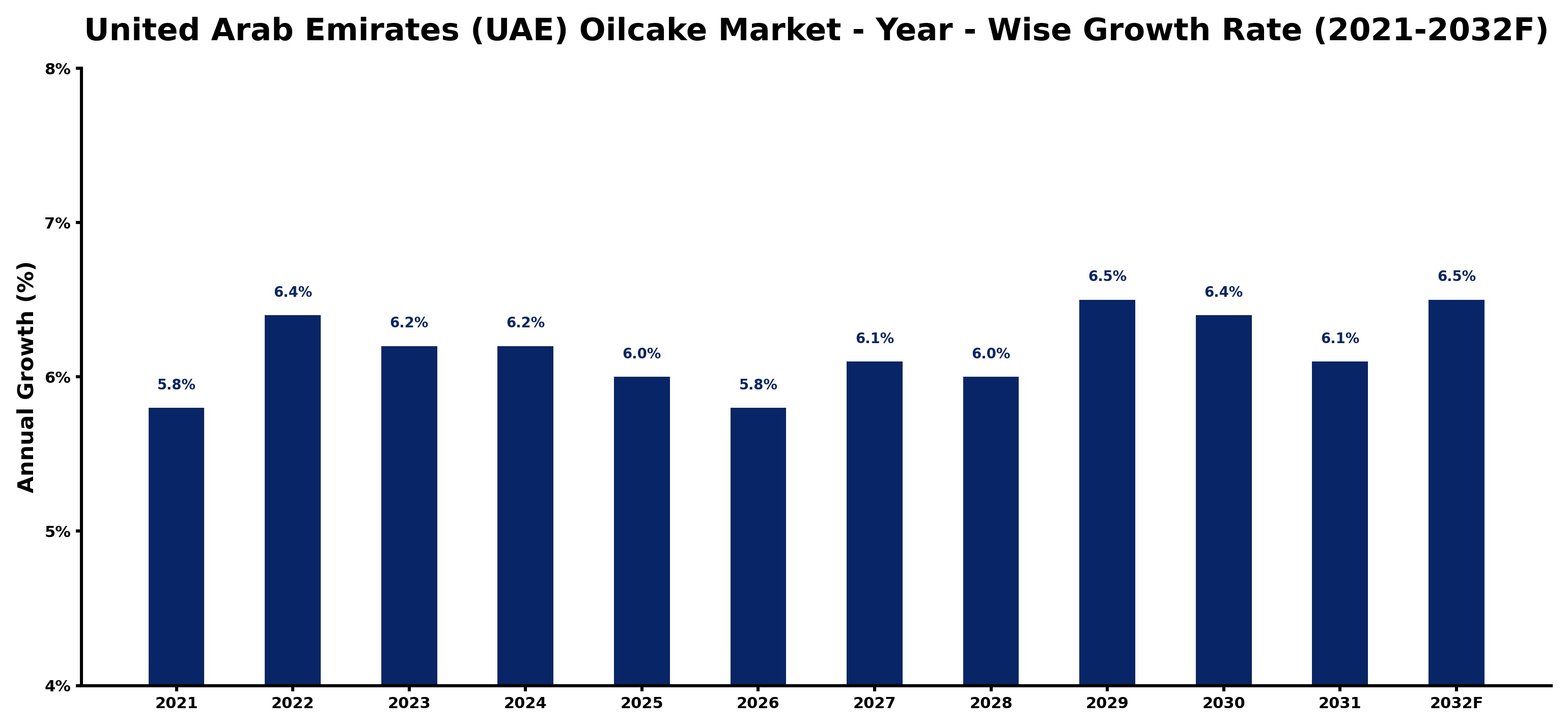
The table below presents the year‑wise growth rates along with the key drivers influencing the market
| Year | Growth Rate | Major Drivers |
| 2021 | 5.8% | Increasing smart city development projects |
| 2022 | 6.4% | Increasing industrial infrastructure investments |
| 2023 | 6.2% | Expansion of transportation and logistics networks |
| 2024 | 6.2% | Expansion of transportation and logistics networks |
| 2025 | 6.0% | Increasing industrial automation investments |
| 2026 | 5.8% | Increasing adoption of advanced technologies |
| 2027 | 6.1% | Growing urbanization and commercial development |
| 2028 | 6.0% | Increasing smart city development projects |
| 2029 | 6.5% | Increasing smart city development projects |
| 2030 | 6.4% | Government infrastructure modernization initiatives |
| 2031 | 6.1% | Growing urbanization and commercial development |
| 2032 | 6.5% | Government infrastructure modernization initiatives |
Note - Market size estimations and growth projections presented in this report are based on 6Wresearch’s advanced forecasting approach, validated with industry datasets as of June 2026.
United Arab Emirates (UAE) Oilcake Market Synopsis
The oilcake market in the UAE is primarily driven by the surging demand for high-quality livestock feed. As the population grows and urban centers expand, the need for sustainable food sources has become critical. Oilcake serves as a nutrient-rich supplement, offering essential proteins necessary for healthy livestock development.
In recent years, there has been a noticeable shift towards optimizing livestock feed compositions. This evolution is a direct response to the increasing pressures on food security and agricultural sustainability. The oilcake, derived from oilseed processing, has emerged as a preferred choice due to its affordability and nutritional profile.
United Arab Emirates (UAE) Oilcake Market Key Takeaways
- The UAE's oilcake market plays a pivotal role in supporting the livestock feed industry.
- Rising urbanization and population growth are driving demand for animal-derived products.
- Government support for domestic agricultural initiatives is enhancing oilcake utilization.
- Competitiveness of oilcake against alternative feed ingredients remains a market dynamic.
- The Covid-19 pandemic highlighted vulnerabilities in the supply chain and distribution networks.
Evaluation of Restraints in United Arab Emirates (UAE) Oilcake Market
Despite the market's promising growth, there are several critical restraints that could hinder its potential. One prominent factor is the inherent volatility in oilseed prices, influenced by global commodity market fluctuations. Such instability directly impacts production costs and, consequently, pricing strategies for oilcake. Additionally, there is a constant need for quality assurance and regulatory compliance in oilcake production, challenging producers to maintain high standards while managing operational costs.
United Arab Emirates (UAE) Oilcake Market Trends
Current trends indicate a shift towards sustainable and organic farming practices, as consumers increasingly prioritize health and environmental impact. This focus is translating into higher demand for oilcake produced with organic processes. Furthermore, advancements in processing technology are enabling manufacturers to enhance the nutritional quality of oilcake, making it more appealing to livestock producers looking for cost-effective solutions.
United Arab Emirates (UAE) Oilcake Market Opportunities
The UAE presents a landscape ripe for investment in the oilcake sector, particularly through innovations that improve production efficiency and nutritional quality. Opportunities lie in diversifying oilseed sources to mitigate price risks and reduce dependency on imports. Additionally, expanding the market for specialty oilcakes tailored to specific livestock needs can open new revenue streams for producers.
Government Initiatives in the United Arab Emirates (UAE) Oilcake Market
The UAE government has implemented various initiatives aimed at boosting the agricultural sector, with a strong emphasis on sustainability and self-sufficiency. Programs designed to enhance local production of oilseeds and oilcake have been prioritized, alongside investments in research and development. These initiatives underscore the government's commitment to reducing reliance on imports and fostering a resilient agricultural economy.
Future Insights of the United Arab Emirates (UAE) Oilcake Market
Looking ahead to 2026-2032, the UAE oilcake market is poised for dynamic evolution, driven by continuous innovations in livestock nutrition. The synergy between local agricultural policies and increasing consumer awareness about health and sustainability will likely propel market growth. The strategic focus on enhancing oilseed production domestically will also strengthen the oilcake supply chain, ensuring that the industry meets the burgeoning demand for animal feed.
United Arab Emirates (UAE) Oilcake Market Latest Developments (May 2025 - June 2026)
Recent developments in the UAE oilcake market have seen companies enhancing their production capabilities to address the growing demand for livestock feed. There is a noticeable uptick in partnerships aimed at improving supply chain logistics and efficiency. Moreover, the industry is witnessing a gradual shift towards incorporating technology to optimize oilcake processing, enhancing both quality and output levels.
United Arab Emirates (UAE) Oilcake Market - Key Attractiveness of the Report
- 10 Years of Market Numbers
- Historical Data Starting from 2022 to 2025
- Base Year: 2025
- Forecast Data until 2032
- Key Performance Indicators Impacting the Market
- Major Upcoming Developments and Projects
Key Highlights of the Report:
- United Arab Emirates (UAE) Oilcake Market Outlook
- Market Size of United Arab Emirates (UAE) Oilcake Market, 2025
- Forecast of United Arab Emirates (UAE) Oilcake Market, 2032
- Historical Data and Forecast of United Arab Emirates (UAE) Oilcake Revenues & Volume for the Period 2022-2032F
- United Arab Emirates (UAE) Oilcake Market Trend Evolution
- United Arab Emirates (UAE) Oilcake Market Drivers and Challenges
- United Arab Emirates (UAE) Oilcake Price Trends
- United Arab Emirates (UAE) Oilcake Porter's Five Forces
- United Arab Emirates (UAE) Oilcake Industry Life Cycle
- Historical Data and Forecast of United Arab Emirates (UAE) Oilcake Market Revenues & Volume By Source Type for the Period 2022-2032F
- Historical Data and Forecast of United Arab Emirates (UAE) Oilcake Market Revenues & Volume By Palm Kernel for the Period 2022-2032F
- Historical Data and Forecast of United Arab Emirates (UAE) Oilcake Market Revenues & Volume By Sunflower for the Period 2022-2032F
- Historical Data and Forecast of United Arab Emirates (UAE) Oilcake Market Revenues & Volume By Sesame for the Period 2022-2032F
- Historical Data and Forecast of United Arab Emirates (UAE) Oilcake Market Revenues & Volume By Coconut for the Period 2022-2032F
- Historical Data and Forecast of United Arab Emirates (UAE) Oilcake Market Revenues & Volume By Mustard for the Period 2022-2032F
- Historical Data and Forecast of United Arab Emirates (UAE) Oilcake Market Revenues & Volume By Groundnut for the Period 2022-2032F
- Historical Data and Forecast of United Arab Emirates (UAE) Oilcake Market Revenues & Volume By Cottonseed for the Period 2022-2032F
- Historical Data and Forecast of United Arab Emirates (UAE) Palm Kernel Oilcake Market Revenues & Volume By Others for the Period 2022-2032F
- Historical Data and Forecast of United Arab Emirates (UAE) Oilcake Market Revenues & Volume By Type for the Period 2022-2032F
- Historical Data and Forecast of United Arab Emirates (UAE) Oilcake Market Revenues & Volume By Edible Oil Cake for the Period 2022-2032F
- Historical Data and Forecast of United Arab Emirates (UAE) Oilcake Market Revenues & Volume By Non-edible Oil Cake for the Period 2022-2032F
- United Arab Emirates (UAE) Oilcake Import Export Trade Statistics
- Market Opportunity Assessment By Source Type
- Market Opportunity Assessment By Type
- United Arab Emirates (UAE) Oilcake Top Companies Market Share
- United Arab Emirates (UAE) Oilcake Competitive Benchmarking By Technical and Operational Parameters
- United Arab Emirates (UAE) Oilcake Company Profiles
- United Arab Emirates (UAE) Oilcake Key Strategic Recommendations






































