United Arab Emirates (UAE) Organic Fruits And Vegetables Market Size, Share & Growth Rate
The United Arab Emirates (UAE) Organic Fruits And Vegetables Market was estimated at USD 311 Million in 2025 and is projected to reach USD 427 Million by 2032, growing at a CAGR of 4.6% from 2026 to 2032. This growth trajectory is being fueled by a robust shift in consumer preferences towards organic products, driven by heightened awareness of health and wellness. Additionally, stringent government regulations regarding food safety are enhancing consumer trust in organic certifications, further propelling market expansion.
United Arab Emirates (UAE) Organic Fruits And Vegetables Market Year-wise Growth Rate and Key Drivers
This graph highlights how the United Arab Emirates (UAE) Organic Fruits And Vegetables Market has steadily grown over the years, supported by major growth factors.
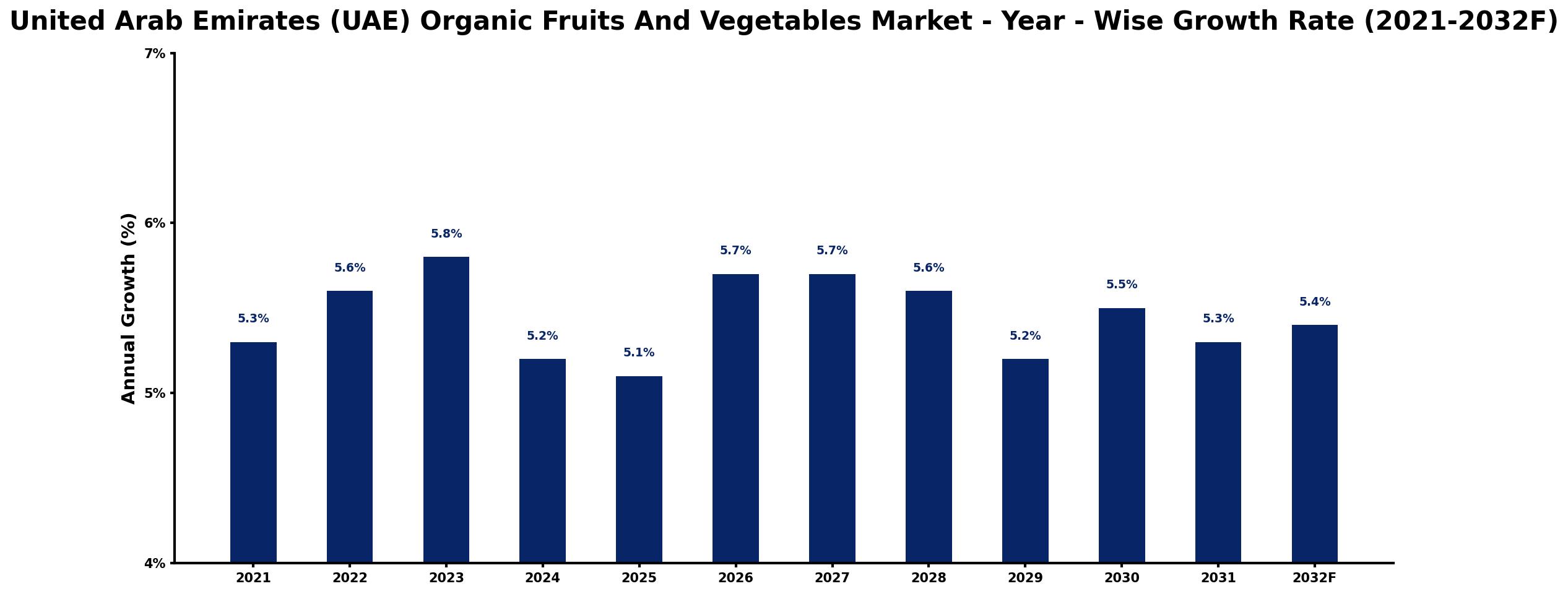
The table below presents the year‑wise growth rates along with the key drivers influencing the market
| Year | Growth Rate | Major Drivers |
| 2021 | 5.3% | Rising health consciousness among consumers |
| 2022 | 5.6% | Increased availability of local produce |
| 2023 | 5.8% | Growing popularity of sustainable practices |
| 2024 | 5.2% | growing emerging market penetration |
| 2025 | 5.1% | Investment in urban farming technologies |
| 2026 | 5.7% | Government support for green initiatives |
| 2027 | 5.7% | Enhanced distribution channels for products |
| 2028 | 5.6% | Growing interest in farm-to-table concepts |
| 2029 | 5.2% | Increased consumer education on nutrition |
| 2030 | 5.5% | rising procurement volume requirements |
| 2031 | 5.3% | Emergence of online shopping platforms |
| 2032 | 5.4% | Strengthened community-supported agriculture programs |
Note: Market size estimations and growth projections presented in this report are based on 6Wresearch's proprietary forecasting methodology, utilizing the latest available industry data, government publications, and primary research inputs.
United Arab Emirates (UAE) Organic Fruits And Vegetables Market Synopsis
The UAE organic fruits and vegetables market has witnessed remarkable momentum in recent years, reflecting a significant shift in consumer behavior. As more consumers prioritize health, the demand for organic produce has surged, positioning this segment as a crucial component of the food industry.
Looking ahead, the market is poised for steady growth as awareness of organic benefits continues to proliferate. With increasing concerns around food safety and quality, coupled with government support, the organic sector is becoming an integral part of the UAEs broader agricultural strategy.
United Arab Emirates (UAE) Organic Fruits And Vegetables Market Key Takeaways
- The UAE organic fruits and vegetables market is on a steady growth trajectory with a projected CAGR of 4.6% from 2026 to 2032.
- Consumer awareness regarding health benefits is significantly driving demand for organic produce.
- Government regulations enhancing food safety are fostering greater trust in organic certifications.
- Sustainable cultivation practices remain crucial for overcoming environmental challenges associated with organic farming in arid regions.
- While the COVID-19 pandemic initially disrupted supply chains, it also catalyzed a permanent shift toward healthier eating habits.
Evaluation of Restraints in United Arab Emirates (UAE) Organic Fruits And Vegetables Market
While the UAE organic fruits and vegetables market shows promising growth, it faces significant restraints that could impact its trajectory. The harsh desert climate and limited water resources present substantial challenges for organic farming, making sustainable irrigation practices and water management essential. Furthermore, the relatively high costs of organic farming can deter new entrants into the market, potentially limiting competition and innovation. These factors necessitate a strategic focus on resource optimization and the development of localized farming solutions to ensure the market's long-term viability.
United Arab Emirates (UAE) Organic Fruits And Vegetables Market Trends
The market is currently witnessing several noteworthy trends. Theres an increasing inclination towards local sourcing of organic produce, driven by consumer preferences for freshness and sustainability. Moreover, technological advancements in agricultural practices, including vertical farming and hydroponics, are gaining traction. These innovations not only enhance yield but also conserve valuable resources. E-commerce is also playing a pivotal role, with a growing number of platforms facilitating direct-to-consumer sales of organic products, thus expanding market reach.
United Arab Emirates (UAE) Organic Fruits And Vegetables Market Opportunities
Investment opportunities are abundant within the UAE organic fruits and vegetables market. The growth in health-conscious consumer behavior presents a fertile ground for the development of new organic product lines. Establishing partnerships with local farms to promote regional produce can yield favorable outcomes. Additionally, there is potential for innovation in packaging and distribution methods that enhance product visibility and convenience for consumers. As the government continues to support organic agriculture, leveraging these policies can further catalyze growth in the sector.
Government Initiatives in the United Arab Emirates (UAE) Organic Fruits And Vegetables Market
The UAE government has taken significant strides to bolster the organic fruits and vegetables market through various initiatives. Policies aimed at promoting sustainable agriculture are being implemented, encouraging farmers to adopt organic farming practices. The establishment of strict certification processes for organic products ensures that consumers receive authentic goods, fostering trust in the market. Additionally, various funding programs and incentives are available to support organic farmers, thereby enhancing production capabilities and market penetration.
Future Insights of the United Arab Emirates (UAE) Organic Fruits And Vegetables Market
As we look towards the future, the UAE organic fruits and vegetables market is set to evolve significantly between 2026 and 2032. Increasing consumer demand for transparency in sourcing and production methods will likely lead to the proliferation of labels and certifications that guarantee organic integrity. Moreover, collaboration between public and private sectors will be crucial in overcoming environmental challenges and promoting sustainable practices. With the right strategies and continued government support, the market is poised to thrive, creating a healthier landscape for consumers and farmers alike.
United Arab Emirates (UAE) Organic Fruits And Vegetables Market Latest Developments (2025 - 2026)
Recent developments in the UAE organic fruits and vegetables market indicate a shift towards enhanced technological integration in farming practices. Innovations focusing on water conservation and eco-friendly cultivation techniques are being prioritized. Furthermore, several initiatives aimed at expanding organic market access through online platforms are gaining traction, providing consumers with more convenient purchasing options. Regulatory frameworks are evolving to better support organic agriculture, ensuring alignment with international standards.
United Arab Emirates (UAE) Organic Fruits And Vegetables Market - Key Attractiveness of the Report
- 10 Years of Market Numbers
- Historical Data Starting from 2022 to 2025
- Base Year: 2025
- Forecast Data until 2032
- Key Performance Indicators Impacting the Market
- Major Upcoming Developments and Projects
Key Highlights of the Report:
- United Arab Emirates (UAE) Organic Fruits And Vegetables Market Outlook
- Market Size of United Arab Emirates (UAE) Organic Fruits And Vegetables Market, 2025
- Forecast of United Arab Emirates (UAE) Organic Fruits And Vegetables Market, 2032
- Historical Data and Forecast of United Arab Emirates (UAE) Organic Fruits And Vegetables Revenues & Volume for the Period 2022-2032F
- United Arab Emirates (UAE) Organic Fruits And Vegetables Market Trend Evolution
- United Arab Emirates (UAE) Organic Fruits And Vegetables Market Drivers and Challenges
- United Arab Emirates (UAE) Organic Fruits And Vegetables Price Trends
- United Arab Emirates (UAE) Organic Fruits And Vegetables Porter's Five Forces
- United Arab Emirates (UAE) Organic Fruits And Vegetables Industry Life Cycle
- Historical Data and Forecast of United Arab Emirates (UAE) Organic Fruits And Vegetables Market Revenues & Volume By Product Type for the Period 2022-2032F
- Historical Data and Forecast of United Arab Emirates (UAE) Organic Fruits And Vegetables Market Revenues & Volume By Organic Fruits for the Period 2022-2032F
- Historical Data and Forecast of United Arab Emirates (UAE) Organic Fruits And Vegetables Market Revenues & Volume By Organic Vegetables for the Period 2022-2032F
- Historical Data and Forecast of United Arab Emirates (UAE) Organic Fruits And Vegetables Market Revenues & Volume By Form for the Period 2022-2032F
- Historical Data and Forecast of United Arab Emirates (UAE) Organic Fruits And Vegetables Market Revenues & Volume By Fresh for the Period 2022-2032F
- Historical Data and Forecast of United Arab Emirates (UAE) Organic Fruits And Vegetables Market Revenues & Volume By Frozen for the Period 2022-2032F
- Historical Data and Forecast of United Arab Emirates (UAE) Organic Fruits And Vegetables Market Revenues & Volume By End User for the Period 2022-2032F
- Historical Data and Forecast of United Arab Emirates (UAE) Organic Fruits And Vegetables Market Revenues & Volume By Residential for the Period 2022-2032F
- Historical Data and Forecast of United Arab Emirates (UAE) Organic Fruits And Vegetables Market Revenues & Volume By Commercial for the Period 2022-2032F
- Historical Data and Forecast of United Arab Emirates (UAE) Organic Fruits And Vegetables Market Revenues & Volume By Distribution Channel for the Period 2022-2032F
- Historical Data and Forecast of United Arab Emirates (UAE) Organic Fruits And Vegetables Market Revenues & Volume By Supermarket for the Period 2022-2032F
- Historical Data and Forecast of United Arab Emirates (UAE) Organic Fruits And Vegetables Market Revenues & Volume By Hypermarket for the Period 2022-2032F
- Historical Data and Forecast of United Arab Emirates (UAE) Organic Fruits And Vegetables Market Revenues & Volume By Convenience Store for the Period 2022-2032F
- Historical Data and Forecast of United Arab Emirates (UAE) Organic Fruits And Vegetables Market Revenues & Volume By Online Sale Channel for the Period 2022-2032F
- Historical Data and Forecast of United Arab Emirates (UAE) Organic Fruits And Vegetables Market Revenues & Volume By Others for the Period 2022-2032F
- United Arab Emirates (UAE) Organic Fruits And Vegetables Import Export Trade Statistics
- Market Opportunity Assessment By Product Type
- Market Opportunity Assessment By Form
- Market Opportunity Assessment By End User
- Market Opportunity Assessment By Distribution Channel
- United Arab Emirates (UAE) Organic Fruits And Vegetables Top Companies Market Share
- United Arab Emirates (UAE) Organic Fruits And Vegetables Competitive Benchmarking By Technical and Operational Parameters
- United Arab Emirates (UAE) Organic Fruits And Vegetables Company Profiles
- United Arab Emirates (UAE) Organic Fruits And Vegetables Key Strategic Recommendations






































