Ghana Organic Fruits And Vegetables Market Size, Share & Growth Rate
The Ghana Organic Fruits And Vegetables Market was estimated at USD 783 Million in 2025 and is projected to reach USD 1136 Million by 2032, growing at a CAGR of 5.5% from 2026 to 2032. This robust growth is propelled by rising consumer awareness surrounding health and sustainability, coupled with an increasing preference for locally sourced organic products. As Ghanaians become more conscious of their dietary choices, local farmers are responding by embracing organic farming practices, thereby broadening the range of available chemical-free produce.
Ghana Organic Fruits And Vegetables Market Year-wise Growth Rate and Key Drivers
This graph highlights how the Ghana Organic Fruits And Vegetables Market has steadily grown over the years, supported by major growth factors.
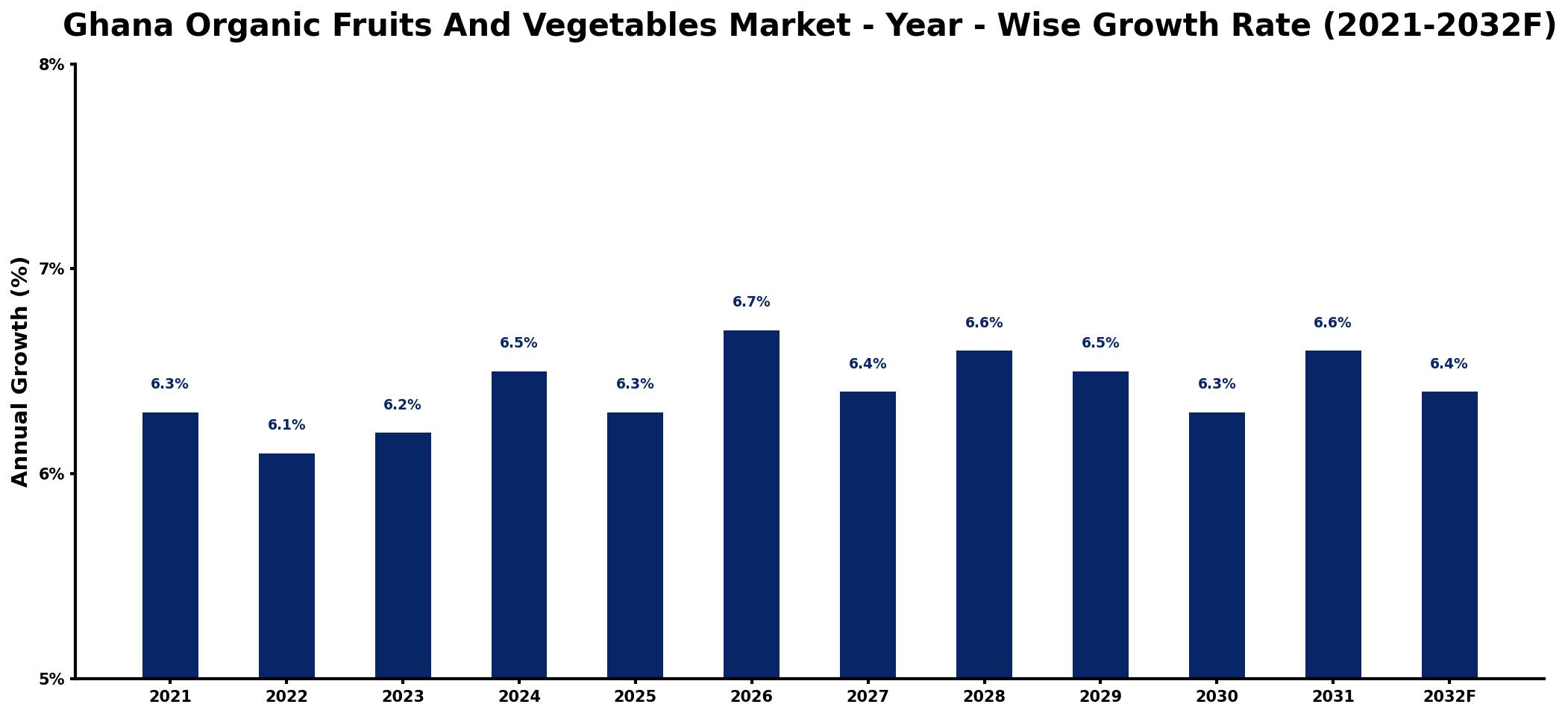
The table below presents the year‑wise growth rates along with the key drivers influencing the market
| Year | Growth Rate | Major Drivers |
| 2021 | 6.3% | Rising consumer health consciousness |
| 2022 | 6.1% | Increased availability of suppliers |
| 2023 | 6.2% | Growing export market opportunities |
| 2024 | 6.5% | Enhanced retail distribution channels |
| 2025 | 6.3% | Expansion of local farming initiatives |
| 2026 | 6.7% | Investment in sustainable practices |
| 2027 | 6.4% | Strengthened government support policies |
| 2028 | 6.6% | Increased consumer education programs |
| 2029 | 6.5% | Emergence of online marketplaces |
| 2030 | 6.3% | Diversification of agricultural investments |
| 2031 | 6.6% | Collaboration with international partners |
| 2032 | 6.4% | Development of innovative packaging solutions |
Note: Market size estimations and growth projections presented in this report are based on 6Wresearch's proprietary forecasting methodology, utilizing the latest available industry data, government publications, and primary research inputs.
Ghana Organic Fruits And Vegetables Market Synopsis
The strongest force currently shaping the Ghana Organic Fruits And Vegetables Market is the surge in consumer awareness regarding health benefits and sustainable farming practices. Local farmers, recognizing this shift, are increasingly adopting organic methodologies to cater to the evolving preferences of health-conscious consumers.
This market is characterized by a diverse selection of organic fruits and vegetables, including mangoes, pineapples, tomatoes, and leafy greens. The push towards organic practices is further supported by governmental initiatives aimed at enhancing organic farming and streamlining certification processes, fostering an environment ripe for market expansion.
Ghana Organic Fruits And Vegetables Market Key Takeaways
- Consumer demand for organic produce is surging due to heightened health and environmental awareness.
- Local farmers are increasingly embracing organic farming methods to meet market demands.
- The market is diversifying with a broader variety of available organic fruits and vegetables.
- Retailers are expanding their organic offerings, responding to consumer trends.
- Significant investment opportunities exist in distribution and marketing to further capitalize on market growth.
Evaluation of Restraints in Ghana Organic Fruits And Vegetables Market
Despite the promising growth trajectory, the Ghana Organic Fruits And Vegetables Market faces several challenges. A considerable barrier remains the limited consumer education regarding the benefits of organic produce, leading to a preference for conventional options. Moreover, the supply and distribution chains for organic products are often inconsistent, creating hurdles for farmers to reach broader markets. The lack of standardized certification processes raises questions about product authenticity and quality, further complicating consumer trust. Lastly, the higher production costs tied to organic farming practices make it difficult for local farmers to compete with cheaper conventional products.
Ghana Organic Fruits And Vegetables Market Trends
Current trends in the Ghana Organic Fruits And Vegetables Market are significantly influenced by the increasing preference for locally sourced, sustainably produced products. This shift is visible in the rising demand for organic items in both retail and online marketplaces. Retailers are responding by enhancing their organic product sections, thereby making such products more accessible. Additionally, the utilization of online platforms for purchasing organic produce is gaining traction, providing consumers with easy access to a wider array of options, reflecting the market's adaptability to modern buying behaviors.
Ghana Organic Fruits And Vegetables Market Opportunities
Investment opportunities in the Ghana Organic Fruits And Vegetables Market are promising, driven by an increasing consumer focus on health and sustainability. There are substantial prospects for investors looking to establish organic farming operations to satisfy rising demand for chemical-free produce. Establishing robust distribution networks will also be vital to connect organic farmers with both retailers and consumers. Furthermore, there is ample room for investment in processing facilities that offer value-added organic products, alongside marketing and branding initiatives to distinguish organic goods in a crowded market.
Government Initiatives in the Ghana Organic Fruits And Vegetables Market
The Ghanaian government has implemented several supportive policies to enhance the organic fruits and vegetables market. The National Organic Agriculture Policy (NOAP) aims to promote sustainable agricultural practices and increase organic production. Additionally, the government provides certification support through the Ghana Organic Agriculture Network (GOAN), ensuring that local organic producers comply with international standards. Initiatives such as Planting for Food and Jobs and the One District, One Factory program are also pivotal in boosting production and processing capabilities, aligning with the global trend towards sustainable food production.
Future Insights of the Ghana Organic Fruits And Vegetables Market
The future outlook for the Ghana Organic Fruits And Vegetables Market appears highly favorable, fueled by rising health consciousness and a demand for sustainable food options. Factors such as heightened awareness of food safety and a growing inclination toward organic produce are expected to continue driving market growth. Government support for organic farming practices, alongside the expansion of retail channels dedicated to organic offerings, will further enhance market opportunities. With Ghana's favorable agricultural climate and rich biodiversity, the country is well-positioned to emerge as a key player in the organic fruits and vegetables sector both domestically and on the international stage.
Ghana Organic Fruits And Vegetables Market Latest Developments (2025 - 2026)
Recent developments in the Ghana Organic Fruits And Vegetables Market indicate a strong push towards enhanced organic farming practices. Local farmers are increasingly adopting innovative agricultural techniques aimed at improving yield quality and quantity. There is also a growing trend among retailers to invest in organic supply chains, focusing on traceability and sustainability. Meanwhile, consumer interest in online shopping for organic produce continues to rise, spurring investments in digital platforms to facilitate easier access to organic options. These trends collectively signal a promising direction for market growth.
Ghana Organic Fruits And Vegetables Market - Key Attractiveness of the Report
- 10 Years of Market Numbers
- Historical Data Starting from 2022 to 2025
- Base Year: 2025
- Forecast Data until 2032
- Key Performance Indicators Impacting the Market
- Major Upcoming Developments and Projects
Key Highlights of the Report:
- Ghana Organic Fruits And Vegetables Market Outlook
- Market Size of Ghana Organic Fruits And Vegetables Market, 2025
- Forecast of Ghana Organic Fruits And Vegetables Market, 2032
- Historical Data and Forecast of Ghana Organic Fruits And Vegetables Revenues & Volume for the Period 2022-2032F
- Ghana Organic Fruits And Vegetables Market Trend Evolution
- Ghana Organic Fruits And Vegetables Market Drivers and Challenges
- Ghana Organic Fruits And Vegetables Price Trends
- Ghana Organic Fruits And Vegetables Porter's Five Forces
- Ghana Organic Fruits And Vegetables Industry Life Cycle
- Historical Data and Forecast of Ghana Organic Fruits And Vegetables Market Revenues & Volume By Product Type for the Period 2022-2032F
- Historical Data and Forecast of Ghana Organic Fruits And Vegetables Market Revenues & Volume By Organic Fruits for the Period 2022-2032F
- Historical Data and Forecast of Ghana Organic Fruits And Vegetables Market Revenues & Volume By Organic Vegetables for the Period 2022-2032F
- Historical Data and Forecast of Ghana Organic Fruits And Vegetables Market Revenues & Volume By Form for the Period 2022-2032F
- Historical Data and Forecast of Ghana Organic Fruits And Vegetables Market Revenues & Volume By Fresh for the Period 2022-2032F
- Historical Data and Forecast of Ghana Organic Fruits And Vegetables Market Revenues & Volume By Frozen for the Period 2022-2032F
- Historical Data and Forecast of Ghana Organic Fruits And Vegetables Market Revenues & Volume By End User for the Period 2022-2032F
- Historical Data and Forecast of Ghana Organic Fruits And Vegetables Market Revenues & Volume By Residential for the Period 2022-2032F
- Historical Data and Forecast of Ghana Organic Fruits And Vegetables Market Revenues & Volume By Commercial for the Period 2022-2032F
- Historical Data and Forecast of Ghana Organic Fruits And Vegetables Market Revenues & Volume By Distribution Channel for the Period 2022-2032F
- Historical Data and Forecast of Ghana Organic Fruits And Vegetables Market Revenues & Volume By Supermarket for the Period 2022-2032F
- Historical Data and Forecast of Ghana Organic Fruits And Vegetables Market Revenues & Volume By Hypermarket for the Period 2022-2032F
- Historical Data and Forecast of Ghana Organic Fruits And Vegetables Market Revenues & Volume By Convenience Store for the Period 2022-2032F
- Historical Data and Forecast of Ghana Organic Fruits And Vegetables Market Revenues & Volume By Online Sale Channel for the Period 2022-2032F
- Historical Data and Forecast of Ghana Organic Fruits And Vegetables Market Revenues & Volume By Others for the Period 2022-2032F
- Ghana Organic Fruits And Vegetables Import Export Trade Statistics
- Market Opportunity Assessment By Product Type
- Market Opportunity Assessment By Form
- Market Opportunity Assessment By End User
- Market Opportunity Assessment By Distribution Channel
- Ghana Organic Fruits And Vegetables Top Companies Market Share
- Ghana Organic Fruits And Vegetables Competitive Benchmarking By Technical and Operational Parameters
- Ghana Organic Fruits And Vegetables Company Profiles
- Ghana Organic Fruits And Vegetables Key Strategic Recommendations






































