United Arab Emirates (UAE) Ornamental Fish Market Size, Share & Growth Rate
The United Arab Emirates (UAE) Ornamental Fish Market was estimated at USD 391 Million in 2025 and is projected to reach USD 552 Million by 2032, growing at a CAGR of 5.0% from 2026 to 2032. This growth trajectory is fueled by a burgeoning affluent consumer base and a strong cultural inclination toward the aesthetic appeal of ornamental fish. Additionally, the expansion of high-end aquarium installations within the hospitality sector is further propelling demand.
United Arab Emirates (UAE) Ornamental Fish Market Year-wise Growth Rate and Key Drivers
This graph highlights how the United Arab Emirates (UAE) Ornamental Fish Market has steadily grown over the years, supported by major growth factors.
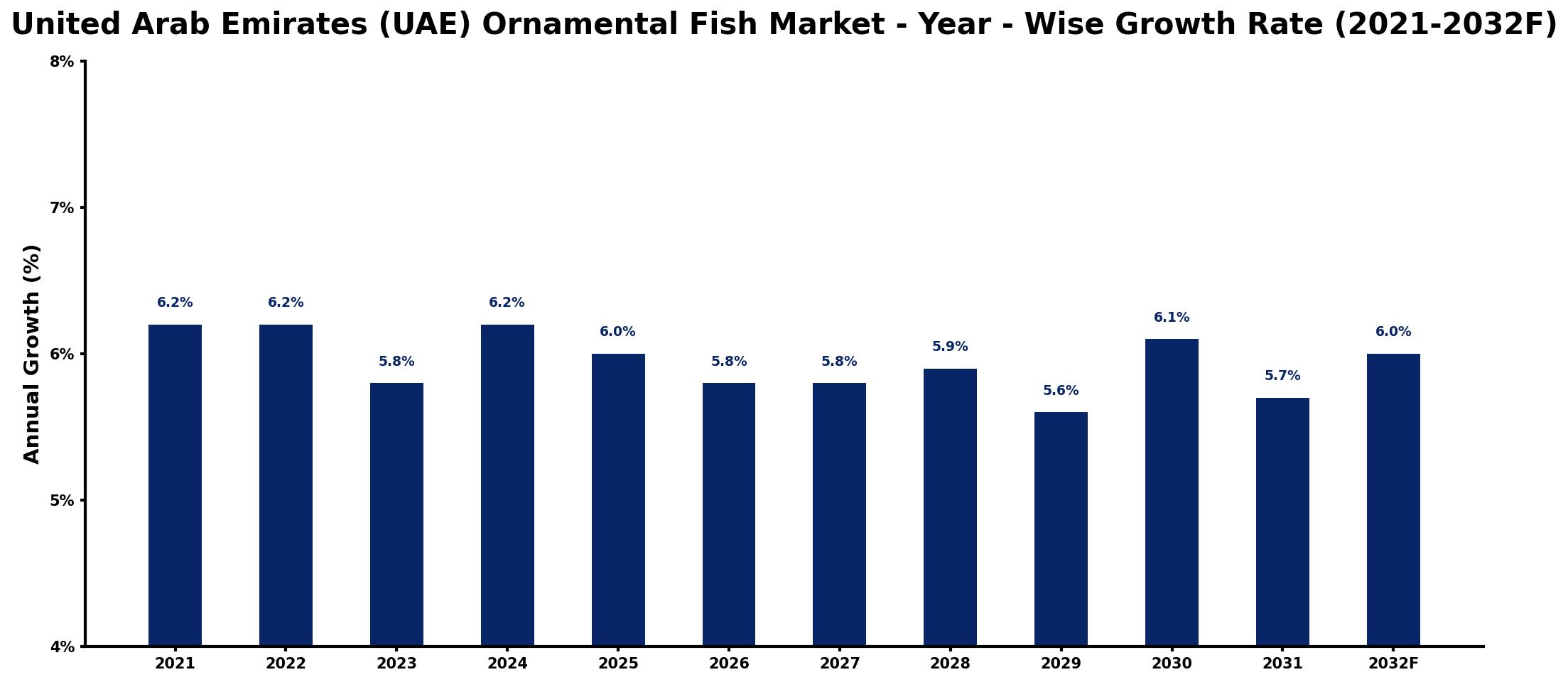
The table below presents the year‑wise growth rates along with the key drivers influencing the market
| Year | Growth Rate | Major Drivers |
| 2021 | 6.2% | Rising interest in aquascaping trends |
| 2022 | 6.2% | Increased investments in aquatic habitats |
| 2023 | 5.8% | Growing popularity of home aquariums |
| 2024 | 6.2% | Expansion of online retail platforms |
| 2025 | 6.0% | Enhanced awareness of sustainable practices |
| 2026 | 5.8% | Development of advanced filtration systems |
| 2027 | 5.8% | Increased consumer focus on aesthetics |
| 2028 | 5.9% | Growth in community aquarium events |
| 2029 | 5.6% | Emergence of new hobbyist groups |
| 2030 | 6.1% | expanding healthcare application demand |
| 2031 | 5.7% | Rising demand for eco-friendly solutions |
| 2032 | 6.0% | Increased collaboration among retailers |
Note: Market size estimations and growth projections presented in this report are based on 6Wresearch's proprietary forecasting methodology, utilizing the latest available industry data, government publications, and primary research inputs.
United Arab Emirates (UAE) Ornamental Fish Market Synopsis
The ornamental fish market in the UAE has witnessed significant momentum over the past few years, driven by an increasingly discerning consumer landscape. As the demand for exotic and colorful fish species soars, specialty stores and exhibitions have proliferated, showcasing the luxurious tastes of Emirati aquarium enthusiasts.
Looking ahead, the market is positioned for continued growth as both the tourism and interior decorating sectors embrace ornamental fish as a vital aesthetic element. With robust logistics facilitating the importation of diverse species, the UAE is set to remain a key player in this vibrant niche market.
United Arab Emirates (UAE) Ornamental Fish Market Key Takeaways
- The market is projected to grow from USD 391 Million in 2025 to USD 552 Million by 2032.
- A culture of luxury and aesthetics fuels demand for exotic fish species in the UAE.
- The hospitality sector's expansion drives high-end aquarium installations, enhancing market growth.
- Logistical efficiencies have made diverse species readily available to consumers.
- Regulatory challenges surrounding the import and export of fish species remain significant concerns.
Evaluation of Restraints in United Arab Emirates (UAE) Ornamental Fish Market
The UAE ornamental fish market faces several restraints that may hinder its expansion. One of the primary challenges is the stringent regulations governing the import and export of exotic fish species, which can complicate logistics and increase costs. Furthermore, the need to ensure the health and well-being of fish during transit is a critical concern that requires robust management practices. Additionally, while the pandemic led to temporary declines in market demand, the long-term effects of such disruptions remain to be fully assessed.
United Arab Emirates (UAE) Ornamental Fish Market Trends
Current trends in the UAE ornamental fish market indicate a growing preference for eco-friendly and sustainable practices among consumers. Many aquarium enthusiasts are now seeking responsibly sourced species that have been bred in captivity, rather than wild-caught specimens. Technology is also playing a significant role; advanced aquarium systems equipped with smart monitoring features are becoming increasingly popular among hobbyists, enhancing the overall experience.
United Arab Emirates (UAE) Ornamental Fish Market Opportunities
Opportunities for growth in the UAE ornamental fish market lie in the development of niche segments, such as aquascaping and the sale of specialized aquarium accessories. Additionally, educational workshops and events focusing on aquarium maintenance and fish care can attract both seasoned and novice enthusiasts. The ongoing development of luxury residential and commercial spaces presents a significant opportunity for high-end aquarium installations and customized aquarium designs.
Government Initiatives in the United Arab Emirates (UAE) Ornamental Fish Market
The UAE government has implemented various initiatives aimed at promoting the ornamental fish market. These include regulations that ensure sustainable fishing practices and encourage the breeding of fish species in captivity. Public spending on environmental conservation also supports the overall health of aquatic ecosystems, which is vital for the ornamental fish industry. Programs designed to educate the public about responsible fish ownership and care further enhance consumer engagement.
Future Insights of the United Arab Emirates (UAE) Ornamental Fish Market
As we look towards 2026-2032, the UAE ornamental fish market is set to evolve with a focus on sustainability and technological advancements. Increased consumer awareness regarding eco-friendly practices will likely reshape purchasing behaviors. Moreover, as infrastructure improves, the market will continue to attract a wider range of exotic fish species, meeting the diverse tastes of Emirati consumers. Overall, the market is poised for robust growth as it adapts to shifting consumer preferences.
United Arab Emirates (UAE) Ornamental Fish Market Latest Developments (2025 - 2026)
Recent developments in the UAE ornamental fish market highlight a trend towards sustainability, with more retailers emphasizing eco-friendly practices and sourcing. Additionally, the market has seen a resurgence post-pandemic, as events and exhibitions return to normalcy, re-igniting consumer interest. New technologies for aquarium maintenance are also being adopted, enhancing the overall experience for both hobbyists and professionals alike.
United Arab Emirates (UAE) Ornamental Fish Market - Key Attractiveness of the Report
- 10 Years of Market Numbers
- Historical Data Starting from 2022 to 2025
- Base Year: 2025
- Forecast Data until 2032
- Key Performance Indicators Impacting the Market
- Major Upcoming Developments and Projects
Key Highlights of the Report:
- United Arab Emirates (UAE) Ornamental Fish Market Outlook
- Market Size of United Arab Emirates (UAE) Ornamental Fish Market, 2025
- Forecast of United Arab Emirates (UAE) Ornamental Fish Market, 2032
- Historical Data and Forecast of United Arab Emirates (UAE) Ornamental Fish Revenues & Volume for the Period 2022-2032F
- United Arab Emirates (UAE) Ornamental Fish Market Trend Evolution
- United Arab Emirates (UAE) Ornamental Fish Market Drivers and Challenges
- United Arab Emirates (UAE) Ornamental Fish Price Trends
- United Arab Emirates (UAE) Ornamental Fish Porter's Five Forces
- United Arab Emirates (UAE) Ornamental Fish Industry Life Cycle
- Historical Data and Forecast of United Arab Emirates (UAE) Ornamental Fish Market Revenues & Volume By Product for the Period 2022-2032F
- Historical Data and Forecast of United Arab Emirates (UAE) Ornamental Fish Market Revenues & Volume By Tropical Freshwater for the Period 2022-2032F
- Historical Data and Forecast of United Arab Emirates (UAE) Ornamental Fish Market Revenues & Volume By Temperate for the Period 2022-2032F
- Historical Data and Forecast of United Arab Emirates (UAE) Ornamental Fish Market Revenues & Volume By Marine for the Period 2022-2032F
- Historical Data and Forecast of United Arab Emirates (UAE) Ornamental Fish Market Revenues & Volume By Application for the Period 2022-2032F
- Historical Data and Forecast of United Arab Emirates (UAE) Ornamental Fish Market Revenues & Volume By Commercial for the Period 2022-2032F
- Historical Data and Forecast of United Arab Emirates (UAE) Ornamental Fish Market Revenues & Volume By Household for the Period 2022-2032F
- United Arab Emirates (UAE) Ornamental Fish Import Export Trade Statistics
- Market Opportunity Assessment By Product
- Market Opportunity Assessment By Application
- United Arab Emirates (UAE) Ornamental Fish Top Companies Market Share
- United Arab Emirates (UAE) Ornamental Fish Competitive Benchmarking By Technical and Operational Parameters
- United Arab Emirates (UAE) Ornamental Fish Company Profiles
- United Arab Emirates (UAE) Ornamental Fish Key Strategic Recommendations






































