Kuwait Ornamental Fish Market Size, Share & Growth Rate
The Kuwait Ornamental Fish Market was estimated at USD 431 Million in 2025 and is projected to reach USD 747 Million by 2032, growing at a CAGR of 8.2% from 2026 to 2032. This robust growth is primarily driven by the rising disposable income of consumers, coupled with an increasing trend towards indoor pet ownership, particularly among urban dwellers. As consumers seek to enhance their living spaces with aesthetically pleasing aquariums, the demand for unique and exotic fish species is set to escalate.
Kuwait Ornamental Fish Market Year-wise Growth Rate and Key Drivers
This graph highlights how the Kuwait Ornamental Fish Market has steadily grown over the years, supported by major growth factors.
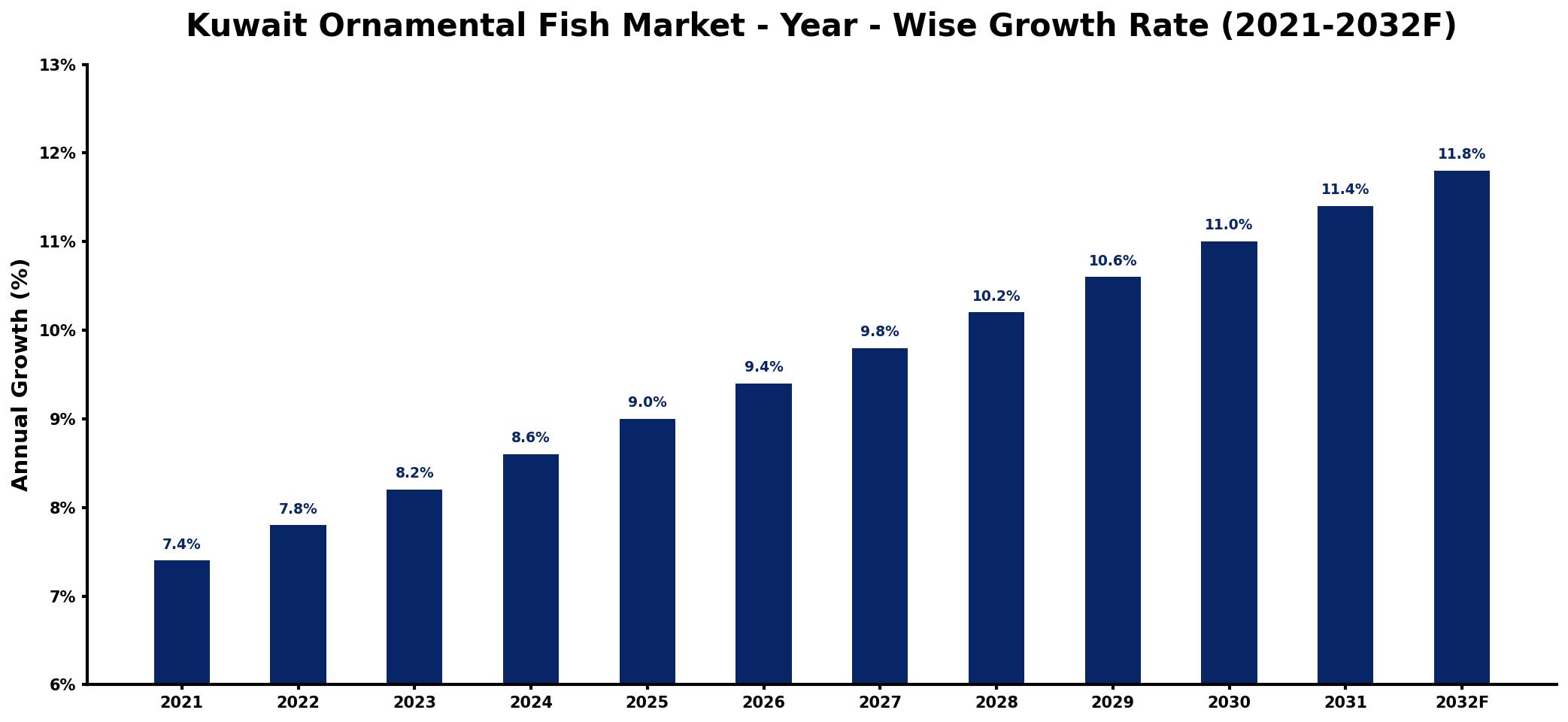
The table below presents the year‑wise growth rates along with the key drivers influencing the market
| Year | Growth Rate | Major Drivers |
| 2021 | 7.4% | Increased interest in aquaculture |
| 2022 | 7.8% | Growth in home aquarium setups |
| 2023 | 8.2% | Rising disposable income levels |
| 2024 | 8.6% | Expansion of online retail platforms |
| 2025 | 9.0% | Increased awareness of biodiversity |
| 2026 | 9.4% | Investment in sustainable practices |
| 2027 | 9.8% | Development of advanced breeding techniques |
| 2028 | 10.2% | Surge in eco-tourism initiatives |
| 2029 | 10.6% | Growing popularity of aquascaping |
| 2030 | 11.0% | Enhanced marketing for hobbyists |
| 2031 | 11.4% | Rise in community engagement programs |
| 2032 | 11.8% | Increase in environmental conservation efforts |
Note: Market size estimations and growth projections presented in this report are based on 6Wresearch's proprietary forecasting methodology, utilizing the latest available industry data, government publications, and primary research inputs.
Kuwait Ornamental Fish Market Synopsis
The Kuwait Ornamental Fish Market is characterized by a burgeoning interest in aquariums, fueled by the influx of pet enthusiasts seeking colorful and exotic species. Enthusiasts and collectors are increasingly drawn to rare varieties such as koi and discus fish, elevating the market's profile and encouraging higher investments in premium segments.
In response to consumer demand, local businesses and international suppliers are adapting to trends emphasizing sustainability and ethical sourcing. As awareness grows regarding responsible practices, there's a notable shift towards aquaculture and captive breeding, lessening dependence on wild-caught fish.
Kuwait Ornamental Fish Market Key Takeaways
- The market is experiencing a significant shift towards higher value and premium fish species, supported by a growing community of hobbyists.
- Technological advancements in aquarium equipment are enhancing consumer experiences, making fish-keeping more accessible and enjoyable.
- Growing emphasis on sustainability is reshaping practices within the market, driving interest in ethically sourced ornamental fish.
- The expansion of online retail platforms is offering consumers greater access to a diverse range of fish species and related products.
- Investment opportunities are ripe for breeding facilities, distribution networks, and ancillary services such as aquarium maintenance.
Evaluation of Restraints in Kuwait Ornamental Fish Market
The Kuwait Ornamental Fish Market faces several significant challenges that could hinder its growth trajectory. Regulatory restrictions on the importation and sale of certain fish species can limit the diversity available to consumers, while economic fluctuations can lead to inconsistent demand for ornamental fish. Furthermore, issues related to transportation logistics and potential disease outbreaks pose risks to suppliers and retailers alike. The market's expansion is also impeded by the need for improved infrastructure and consumer education on responsible fish ownership, which are vital to ensuring sustainable growth in this sector.
Kuwait Ornamental Fish Market Trends
The current trends within the Kuwait Ornamental Fish Market are marked by a preference for unique and exotic species, signaling a discerning consumer base eager for differentiation in their aquariums. The focus on sustainable practices, including increased interest in aquaculture and ethical breeding, is reshaping the landscape. Additionally, technological innovations in aquarium care equipment and e-commerce are enhancing customer engagement and providing fresh access to diverse aquatic options.
Kuwait Ornamental Fish Market Opportunities
There exists a rich landscape of investment opportunities within the Kuwait Ornamental Fish Market. Entrepreneurs are well-positioned to capitalize on the growing demand for exotic fish by developing breeding facilities and enhancing distribution networks. Moreover, the provision of complementary services, such as aquarium setup and maintenance, presents additional avenues for revenue. Collaborating with local retailers and leveraging online platforms can further amplify visibility and reach in this expanding market.
Government Initiatives in the Kuwait Ornamental Fish Market
The Kuwaiti government is actively involved in regulating the ornamental fish market, placing emphasis on sustainability and the conservation of marine resources. The Ministry of Commerce and Industry oversees import and export operations, ensuring compliance with international standards to protect local ecosystems. Additionally, the Public Authority for Agricultural Affairs and Fish Resources monitors practices to promote responsible breeding and sales, thereby safeguarding native species and combating illegal trade.
Future Insights of the Kuwait Ornamental Fish Market
Looking ahead to the period from 2026 to 2032, the Kuwait Ornamental Fish Market is poised for steady growth, bolstered by increasing urbanization and a rising propensity for pet ownership as a source of companionship. As technology continues to evolve, the availability and variety of ornamental fish are expected to expand. However, the market must navigate ongoing regulatory constraints and sustainability challenges to maintain momentum. This dynamic environment presents ample opportunities for innovation and adaptation, keeping the market vibrant.
Kuwait Ornamental Fish Market Latest Developments (2025 - 2026)
In the latest industry developments, several pet shops and online retailers are ramping up efforts to offer a wider range of exotic fish species, responding to consumer demand for diversity. Trade shows have become vital platforms for showcasing advancements in aquarium technology and sustainable practices, drawing interest from both local and international stakeholders. Additionally, educational initiatives aimed at promoting responsible fish ownership are gaining traction, marking a proactive approach to nurturing a more knowledgeable consumer base.
Kuwait Ornamental Fish Market - Key Attractiveness of the Report
- 10 Years of Market Numbers
- Historical Data Starting from 2022 to 2025
- Base Year: 2025
- Forecast Data until 2032
- Key Performance Indicators Impacting the Market
- Major Upcoming Developments and Projects
Key Highlights of the Report:
- Kuwait Ornamental Fish Market Outlook
- Market Size of Kuwait Ornamental Fish Market, 2025
- Forecast of Kuwait Ornamental Fish Market, 2032
- Historical Data and Forecast of Kuwait Ornamental Fish Revenues & Volume for the Period 2022-2032F
- Kuwait Ornamental Fish Market Trend Evolution
- Kuwait Ornamental Fish Market Drivers and Challenges
- Kuwait Ornamental Fish Price Trends
- Kuwait Ornamental Fish Porter's Five Forces
- Kuwait Ornamental Fish Industry Life Cycle
- Historical Data and Forecast of Kuwait Ornamental Fish Market Revenues & Volume By Product for the Period 2022-2032F
- Historical Data and Forecast of Kuwait Ornamental Fish Market Revenues & Volume By Tropical Freshwater for the Period 2022-2032F
- Historical Data and Forecast of Kuwait Ornamental Fish Market Revenues & Volume By Temperate for the Period 2022-2032F
- Historical Data and Forecast of Kuwait Ornamental Fish Market Revenues & Volume By Marine for the Period 2022-2032F
- Historical Data and Forecast of Kuwait Ornamental Fish Market Revenues & Volume By Application for the Period 2022-2032F
- Historical Data and Forecast of Kuwait Ornamental Fish Market Revenues & Volume By Commercial for the Period 2022-2032F
- Historical Data and Forecast of Kuwait Ornamental Fish Market Revenues & Volume By Household for the Period 2022-2032F
- Kuwait Ornamental Fish Import Export Trade Statistics
- Market Opportunity Assessment By Product
- Market Opportunity Assessment By Application
- Kuwait Ornamental Fish Top Companies Market Share
- Kuwait Ornamental Fish Competitive Benchmarking By Technical and Operational Parameters
- Kuwait Ornamental Fish Company Profiles
- Kuwait Ornamental Fish Key Strategic Recommendations






































