United Arab Emirates (UAE) Oyster Market Size, Share & Growth Rate
The United Arab Emirates (UAE) Oyster Market was estimated at USD 230 Million in 2025 and is projected to reach USD 321 Million by 2032, growing at a CAGR of 4.9% from 2026 to 2032. This upward trajectory reflects the rising disposable incomes among consumers, which has fueled demand for premium seafood options. Furthermore, the flourishing culinary landscape in the UAE, with its emphasis on gourmet dining experiences, has significantly contributed to the markets expansion.
United Arab Emirates (UAE) Oyster Market Year-wise Growth Rate and Key Drivers
This graph highlights how the United Arab Emirates (UAE) Oyster Market has steadily grown over the years, supported by major growth factors.
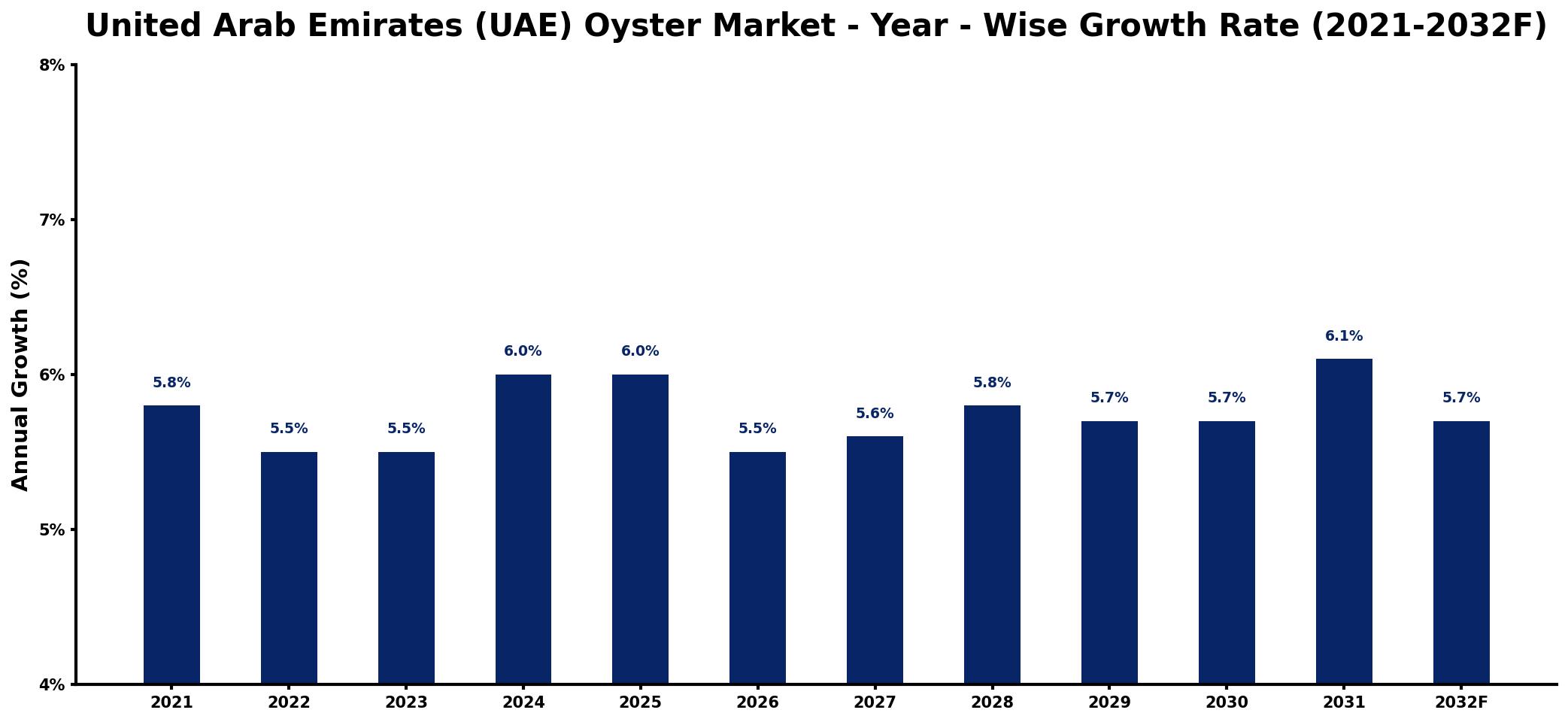
The table below presents the year‑wise growth rates along with the key drivers influencing the market
| Year | Growth Rate | Major Drivers |
| 2021 | 5.8% | Rising demand for seafood options |
| 2022 | 5.5% | Increased investments in aquaculture |
| 2023 | 5.5% | Expansion of gourmet dining experiences |
| 2024 | 6.0% | Growth in health consciousness trends |
| 2025 | 6.0% | Boost in coastal tourism activities |
| 2026 | 5.5% | Development of sustainable sourcing practices |
| 2027 | 5.6% | Emergence of new food technologies |
| 2028 | 5.8% | Enhancement of distribution networks |
| 2029 | 5.7% | Growing popularity of local cuisines |
| 2030 | 5.7% | Increased participation in food festivals |
| 2031 | 6.1% | strengthening underlying market demand |
| 2032 | 5.7% | increased pharmaceutical industry usage |
Note: Market size estimations and growth projections presented in this report are based on 6Wresearch's proprietary forecasting methodology, utilizing the latest available industry data, government publications, and primary research inputs.
United Arab Emirates (UAE) Oyster Market Synopsis
Oyster consumption in the UAE is becoming increasingly sophisticated, with consumers gravitating towards premium imports that enhance the dining experience. Renowned for their exquisite taste and unique culinary applications, oysters are now a prominent fixture on menus of high-end restaurants and luxury hotels throughout the region.
The local oyster farming sector is gaining traction, but it coexists with a robust import market that caters to the discerning palate of UAE consumers. This dynamic creates a diverse offering, allowing chefs to showcase a range of oyster varieties from different parts of the world, enhancing the overall seafood culinary experience.
United Arab Emirates (UAE) Oyster Market Key Takeaways
- The UAE oyster market is witnessing sustained growth driven by rising consumer income levels and culinary sophistication.
- Imported premium oysters are increasingly prevalent in the market, enhancing the local dining experience.
- Water quality issues pose ongoing challenges for domestic oyster farming, affecting supply stability.
- COVID-19 has temporarily disrupted the market, but a recovery is underway as restaurants reopen and demand rebounds.
- Key players in the market are well-positioned to leverage the growing appetite for premium seafood.
Evaluation of Restraints in United Arab Emirates (UAE) Oyster Market
Despite the promising growth trajectory, the UAE oyster market faces critical restraints that can limit its full potential. Water quality and contamination issues present significant barriers to local oyster farming, compromising both the safety and availability of the product. Furthermore, the reliance on imports can lead to vulnerabilities in the supply chain, particularly in the face of global disruptions, affecting both pricing and access to premium oysters. Industry stakeholders must address these concerns to sustain growth and ensure market resilience.
United Arab Emirates (UAE) Oyster Market Trends
Current trends in the UAE oyster market are heavily influenced by the increasing consumer preference for health-conscious dining. Oysters are often celebrated for their nutritional benefits, prompting chefs to incorporate them into innovative dishes that cater to health-oriented diners. Additionally, there is a noticeable shift towards sustainability, with many consumers actively seeking out ethically sourced and environmentally friendly seafood options.
United Arab Emirates (UAE) Oyster Market Opportunities
There are significant opportunities for growth in the UAE oyster market, especially in expanding local oyster farming initiatives. By investing in advanced aquaculture technologies and sustainable practices, stakeholders can enhance production capabilities while addressing quality concerns. Moreover, as the region continues to establish itself as a culinary hotspot, there is ample scope for developing unique oyster-related experiences, such as oyster tasting events and farm-to-table dining experiences that engage consumers.
Government Initiatives in the United Arab Emirates (UAE) Oyster Market
The UAE government has introduced various initiatives aimed at boosting the aquaculture sector, including funding for research and development projects that focus on sustainable seafood practices. Additionally, efforts to enhance water quality through environmental regulations and improved monitoring systems are critical for fostering a safe and viable oyster farming industry. Public awareness campaigns promoting the health benefits of seafood consumption also align with governmental objectives to diversify and enhance the local food market.
Future Insights of the United Arab Emirates (UAE) Oyster Market
Looking ahead to 2026-2032, the UAE oyster market is poised for robust growth, fueled by the increasing integration of oysters into the culinary fabric of the nation. As consumer preferences shift toward premium seafood options, the market is likely to see further innovation in oyster offerings and culinary techniques. The balance between local production and imported products will be pivotal in shaping market dynamics, as stakeholders navigate challenges and capitalize on emerging opportunities in this evolving landscape.
United Arab Emirates (UAE) Oyster Market Latest Developments (2025 - 2026)
Recent trends indicate a resurgence in the demand for oysters post-COVID-19, with many restaurants revitalizing their menus to include an array of oyster options. Local oyster farms are increasingly leveraging technology to enhance production efficiency, while partnerships with international suppliers are being forged to ensure a steady supply of high-quality oysters. Additionally, sustainability initiatives are gaining momentum, with stakeholders focusing on eco-friendly practices and responsible sourcing.
United Arab Emirates (UAE) Oyster Market - Key Attractiveness of the Report
- 10 Years of Market Numbers
- Historical Data Starting from 2022 to 2025
- Base Year: 2025
- Forecast Data until 2032
- Key Performance Indicators Impacting the Market
- Major Upcoming Developments and Projects
Key Highlights of the Report:
- United Arab Emirates (UAE) Oyster Market Outlook
- Market Size of United Arab Emirates (UAE) Oyster Market, 2025
- Forecast of United Arab Emirates (UAE) Oyster Market, 2032
- Historical Data and Forecast of United Arab Emirates (UAE) Oyster Revenues & Volume for the Period 2022-2032F
- United Arab Emirates (UAE) Oyster Market Trend Evolution
- United Arab Emirates (UAE) Oyster Market Drivers and Challenges
- United Arab Emirates (UAE) Oyster Price Trends
- United Arab Emirates (UAE) Oyster Porter's Five Forces
- United Arab Emirates (UAE) Oyster Industry Life Cycle
- Historical Data and Forecast of United Arab Emirates (UAE) Oyster Market Revenues & Volume By Oyster Type for the Period 2022-2032F
- Historical Data and Forecast of United Arab Emirates (UAE) Oyster Market Revenues & Volume By Cupped Oyster for the Period 2022-2032F
- Historical Data and Forecast of United Arab Emirates (UAE) Oyster Market Revenues & Volume By Pacific Cupped Oyster for the Period 2022-2032F
- Historical Data and Forecast of United Arab Emirates (UAE) Oyster Market Revenues & Volume By American Cupped Oyster for the Period 2022-2032F
- Historical Data and Forecast of United Arab Emirates (UAE) Oyster Market Revenues & Volume By Penguin Wing Oyster for the Period 2022-2032F
- Historical Data and Forecast of United Arab Emirates (UAE) Oyster Market Revenues & Volume By Others for the Period 2022-2032F
- Historical Data and Forecast of United Arab Emirates (UAE) Oyster Market Revenues & Volume By End User for the Period 2022-2032F
- Historical Data and Forecast of United Arab Emirates (UAE) Oyster Market Revenues & Volume By Foodservice for the Period 2022-2032F
- Historical Data and Forecast of United Arab Emirates (UAE) Oyster Market Revenues & Volume By Retail for the Period 2022-2032F
- Historical Data and Forecast of United Arab Emirates (UAE) Oyster Market Revenues & Volume By Packaging Form for the Period 2022-2032F
- Historical Data and Forecast of United Arab Emirates (UAE) Oyster Market Revenues & Volume By Fresh for the Period 2022-2032F
- Historical Data and Forecast of United Arab Emirates (UAE) Oyster Market Revenues & Volume By Frozen for the Period 2022-2032F
- Historical Data and Forecast of United Arab Emirates (UAE) Oyster Market Revenues & Volume By Canned for the Period 2022-2032F
- Historical Data and Forecast of United Arab Emirates (UAE) Oyster Market Revenues & Volume By Others for the Period 2022-2032F
- United Arab Emirates (UAE) Oyster Import Export Trade Statistics
- Market Opportunity Assessment By Oyster Type
- Market Opportunity Assessment By End User
- Market Opportunity Assessment By Packaging Form
- United Arab Emirates (UAE) Oyster Top Companies Market Share
- United Arab Emirates (UAE) Oyster Competitive Benchmarking By Technical and Operational Parameters
- United Arab Emirates (UAE) Oyster Company Profiles
- United Arab Emirates (UAE) Oyster Key Strategic Recommendations






































