United Arab Emirates (UAE) Peat Market Size, Share & Growth Rate
The United Arab Emirates (UAE) Peat Market was estimated at USD 241 Million in 2025 and is projected to reach USD 321 Million by 2032, growing at a CAGR of 4.2% from 2026 to 2032. This growth trajectory can be attributed to the UAE's ongoing commitment to enhancing food security and sustainable agricultural practices, which heavily rely on soil conditioning. Additionally, the increasing interest in urban greening and landscaping further fuels the demand for peat-based products, making it a crucial component of the country's agricultural and horticultural sectors.
United Arab Emirates (UAE) Peat Market Year-wise Growth Rate and Key Drivers
This graph highlights how the United Arab Emirates (UAE) Peat Market has steadily grown over the years, supported by major growth factors.
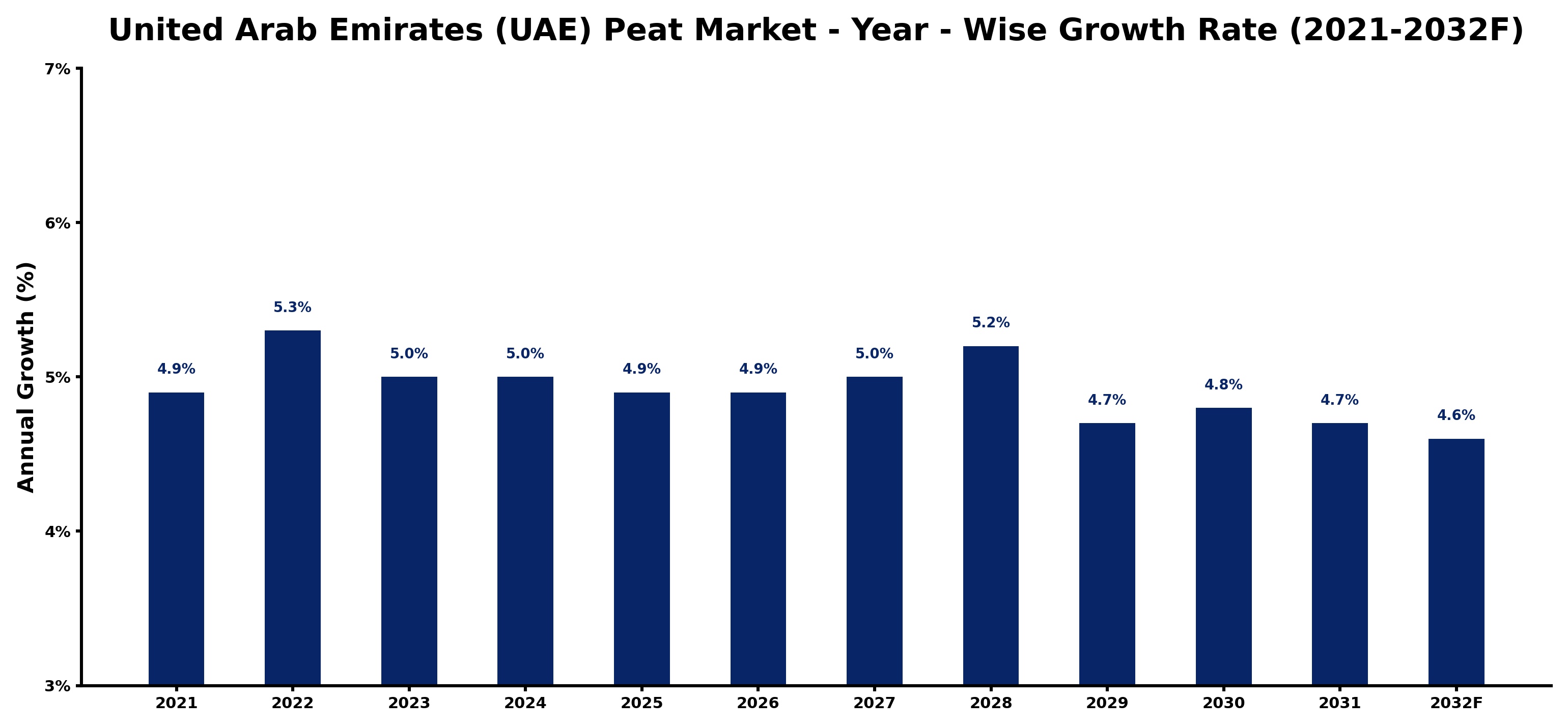
The table below presents the year‑wise growth rates along with the key drivers influencing the market
| Year | Growth Rate | Major Drivers |
| 2021 | 4.9% | Smart manufacturing investments boost UAE peat processing capacity |
| 2022 | 5.3% | Logistics expansion boosts peat transport efficiency across the region |
| 2023 | 5.0% | Logistics network upgrades boosted peat supply chain efficiency |
| 2024 | 5.0% | Infrastructure upgrades boost demand for specialized peat processing equipment |
| 2025 | 4.9% | Smart technology integration enhanced peat extraction and processing efficiency |
| 2026 | 4.9% | Modernized construction practices boost peat utilization in infrastructure projects |
| 2027 | 5.0% | Smart manufacturing adoption boosted peat processing equipment investments |
| 2028 | 5.2% | Infrastructure investments boosted demand for industrial peat products |
| 2029 | 4.7% | Manufacturing investments in peat processing boost local supply chain efficiency |
| 2030 | 4.8% | Logistics investments improved peat export capabilities in regional markets |
| 2031 | 4.7% | Infrastructure upgrades stimulate demand for high quality peat products |
| 2032 | 4.6% | Modernized logistics systems optimized peat export and supply chains |
Note - Market size estimations and growth projections presented in this report are based on 6Wresearch's advanced forecasting approach, validated with industry datasets as of June 2026.
United Arab Emirates (UAE) Peat Market Synopsis
In the UAE, peat's role as a vital soil conditioner is gaining recognition among local farmers and gardeners, particularly in arid regions where soil quality is a significant concern. This increasing awareness has prompted a surge in the adoption of peat-based solutions in both commercial and residential gardening. Furthermore, the country's ambitious landscaping projects and infrastructural developments have opened new avenues for peat utilization.
The nation's strategic focus on boosting domestic food production has catalyzed investments in peat extraction and processing facilities. This aligns with a broader trend towards sustainable agriculture, wherein peat is regarded as an effective medium for improving soil health and enhancing crop yields. The synergy between environmental sustainability and agricultural productivity continues to position the UAE peat market for robust growth.
United Arab Emirates (UAE) Peat Market Key Takeaways
- Peat is increasingly recognized as a crucial soil conditioner in UAE's agriculture and horticulture sectors.
- The market is being driven by the UAE's initiatives focused on food security and sustainable agricultural practices.
- Urban greening projects and increased landscaping activities are bolstering demand for peat products.
- Sustainable peat extraction practices are becoming essential in addressing environmental concerns.
- The impact of COVID-19 on gardening trends has led to heightened awareness and interest in peat-based products.
Evaluation of Restraints in United Arab Emirates (UAE) Peat Market
While the UAE Peat market exhibits promising growth, it is not without its challenges. Environmental concerns surrounding peat extraction, particularly its effects on biodiversity and greenhouse gas emissions, pose significant obstacles. The delicate balance between leveraging peat for agricultural benefits and preserving natural ecosystems requires careful management. Additionally, the geographical constraints and logistical difficulties inherent in transporting peat-based products in a region largely dependent on imports can impact supply chains and pricing strategies, further complicating market dynamics.
United Arab Emirates (UAE) Peat Market Trends
Current trends in the UAE Peat market indicate a shift towards organic gardening and sustainable horticultural practices. More consumers are adopting eco-friendly gardening products, further propelling the demand for peat-based solutions. Technological advancements in extraction and processing methods are also emerging, focusing on minimizing environmental impacts while maximizing efficiency. Moreover, a growing preference for locally sourced products is fostering a trend toward regional peat production, which could reshape the supply landscape in the future.
United Arab Emirates (UAE) Peat Market Opportunities
Investors and stakeholders in the UAE Peat market have a variety of opportunities to capitalize on. There is significant potential for innovation in sustainable peat extraction techniques and the development of new peat-based products tailored to the unique requirements of the UAE's sandy soils. Furthermore, the ongoing urbanization and development of green spaces present lucrative avenues for partnerships with landscape architects and urban planners. As public interest in gardening continues to grow, the sector is ripe for expansion, particularly in eco-friendly product offerings.
Government Initiatives in the United Arab Emirates (UAE) Peat Market
The UAE government has established various initiatives aimed at promoting sustainable agricultural practices, which inherently impact the peat market. These initiatives include public spending on agricultural technology and soil management practices, as well as programs aimed at enhancing food security through improved soil fertility. Incentives for research and development in sustainable farming methods, including the use of organic amendments like peat, are essential components of the country's long-term agricultural strategy.
Future Insights of the United Arab Emirates (UAE) Peat Market
Looking ahead to the 2026-2032 timeframe, the UAE Peat market is set to experience continued growth driven by increasing awareness of sustainable agricultural practices and soil management. As the nation strives to balance ecological considerations with agricultural demands, there will be an emphasis on sustainable peat extraction methods. Additionally, ongoing urbanization and landscaping projects will likely contribute to a steady rise in demand for peat-based products, further establishing peat as a cornerstone of agricultural innovation in the UAE.
United Arab Emirates (UAE) Peat Market Latest Developments (May 2025 - June 2026)
Recent developments within the UAE Peat market indicate a growing interest among stakeholders in sustainable extraction methods and the introduction of innovative peat-based products. Various companies are beginning to explore collaborations with environmental organizations to ensure responsible practices. Furthermore, local agricultural cooperatives are increasingly looking into the benefits of peat in enhancing soil quality and crop yields, showcasing a collective movement towards integrating peat solutions into mainstream agricultural practices.
United Arab Emirates (UAE) Peat Market - Key Attractiveness of the Report
- 10 Years of Market Numbers
- Historical Data Starting from 2022 to 2025
- Base Year: 2025
- Forecast Data until 2032
- Key Performance Indicators Impacting the Market
- Major Upcoming Developments and Projects
Key Highlights of the Report:
- United Arab Emirates (UAE) Peat Market Outlook
- Market Size of United Arab Emirates (UAE) Peat Market, 2025
- Forecast of United Arab Emirates (UAE) Peat Market, 2032
- Historical Data and Forecast of United Arab Emirates (UAE) Peat Revenues & Volume for the Period 2022-2032F
- United Arab Emirates (UAE) Peat Market Trend Evolution
- United Arab Emirates (UAE) Peat Market Drivers and Challenges
- United Arab Emirates (UAE) Peat Price Trends
- United Arab Emirates (UAE) Peat Porter's Five Forces
- United Arab Emirates (UAE) Peat Industry Life Cycle
- Historical Data and Forecast of United Arab Emirates (UAE) Peat Market Revenues & Volume By Type for the Period 2022-2032F
- Historical Data and Forecast of United Arab Emirates (UAE) Peat Market Revenues & Volume By Coco Peat for the Period 2022-2032F
- Historical Data and Forecast of United Arab Emirates (UAE) Peat Market Revenues & Volume By Sod Peat for the Period 2022-2032F
- Historical Data and Forecast of United Arab Emirates (UAE) Peat Market Revenues & Volume By Other for the Period 2022-2032F
- Historical Data and Forecast of United Arab Emirates (UAE) Peat Market Revenues & Volume By Material Type for the Period 2022-2032F
- Historical Data and Forecast of United Arab Emirates (UAE) Peat Market Revenues & Volume By Fibric for the Period 2022-2032F
- Historical Data and Forecast of United Arab Emirates (UAE) Peat Market Revenues & Volume By Hemic for the Period 2022-2032F
- Historical Data and Forecast of United Arab Emirates (UAE) Peat Market Revenues & Volume By Sapric for the Period 2022-2032F
- Historical Data and Forecast of United Arab Emirates (UAE) Peat Market Revenues & Volume By Others for the Period 2022-2032F
- Historical Data and Forecast of United Arab Emirates (UAE) Peat Market Revenues & Volume By Application for the Period 2022-2032F
- Historical Data and Forecast of United Arab Emirates (UAE) Peat Market Revenues & Volume By Agriculture for the Period 2022-2032F
- Historical Data and Forecast of United Arab Emirates (UAE) Peat Market Revenues & Volume By Fuel & Energy for the Period 2022-2032F
- Historical Data and Forecast of United Arab Emirates (UAE) Peat Market Revenues & Volume By Others for the Period 2022-2032F
- United Arab Emirates (UAE) Peat Import Export Trade Statistics
- Market Opportunity Assessment By Type
- Market Opportunity Assessment By Material Type
- Market Opportunity Assessment By Application
- United Arab Emirates (UAE) Peat Top Companies Market Share
- United Arab Emirates (UAE) Peat Competitive Benchmarking By Technical and Operational Parameters
- United Arab Emirates (UAE) Peat Company Profiles
- United Arab Emirates (UAE) Peat Key Strategic Recommendations






































