United Arab Emirates (UAE) Personal computers (PC) Market Summary
The united arab emirates (uae) personal computers (pc) market was estimated at USD 485 Million in 2025 and is projected to reach USD 645 Million by 2032, growing at a CAGR of 5.2% from 2026 to 2032.
United Arab Emirates (UAE) Personal computers (PC) Market Year-wise Growth Rate and Key Drivers
This graph highlights how the United Arab Emirates (UAE) Personal computers (PC) Market has steadily grown over the past five years, supported by major growth factors.
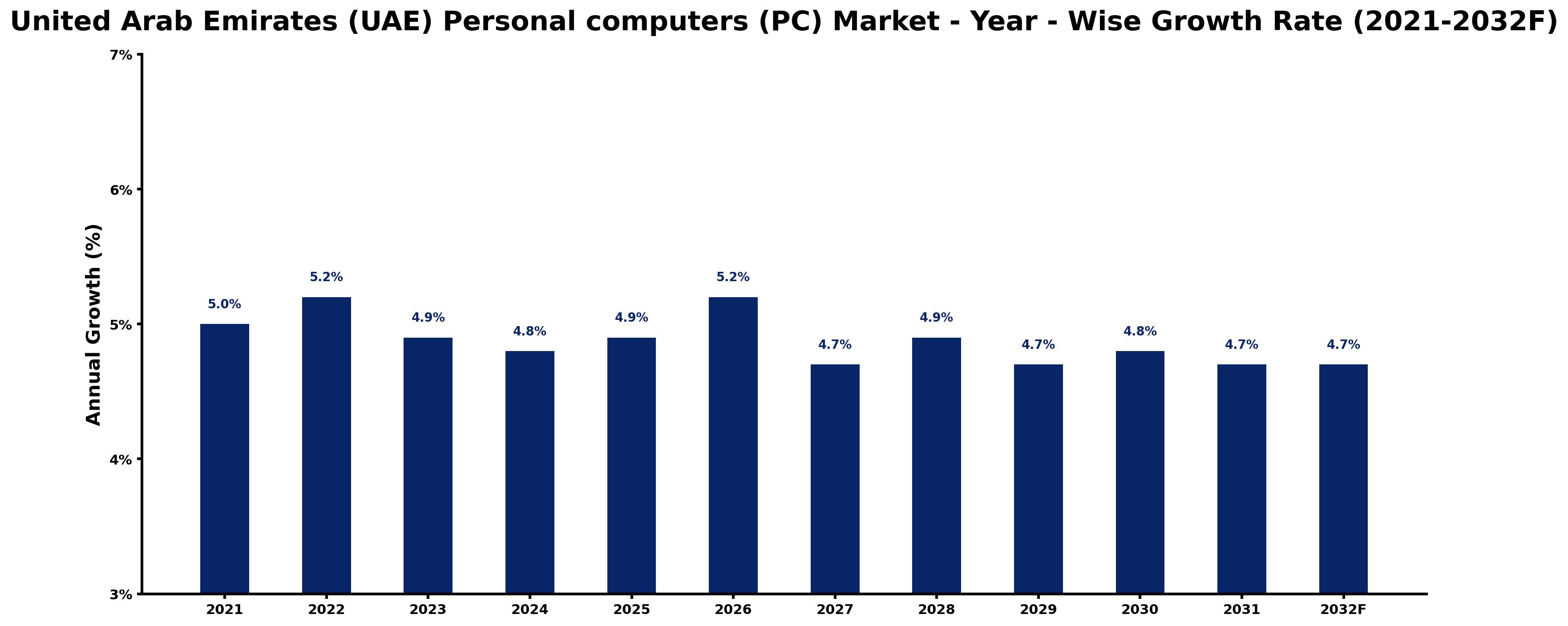
The table below presents the year wise growth rates along with the key drivers influencing the market
| Year | Growth Rate | Major Drivers |
| 2021 | 5.0% | Post-lockdown retail projects fueled a demand for enhanced home office setups. |
| 2022 | 5.2% | Shift towards remote work prompted businesses to invest in robust IT infrastructure. |
| 2023 | 4.9% | Educational institutions embraced digital tools, driving personal computer sales for students. |
| 2024 | 4.8% | Local manufacturers began producing PCs, enhancing supply chain resilience in the region. |
| 2025 | 4.9% | Rising digital literacy initiatives encouraged families to purchase personal computers for learning. |
| 2026 | 5.2% | E-commerce platforms expanded, offering consumers a wider range of PC options and models. |
| 2027 | 4.7% | Corporate budgets shifted, emphasizing technology upgrades to improve workforce productivity. |
| 2028 | 4.9% | Smart city developments prompted demand for connected devices, including advanced personal computers. |
| 2029 | 4.7% | Cybersecurity concerns led businesses to opt for high-performance PCs with enhanced security features. |
| 2030 | 4.8% | Increased gaming culture spurred demand for high-spec personal computers among younger demographics. |
| 2031 | 4.7% | Sustainability trends influenced purchases, favoring energy-efficient models and eco-friendly materials. |
| 2032 | 4.7% | Cloud computing growth necessitated powerful personal computers to access complex applications efficiently. |
Note - Market size estimations and growth projections presented in this report are based on 6Wresearch's advanced forecasting approach, validated with industry datasets as of June 2026.
United Arab Emirates (UAE) Personal computers (PC) Market Synopsis
The United Arab Emirates (UAE) Personal computers (PC) Market is projected to reach 5.2% and witness significant growth during the forecast period (2026-2032). The market for personal computers in the UAE encompasses a diverse array of devices including desktops, laptops, and portable computing products. Key factors driving this growth include the increasing digitalization of various sectors, the ever-evolving landscape of remote work and online learning, and the escalating disposable incomes of the UAE's population.
United Arab Emirates (UAE) Personal computers (PC) Market Growth Drivers
The growth trajectory of the UAE personal computers (PC) market is influenced by a confluence of factors. The COVID-19 pandemic acted as a catalyst, significantly escalating the demand for personal computing devices as organizations and individuals adapted to a new working and learning environment.
- The increase in remote work environments has led to a surge in the demand for laptops and desktops as businesses prioritize equipping their workforce with necessary technology.
- Growth in the educational sector has necessitated the acquisition of PCs for both students and educators engaging in online learning and virtual classrooms.
- Rising disposable incomes have empowered consumers to invest in personal computers for both entertainment and professional purposes, further enhancing market growth.
- The thriving gaming industry has generated an upsurge in demand for high-performance gaming PCs and accessories, solidifying another critical segment of the market.
- Technological advancements in hardware and software capabilities have made PCs more appealing by enhancing performance and user experience, driving continuous upgrades among consumers.
United Arab Emirates (UAE) Personal computers (PC) Market Challenges and Restraints
Despite the robust growth prospects, the UAE personal computers (PC) market faces several challenges. With rapid technological advancements, consumer behavior is shifting towards more frequent replacements, creating pressure on manufacturers to innovate and keep pace with changing preferences.
- The competition posed by smartphones and tablets, particularly those offering comparable capabilities at lower price points, is increasingly challenging the traditional PC market.
- Supply chain disruptions, which can lead to increased production costs and delivery delays, may pose significant operational hurdles for manufacturers.
- As consumer preferences shift towards mobile and cloud solutions, traditional desktop PCs may experience declining demand, necessitating re-evaluation of market strategies.
- Environmental concerns surrounding e-waste and the sustainability of manufacturing practices are drawing scrutiny, influencing purchasing decisions and regulatory policies.
- Economic fluctuations can impact consumer spending behavior, potentially leading to downturns in high-value purchases such as personal computers.
United Arab Emirates (UAE) Personal computers (PC) Market Covid-19 Impact
The COVID-19 pandemic has dramatically reshaped the landscape of the UAE personal computers (PC) market. The urgent transition to remote work and online learning created an unprecedented spike in demand for laptops and desktops.
- Initially, the market witnessed a surge in sales as both businesses and educational institutions scrambled to meet the new operational requirements.
- The adaptability of the market has shown resilience in the face of the pandemic, sustaining strong demand even as restrictions have gradually been lifted.
- The trend of hybrid working models continues to bolster the necessity for personal computers, as flexibility in work arrangements remains a priority for many employees.
- Investments in IT infrastructure have also increased, as companies prioritize the digital transformation that the pandemic has accelerated.
- As consumers adapted to spending more time at home, the demand for gaming and streaming devices likewise contributed positively to the PC market.
United Arab Emirates (UAE) Personal computers (PC) Market Government Investment and Initiatives
The UAE government has recognized the pivotal role of technology in achieving economic diversification and sustainable growth. As part of its Vision 2021, the government has invested heavily in initiatives that bolster the technology infrastructure.
- Various public spending programs are aimed at enhancing digital literacy and access to technology across all sectors, leading to a more informed and technologically adept population.
- Initiatives supporting entrepreneurs and SMEs in the tech sphere promote innovations that directly impact the personal computers (PC) market by fostering local manufacturing capabilities.
- Government-funded projects focusing on smart cities and digital transformation are likely to increase the demand for personal computing devices as they become integrated into everyday life.
- The UAE's regulatory framework is increasingly supportive of the tech industry, providing incentives for companies to innovate and contribute to the personal computers (PC) ecosystem.
- Additionally, collaborative efforts between the UAE government and educational institutions aim to create a robust environment for tech-savvy graduates, thereby indirectly fostering future market growth.
United Arab Emirates (UAE) Personal computers (PC) Market Latest Developments (May 2025 - June 2026)
In recent months, the UAE personal computers (PC) market has seen a flurry of strategic developments. Major companies are increasingly focused on enhancing supply chain efficiencies to address previously encountered disruptions.
- Innovation has become a focal point, with manufacturers introducing new models that incorporate advanced technologies such as AI and enhanced graphics capabilities tailored for gaming and professional use.
- There is a notable expansion of retail and e-commerce channels, enabling consumers to access a wider range of products and services in the personal computers (PC) market.
- Partnerships with educational institutions have been formed to enhance the integration of PCs in remote learning environments, reflecting a sustained commitment to digital education.
- Corporate investments in sustainability practices are emerging, aiming to reduce the environmental footprint associated with PC manufacturing and recycling.
- The market has observed an influx of innovative financing options, allowing consumers to purchase high-performance computers without significant upfront costs, further stimulating demand.
United Arab Emirates (UAE) Personal computers (PC) Market - Key Attractiveness of the Report
- 10 Years of Market Numbers
- Historical Data Starting from 2022 to 2025
- Base Year: 2025
- Forecast Data until 2032
- Key Performance Indicators Impacting the Market
- Major Upcoming Developments and Projects
Key Highlights of the Report:
- United Arab Emirates (UAE) Personal computers (PC) Market Outlook
- Market Size of United Arab Emirates (UAE) Personal computers (PC) Market, 2025
- Forecast of United Arab Emirates (UAE) Personal computers (PC) Market, 2032
- Historical Data and Forecast of United Arab Emirates (UAE) Personal computers (PC) Revenues & Volume for the Period 2022-2032F
- United Arab Emirates (UAE) Personal computers (PC) Market Trend Evolution
- United Arab Emirates (UAE) Personal computers (PC) Market Drivers and Challenges
- United Arab Emirates (UAE) Personal computers (PC) Price Trends
- United Arab Emirates (UAE) Personal computers (PC) Porter's Five Forces
- United Arab Emirates (UAE) Personal computers (PC) Industry Life Cycle
- Historical Data and Forecast of United Arab Emirates (UAE) Personal computers (PC) Market Revenues & Volume By Product for the Period 2022-2032F
- Historical Data and Forecast of United Arab Emirates (UAE) Personal computers (PC) Market Revenues & Volume By Commercial Desktop for the Period 2022-2032F
- Historical Data and Forecast of United Arab Emirates (UAE) Personal computers (PC) Market Revenues & Volume By Commercial Notebook for the Period 2022-2032F
- Historical Data and Forecast of United Arab Emirates (UAE) Personal computers (PC) Market Revenues & Volume By Consumer Desktop for the Period 2022-2032F
- Historical Data and Forecast of United Arab Emirates (UAE) Personal computers (PC) Market Revenues & Volume By Consumer Notebook and Workstation for the Period 2022-2032F
- Historical Data and Forecast of United Arab Emirates (UAE) Personal computers (PC) Market Revenues & Volume By Distribution Channel for the Period 2022-2032F
- Historical Data and Forecast of United Arab Emirates (UAE) Personal computers (PC) Market Revenues & Volume By Online for the Period 2022-2032F
- Historical Data and Forecast of United Arab Emirates (UAE) Personal computers (PC) Market Revenues & Volume By Offline for the Period 2022-2032F
- United Arab Emirates (UAE) Personal computers (PC) Import Export Trade Statistics
- Market Opportunity Assessment By Product
- Market Opportunity Assessment By Distribution Channel
- United Arab Emirates (UAE) Personal computers (PC) Top Companies Market Share
- United Arab Emirates (UAE) Personal computers (PC) Competitive Benchmarking By Technical and Operational Parameters
- United Arab Emirates (UAE) Personal computers (PC) Company Profiles
- United Arab Emirates (UAE) Personal computers (PC) Key Strategic Recommendations






































