United Arab Emirates (UAE) Pressed & Blown Glass Market Size, Share & Growth Rate
The United Arab Emirates (UAE) Pressed & Blown Glass Market was estimated at USD 160 Million in 2025 and is projected to reach USD 223 Million by 2032, growing at a CAGR of 4.9% from 2026 to 2032. This growth trajectory is primarily fueled by the countrys booming construction sector, driven by a surge in high-rise buildings and luxury developments. Additionally, the rising demand for decorative glass items within the thriving tourism and hospitality industry is further propelling the market forward.
United Arab Emirates (UAE) Pressed & Blown Glass Market Year-wise Growth Rate and Key Drivers
This graph highlights how the United Arab Emirates (UAE) Pressed & Blown Glass Market has steadily grown over the years, supported by major growth factors.
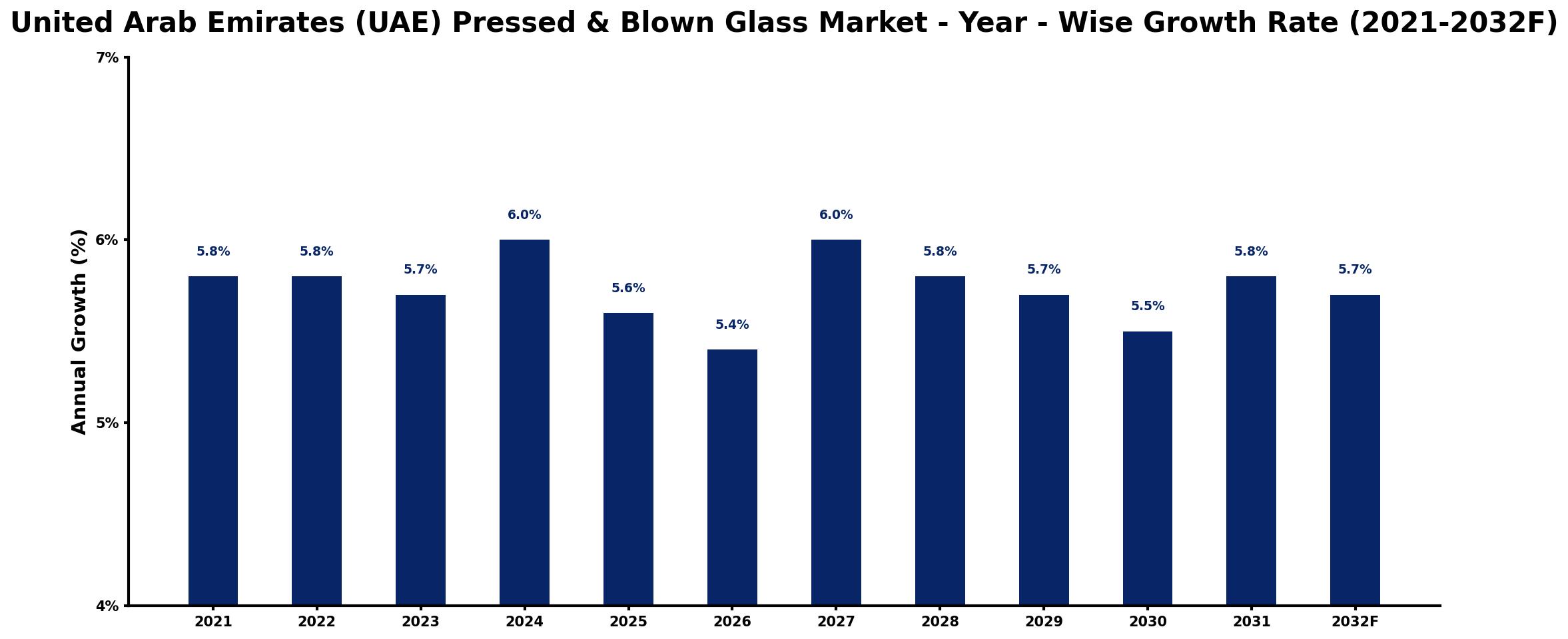
The table below presents the year‑wise growth rates along with the key drivers influencing the market
| Year | Growth Rate | Major Drivers |
| 2021 | 5.8% | Rising construction sector investments |
| 2022 | 5.8% | Increased tourism and hospitality demand |
| 2023 | 5.7% | Expansion of retail and e-commerce |
| 2024 | 6.0% | Growing home decor and furnishings |
| 2025 | 5.6% | Surge in luxury consumer spending |
| 2026 | 5.4% | Innovations in design and technology |
| 2027 | 6.0% | Strengthening export markets opportunities |
| 2028 | 5.8% | Boost in cultural heritage projects |
| 2029 | 5.7% | expanding healthcare application demand |
| 2030 | 5.5% | Increased demand for sustainable materials |
| 2031 | 5.8% | Development of luxury interior projects |
| 2032 | 5.7% | growing automotive sector requirements |
Note: Market size estimations and growth projections presented in this report are based on 6Wresearch's proprietary forecasting methodology, utilizing the latest available industry data, government publications, and primary research inputs.
United Arab Emirates (UAE) Pressed & Blown Glass Market Synopsis
In the UAE, pressed and blown glass products are a fusion of artistry and utility, often featured prominently in luxury hotels and residential interiors. The demand for unique and high-quality glassware is complemented by the nations commitment to showcasing cultural heritage through modern craftsmanship.
The market is also characterized by a strong inclination towards sustainable practices, with manufacturers increasingly adopting energy-efficient technologies. This trend not only caters to eco-conscious consumers but also aligns with the UAEs vision for sustainable urban development, enhancing the overall market appeal.
- The UAE's architectural renaissance drives demand for premium pressed and blown glass products.
- The hospitality sector's expansion fosters a unique niche for decorative glassware.
- Adoption of advanced glass technologies enhances energy efficiency and aesthetic appeal.
- Strong craftsmanship traditions are crucial for product differentiation in the market.
- COVID-19 led to temporary downturns, but a robust recovery is anticipated as sectors rebound.
Despite its promising outlook, the UAE pressed and blown glass market grapples with significant challenges. The increasing demand for eco-friendly alternatives has prompted scrutiny on traditional glass products, posing a competitive threat from sustainable materials. Moreover, the reliance on skilled artisans for the intricate crafting of blown glass presents hurdles in talent acquisition and retention. As manufacturers seek to innovate, they must navigate the delicate balance between maintaining artisanal quality and embracing modern manufacturing techniques.
Emerging trends within the UAE pressed and blown glass market indicate a shift towards personalization and customization. Consumers increasingly seek unique pieces that reflect individual tastes, pushing manufacturers to innovate. Furthermore, advancements in glass technology, such as thermal insulation and self-cleaning properties, are becoming prevalent as industry players respond to sustainability demands. These trends not only enhance product functionality but also improve aesthetic appeal, making them integral to future growth.
The market presents numerous growth opportunities, particularly in the luxury segment. With the UAE positioning itself as a global tourism hub, opportunities abound for companies to cater to high-end resorts and hotels seeking unique glass decor solutions. Additionally, initiatives aimed at promoting local craftsmanship can foster partnerships between artisans and commercial enterprises, expanding distribution channels. As the market evolves, businesses that embrace innovation alongside traditional techniques will likely find significant success.
The UAE government has implemented various policies to support the growth of the pressed and blown glass sector. Initiatives aimed at enhancing local manufacturing capabilities and promoting sustainable practices are at the forefront of public spending. Additionally, investment in infrastructure projects and urban development reflects the governments commitment to creating a conducive environment for industry growth, thereby attracting both local and international investments.
Looking towards 2026-2032, the UAE pressed and blown glass market is set to experience transformative growth. As the architectural landscape continues to evolve, driven by innovative designs and the UAE's Vision 2021 strategy, the need for quality glass products will escalate. Furthermore, a heightened focus on sustainability will steer manufacturers towards integrating advanced technologies into their production processes. This dual focus on innovation and environmental responsibility will shape the market, making it a vibrant landscape for investors and stakeholders alike.
The UAE pressed and blown glass market has witnessed a resurgence post-pandemic, with numerous projects in architecture and hospitality ramping up. Industry players are increasingly exploring collaborations to develop novel glass products that incorporate advanced technologies. Additionally, a renewed interest in locally sourced materials is emerging, reflecting both consumer preferences and sustainability imperatives.
- 10 Years of Market Numbers
- Historical Data Starting from 2022 to 2025
- Base Year: 2025
- Forecast Data until 2032
- Key Performance Indicators Impacting the Market
- Major Upcoming Developments and Projects
Key Highlights of the Report:
- United Arab Emirates (UAE) Pressed & Blown Glass Market Outlook
- Market Size of United Arab Emirates (UAE) Pressed & Blown Glass Market, 2025
- Forecast of United Arab Emirates (UAE) Pressed & Blown Glass Market, 2032
- Historical Data and Forecast of United Arab Emirates (UAE) Pressed & Blown Glass Revenues & Volume for the Period 2022-2032F
- United Arab Emirates (UAE) Pressed & Blown Glass Market Trend Evolution
- United Arab Emirates (UAE) Pressed & Blown Glass Market Drivers and Challenges
- United Arab Emirates (UAE) Pressed & Blown Glass Price Trends
- United Arab Emirates (UAE) Pressed & Blown Glass Porter's Five Forces
- United Arab Emirates (UAE) Pressed & Blown Glass Industry Life Cycle
- Historical Data and Forecast of United Arab Emirates (UAE) Pressed & Blown Glass Market Revenues & Volume By Type for the Period 2022-2032F
- Historical Data and Forecast of United Arab Emirates (UAE) Pressed & Blown Glass Market Revenues & Volume By Mold-blown for the Period 2022-2032F
- Historical Data and Forecast of United Arab Emirates (UAE) Pressed & Blown Glass Market Revenues & Volume By Pressed for the Period 2022-2032F
- Historical Data and Forecast of United Arab Emirates (UAE) Pressed & Blown Glass Market Revenues & Volume By Glass for the Period 2022-2032F
- Historical Data and Forecast of United Arab Emirates (UAE) Pressed & Blown Glass Market Revenues & Volume By Glassblowing for the Period 2022-2032F
- Historical Data and Forecast of United Arab Emirates (UAE) Pressed & Blown Glass Market Revenues & Volume By Molten for the Period 2022-2032F
- United Arab Emirates (UAE) Pressed & Blown Glass Import Export Trade Statistics
- Market Opportunity Assessment By Type
- United Arab Emirates (UAE) Pressed & Blown Glass Top Companies Market Share
- United Arab Emirates (UAE) Pressed & Blown Glass Competitive Benchmarking By Technical and Operational Parameters
- United Arab Emirates (UAE) Pressed & Blown Glass Company Profiles
- United Arab Emirates (UAE) Pressed & Blown Glass Key Strategic Recommendations






































