United Arab Emirates (UAE) Real Estate Market Size, Share & Growth Rate
The United Arab Emirates (UAE) Real Estate Market was estimated at USD 1232 Million in 2025 and is projected to reach USD 1759 Million by 2032, growing at a CAGR of 5.2% from 2026 to 2032. This growth trajectory is fundamentally driven by the UAE's strategic position as a global business hub and ongoing governmental initiatives aimed at economic diversification. As the nation prepares for landmark events like Expo 2025 and aligns with Vision 2031, the demand for innovative commercial and residential properties continues to surge, further enhancing the market's robustness.
United Arab Emirates (UAE) Real Estate Market Year-wise Growth Rate and Key Drivers
This graph highlights how the United Arab Emirates (UAE) Real Estate Market has steadily grown over the years, supported by major growth factors.
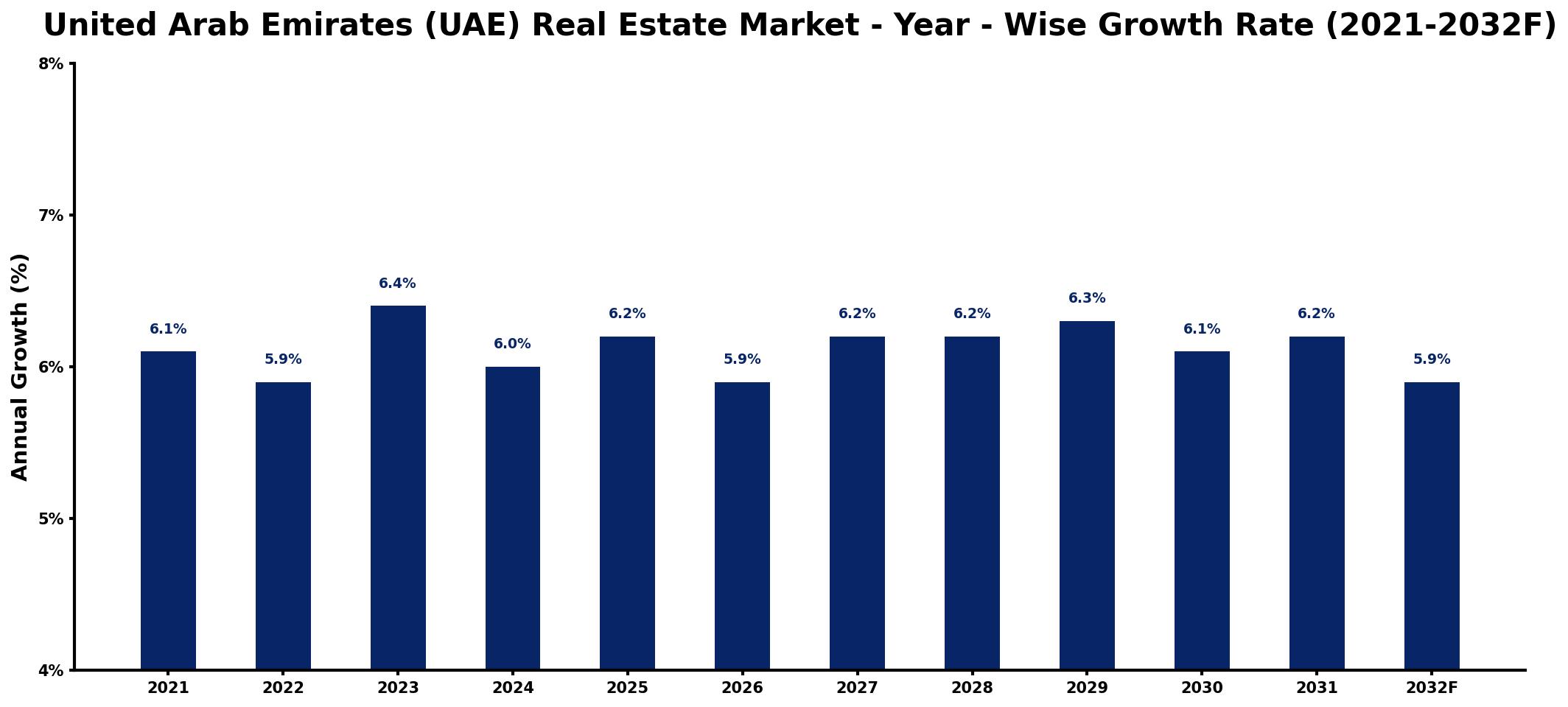
The table below presents the year‑wise growth rates along with the key drivers influencing the market
| Year | Growth Rate | Major Drivers |
| 2021 | 6.1% | Increased foreign investment inflow |
| 2022 | 5.9% | Rising expatriate population growth |
| 2023 | 6.4% | Expansion of tourism infrastructure projects |
| 2024 | 6.0% | Growing demand for residential properties |
| 2025 | 6.2% | Development of smart city initiatives |
| 2026 | 5.9% | Strengthening economic diversification efforts |
| 2027 | 6.2% | Surge in luxury market interest |
| 2028 | 6.2% | stronger distribution network expansion |
| 2029 | 6.3% | Increase in green building trends |
| 2030 | 6.1% | rising demand from electronics |
| 2031 | 6.2% | Growth in co-living spaces popularity |
| 2032 | 5.9% | Rising interest in investment opportunities |
Note: Market size estimations and growth projections presented in this report are based on 6Wresearch's proprietary forecasting methodology, utilizing the latest available industry data, government publications, and primary research inputs.
United Arab Emirates (UAE) Real Estate Market Synopsis
The most powerful force currently shaping the UAE Real Estate Market is the government's unwavering commitment to creating a business-friendly environment. This dedication not only facilitates foreign investments but also nurtures local developments, ensuring that the market is both dynamic and resilient.
Additionally, the evolution of consumer preferences post-pandemic is significantly influencing the sector. The shift towards remote working has increased the demand for spacious residences and properties in suburban areas, driving developers to rethink their strategies and offerings.
United Arab Emirates (UAE) Real Estate Market Key Takeaways
- The market is experiencing a robust recovery post-COVID-19, with increased transaction volumes driven by digital platforms.
- Government initiatives play a crucial role in boosting investor confidence and property demand.
- Consumer preferences are evolving, favoring larger spaces and suburban living.
- Infrastructure development is at the forefront, enhancing the appeal of real estate investments across the UAE.
- Regulatory frameworks continue to adapt, providing a stable environment for international and domestic investors.
Evaluation of Restraints in United Arab Emirates (UAE) Real Estate Market
Despite the growth potential, the UAE Real Estate Market faces notable restraints. Fluctuations in property prices can significantly affect investor confidence, leading to market volatility. Additionally, the balance between supply and demand, particularly in the residential sector, remains precarious. Regulatory changes can create uncertainty, deterring potential investors, while macroeconomic factors also pose a risk. Understanding these dynamics is crucial for stakeholders aiming to navigate the complexities of this evolving market.
United Arab Emirates (UAE) Real Estate Market Trends
A range of current and emerging trends are shaping the UAE Real Estate Market. Notably, sustainability has become a critical focus, with eco-friendly developments increasingly sought after. Additionally, the integration of smart technologies in residential and commercial spaces is gaining traction, catering to a tech-savvy demographic. The rise of mixed-use developments also reflects changing lifestyle preferences, combining living, working, and leisure spaces to foster vibrant communities.
United Arab Emirates (UAE) Real Estate Market Opportunities
Opportunities for growth in the UAE Real Estate Market are abundant. As the nation focuses on diversifying its economy, sectors such as tourism and hospitality present lucrative avenues for investment. There is also a significant push towards urban regeneration projects, creating chances for revitalizing underutilized areas. Furthermore, with the increasing interest in property ownership among expatriates, the demand for residential developments continues to rise, signaling a promising horizon for developers.
Government Initiatives in the United Arab Emirates (UAE) Real Estate Market
The UAE government has implemented several initiatives aimed at propelling the real estate sector forward. Policies encouraging foreign investment, alongside the facilitation of long-term residency visas for property owners, have enhanced market attractiveness. Investment in infrastructure, particularly in transportation and utilities, complements ongoing real estate projects, ensuring robust connectivity and sustainability in urban development. Additionally, the government continues to support economic diversification efforts through various programs aimed at enhancing the sector's resilience.
Future Insights of the United Arab Emirates (UAE) Real Estate Market
Looking ahead, the UAE Real Estate Market is poised for substantial evolution between 2026 and 2032. As the nation embarks on ambitious projects aligned with Vision 2031, innovative developments and infrastructure enhancements will likely drive demand. The continued emphasis on sustainability and smart living solutions will further shape property offerings. With a stable political landscape and ongoing government support, the market is expected to remain an attractive destination for both local and international investors.
United Arab Emirates (UAE) Real Estate Market Latest Developments (2025 - 2026)
In recent months, the UAE Real Estate Market has witnessed significant activity, reflecting the sector's recovery and growth. Developments focusing on mixed-use properties have gained momentum, aligning with evolving lifestyle preferences. The adoption of digital platforms for property transactions continues to expand, streamlining processes and enhancing accessibility. Furthermore, government-backed initiatives aimed at attracting foreign investment have seen increased participation from international stakeholders, reflecting a renewed confidence in the market's future.
United Arab Emirates (UAE) Real Estate Market - Key Attractiveness of the Report
- 10 Years of Market Numbers
- Historical Data Starting from 2022 to 2025
- Base Year: 2025
- Forecast Data until 2032
- Key Performance Indicators Impacting the Market
- Major Upcoming Developments and Projects
Key Highlights of the Report:
- United Arab Emirates (UAE) Real Estate Market Outlook
- Market Size of United Arab Emirates (UAE) Real Estate Market, 2025
- Forecast of United Arab Emirates (UAE) Real Estate Market, 2032
- Historical Data and Forecast of United Arab Emirates (UAE) Real Estate Revenues & Volume for the Period 2022-2032F
- United Arab Emirates (UAE) Real Estate Market Trend Evolution
- United Arab Emirates (UAE) Real Estate Market Drivers and Challenges
- United Arab Emirates (UAE) Real Estate Price Trends
- United Arab Emirates (UAE) Real Estate Porter's Five Forces
- United Arab Emirates (UAE) Real Estate Industry Life Cycle
- Historical Data and Forecast of United Arab Emirates (UAE) Real Estate Market Revenues & Volume By Property for the Period 2022-2032F
- Historical Data and Forecast of United Arab Emirates (UAE) Real Estate Market Revenues & Volume By Residential for the Period 2022-2032F
- Historical Data and Forecast of United Arab Emirates (UAE) Real Estate Market Revenues & Volume By Commercial for the Period 2022-2032F
- Historical Data and Forecast of United Arab Emirates (UAE) Real Estate Market Revenues & Volume By Industrial for the Period 2022-2032F
- Historical Data and Forecast of United Arab Emirates (UAE) Real Estate Market Revenues & Volume By Land for the Period 2022-2032F
- Historical Data and Forecast of United Arab Emirates (UAE) Real Estate Market Revenues & Volume By Others for the Period 2022-2032F
- Historical Data and Forecast of United Arab Emirates (UAE) Real Estate Market Revenues & Volume By Type for the Period 2022-2032F
- Historical Data and Forecast of United Arab Emirates (UAE) Real Estate Market Revenues & Volume By Sales for the Period 2022-2032F
- Historical Data and Forecast of United Arab Emirates (UAE) Real Estate Market Revenues & Volume By Rental for the Period 2022-2032F
- Historical Data and Forecast of United Arab Emirates (UAE) Real Estate Market Revenues & Volume By Lease for the Period 2022-2032F
- United Arab Emirates (UAE) Real Estate Import Export Trade Statistics
- Market Opportunity Assessment By Property
- Market Opportunity Assessment By Type
- United Arab Emirates (UAE) Real Estate Top Companies Market Share
- United Arab Emirates (UAE) Real Estate Competitive Benchmarking By Technical and Operational Parameters
- United Arab Emirates (UAE) Real Estate Company Profiles
- United Arab Emirates (UAE) Real Estate Key Strategic Recommendations






































