United Arab Emirates (UAE) Recycled Plastics Market Size, Share & Growth Rate
The United Arab Emirates (UAE) Recycled Plastics Market was estimated at USD 205 Million in 2025 and is projected to reach USD 274 Million by 2032, growing at a CAGR of 4.2% from 2026 to 2032. This upward trajectory is fueled by a combination of rising environmental consciousness among consumers and businesses, alongside government initiatives that encourage recycling practices. With a focus on reducing plastic waste, the market is witnessing an increasing shift towards sustainable alternatives, especially in sectors such as packaging, automotive, and construction.
United Arab Emirates (UAE) Recycled Plastics Market Year-wise Growth Rate and Key Drivers
This graph highlights how the United Arab Emirates (UAE) Recycled Plastics Market has steadily grown over the years, supported by major growth factors.
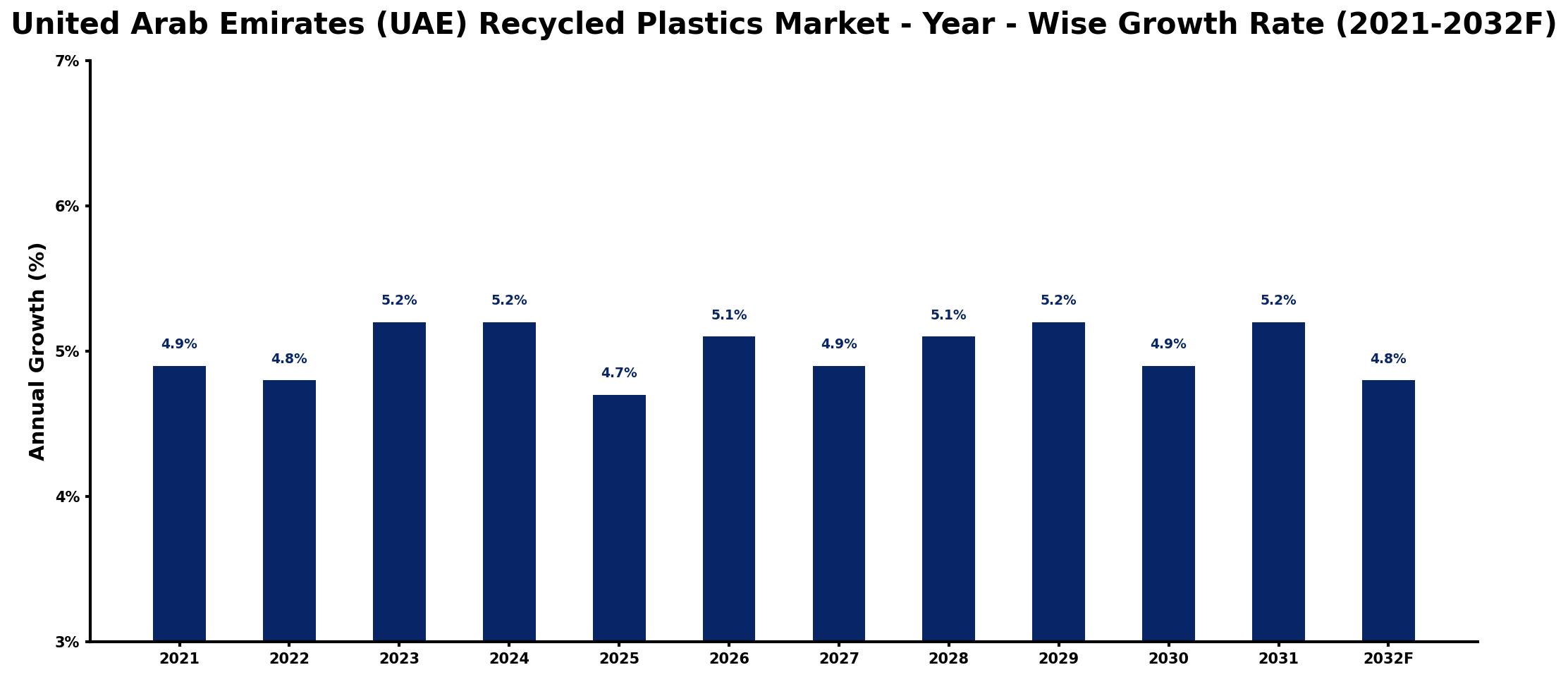
The table below presents the year‑wise growth rates along with the key drivers influencing the market
| Year | Growth Rate | Major Drivers |
| 2021 | 4.9% | Increased consumer sustainability awareness |
| 2022 | 4.8% | Growing demand for eco-friendly materials |
| 2023 | 5.2% | Expansion of waste management initiatives |
| 2024 | 5.2% | Rise in regulatory support initiatives |
| 2025 | 4.7% | Investment in advanced processing technologies |
| 2026 | 5.1% | Emergence of new recycling facilities |
| 2027 | 4.9% | Strengthened corporate sustainability commitments |
| 2028 | 5.1% | Diversification of end-use applications |
| 2029 | 5.2% | Enhanced public-private partnership collaborations |
| 2030 | 4.9% | Growing international market opportunities |
| 2031 | 5.2% | Increased participation in circular economy |
| 2032 | 4.8% | Ongoing innovation in material alternatives |
Note: Market size estimations and growth projections presented in this report are based on 6Wresearch's proprietary forecasting methodology, utilizing the latest available industry data, government publications, and primary research inputs.
United Arab Emirates (UAE) Recycled Plastics Market Synopsis
The recycled plastics market in the UAE has gained momentum, particularly in the packaging industry where companies are actively seeking eco-friendly alternatives to traditional materials. As a result, the sector is not only aiding in waste reduction but also contributing to the circular economy, which is becoming a priority for local businesses.
Additionally, the construction industry is increasingly adopting recycled plastics to meet sustainability targets, leveraging these materials for various applications. The government's emphasis on innovation in recycling technologies further supports this trend, creating a conducive environment for growth and investment in recycled plastics.
United Arab Emirates (UAE) Recycled Plastics Market Key Takeaways
- Strong demand from multiple industries including packaging, automotive, and construction.
- Rising environmental awareness among consumers and businesses driving the shift to recycled plastics.
- Government initiatives fostering a favorable regulatory environment for recycling practices.
- Investment in advanced recycling technologies improving the cost-effectiveness of recycled materials.
- Challenges in infrastructure and supply chain management remain but are being addressed progressively.
Evaluation of Restraints in United Arab Emirates (UAE) Recycled Plastics Market
While the UAE recycled plastics market is on the rise, it encounters several constraints that hamper its full potential. The current infrastructure for collecting and sorting plastic waste is underdeveloped, leading to inefficiencies in the supply chain. Furthermore, ensuring a consistent and high-quality supply of recycled plastics poses a challenge. These limitations can hinder market growth and the ability to meet the increasing demand from various industries. Addressing these issues will require coordinated efforts among stakeholders to enhance recycling facilities and streamline logistics.
United Arab Emirates (UAE) Recycled Plastics Market Trends
The UAE recycled plastics market is witnessing several pivotal trends. One notable trend is the increased collaboration between private enterprises and governmental bodies to enhance recycling efforts and increase public awareness. Furthermore, the adoption of cutting-edge technologies, such as advanced sorting and processing systems, is improving efficiency and the quality of recycled products. The rise of eco-labeling and consumer demand for sustainable products is also pushing companies to invest more in recycled materials. As corporate social responsibility becomes more integral to business strategies, expect a surge in initiatives that prioritize sustainability across all sectors.
United Arab Emirates (UAE) Recycled Plastics Market Opportunities
The UAE's commitment to sustainability presents a wealth of opportunities within the recycled plastics market. Industries are increasingly looking for innovative solutions that align with sustainability goals, creating room for businesses to develop and market eco-friendly products. Moreover, investment in local recycling facilities could reduce dependency on imported materials, creating an autonomous supply chain. By capitalizing on these developments, companies can carve out significant market share while contributing positively to environmental goals.
Government Initiatives in the United Arab Emirates (UAE) Recycled Plastics Market
The UAE government is actively involved in promoting recycling and sustainability through various initiatives and policies. National campaigns aimed at reducing plastic waste are in place, along with programs that encourage businesses to adopt sustainable practices. These initiatives often include incentives for companies that invest in recycling technologies and infrastructure improvements. The government's commitment to enhancing the country's recycling rates reflects a broader vision of a sustainable future, positioning the UAE as a leader in environmental stewardship.
Future Insights of the United Arab Emirates (UAE) Recycled Plastics Market
Looking ahead to the period from 2026 to 2032, the UAE recycled plastics market is expected to continue its growth trajectory. The increasing regulatory push for sustainable practices, coupled with enhanced consumer awareness, will drive demand across sectors. Additionally, the ongoing development of recycling infrastructure and technology is set to improve efficiency and output. As businesses increasingly recognize the economic and environmental benefits of utilizing recycled materials, we anticipate a robust expansion of this market, positioning it as a key player in the region's economic landscape.
United Arab Emirates (UAE) Recycled Plastics Market Latest Developments (2025 - 2026)
Recent developments in the UAE recycled plastics market indicate a strong focus on enhancing recycling capabilities and public awareness campaigns. Initiatives aimed at improving the efficiency of recycling processes are emerging, along with collaborations between private companies and the government to address the infrastructural challenges. Companies are also exploring new market opportunities, particularly in sustainable packaging solutions, as consumer preferences shift increasingly towards environmentally friendly products.
United Arab Emirates (UAE) Recycled Plastics Market - Key Attractiveness of the Report
- 10 Years of Market Numbers
- Historical Data Starting from 2022 to 2025
- Base Year: 2025
- Forecast Data until 2032
- Key Performance Indicators Impacting the Market
- Major Upcoming Developments and Projects
Key Highlights of the Report:
- United Arab Emirates (UAE) Recycled Plastics Market Outlook
- Market Size of United Arab Emirates (UAE) Recycled Plastics Market, 2025
- Forecast of United Arab Emirates (UAE) Recycled Plastics Market, 2032
- Historical Data and Forecast of United Arab Emirates (UAE) Recycled Plastics Revenues & Volume for the Period 2022-2032F
- United Arab Emirates (UAE) Recycled Plastics Market Trend Evolution
- United Arab Emirates (UAE) Recycled Plastics Market Drivers and Challenges
- United Arab Emirates (UAE) Recycled Plastics Price Trends
- United Arab Emirates (UAE) Recycled Plastics Porter's Five Forces
- United Arab Emirates (UAE) Recycled Plastics Industry Life Cycle
- Historical Data and Forecast of United Arab Emirates (UAE) Recycled Plastics Market Revenues & Volume By Plastic Type for the Period 2022-2032F
- Historical Data and Forecast of United Arab Emirates (UAE) Recycled Plastics Market Revenues & Volume By Polyethylene Terephthalate (Pet) for the Period 2022-2032F
- Historical Data and Forecast of United Arab Emirates (UAE) Recycled Plastics Market Revenues & Volume By High Density Polyethylene (Hdpe) for the Period 2022-2032F
- Historical Data and Forecast of United Arab Emirates (UAE) Recycled Plastics Market Revenues & Volume By Polypropylene (Pp) for the Period 2022-2032F
- Historical Data and Forecast of United Arab Emirates (UAE) Recycled Plastics Market Revenues & Volume By Low Density Polyethylene (Ldpe) for the Period 2022-2032F
- Historical Data and Forecast of United Arab Emirates (UAE) Recycled Plastics Market Revenues & Volume By Others for the Period 2022-2032F
- Historical Data and Forecast of United Arab Emirates (UAE) Recycled Plastics Market Revenues & Volume By Application for the Period 2022-2032F
- Historical Data and Forecast of United Arab Emirates (UAE) Recycled Plastics Market Revenues & Volume By Non-food Contact Packaging for the Period 2022-2032F
- Historical Data and Forecast of United Arab Emirates (UAE) Recycled Plastics Market Revenues & Volume By Food Contact Packaging for the Period 2022-2032F
- Historical Data and Forecast of United Arab Emirates (UAE) Recycled Plastics Market Revenues & Volume By Construction for the Period 2022-2032F
- Historical Data and Forecast of United Arab Emirates (UAE) Recycled Plastics Market Revenues & Volume By Automotive for the Period 2022-2032F
- Historical Data and Forecast of United Arab Emirates (UAE) Recycled Plastics Market Revenues & Volume By Others for the Period 2022-2032F
- Historical Data and Forecast of United Arab Emirates (UAE) Recycled Plastics Market Revenues & Volume By Raw Material for the Period 2022-2032F
- Historical Data and Forecast of United Arab Emirates (UAE) Recycled Plastics Market Revenues & Volume By Plastic Bottles for the Period 2022-2032F
- Historical Data and Forecast of United Arab Emirates (UAE) Recycled Plastics Market Revenues & Volume By Plastic Films for the Period 2022-2032F
- Historical Data and Forecast of United Arab Emirates (UAE) Recycled Plastics Market Revenues & Volume By Rigid Plastic And Foam for the Period 2022-2032F
- Historical Data and Forecast of United Arab Emirates (UAE) Recycled Plastics Market Revenues & Volume By Fibres for the Period 2022-2032F
- Historical Data and Forecast of United Arab Emirates (UAE) Recycled Plastics Market Revenues & Volume By Others for the Period 2022-2032F
- United Arab Emirates (UAE) Recycled Plastics Import Export Trade Statistics
- Market Opportunity Assessment By Plastic Type
- Market Opportunity Assessment By Application
- Market Opportunity Assessment By Raw Material
- United Arab Emirates (UAE) Recycled Plastics Top Companies Market Share
- United Arab Emirates (UAE) Recycled Plastics Competitive Benchmarking By Technical and Operational Parameters
- United Arab Emirates (UAE) Recycled Plastics Company Profiles
- United Arab Emirates (UAE) Recycled Plastics Key Strategic Recommendations






































