United Arab Emirates (UAE) RegTech Market Size & Growth Rate (2026-2032)
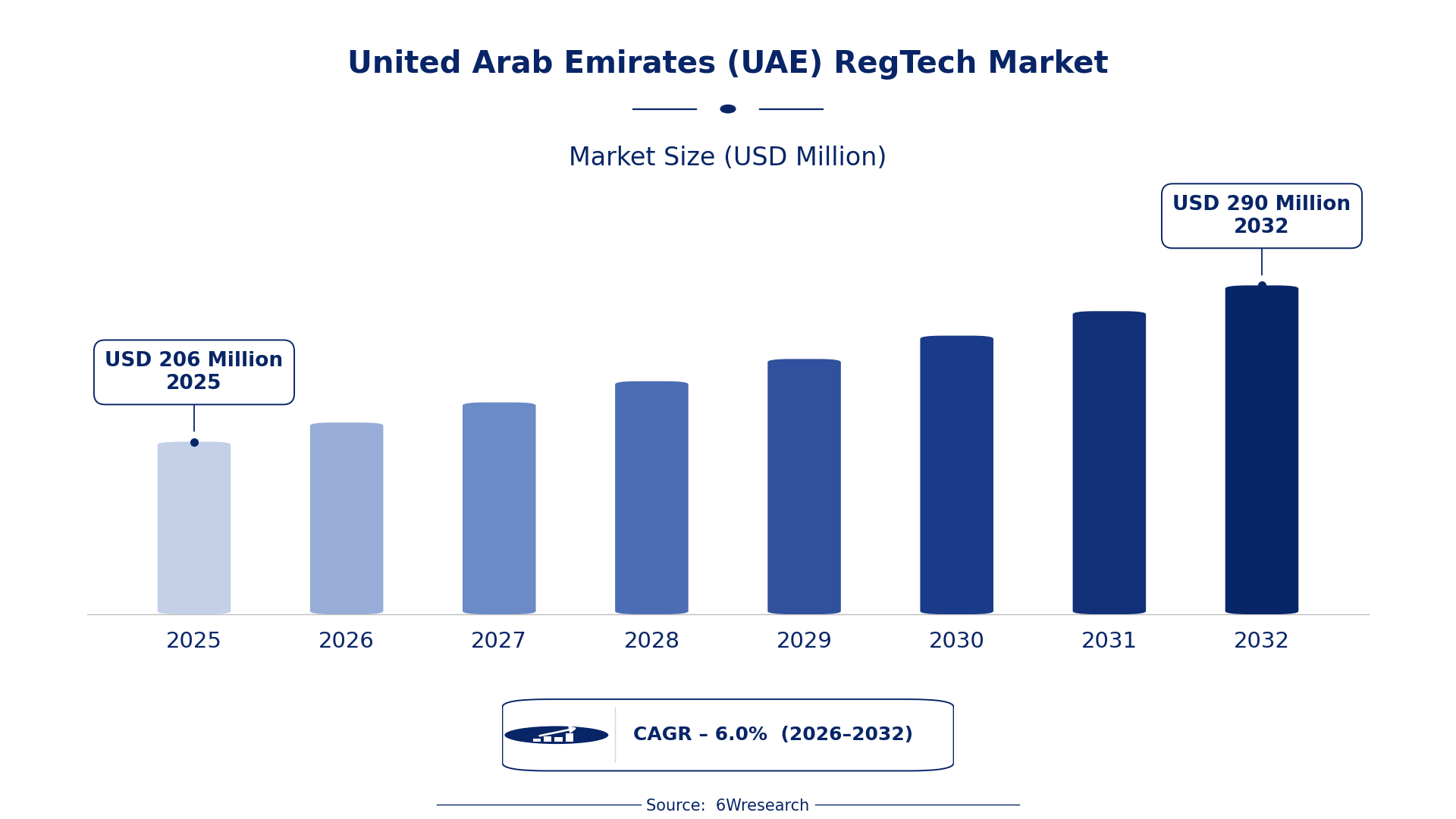
The United Arab Emirates (UAE) RegTech Market was estimated at USD 206 Million in 2025 and is projected to reach USD 290 Million by 2032, growing at a CAGR of 6.0% from 2026 to 2032.
United Arab Emirates (UAE) RegTech Market Synopsis
The UAE RegTech market is underpinned by a pressing need for advanced compliance solutions as businesses grapple with intricate regulations. The financial sector's rapid growth, coupled with the demand for technology to streamline compliance processes, is creating a fertile ground for RegTech innovations.
As the UAE positions itself as a global financial hub, the urgency for organizations to adhere to both local and international regulations has intensified. Companies are increasingly turning to RegTech solutions for KYC checks, risk management, and regulatory compliance, highlighting the sector's crucial role in facilitating secure and efficient financial operations.
United Arab Emirates (UAE) RegTech Market Year-wise Growth Rate and Key Drivers
This graph illustrates the annual growth rates of the United Arab Emirates (UAE) RegTech Market from 2021 to 2032, highlighting a steady upward trajectory and projected expansion over the forecast period.
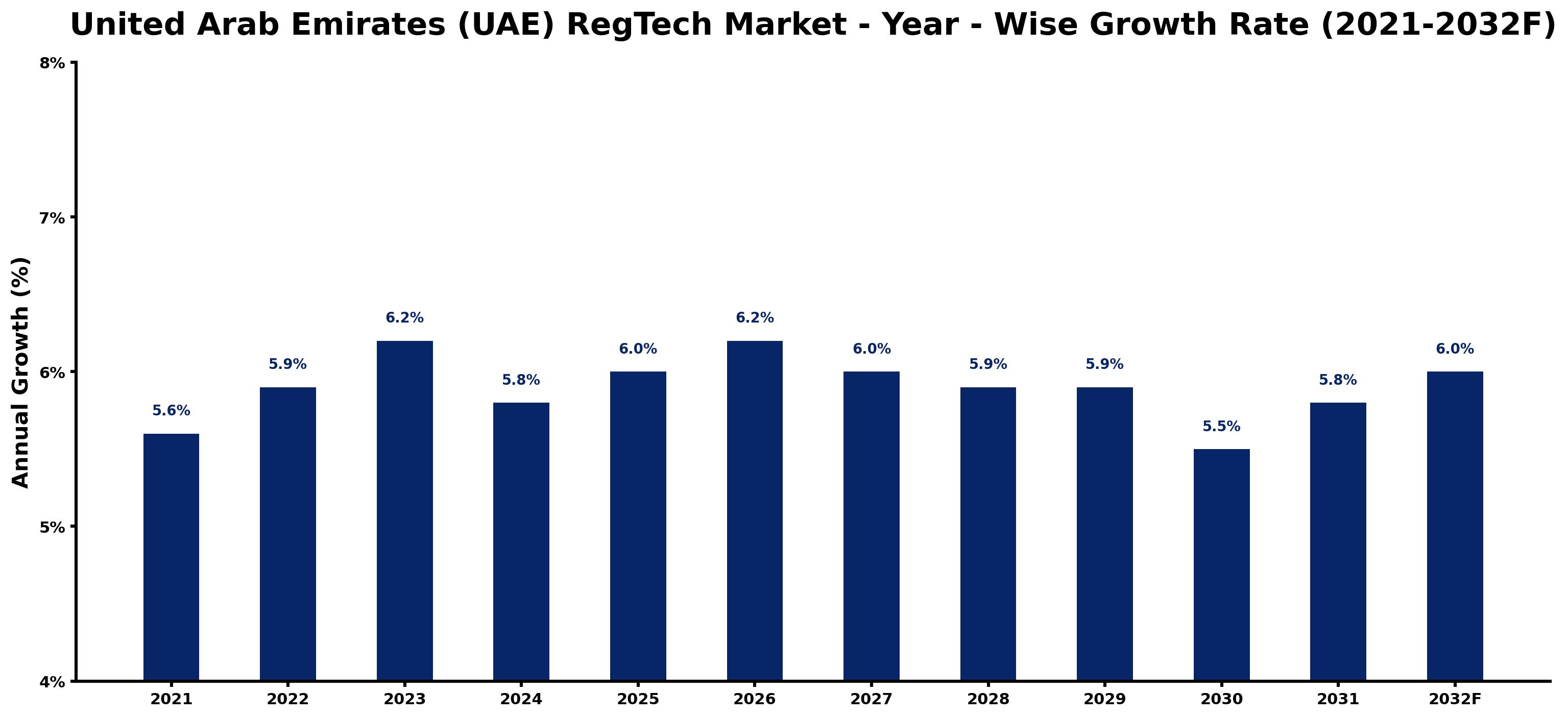
The table below presents the year‑wise growth rates along with the key drivers influencing the market
| Year | Growth Rate | Major Drivers |
| 2021 | 5.6% | Central Bank initiatives streamline regulatory reporting processes. |
| 2022 | 5.9% | Increased investment in fintech startups drives innovation in RegTech. |
| 2023 | 6.2% | Enhanced cybersecurity laws require stronger compliance technologies. |
| 2024 | 5.8% | UAE's digital economy strategy fosters demand for automation tools. |
| 2025 | 6.0% | Growing fintech ecosystem encourages collaborative RegTech development. |
| 2026 | 6.2% | Regulatory Sandbox promotes testing of emerging RegTech solutions. |
| 2027 | 6.0% | Federal Law on Anti-Money Laundering boosts compliance urgency. |
| 2028 | 5.9% | Insurance Authority mandates digital KYC practices for firms. |
| 2029 | 5.9% | Strengthening data protection regulations heightens compliance software need. |
| 2030 | 5.5% | Free zone initiatives incentivize innovative compliance technology startups. |
| 2031 | 5.8% | Increased focus on consumer protection regulations drives demand. |
| 2032 | 6.0% | UAE’s digital transformation goals enhance RegTech market opportunities. |
Note: Market size estimations and growth projections presented in this report are based on 6Wresearch's proprietary forecasting methodology, utilizing the latest available industry data, government publications, and primary research inputs.
United Arab Emirates (UAE) RegTech Market Key Takeaways
Below are some of the specific key takeaways from the market, including:
- The UAE's evolving regulatory framework is a primary driver for RegTech adoption.
- Companies seek innovative solutions to navigate complex compliance landscapes efficiently.
- Investment in technology is vital for financial institutions aiming to mitigate risks and enhance compliance.
- Government initiatives are actively shaping the direction and growth of the RegTech sector.
- The market is expected to witness sustained growth through 2032, supported by increasing demand for compliance solutions.
Evaluation of Restraints in United Arab Emirates (UAE) RegTech Market
The UAE RegTech market faces constraints primarily linked to the rapid changes in regulatory requirements. Organizations must develop flexible and adaptive solutions to remain compliant, which can strain resources and innovation cycles. Additionally, the challenge of integrating RegTech solutions with existing systems often leads to implementation delays. The high stakes of financial data security demand stringent cybersecurity measures, further complicating the landscape for RegTech providers.
United Arab Emirates (UAE) RegTech Market Trends
Key trends shaping the UAE RegTech market include the integration of artificial intelligence and machine learning into compliance processes, enhancing efficiency and accuracy. As financial institutions increasingly prioritize customer-centric services, RegTech solutions that facilitate real-time compliance monitoring are gaining traction. on top of that, the rise of digital banking and fintech startups is pushing the demand for scalable and cost-effective RegTech solutions, driving innovation in the sector.
United Arab Emirates (UAE) RegTech Market Opportunities
The landscape for growth in the UAE RegTech market is promising. Opportunities lie in developing specialized solutions tailored to the unique regulatory needs of various sectors, including insurance and real estate. The increasing focus on anti-money laundering (AML) measures presents a ripe avenue for innovation. Collaboration between regulatory bodies and technology providers can lead to enhanced frameworks that support compliance while fostering growth in the sector.
Government Initiatives in the United Arab Emirates (UAE) RegTech Market
Government action is a cornerstone of the UAE RegTech market, with a strategic emphasis on enhancing regulatory frameworks and compliance mechanisms. The UAE government is committed to establishing a transparent financial ecosystem that attracts global investors and ensures adherence to international standards. As such, regulatory initiatives are increasingly focused on creating a conducive environment for RegTech development and implementation.
- A regulatory framework introduced in 2025 mandating comprehensive billing transparency for financial institutions.
- A national digital infrastructure upgrade programme now in its rollout phase, aimed at enhancing data security and compliance.
- Current initiatives are underway to foster collaboration between financial regulators and RegTech companies, promoting innovation.
- A planned public-private initiative is expected to enhance the integration of RegTech solutions into existing financial systems by 2028.
- Ongoing development of a centralized compliance monitoring platform to streamline regulatory reporting processes.
Future Insights of the United Arab Emirates (UAE) RegTech Market
Looking ahead to 2026-2032, the UAE RegTech market is expected to expand significantly. As regulatory demands intensify, organizations will increasingly rely on technology to ensure compliance. The trend towards digitalization in financial services will likely accelerate the adoption of RegTech solutions, while ongoing government support and regulatory clarity will provide a stable foundation for growth. The interplay between innovation and regulation will shape the future of this market, driving advancements that improve compliance efficiency and risk management.
United Arab Emirates (UAE) RegTech Market Latest Developments
Recent developments in the UAE RegTech market highlight a surge in activity as organizations adapt to evolving regulatory requirements. The trend toward automation and smart technology is becoming increasingly pronounced, with companies seeking to enhance their compliance capabilities through innovative solutions. Strategic partnerships are also on the rise, as firms collaborate to bolster their offerings in response to market demands.
- A major technology vendor launched a new RegTech platform in early 2025 that automates compliance reporting and risk assessments.
- An initiative that began in mid-2025 aims to develop AI-driven tools for KYC processes, currently underway with several pilot projects.
- In early 2026, a leading regional operator is expected to expand its services by integrating blockchain technology for secure transactions.
- A partnership formed in Q3 2025 between a financial institution and a RegTech firm to enhance AML compliance solutions is currently ongoing.
- Plans for a new regulatory sandbox are anticipated to be announced in late 2026, allowing startups to test innovative RegTech solutions in a controlled environment.
United Arab Emirates (UAE) RegTech Market - Key Attractiveness of the Report
- 10 Years of Market Numbers
- Historical Data Starting from 2022 to 2025
- Base Year: 2025
- Forecast Data until 2032
- Key Performance Indicators Impacting the Market
- Major Upcoming Developments and Projects
Key Highlights of the Report:
- United Arab Emirates (UAE) RegTech Market Outlook
- Market Size of United Arab Emirates (UAE) RegTech Market, 2025
- Forecast of United Arab Emirates (UAE) RegTech Market, 2032
- Historical Data and Forecast of United Arab Emirates (UAE) RegTech Revenues & Volume for the Period 2022-2032F
- United Arab Emirates (UAE) RegTech Market Trend Evolution
- United Arab Emirates (UAE) RegTech Market Drivers and Challenges
- United Arab Emirates (UAE) RegTech Price Trends
- United Arab Emirates (UAE) RegTech Porter's Five Forces
- United Arab Emirates (UAE) RegTech Industry Life Cycle
- Historical Data and Forecast of United Arab Emirates (UAE) RegTech Market Revenues & Volume By Component for the Period 2022-2032F
- Historical Data and Forecast of United Arab Emirates (UAE) RegTech Market Revenues & Volume By Solutions for the Period 2022-2032F
- Historical Data and Forecast of United Arab Emirates (UAE) RegTech Market Revenues & Volume By Services for the Period 2022-2032F
- Historical Data and Forecast of United Arab Emirates (UAE) RegTech Market Revenues & Volume By Application for the Period 2022-2032F
- Historical Data and Forecast of United Arab Emirates (UAE) RegTech Market Revenues & Volume By Risk & Compliance Management for the Period 2022-2032F
- Historical Data and Forecast of United Arab Emirates (UAE) RegTech Market Revenues & Volume By Identity Management for the Period 2022-2032F
- Historical Data and Forecast of United Arab Emirates (UAE) RegTech Market Revenues & Volume By Regulatory Reporting for the Period 2022-2032F
- Historical Data and Forecast of United Arab Emirates (UAE) RegTech Market Revenues & Volume By AML and Fraud Management for the Period 2022-2032F
- Historical Data and Forecast of United Arab Emirates (UAE) RegTech Market Revenues & Volume By Regulatory Intelligence for the Period 2022-2032F
- Historical Data and Forecast of United Arab Emirates (UAE) RegTech Market Revenues & Volume By Organization Size for the Period 2022-2032F
- Historical Data and Forecast of United Arab Emirates (UAE) RegTech Market Revenues & Volume By SMEs for the Period 2022-2032F
- Historical Data and Forecast of United Arab Emirates (UAE) RegTech Market Revenues & Volume By Large Enterprises for the Period 2022-2032F
- Historical Data and Forecast of United Arab Emirates (UAE) RegTech Market Revenues & Volume By Deployment Mode for the Period 2022-2032F
- Historical Data and Forecast of United Arab Emirates (UAE) RegTech Market Revenues & Volume By On-Premises for the Period 2022-2032F
- Historical Data and Forecast of United Arab Emirates (UAE) RegTech Market Revenues & Volume By Cloud for the Period 2022-2032F
- Historical Data and Forecast of United Arab Emirates (UAE) RegTech Market Revenues & Volume By Vertical for the Period 2022-2032F
- Historical Data and Forecast of United Arab Emirates (UAE) RegTech Market Revenues & Volume By Banking for the Period 2022-2032F
- Historical Data and Forecast of United Arab Emirates (UAE) RegTech Market Revenues & Volume By Insurance for the Period 2022-2032F
- Historical Data and Forecast of United Arab Emirates (UAE) RegTech Market Revenues & Volume By Non-Financial for the Period 2022-2032F
- United Arab Emirates (UAE) RegTech Import Export Trade Statistics
- Market Opportunity Assessment By Component
- Market Opportunity Assessment By Application
- Market Opportunity Assessment By Organization Size
- Market Opportunity Assessment By Deployment Mode
- Market Opportunity Assessment By Vertical
- United Arab Emirates (UAE) RegTech Top Companies Market Share
- United Arab Emirates (UAE) RegTech Competitive Benchmarking By Technical and Operational Parameters
- United Arab Emirates (UAE) RegTech Company Profiles
- United Arab Emirates (UAE) RegTech Key Strategic Recommendations






































