United Arab Emirates (UAE) Reptile Leather Market Size, Share & Growth Rate
The United Arab Emirates (UAE) Reptile Leather Market was estimated at USD 583 Million in 2025 and is projected to reach USD 831 Million by 2032, growing at a CAGR of 5.2% from 2026 to 2032. This growth trajectory is being propelled by the rising demand for luxury fashion items that utilize exotic reptile skins, particularly in high-end handbags and footwear. As consumer interest in unique materials continues to surge, the market is poised to benefit from the increasing wealth and discerning taste of luxury buyers in the UAE.
United Arab Emirates (UAE) Reptile Leather Market Year-wise Growth Rate and Key Drivers
This graph highlights how the United Arab Emirates (UAE) Reptile Leather Market has steadily grown over the years, supported by major growth factors.
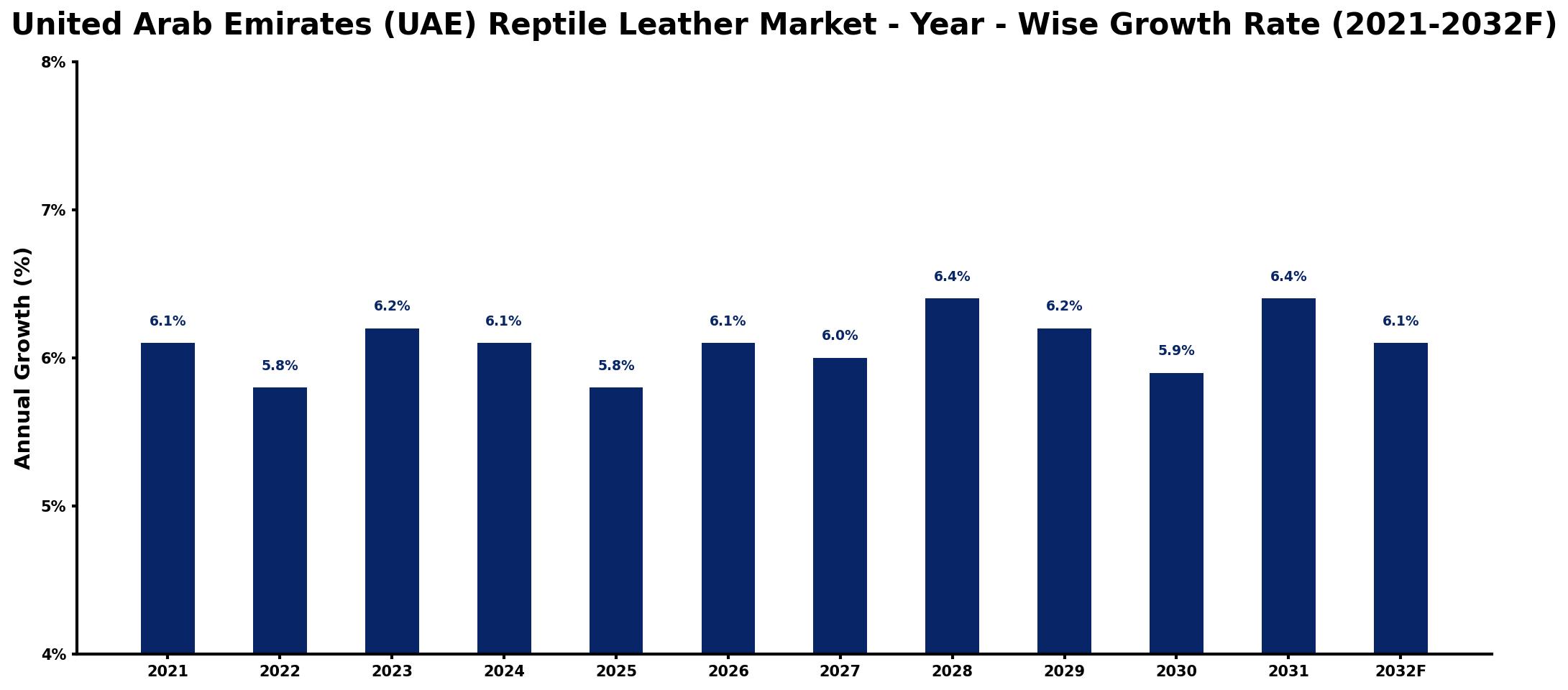
The table below presents the year‑wise growth rates along with the key drivers influencing the market
| Year | Growth Rate | Major Drivers |
| 2021 | 6.1% | Luxury fashion trend adoption rises |
| 2022 | 5.8% | Increased investment in sustainable sourcing |
| 2023 | 6.2% | Growing demand from high-end markets |
| 2024 | 6.1% | Expansion of custom design services |
| 2025 | 5.8% | Emergence of online retail platforms |
| 2026 | 6.1% | Rising interest in exotic materials |
| 2027 | 6.0% | Strengthening of global trade relationships |
| 2028 | 6.4% | Increased consumer awareness of exclusivity |
| 2029 | 6.2% | Development of innovative production techniques |
| 2030 | 5.9% | Enhanced marketing strategies attract buyers |
| 2031 | 6.4% | Collaboration with luxury brands grows |
| 2032 | 6.1% | Focus on eco-friendly production methods |
Note: Market size estimations and growth projections presented in this report are based on 6Wresearch's proprietary forecasting methodology, utilizing the latest available industry data, government publications, and primary research inputs.
United Arab Emirates (UAE) Reptile Leather Market Synopsis
In the UAE, the reptile leather market has established a niche within the luxury fashion sector, characterized by an exclusive clientele who prioritize craftsmanship and unique materials. High-end fashion designers are increasingly incorporating crocodile and snake skins into their collections, reinforcing the appeal of these products among affluent consumers.
The market is also notable for its artisanal craftsmanship, with skilled artisans devoted to creating luxurious and durable items. This commitment to quality not only attracts discerning consumers but also sets the standard for excellence in reptile leather production throughout the region.
United Arab Emirates (UAE) Reptile Leather Market Key Takeaways
- The market is witnessing steady growth, driven by increasing luxury consumption.
- Reptile leather products are popular among high-end fashion designers, boosting demand.
- Ethical sourcing and sustainability are crucial focus areas for market players.
- The UAE's affluent consumer base shows a clear preference for unique and exotic materials.
- Artisanal craftsmanship remains a cornerstone of the reptile leather offerings.
Evaluation of Restraints in United Arab Emirates (UAE) Reptile Leather Market
The UAE reptile leather market faces significant challenges primarily related to sustainability and ethical sourcing. Growing global concern for animal welfare demands stringent adherence to sourcing guidelines. Companies are increasingly pressured to maintain transparency in their supply chains, which adds layers of complexity and cost. As consumer awareness rises, failure to address these ethical considerations may hinder market growth and damage brand reputations.
United Arab Emirates (UAE) Reptile Leather Market Trends
Notable trends shaping the UAE reptile leather market include a strong shift towards sustainable practices. Brands are exploring innovative methods to ensure their leather is sourced responsibly. Additionally, theres an increasing demand for limited edition collections and bespoke items, which cater to the elite consumers desire for exclusivity. The intersection of technology and craftsmanship is also emerging, with advances in design tools enhancing the creative process.
United Arab Emirates (UAE) Reptile Leather Market Opportunities
Investors and stakeholders in the UAE reptile leather market can capitalize on several growth opportunities. The luxury sector is expanding rapidly, with potential for product diversification into menswear and home décor. Collaborations between luxury brands and innovative designers may unlock fresh avenues for product development. Furthermore, increasing tourism in the region represents a chance to broaden consumer exposure to exotic leather goods.
Government Initiatives in the United Arab Emirates (UAE) Reptile Leather Market
The UAE government is actively promoting sustainable practices within its luxury sectors, including the reptile leather market. Various initiatives aim to enhance transparency and ethical sourcing in production processes. Additionally, programs designed to support artisanal craftsmanship are being implemented, encouraging skill development and preserving traditional techniques. These efforts create a favorable environment for businesses committed to sustainable luxury.
Future Insights of the United Arab Emirates (UAE) Reptile Leather Market
Looking ahead to 2026-2032, the UAE reptile leather market is positioned for robust growth. The combination of increasing disposable incomes and evolving consumer preferences toward luxury goods is likely to sustain market expansion. Additionally, ongoing commitment to sustainability will increasingly resonate with consumers, solidifying the market's foundation for ethical luxury. As global fashion trends evolve, the ability to innovate while respecting conservation efforts will define the success of stakeholders in this sector.
United Arab Emirates (UAE) Reptile Leather Market Latest Developments (2025 - 2026)
Recent developments in the UAE reptile leather market indicate a growing emphasis on sustainable practices and ethical sourcing. Leading brands are increasingly adopting eco-friendly methods and seeking to establish certifications that reassure consumers about their ethical commitments. Additionally, innovations in design technology are enabling brands to offer unique, customizable products, heightening competition in the luxury segment. The market is also witnessing an influx of collaborations among fashion houses, enhancing the visibility and appeal of reptile leather items.
United Arab Emirates (UAE) Reptile Leather Market - Key Attractiveness of the Report
- 10 Years of Market Numbers
- Historical Data Starting from 2022 to 2025
- Base Year: 2025
- Forecast Data until 2032
- Key Performance Indicators Impacting the Market
- Major Upcoming Developments and Projects
Key Highlights of the Report:
- United Arab Emirates (UAE) Reptile Leather Market Outlook
- Market Size of United Arab Emirates (UAE) Reptile Leather Market, 2025
- Forecast of United Arab Emirates (UAE) Reptile Leather Market, 2032
- Historical Data and Forecast of United Arab Emirates (UAE) Reptile Leather Revenues & Volume for the Period 2022-2032F
- United Arab Emirates (UAE) Reptile Leather Market Trend Evolution
- United Arab Emirates (UAE) Reptile Leather Market Drivers and Challenges
- United Arab Emirates (UAE) Reptile Leather Price Trends
- United Arab Emirates (UAE) Reptile Leather Porter's Five Forces
- United Arab Emirates (UAE) Reptile Leather Industry Life Cycle
- Historical Data and Forecast of United Arab Emirates (UAE) Reptile Leather Market Revenues & Volume By Distribution Channels for the Period 2022-2032F
- Historical Data and Forecast of United Arab Emirates (UAE) Reptile Leather Market Revenues & Volume By Online stores for the Period 2022-2032F
- Historical Data and Forecast of United Arab Emirates (UAE) Reptile Leather Market Revenues & Volume By Retail stores for the Period 2022-2032F
- United Arab Emirates (UAE) Reptile Leather Import Export Trade Statistics
- Market Opportunity Assessment By Distribution Channels
- United Arab Emirates (UAE) Reptile Leather Top Companies Market Share
- United Arab Emirates (UAE) Reptile Leather Competitive Benchmarking By Technical and Operational Parameters
- United Arab Emirates (UAE) Reptile Leather Company Profiles
- United Arab Emirates (UAE) Reptile Leather Key Strategic Recommendations






































