United Arab Emirates (UAE) Retail Industry Market Size, Share & Growth Rate
The United Arab Emirates (UAE) Retail Industry Market was estimated at USD 959 Million in 2025 and is projected to reach USD 1617 Million by 2032, growing at a CAGR of 7.7% from 2026 to 2032. This upward trajectory is underpinned by the UAE's strong economic foundation, characterized by high disposable incomes and a thriving business environment. The dynamic consumer landscape, enhanced by a diverse expatriate population, continues to propel spending and shape market trends.
United Arab Emirates (UAE) Retail Industry Market Year-wise Growth Rate and Key Drivers
This graph highlights how the United Arab Emirates (UAE) Retail Industry Market has steadily grown over the years, supported by major growth factors.
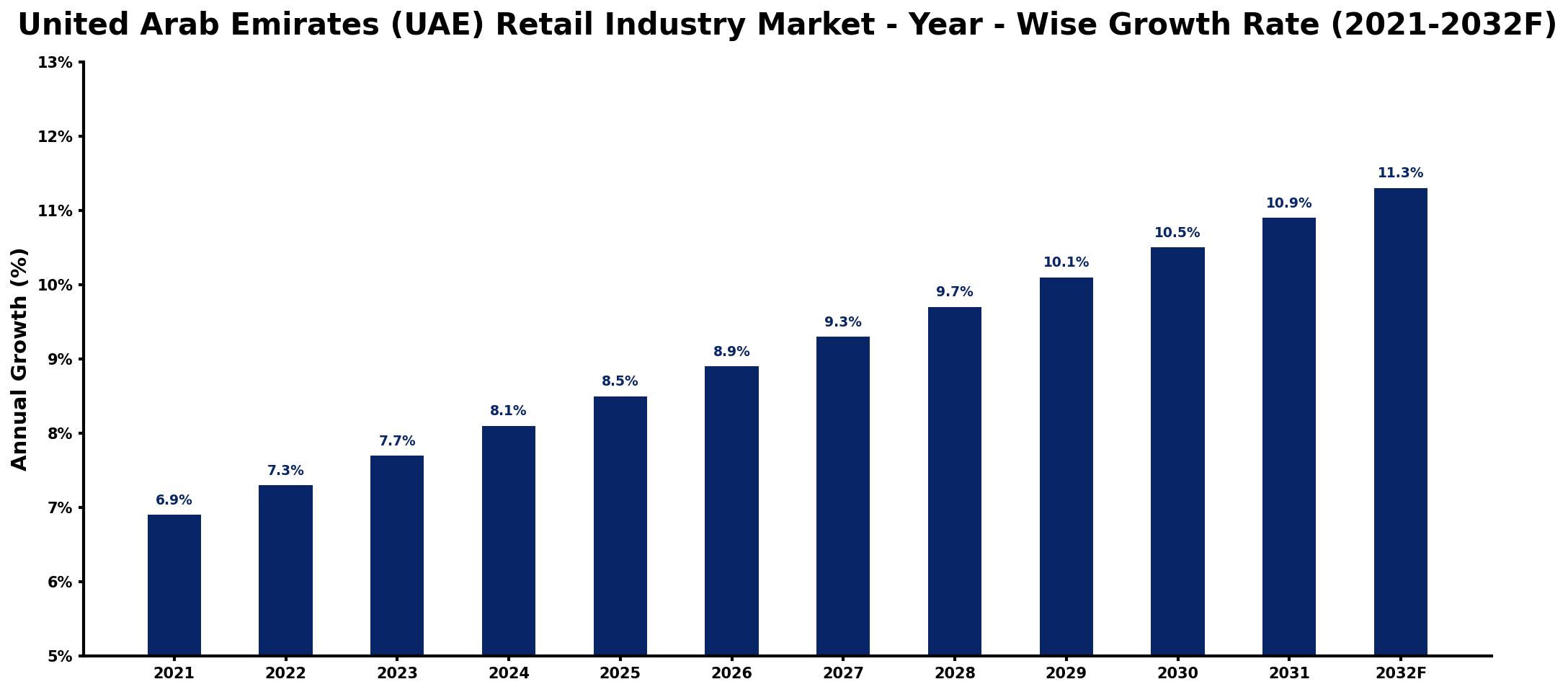
The table below presents the year‑wise growth rates along with the key drivers influencing the market
| Year | Growth Rate | Major Drivers |
| 2021 | 6.9% | Rise in consumer spending habits |
| 2022 | 7.3% | Growth of online shopping platforms |
| 2023 | 7.7% | Increased tourism and travel activities |
| 2024 | 8.1% | Expansion of luxury brands presence |
| 2025 | 8.5% | Emergence of new shopping centers |
| 2026 | 8.9% | Boost in e-commerce logistics solutions |
| 2027 | 9.3% | Adoption of sustainable shopping practices |
| 2028 | 9.7% | Increase in disposable income levels |
| 2029 | 10.1% | growing regional consumption patterns |
| 2030 | 10.5% | Enhancement of customer experience initiatives |
| 2031 | 10.9% | Growth in population and demographics |
| 2032 | 11.3% | Rise of experiential shopping trends |
Note: Market size estimations and growth projections presented in this report are based on 6Wresearch's proprietary forecasting methodology, utilizing the latest available industry data, government publications, and primary research inputs.
United Arab Emirates (UAE) Retail Industry Market Synopsis
The retail landscape in the UAE is marked by luxury and innovation, showcasing an array of shopping experiences from extravagant malls to traditional souks. This vibrant environment not only reflects the nations affluence but also caters to a wide range of consumer preferences, reinforcing its status as a retail hub in the Middle East.
As a key player in the regions retail sector, the UAE has cultivated a marketplace that thrives on both global and local brands. Retailers are increasingly adopting technology and enhancing their omnichannel strategies to meet the evolving expectations of their consumers, especially in the wake of digital acceleration driven by the COVID-19 pandemic.
United Arab Emirates (UAE) Retail Industry Market Key Takeaways
- The retail sector in the UAE is characterized by a blend of luxury and diverse consumer offerings.
- High disposable incomes and a cosmopolitan demographic contribute significantly to market growth.
- E-commerce is rapidly reshaping consumer behaviors and retail strategies.
- The post-pandemic recovery is marked by a strong focus on digital transformation and sustainability.
- Major local players are adapting to enhance consumer experiences amid changing market dynamics.
Evaluation of Restraints in United Arab Emirates (UAE) Retail Industry Market
Despite its robust growth, the UAE retail industry faces certain restraints. The growing competition from e-commerce platforms presents a significant challenge, as traditional retail players navigate shifts in consumer preferences toward online shopping. Additionally, economic fluctuations can influence consumer spending patterns, prompting retailers to adapt strategically. The imperative for sustainability is becoming increasingly important, pushing retailers to innovate and improve their operational practices.
United Arab Emirates (UAE) Retail Industry Market Trends
The retail landscape in the UAE is evolving rapidly, influenced by several key trends. Digital transformation is at the forefront, with retailers investing heavily in their online platforms to create seamless shopping experiences. Personalization and targeted marketing strategies are increasingly important as brands seek to engage their diverse consumer base. Additionally, sustainability initiatives are gaining traction, with consumers gravitating toward brands that prioritize eco-friendly practices. Enhanced omnichannel strategies are becoming essential, blending in-store experiences with digital solutions.
United Arab Emirates (UAE) Retail Industry Market Opportunities
There are significant growth and investment opportunities within the UAE retail market. The rise in e-commerce offers a gateway for both established and emerging brands to capture a larger market share. Additionally, as consumers become more health-conscious, there is an increasing demand for organic and health-oriented products. The potential for tech-driven retail solutions, including AR and VR shopping experiences, presents exciting avenues for differentiation and customer engagement in the coming years.
Government Initiatives in the United Arab Emirates (UAE) Retail Industry Market
The UAE government has introduced various initiatives aimed at bolstering the retail sector. These include incentives for innovation and technology adoption, as well as support for small and medium-sized enterprises (SMEs) in the retail space. Public spending on infrastructure improvements enhances the shopping experience and accessibility, while regulatory frameworks promote foreign investment, enabling a more competitive market environment.
Future Insights of the United Arab Emirates (UAE) Retail Industry Market
Looking ahead to 2026-2032, the UAE retail industry is poised for continued expansion driven by evolving consumer trends and technological advancements. The emphasis on omnichannel retail will further transform the shopping experience, while the integration of advanced analytics will allow retailers to tailor offerings more effectively. As sustainability becomes a core focus, businesses that adapt to these changing dynamics are likely to thrive in this competitive landscape.
United Arab Emirates (UAE) Retail Industry Market Latest Developments (2025 - 2026)
Recent developments in the UAE retail industry indicate a strong push towards digital integration and customer experience enhancement. Many retailers are actively exploring partnerships with tech firms to implement innovative solutions, improving both online and offline shopping environments. There is also a noticeable trend towards community engagement, with retailers hosting events and local collaborations to strengthen brand loyalty and connect with consumers on a more personal level.
United Arab Emirates (UAE) Retail Industry Market - Key Attractiveness of the Report
- 10 Years of Market Numbers
- Historical Data Starting from 2022 to 2025
- Base Year: 2025
- Forecast Data until 2032
- Key Performance Indicators Impacting the Market
- Major Upcoming Developments and Projects
Key Highlights of the Report:
- United Arab Emirates (UAE) Retail Industry Market Outlook
- Market Size of United Arab Emirates (UAE) Retail Industry Market, 2025
- Forecast of United Arab Emirates (UAE) Retail Industry Market, 2032
- Historical Data and Forecast of United Arab Emirates (UAE) Retail Industry Revenues & Volume for the Period 2022-2032F
- United Arab Emirates (UAE) Retail Industry Market Trend Evolution
- United Arab Emirates (UAE) Retail Industry Market Drivers and Challenges
- United Arab Emirates (UAE) Retail Industry Price Trends
- United Arab Emirates (UAE) Retail Industry Porter's Five Forces
- United Arab Emirates (UAE) Retail Industry Industry Life Cycle
- Historical Data and Forecast of United Arab Emirates (UAE) Retail Industry Market Revenues & Volume By Product for the Period 2022-2032F
- Historical Data and Forecast of United Arab Emirates (UAE) Retail Industry Market Revenues & Volume By Food and Beverages for the Period 2022-2032F
- Historical Data and Forecast of United Arab Emirates (UAE) Retail Industry Market Revenues & Volume By Personal and Household Care for the Period 2022-2032F
- Historical Data and Forecast of United Arab Emirates (UAE) Retail Industry Market Revenues & Volume By Apparel, Footwear, and Accessories for the Period 2022-2032F
- Historical Data and Forecast of United Arab Emirates (UAE) Retail Industry Market Revenues & Volume By Furniture, Toys, and Hobby for the Period 2022-2032F
- Historical Data and Forecast of United Arab Emirates (UAE) Retail Industry Market Revenues & Volume By Electronic and Household Appliances for the Period 2022-2032F
- Historical Data and Forecast of United Arab Emirates (UAE) Retail Industry Market Revenues & Volume By Other Products for the Period 2022-2032F
- Historical Data and Forecast of United Arab Emirates (UAE) Retail Industry Market Revenues & Volume By Distribution Channel for the Period 2022-2032F
- Historical Data and Forecast of United Arab Emirates (UAE) Retail Industry Market Revenues & Volume By Supermarkets/Hypermarkets for the Period 2022-2032F
- Historical Data and Forecast of United Arab Emirates (UAE) Retail Industry Market Revenues & Volume By Convenience Stores for the Period 2022-2032F
- Historical Data and Forecast of United Arab Emirates (UAE) Retail Industry Market Revenues & Volume By Department Stores for the Period 2022-2032F
- Historical Data and Forecast of United Arab Emirates (UAE) Retail Industry Market Revenues & Volume By Specialty Stores for the Period 2022-2032F
- Historical Data and Forecast of United Arab Emirates (UAE) Retail Industry Market Revenues & Volume By Online for the Period 2022-2032F
- Historical Data and Forecast of United Arab Emirates (UAE) Retail Industry Market Revenues & Volume By Other Distribution Channels for the Period 2022-2032F
- United Arab Emirates (UAE) Retail Industry Import Export Trade Statistics
- Market Opportunity Assessment By Product
- Market Opportunity Assessment By Distribution Channel
- United Arab Emirates (UAE) Retail Industry Top Companies Market Share
- United Arab Emirates (UAE) Retail Industry Competitive Benchmarking By Technical and Operational Parameters
- United Arab Emirates (UAE) Retail Industry Company Profiles
- United Arab Emirates (UAE) Retail Industry Key Strategic Recommendations






































