United Arab Emirates (UAE) Rolling Mill Components and Ancillary Equipment Market Size, Share & Growth Rate
The United Arab Emirates (UAE) Rolling Mill Components and Ancillary Equipment Market was estimated at USD 236 Million in 2025 and is projected to reach USD 320 Million by 2032, growing at a CAGR of 4.4% from 2026 to 2032. This growth trajectory is driven primarily by the ongoing construction boom and significant infrastructure development in the UAE, which has spurred an increased demand for high-quality steel and metal products. As the country progresses towards diversifying its economy and investing in advanced manufacturing technologies, the requirement for rolling mills and their components is anticipated to rise.
United Arab Emirates (UAE) Rolling Mill Components and Ancillary Equipment Market Year-wise Growth Rate and Key Drivers
This graph highlights how the United Arab Emirates (UAE) Rolling Mill Components and Ancillary Equipment Market has steadily grown over the years, supported by major growth factors.
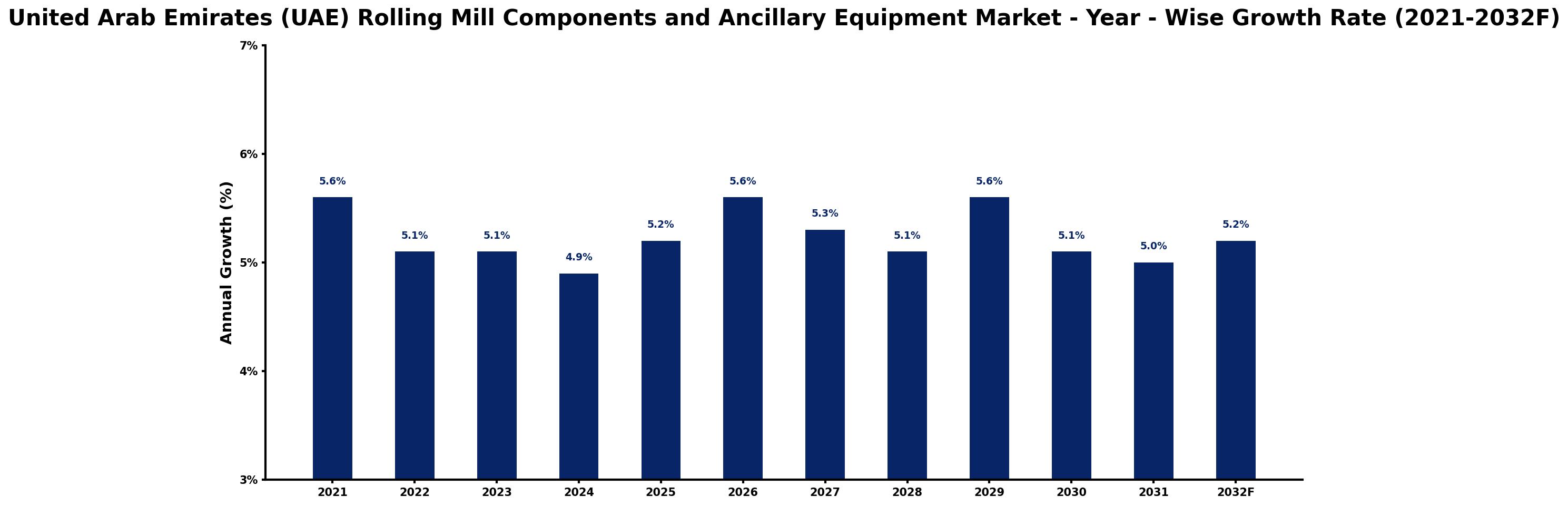
The table below presents the year‑wise growth rates along with the key drivers influencing the market
| Year | Growth Rate | Major Drivers |
| 2021 | 5.6% | Increased infrastructure development projects |
| 2022 | 5.1% | Rising demand for construction materials |
| 2023 | 5.1% | Expansion of manufacturing capabilities |
| 2024 | 4.9% | Growth in renewable energy investments |
| 2025 | 5.2% | Boost in automotive production rates |
| 2026 | 5.6% | Surge in regional construction activities |
| 2027 | 5.3% | Heightened focus on industrial automation |
| 2028 | 5.1% | Strengthened logistics and supply chains |
| 2029 | 5.6% | Increased foreign direct investments |
| 2030 | 5.1% | Growing urbanization and housing demand |
| 2031 | 5.0% | increased capital investment inflows |
| 2032 | 5.2% | Investment in advanced technologies |
Note: Market size estimations and growth projections presented in this report are based on 6Wresearch's proprietary forecasting methodology, utilizing the latest available industry data, government publications, and primary research inputs.
United Arab Emirates (UAE) Rolling Mill Components and Ancillary Equipment Market Synopsis
The UAE Rolling Mill Components and Ancillary Equipment Market has recently experienced a period of growth, bolstered by the vigorous momentum in the construction and manufacturing sectors. However, looking ahead, the market is poised for even greater expansion as ongoing and upcoming infrastructure projects enhance the demand for specialized steel products and rolling mill components.
While the market is recovering from the temporary setbacks caused by the COVID-19 pandemic, strategic government investments and an increase in private sector projects are expected to provide a solid foundation for future growth. The integration of advanced technologies into rolling mill operations will also redefine industry standards, setting the stage for continued innovation and efficiency.
United Arab Emirates (UAE) Rolling Mill Components and Ancillary Equipment Market Key Takeaways
- The market is projected to grow from USD 236 Million in 2025 to USD 320 Million by 2032.
- A surge in construction and infrastructure projects is driving demand for rolling mill components.
- Government investments in infrastructure are playing a crucial role in market growth.
- Technological advancements in automation and digitalization are shaping the future of the industry.
- The market is expected to recover from COVID-19 impacts, with strong growth opportunities on the horizon.
Evaluation of Restraints in United Arab Emirates (UAE) Rolling Mill Components and Ancillary Equipment Market
Despite its promising outlook, the UAE Rolling Mill Components and Ancillary Equipment Market faces certain restraints. A significant challenge is the urgent need for advanced automation and digitalization in manufacturing processes. Existing mill setups often lack compatibility with newer technologies, which raises concerns over the costs associated with upgrading equipment. Moreover, navigating the evolving industrial standards and regulatory requirements is critical for market participants, requiring them to maintain compliance while innovating their product offerings.
United Arab Emirates (UAE) Rolling Mill Components and Ancillary Equipment Market Trends
Several key trends are currently shaping the UAE Rolling Mill Components and Ancillary Equipment Market. Firstly, there is a marked shift towards incorporating smart technologies, including IoT and AI, to enhance operational efficiency and predictive maintenance. Secondly, sustainability initiatives are gaining traction, leading manufacturers to prioritize eco-friendly materials and processes. Lastly, the increasing customization of rolling mill components is reflecting the growing demand for specialized steel products tailored to specific applications.
United Arab Emirates (UAE) Rolling Mill Components and Ancillary Equipment Market Opportunities
Genuine growth opportunities lie primarily in the burgeoning infrastructure sector. As the UAE prepares to host major international events and enhance its urban landscapes, significant investments in both public and private construction projects are expected. This creates a fertile ground for rolling mill components, especially those that support advanced manufacturing processes. Additionally, the increasing focus on automation presents avenues for players to introduce innovative solutions that align with industry 4.0 trends.
Government Initiatives in the United Arab Emirates (UAE) Rolling Mill Components and Ancillary Equipment Market
The UAE government is actively promoting initiatives aimed at boosting the industrial sector, which in turn supports the Rolling Mill Components and Ancillary Equipment Market. Increased public spending on infrastructure development and regulatory frameworks designed to facilitate foreign investments are key aspects of this strategy. Furthermore, programs aimed at enhancing the overall manufacturing landscape, including training and skill development, are expected to bolster the availability of advanced technologies in rolling mill operations.
Future Insights of the United Arab Emirates (UAE) Rolling Mill Components and Ancillary Equipment Market
As we look towards 2026-2032, the UAE Rolling Mill Components and Ancillary Equipment Market is anticipated to continue its upward trajectory. The convergence of economic recovery post-COVID-19, coupled with robust governmental support for infrastructural growth, will likely create a stable environment for investment and innovation. The emphasis on sustainability and advanced manufacturing processes will further dictate the direction of market growth, ensuring that stakeholders remain competitive in a rapidly evolving industrial landscape.
United Arab Emirates (UAE) Rolling Mill Components and Ancillary Equipment Market Latest Developments (2025 - 2026)
Recent industry directions indicate a heightened focus on collaboration between manufacturers and technology providers to enhance production efficiency. Companies are increasingly investing in research and development to integrate smart technologies into rolling mill operations. Additionally, there is a growing interest in adopting sustainable practices that align with global environmental standards, driving product innovation and consumer demand.
United Arab Emirates (UAE) Rolling Mill Components and Ancillary Equipment Market - Key Attractiveness of the Report
- 10 Years of Market Numbers
- Historical Data Starting from 2022 to 2025
- Base Year: 2025
- Forecast Data until 2032
- Key Performance Indicators Impacting the Market
- Major Upcoming Developments and Projects
Key Highlights of the Report:
- United Arab Emirates (UAE) Rolling Mill Components and Ancillary Equipment Market Outlook
- Market Size of United Arab Emirates (UAE) Rolling Mill Components and Ancillary Equipment Market, 2025
- Forecast of United Arab Emirates (UAE) Rolling Mill Components and Ancillary Equipment Market, 2032
- Historical Data and Forecast of United Arab Emirates (UAE) Rolling Mill Components and Ancillary Equipment Revenues & Volume for the Period 2022-2032F
- United Arab Emirates (UAE) Rolling Mill Components and Ancillary Equipment Market Trend Evolution
- United Arab Emirates (UAE) Rolling Mill Components and Ancillary Equipment Market Drivers and Challenges
- United Arab Emirates (UAE) Rolling Mill Components and Ancillary Equipment Price Trends
- United Arab Emirates (UAE) Rolling Mill Components and Ancillary Equipment Porter's Five Forces
- United Arab Emirates (UAE) Rolling Mill Components and Ancillary Equipment Industry Life Cycle
- Historical Data and Forecast of United Arab Emirates (UAE) Rolling Mill Components and Ancillary Equipment Market Revenues & Volume By Product for the Period 2022-2032F
- Historical Data and Forecast of United Arab Emirates (UAE) Rolling Mill Components and Ancillary Equipment Market Revenues & Volume By Iron Rolls for the Period 2022-2032F
- Historical Data and Forecast of United Arab Emirates (UAE) Rolling Mill Components and Ancillary Equipment Market Revenues & Volume By Steel Rolls for the Period 2022-2032F
- Historical Data and Forecast of United Arab Emirates (UAE) Rolling Mill Components and Ancillary Equipment Market Revenues & Volume By Others for the Period 2022-2032F
- Historical Data and Forecast of United Arab Emirates (UAE) Rolling Mill Components and Ancillary Equipment Market Revenues & Volume By End User for the Period 2022-2032F
- Historical Data and Forecast of United Arab Emirates (UAE) Rolling Mill Components and Ancillary Equipment Market Revenues & Volume By Oil & Gas for the Period 2022-2032F
- Historical Data and Forecast of United Arab Emirates (UAE) Rolling Mill Components and Ancillary Equipment Market Revenues & Volume By Industrial for the Period 2022-2032F
- Historical Data and Forecast of United Arab Emirates (UAE) Rolling Mill Components and Ancillary Equipment Market Revenues & Volume By Automotive for the Period 2022-2032F
- Historical Data and Forecast of United Arab Emirates (UAE) Rolling Mill Components and Ancillary Equipment Market Revenues & Volume By Mining for the Period 2022-2032F
- Historical Data and Forecast of United Arab Emirates (UAE) Rolling Mill Components and Ancillary Equipment Market Revenues & Volume By Others for the Period 2022-2032F
- United Arab Emirates (UAE) Rolling Mill Components and Ancillary Equipment Import Export Trade Statistics
- Market Opportunity Assessment By Product
- Market Opportunity Assessment By End User
- United Arab Emirates (UAE) Rolling Mill Components and Ancillary Equipment Top Companies Market Share
- United Arab Emirates (UAE) Rolling Mill Components and Ancillary Equipment Competitive Benchmarking By Technical and Operational Parameters
- United Arab Emirates (UAE) Rolling Mill Components and Ancillary Equipment Company Profiles
- United Arab Emirates (UAE) Rolling Mill Components and Ancillary Equipment Key Strategic Recommendations






































