United Arab Emirates (UAE) Smart Building Market Size, Share & Growth Rate
The United Arab Emirates (UAE) Smart Building Market was estimated at USD 646 Million in 2025 and is projected to reach USD 1138 Million by 2032, growing at a CAGR of 8.4% from 2026 to 2032. This promising trajectory is underpinned by the UAEs commitment to sustainable urbanization and a burgeoning demand for intelligent infrastructure. Factors such as rapid urbanization, heightened energy efficiency awareness, and a robust push for integrated technology solutions are propelling the market forward.
United Arab Emirates (UAE) Smart Building Market Year-wise Growth Rate and Key Drivers
This graph highlights how the United Arab Emirates (UAE) Smart Building Market has steadily grown over the years, supported by major growth factors.
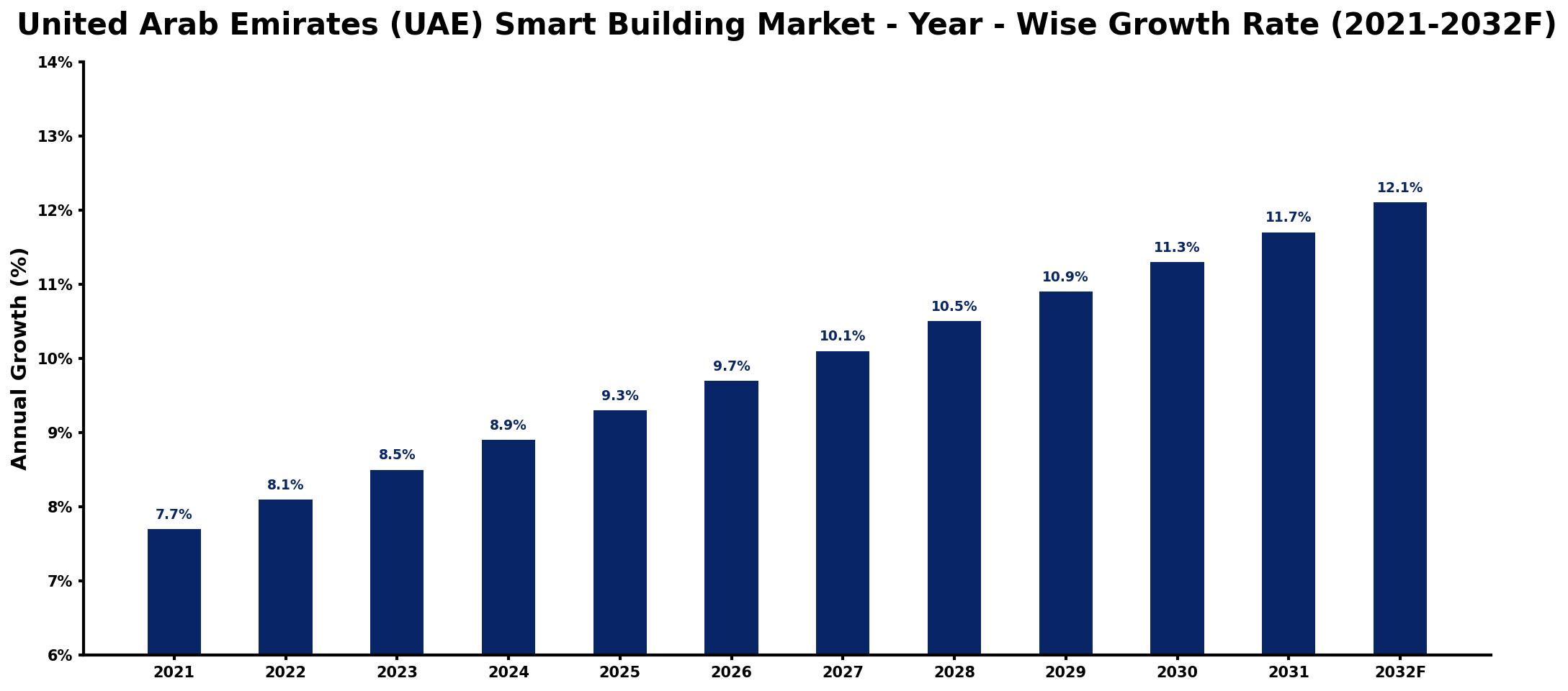
The table below presents the year‑wise growth rates along with the key drivers influencing the market
| Year | Growth Rate | Major Drivers |
| 2021 | 7.7% | increased focus on sustainability initiatives |
| 2022 | 8.1% | growing demand for energy efficiency |
| 2023 | 8.5% | rise in urbanization and infrastructure |
| 2024 | 8.9% | expansion of IoT technology adoption |
| 2025 | 9.3% | investments in renewable energy sources |
| 2026 | 9.7% | growing regulatory support for innovation |
| 2027 | 10.1% | increased public-private partnerships emerging |
| 2028 | 10.5% | enhanced connectivity in urban areas |
| 2029 | 10.9% | greater emphasis on occupant comfort |
| 2030 | 11.3% | surge in technological advancements available |
| 2031 | 11.7% | increased pharmaceutical industry usage |
| 2032 | 12.1% | growing emerging market penetration |
Note: Market size estimations and growth projections presented in this report are based on 6Wresearch's proprietary forecasting methodology, utilizing the latest available industry data, government publications, and primary research inputs.
United Arab Emirates (UAE) Smart Building Market Synopsis
In the UAE, the integration of smart technologies within building infrastructure is not merely an option but a necessity, influenced by government initiatives and increasing urban density. The market comprises diverse systems including automation, intelligent HVAC, and sophisticated security solutions, all designed to enhance energy efficiency and occupant comfort.
Moreover, the growing awareness among property developers regarding the long-term financial and environmental benefits of adopting smart building technologies is driving investments across the region. As a result, the smart building landscape in the UAE is rapidly evolving, marked by innovation and a competitive edge.
United Arab Emirates (UAE) Smart Building Market Key Takeaways
- The market is projected to experience significant growth, fueled by government initiatives for smart urban development.
- Increased emphasis on energy efficiency and occupant well-being is driving the adoption of intelligent building systems.
- The integration of IoT devices is becoming standard practice in both new constructions and retrofits across the UAE.
- Stakeholders face challenges regarding system interoperability and data security as they implement advanced technologies.
- Leading companies are innovating to create tailored solutions, further enhancing market competitiveness.
Evaluation of Restraints in United Arab Emirates (UAE) Smart Building Market
Despite robust growth prospects, the UAE smart building market faces notable challenges. One of the primary constraints is the complexity involved in integrating various smart technologies into a cohesive system. As buildings incorporate advanced automation for HVAC, lighting, and security, ensuring compatibility and seamless communication between diverse platforms becomes increasingly intricate. Moreover, stakeholders must navigate data privacy concerns, as the collection and analysis of sensitive user information are fundamental to smart technologies. Balancing the advancement of convenience and security remains a significant challenge.
United Arab Emirates (UAE) Smart Building Market Trends
Current trends in the UAE smart building market reflect a strong inclination towards sustainable practices and enhanced user experiences. Technologies that support energy management, such as smart grids and renewable energy integration, are gaining traction. Furthermore, the rise of occupant-centric solutions, including personalized climate controls and advanced security systems, underscores a shift towards enhancing the quality of life in both residential and commercial spaces. These trends highlight a broader movement towards creating smart cities that prioritize efficiency and occupant satisfaction.
United Arab Emirates (UAE) Smart Building Market Opportunities
Opportunities for growth in the UAE smart building market are abundant, particularly as the government continues to invest in smart city initiatives. Expanding existing infrastructure with smart technologies presents significant potential for both public and private sector investment. Additionally, the rising demand for retrofitting older buildings to meet modern energy efficiency standards opens up avenues for companies specializing in smart upgrades. As the market matures, innovative solutions addressing occupant health and safety, along with energy-efficient practices, will attract further investments and collaborations.
Government Initiatives in the United Arab Emirates (UAE) Smart Building Market
The UAE government has launched several strategic initiatives aimed at promoting smart building technologies, underscoring its commitment to sustainable urban growth. Policies aimed at creating smart cities emphasize energy efficiency, integrated transport, and advanced infrastructure. Public funding is directed towards research and development of smart solutions, while various incentives are in place to encourage the adoption of energy-efficient systems. These initiatives reflect the government's proactive role in fostering innovation within the sector.
Future Insights of the United Arab Emirates (UAE) Smart Building Market
Looking ahead to the 2026-2032 period, the UAE smart building market is poised for significant transformation driven by technological innovation and policy support. As urbanization intensifies, the need for smart, sustainable solutions will become more critical. The integration of artificial intelligence and advanced analytics into building management systems is expected to optimize energy consumption and enhance security measures. Consequently, stakeholders who invest in these technologies will likely gain a competitive advantage, ensuring the UAE remains at the forefront of smart building development in the region.
United Arab Emirates (UAE) Smart Building Market Latest Developments (2025 - 2026)
Recent developments in the UAE smart building market have been characterized by a surge in innovative collaborations between technology firms and construction companies. New partnerships are being formed to develop integrated systems that enhance energy efficiency and user experience. Additionally, several high-profile projects aimed at creating smart urban environments are underway, reflecting the UAE's vision of a technologically advanced society. Stakeholders are increasingly focusing on sustainability practices, with projects incorporating renewable energy sources and smart technologies to optimize operational efficiency.
United Arab Emirates (UAE) Smart Building Market - Key Attractiveness of the Report
- 10 Years of Market Numbers
- Historical Data Starting from 2022 to 2025
- Base Year: 2025
- Forecast Data until 2032
- Key Performance Indicators Impacting the Market
- Major Upcoming Developments and Projects
Key Highlights of the Report:
- United Arab Emirates (UAE) Smart Building Market Outlook
- Market Size of United Arab Emirates (UAE) Smart Building Market, 2025
- Forecast of United Arab Emirates (UAE) Smart Building Market, 2032
- Historical Data and Forecast of United Arab Emirates (UAE) Smart Building Revenues & Volume for the Period 2022-2032F
- United Arab Emirates (UAE) Smart Building Market Trend Evolution
- United Arab Emirates (UAE) Smart Building Market Drivers and Challenges
- United Arab Emirates (UAE) Smart Building Price Trends
- United Arab Emirates (UAE) Smart Building Porter's Five Forces
- United Arab Emirates (UAE) Smart Building Industry Life Cycle
- Historical Data and Forecast of United Arab Emirates (UAE) Smart Building Market Revenues & Volume By Component for the Period 2022-2032F
- Historical Data and Forecast of United Arab Emirates (UAE) Smart Building Market Revenues & Volume By Solution for the Period 2022-2032F
- Historical Data and Forecast of United Arab Emirates (UAE) Smart Building Market Revenues & Volume By Services for the Period 2022-2032F
- Historical Data and Forecast of United Arab Emirates (UAE) Smart Building Market Revenues & Volume By Application for the Period 2022-2032F
- Historical Data and Forecast of United Arab Emirates (UAE) Smart Building Market Revenues & Volume By Residential for the Period 2022-2032F
- Historical Data and Forecast of United Arab Emirates (UAE) Smart Building Market Revenues & Volume By Commercial for the Period 2022-2032F
- United Arab Emirates (UAE) Smart Building Import Export Trade Statistics
- Market Opportunity Assessment By Component
- Market Opportunity Assessment By Application
- United Arab Emirates (UAE) Smart Building Top Companies Market Share
- United Arab Emirates (UAE) Smart Building Competitive Benchmarking By Technical and Operational Parameters
- United Arab Emirates (UAE) Smart Building Company Profiles
- United Arab Emirates (UAE) Smart Building Key Strategic Recommendations






































