United Arab Emirates (UAE) Sponge Iron Market Size, Share & Growth Rate
The United Arab Emirates (UAE) Sponge Iron Market was estimated at USD 418 Million in 2025 and is projected to reach USD 570 Million by 2032, growing at a CAGR of 4.5% from 2026 to 2032. This growth trajectory is largely driven by the expansion of the steel production capacity within the region, supported by burgeoning demands from construction and industrial sectors. As infrastructure projects continue to develop across the UAE, the need for high-quality sponge iron as a raw material in steelmaking becomes ever more critical.
United Arab Emirates (UAE) Sponge Iron Market Year-wise Growth Rate and Key Drivers
This graph highlights how the United Arab Emirates (UAE) Sponge Iron Market has steadily grown over the years, supported by major growth factors.
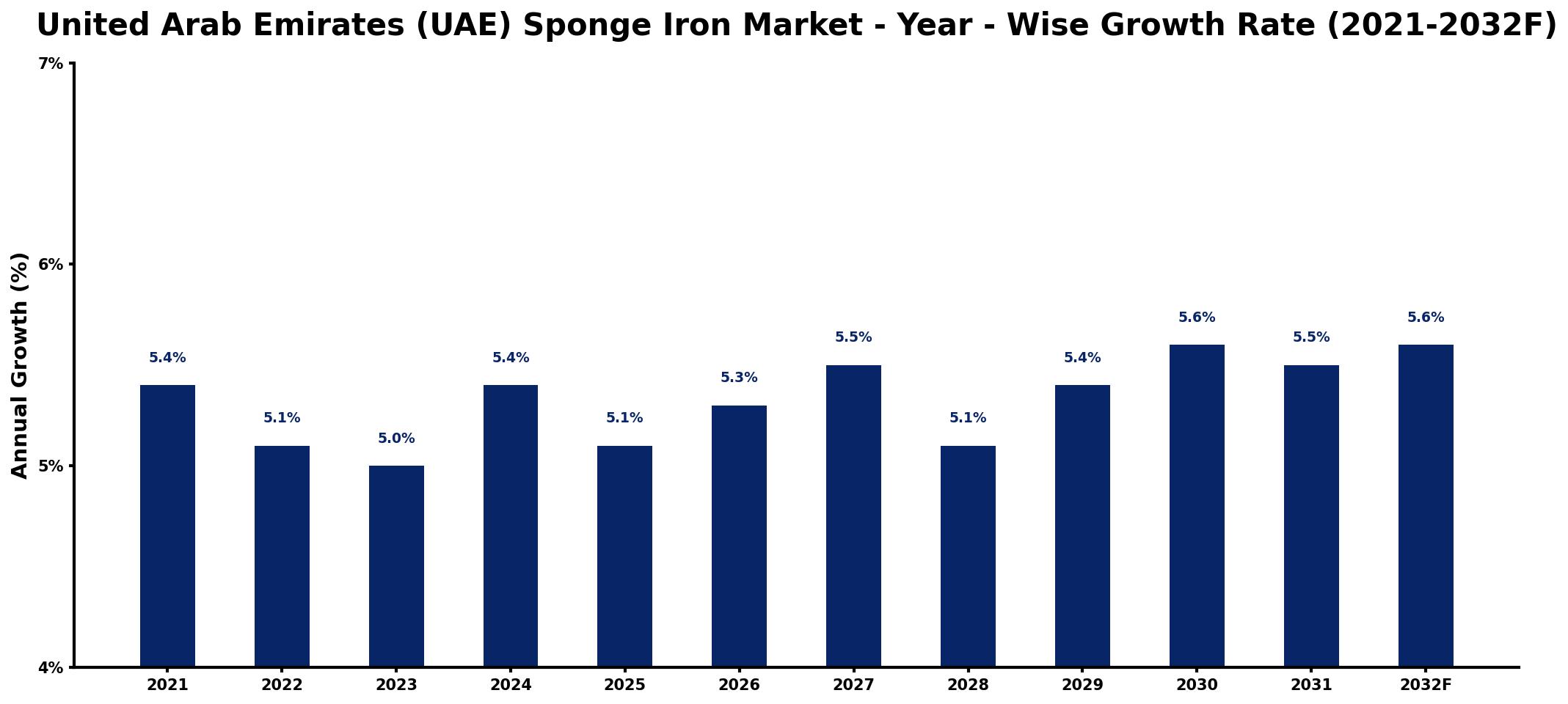
The table below presents the year‑wise growth rates along with the key drivers influencing the market
| Year | Growth Rate | Major Drivers |
| 2021 | 5.4% | Rising construction sector investments |
| 2022 | 5.1% | Increased demand from manufacturing |
| 2023 | 5.0% | Expansion of renewable energy projects |
| 2024 | 5.4% | Growth in infrastructure development |
| 2025 | 5.1% | Surge in automotive production needs |
| 2026 | 5.3% | Boost in real estate activities |
| 2027 | 5.5% | Growing demand for industrial applications |
| 2028 | 5.1% | Increased focus on sustainability initiatives |
| 2029 | 5.4% | Heightened investments in technology |
| 2030 | 5.6% | improved processing technologies adoption |
| 2031 | 5.5% | Rising urbanization and population growth |
| 2032 | 5.6% | Increased government infrastructure spending |
Note: Market size estimations and growth projections presented in this report are based on 6Wresearch's proprietary forecasting methodology, utilizing the latest available industry data, government publications, and primary research inputs.
United Arab Emirates (UAE) Sponge Iron Market Synopsis
The UAE sponge iron market has exhibited robust momentum, propelled by the flourishing steel industry that underpins various key sectors, including construction and automotive manufacturing. This growth, however, faces potential hurdles as global fluctuations in raw material prices and competition from alternative production methods pose challenges.
As the market evolves, there is a discernible shift towards more sustainable production practices and technological advancements. The adaptive nature of the UAE sponge iron industry, particularly during disruptions like the Covid-19 pandemic, has demonstrated resilience, indicating that the market is poised for further evolution in response to both domestic and international pressures.
United Arab Emirates (UAE) Sponge Iron Market Key Takeaways
- The sponge iron market is essential for meeting the UAEs growing steel production demands.
- Sustainable production methods are increasingly prioritized to align with global environmental standards.
- Technological innovations are critical for enhancing operational efficiency and reducing production costs.
- The competition from alternative iron production methods is driving market players to adapt and innovate.
- Infrastructure projects are significant drivers of demand, ensuring consistent growth in the sponge iron sector.
Evaluation of Restraints in United Arab Emirates (UAE) Sponge Iron Market
The UAE sponge iron market faces several restraints that impact its growth and stability. Primarily, the volatility in iron ore prices creates unpredictability in production costs, which can strain profit margins. Additionally, rising energy expenses further compound these challenges, making it essential for producers to implement effective cost-management strategies. The market must also contend with increasing competition from alternative iron-making processes, necessitating ongoing investments in technology to enhance efficiency and maintain a competitive edge.
United Arab Emirates (UAE) Sponge Iron Market Trends
The sponge iron market in the UAE is witnessing notable trends, particularly in the realm of sustainability and technological advancement. As environmental concerns gain prominence, there is a noticeable shift towards adopting cleaner production technologies that minimize carbon emissions. Furthermore, automation and data analytics are being integrated into operations, improving production efficiency and decision-making processes. The industry is also increasingly focusing on sourcing raw materials locally, which can help mitigate the risks associated with global supply chain disruptions.
United Arab Emirates (UAE) Sponge Iron Market Opportunities
Opportunities for growth within the UAE sponge iron market are abundant, particularly as the nation continues to invest heavily in infrastructure development. There is a unique chance for companies to explore collaborations in research and innovation, focusing on developing advanced production technologies. Additionally, the ongoing push for sustainable practices opens avenues for investment in green technologies that could enhance production capabilities while meeting international environmental standards. Companies that prioritize adaptability and innovation will likely find significant growth potential in this evolving market landscape.
Government Initiatives in the United Arab Emirates (UAE) Sponge Iron Market
The UAE government has introduced various initiatives aimed at bolstering the sponge iron market as part of its broader economic diversification strategy. Policies encouraging sustainable industrial practices and investments in infrastructure development align with the nation's goals for economic growth. Public spending on infrastructure projects not only provides immediate demand for sponge iron but also fosters an environment conducive to technological innovation and operational improvements within the industry.
Future Insights of the United Arab Emirates (UAE) Sponge Iron Market
Looking ahead to 2026-2032, the UAE sponge iron market is expected to grow steadily, driven by the dual forces of infrastructure expansion and technological innovation. As the regional economy continues to develop, the demand for steel will remain robust, ensuring a sustained need for sponge iron. Moreover, the emphasis on sustainable production methods will likely reshape competitive dynamics, prompting market players to adapt to changing consumer preferences and regulatory landscapes. The strategic positioning of companies willing to innovate will be crucial for capitalizing on emerging opportunities in the market.
United Arab Emirates (UAE) Sponge Iron Market Latest Developments (2025 - 2026)
Recent industry developments indicate a shift towards increased capacity in sponge iron production as companies look to meet the rising demand driven by infrastructure projects. Technological advancements, including the adoption of automation and improved quality control measures, have also been noted. Moreover, industry players are exploring partnerships to bolster R&D efforts focused on sustainable practices, aiming to enhance efficiency and environmental compliance.
United Arab Emirates (UAE) Sponge Iron Market - Key Attractiveness of the Report
- 10 Years of Market Numbers
- Historical Data Starting from 2022 to 2025
- Base Year: 2025
- Forecast Data until 2032
- Key Performance Indicators Impacting the Market
- Major Upcoming Developments and Projects
Key Highlights of the Report:
- United Arab Emirates (UAE) Sponge Iron Market Outlook
- Market Size of United Arab Emirates (UAE) Sponge Iron Market, 2025
- Forecast of United Arab Emirates (UAE) Sponge Iron Market, 2032
- Historical Data and Forecast of United Arab Emirates (UAE) Sponge Iron Revenues & Volume for the Period 2022-2032F
- United Arab Emirates (UAE) Sponge Iron Market Trend Evolution
- United Arab Emirates (UAE) Sponge Iron Market Drivers and Challenges
- United Arab Emirates (UAE) Sponge Iron Price Trends
- United Arab Emirates (UAE) Sponge Iron Porter's Five Forces
- United Arab Emirates (UAE) Sponge Iron Industry Life Cycle
- Historical Data and Forecast of United Arab Emirates (UAE) Sponge Iron Market Revenues & Volume By Types for the Period 2022-2032F
- Historical Data and Forecast of United Arab Emirates (UAE) Sponge Iron Market Revenues & Volume By Gas Based Technology for the Period 2022-2032F
- Historical Data and Forecast of United Arab Emirates (UAE) Sponge Iron Market Revenues & Volume By Coal-Based Technology for the Period 2022-2032F
- Historical Data and Forecast of United Arab Emirates (UAE) Sponge Iron Market Revenues & Volume By Applications for the Period 2022-2032F
- Historical Data and Forecast of United Arab Emirates (UAE) Sponge Iron Market Revenues & Volume By Metallurgical Industry for the Period 2022-2032F
- Historical Data and Forecast of United Arab Emirates (UAE) Sponge Iron Market Revenues & Volume By Steel Industry for the Period 2022-2032F
- Historical Data and Forecast of United Arab Emirates (UAE) Sponge Iron Market Revenues & Volume By Achitechive for the Period 2022-2032F
- Historical Data and Forecast of United Arab Emirates (UAE) Sponge Iron Market Revenues & Volume By Others for the Period 2022-2032F
- United Arab Emirates (UAE) Sponge Iron Import Export Trade Statistics
- Market Opportunity Assessment By Types
- Market Opportunity Assessment By Applications
- United Arab Emirates (UAE) Sponge Iron Top Companies Market Share
- United Arab Emirates (UAE) Sponge Iron Competitive Benchmarking By Technical and Operational Parameters
- United Arab Emirates (UAE) Sponge Iron Company Profiles
- United Arab Emirates (UAE) Sponge Iron Key Strategic Recommendations






































