United Arab Emirates (UAE) Spun Yarn Market Size, Share & Growth Rate
The United Arab Emirates (UAE) Spun Yarn Market was estimated at USD 473 Million in 2025 and is projected to reach USD 659 Million by 2032, growing at a CAGR of 4.9% from 2026 to 2032. This growth trajectory is largely driven by the increasing demand for high-quality textile products across various segments, including apparel and home textiles. The UAEs strategic location as a trade hub and its advanced manufacturing capabilities further enhance its competitive position within the global market.
United Arab Emirates (UAE) Spun Yarn Market Year-wise Growth Rate and Key Drivers
This graph highlights how the United Arab Emirates (UAE) Spun Yarn Market has steadily grown over the years, supported by major growth factors.
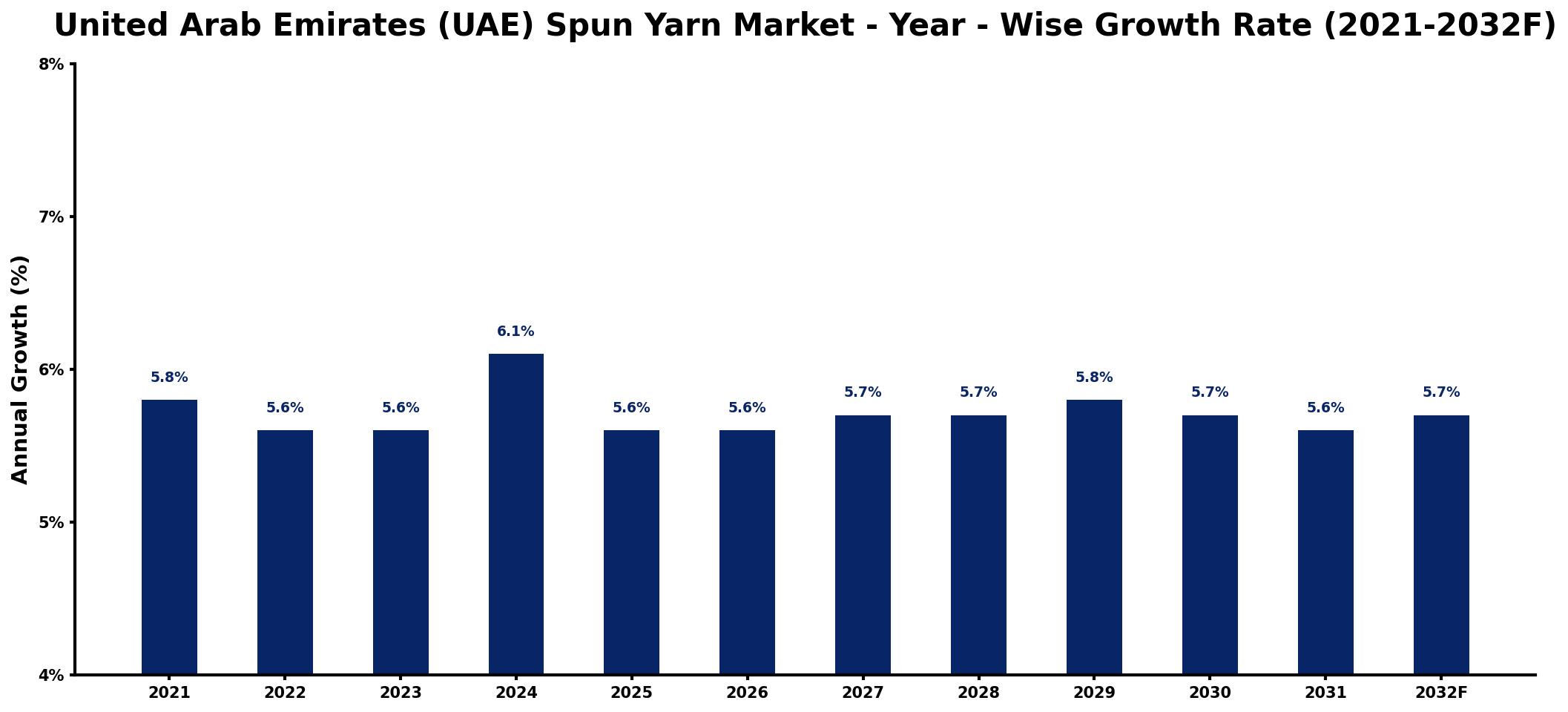
The table below presents the year‑wise growth rates along with the key drivers influencing the market
| Year | Growth Rate | Major Drivers |
| 2021 | 5.8% | Rise in textile manufacturing capacity |
| 2022 | 5.6% | Increased demand from fashion industry |
| 2023 | 5.6% | Growth in home textile sector |
| 2024 | 6.1% | Expansion of export markets |
| 2025 | 5.6% | Investment in sustainable practices |
| 2026 | 5.6% | Technological advancements in production |
| 2027 | 5.7% | Rising consumer preference for quality |
| 2028 | 5.7% | expanding industrial usage applications |
| 2029 | 5.8% | Increase in global trade agreements |
| 2030 | 5.7% | increased domestic production output |
| 2031 | 5.6% | Development of innovative materials |
| 2032 | 5.7% | Growing interest in eco-friendly products |
Note: Market size estimations and growth projections presented in this report are based on 6Wresearch's proprietary forecasting methodology, utilizing the latest available industry data, government publications, and primary research inputs.
United Arab Emirates (UAE) Spun Yarn Market Synopsis
Recent momentum in the UAE spun yarn market reflects a steady recovery from the disruptions caused by the pandemic. As the textile industry re-establishes itself, the demand for spun yarn continues to grow, highlighting its integral role in both domestic and international markets.
Looking forward, the market is poised for sustained growth, bolstered by innovations in production processes and a strong focus on sustainability. With increasing consumer awareness around quality and environmental impact, the market's direction is increasingly aligning with these emerging trends.
United Arab Emirates (UAE) Spun Yarn Market Key Takeaways
- The market is expected to witness a robust CAGR of 4.9% from 2026 to 2032.
- High-quality manufacturing standards are essential for maintaining competitive advantage.
- There is a significant shift towards e-commerce and online retail channels.
- The strategic location of the UAE enhances its role as a global trade hub.
- Adaptation to consumer preferences is crucial for sustaining market growth.
Evaluation of Restraints in United Arab Emirates (UAE) Spun Yarn Market
Despite the growth prospects, the UAE spun yarn market is hindered by challenges in maintaining quality control and consistency throughout the production process. Variations in yarn quality can lead to customer dissatisfaction, impacting brand loyalty and market competitiveness. Ensuring that raw materials adhere to stringent standards is vital, as is addressing the operational inefficiencies that can occur during the spinning phase.
United Arab Emirates (UAE) Spun Yarn Market Trends
Current trends shaping the UAE spun yarn market include a growing emphasis on sustainable practices and technological advancements in production. More manufacturers are investing in eco-friendly materials and processes to meet consumer expectations for sustainability. Furthermore, advancements in automation and smart manufacturing technologies are leading to improved efficiency and higher product quality.
United Arab Emirates (UAE) Spun Yarn Market Opportunities
The market presents substantial opportunities for investment, particularly in the realm of sustainable yarn production. As global consumers become more environmentally conscious, companies that prioritize green practices are likely to gain a competitive edge. Additionally, tapping into emerging markets and expanding product offerings can further drive growth.
Government Initiatives in the United Arab Emirates (UAE) Spun Yarn Market
The UAE government has been proactive in supporting the textile sector through various initiatives and policies aimed at fostering innovation and enhancing manufacturing capabilities. Public spending on infrastructure, along with incentives for adopting sustainable practices, is paving the way for a more robust spun yarn market. Such initiatives contribute to an environment conducive to growth and investment in the sector.
Future Insights of the United Arab Emirates (UAE) Spun Yarn Market
Looking ahead, the UAE spun yarn market is set to expand significantly between 2026 and 2032, fueled by a combination of technological innovations and increased consumer demand for high-quality textiles. The push towards sustainability will likely shape product development and consumer preferences, encouraging manufacturers to adapt swiftly to these trends. As the market evolves, the integration of digital technologies will also redefine operational efficiency and product offerings.
United Arab Emirates (UAE) Spun Yarn Market Latest Developments (2025 - 2026)
Recent developments in the UAE spun yarn market indicate a focus on enhancing production techniques and diversifying product ranges. Companies are actively exploring partnerships to improve supply chain efficiencies and expand their presence in international markets. Innovation in sustainable materials is also on the rise, aligning with global consumer demands for eco-friendly textile options.
United Arab Emirates (UAE) Spun Yarn Market - Key Attractiveness of the Report
- 10 Years of Market Numbers
- Historical Data Starting from 2022 to 2025
- Base Year: 2025
- Forecast Data until 2032
- Key Performance Indicators Impacting the Market
- Major Upcoming Developments and Projects
Key Highlights of the Report:
- United Arab Emirates (UAE) Spun Yarn Market Outlook
- Market Size of United Arab Emirates (UAE) Spun Yarn Market, 2025
- Forecast of United Arab Emirates (UAE) Spun Yarn Market, 2032
- Historical Data and Forecast of United Arab Emirates (UAE) Spun Yarn Revenues & Volume for the Period 2022-2032F
- United Arab Emirates (UAE) Spun Yarn Market Trend Evolution
- United Arab Emirates (UAE) Spun Yarn Market Drivers and Challenges
- United Arab Emirates (UAE) Spun Yarn Price Trends
- United Arab Emirates (UAE) Spun Yarn Porter's Five Forces
- United Arab Emirates (UAE) Spun Yarn Industry Life Cycle
- Historical Data and Forecast of United Arab Emirates (UAE) Spun Yarn Market Revenues & Volume By Application for the Period 2022-2032F
- Historical Data and Forecast of United Arab Emirates (UAE) Spun Yarn Market Revenues & Volume By Textile for the Period 2022-2032F
- Historical Data and Forecast of United Arab Emirates (UAE) Spun Yarn Market Revenues & Volume By Healthcare for the Period 2022-2032F
- Historical Data and Forecast of United Arab Emirates (UAE) Spun Yarn Market Revenues & Volume By Home Furnishing for the Period 2022-2032F
- Historical Data and Forecast of United Arab Emirates (UAE) Spun Yarn Market Revenues & Volume By Others for the Period 2022-2032F
- United Arab Emirates (UAE) Spun Yarn Import Export Trade Statistics
- Market Opportunity Assessment By Application
- United Arab Emirates (UAE) Spun Yarn Top Companies Market Share
- United Arab Emirates (UAE) Spun Yarn Competitive Benchmarking By Technical and Operational Parameters
- United Arab Emirates (UAE) Spun Yarn Company Profiles
- United Arab Emirates (UAE) Spun Yarn Key Strategic Recommendations






































