United Arab Emirates (UAE) Structural Steel Fabrication Market Size, Share & Growth Rate
The United Arab Emirates (UAE) Structural Steel Fabrication Market was estimated at USD 243 Million in 2025 and is projected to reach USD 332 Million by 2032, growing at a CAGR of 4.6% from 2026 to 2032. This anticipated growth trajectory can be attributed to a combination of robust construction activities and significant investments in infrastructure development. The UAEs commitment to ambitious architectural projects further stimulates demand for prefabricated and customized structural steel solutions.
United Arab Emirates (UAE) Structural Steel Fabrication Market Year-wise Growth Rate and Key Drivers
This graph highlights how the United Arab Emirates (UAE) Structural Steel Fabrication Market has steadily grown over the years, supported by major growth factors.
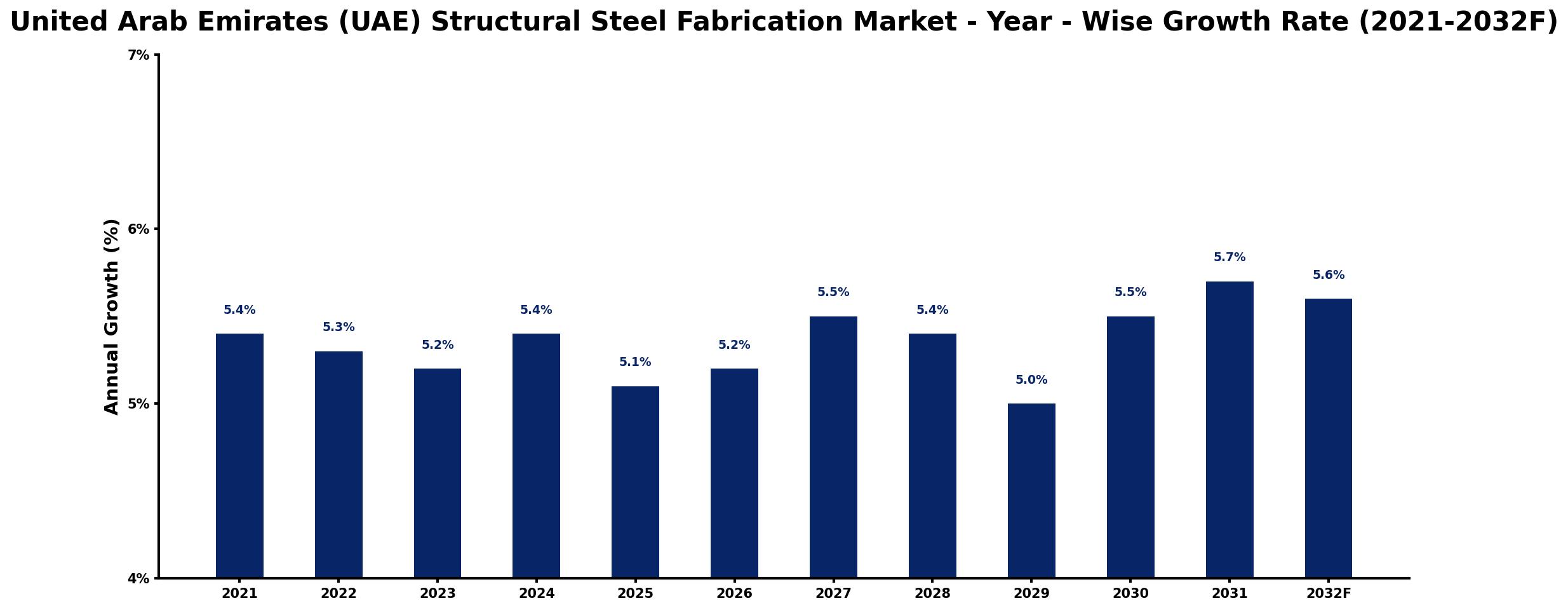
The table below presents the year‑wise growth rates along with the key drivers influencing the market
| Year | Growth Rate | Major Drivers |
| 2021 | 5.4% | Infrastructure projects drive demand surge |
| 2022 | 5.3% | Government initiatives boost construction growth |
| 2023 | 5.2% | Rising commercial projects increase investments |
| 2024 | 5.4% | Urbanization trends stimulate market activity |
| 2025 | 5.1% | Public sector projects enhance opportunities |
| 2026 | 5.2% | Sustainability initiatives foster new investments |
| 2027 | 5.5% | Technological advancements improve efficiency |
| 2028 | 5.4% | International collaborations expand market reach |
| 2029 | 5.0% | Residential developments drive sector expansion |
| 2030 | 5.5% | Tourism projects create new demands |
| 2031 | 5.7% | Renewable energy projects enhance investment |
| 2032 | 5.6% | Logistics infrastructure supports market growth |
Note: Market size estimations and growth projections presented in this report are based on 6Wresearch's proprietary forecasting methodology, utilizing the latest available industry data, government publications, and primary research inputs.
United Arab Emirates (UAE) Structural Steel Fabrication Market Synopsis
Recently, the UAE structural steel fabrication market has experienced remarkable momentum, bolstered by a dynamic construction landscape that prioritizes innovative design and rapid project delivery. Looking ahead, the market is poised for sustained growth, driven by the ongoing modernization efforts in both public and private sectors, which emphasize high-quality materials and advanced fabrication techniques.
The fusion of economic diversification initiatives with the infrastructural demands of the UAE's oil and gas sector presents a unique growth opportunity for structural steel fabricators. As projects evolve in complexity and scale, the need for specialized fabrication capabilities will become increasingly essential, marking a pivotal moment for industry players.
United Arab Emirates (UAE) Structural Steel Fabrication Market Key Takeaways
- The market is driven by escalating demand from construction and infrastructure sectors.
- Technological advancements in fabrication processes are enhancing operational efficiency.
- Custom and prefabricated steel components are increasingly preferred by architects and builders.
- Compliance with rigorous safety and quality standards remains a critical focus.
- Investments in the oil and gas industry continue to support market growth.
Evaluation of Restraints in United Arab Emirates (UAE) Structural Steel Fabrication Market
Despite its positive outlook, the UAE structural steel fabrication market faces notable challenges. Heightened competition has resulted in price pressures that can erode profit margins for fabricators. Moreover, adhering to the stringent safety and quality standards required for large-scale projects often necessitates significant resource allocation. Economic fluctuations, especially those affecting the construction timeline, could also present temporary setbacks in demand and revenue.
United Arab Emirates (UAE) Structural Steel Fabrication Market Trends
Key trends shaping the UAE structural steel fabrication market include the increased adoption of green building practices and sustainable materials. As environmental concerns gain traction, there is a growing emphasis on eco-friendly fabrication techniques. Furthermore, digital technologies, such as Building Information Modeling (BIM) and automation, are transforming fabrication processes, leading to improved precision and reduced waste. These innovations are becoming crucial differentiators for competitive firms.
United Arab Emirates (UAE) Structural Steel Fabrication Market Opportunities
The UAE structural steel fabrication market presents numerous growth and investment opportunities. The ongoing infrastructure initiatives, particularly in the realms of transportation and urban development, provide a fertile ground for expansion. Moreover, the anticipated growth in renewable energy projects will likely stimulate demand for robust steel structures, especially in solar and wind energy applications. Positioning for these emerging sectors could yield significant returns.
Government Initiatives in the United Arab Emirates (UAE) Structural Steel Fabrication Market
Government initiatives aimed at diversifying the economy and enhancing infrastructure play a crucial role in shaping the UAE structural steel fabrication market. National strategies focus on public spending for infrastructural projects and encourage private sector investment. Additionally, various programs promote sustainable construction practices, which, in turn, enhance demand for innovative structural steel solutions. The governments focus on creating a conducive business environment further supports industry growth.
Future Insights of the United Arab Emirates (UAE) Structural Steel Fabrication Market
Looking forward to the period between 2026 and 2032, the UAE structural steel fabrication market is set for significant advancements. As construction projects become increasingly ambitious, the demand for high-quality, custom-fabricated steel components is expected to rise. Coupled with ongoing technological improvements and a proactive regulatory framework, market participants are likely to find ample opportunities for innovation and growth, solidifying the UAE's position as a leader in the structural steel fabrication domain.
United Arab Emirates (UAE) Structural Steel Fabrication Market Latest Developments (2025 - 2026)
In recent months, the UAE structural steel fabrication market has seen a flurry of activity characterized by new technological partnerships and initiatives aimed at enhancing operational efficiencies. Several industry players are investing in automation and advanced manufacturing processes to increase output and reduce costs. Additionally, there has been a notable focus on sustainability, with companies adopting eco-friendly practices in their fabrication processes, aligning with national green initiatives.
United Arab Emirates (UAE) Structural Steel Fabrication Market - Key Attractiveness of the Report
- 10 Years of Market Numbers
- Historical Data Starting from 2022 to 2025
- Base Year: 2025
- Forecast Data until 2032
- Key Performance Indicators Impacting the Market
- Major Upcoming Developments and Projects
Key Highlights of the Report:
- United Arab Emirates (UAE) Structural Steel Fabrication Market Outlook
- Market Size of United Arab Emirates (UAE) Structural Steel Fabrication Market, 2025
- Forecast of United Arab Emirates (UAE) Structural Steel Fabrication Market, 2032
- Historical Data and Forecast of United Arab Emirates (UAE) Structural Steel Fabrication Revenues & Volume for the Period 2022-2032F
- United Arab Emirates (UAE) Structural Steel Fabrication Market Trend Evolution
- United Arab Emirates (UAE) Structural Steel Fabrication Market Drivers and Challenges
- United Arab Emirates (UAE) Structural Steel Fabrication Price Trends
- United Arab Emirates (UAE) Structural Steel Fabrication Porter's Five Forces
- United Arab Emirates (UAE) Structural Steel Fabrication Industry Life Cycle
- Historical Data and Forecast of United Arab Emirates (UAE) Structural Steel Fabrication Market Revenues & Volume By End-user Industry for the Period 2022-2032F
- Historical Data and Forecast of United Arab Emirates (UAE) Structural Steel Fabrication Market Revenues & Volume By Manufacturing for the Period 2022-2032F
- Historical Data and Forecast of United Arab Emirates (UAE) Structural Steel Fabrication Market Revenues & Volume By Power and Energy for the Period 2022-2032F
- Historical Data and Forecast of United Arab Emirates (UAE) Structural Steel Fabrication Market Revenues & Volume By Construction for the Period 2022-2032F
- Historical Data and Forecast of United Arab Emirates (UAE) Structural Steel Fabrication Market Revenues & Volume By Oil and Gas for the Period 2022-2032F
- Historical Data and Forecast of United Arab Emirates (UAE) Structural Steel Fabrication Market Revenues & Volume By Other for the Period 2022-2032F
- Historical Data and Forecast of United Arab Emirates (UAE) Structural Steel Fabrication Market Revenues & Volume By Product Type for the Period 2022-2032F
- Historical Data and Forecast of United Arab Emirates (UAE) Structural Steel Fabrication Market Revenues & Volume By Heavy Sectional Steel for the Period 2022-2032F
- Historical Data and Forecast of United Arab Emirates (UAE) Structural Steel Fabrication Market Revenues & Volume By Light Sectional Steel for the Period 2022-2032F
- Historical Data and Forecast of United Arab Emirates (UAE) Structural Steel Fabrication Market Revenues & Volume By Other for the Period 2022-2032F
- United Arab Emirates (UAE) Structural Steel Fabrication Import Export Trade Statistics
- Market Opportunity Assessment By End-user Industry
- Market Opportunity Assessment By Product Type
- United Arab Emirates (UAE) Structural Steel Fabrication Top Companies Market Share
- United Arab Emirates (UAE) Structural Steel Fabrication Competitive Benchmarking By Technical and Operational Parameters
- United Arab Emirates (UAE) Structural Steel Fabrication Company Profiles
- United Arab Emirates (UAE) Structural Steel Fabrication Key Strategic Recommendations






































