United Arab Emirates (UAE) Textile Felt Market Size, Share & Growth Rate
The United Arab Emirates (UAE) Textile Felt Market was estimated at USD 168 Million in 2025 and is projected to reach USD 226 Million by 2032, growing at a CAGR of 4.3% from 2026 to 2032. This upward trajectory is primarily driven by the nation's booming construction and automotive sectors, which increasingly utilize textile felts for insulation, soundproofing, and various automotive components. Furthermore, rising disposable incomes among consumers fuel the demand for high-quality textile products across multiple applications.
United Arab Emirates (UAE) Textile Felt Market Year-wise Growth Rate and Key Drivers
This graph highlights how the United Arab Emirates (UAE) Textile Felt Market has steadily grown over the years, supported by major growth factors.
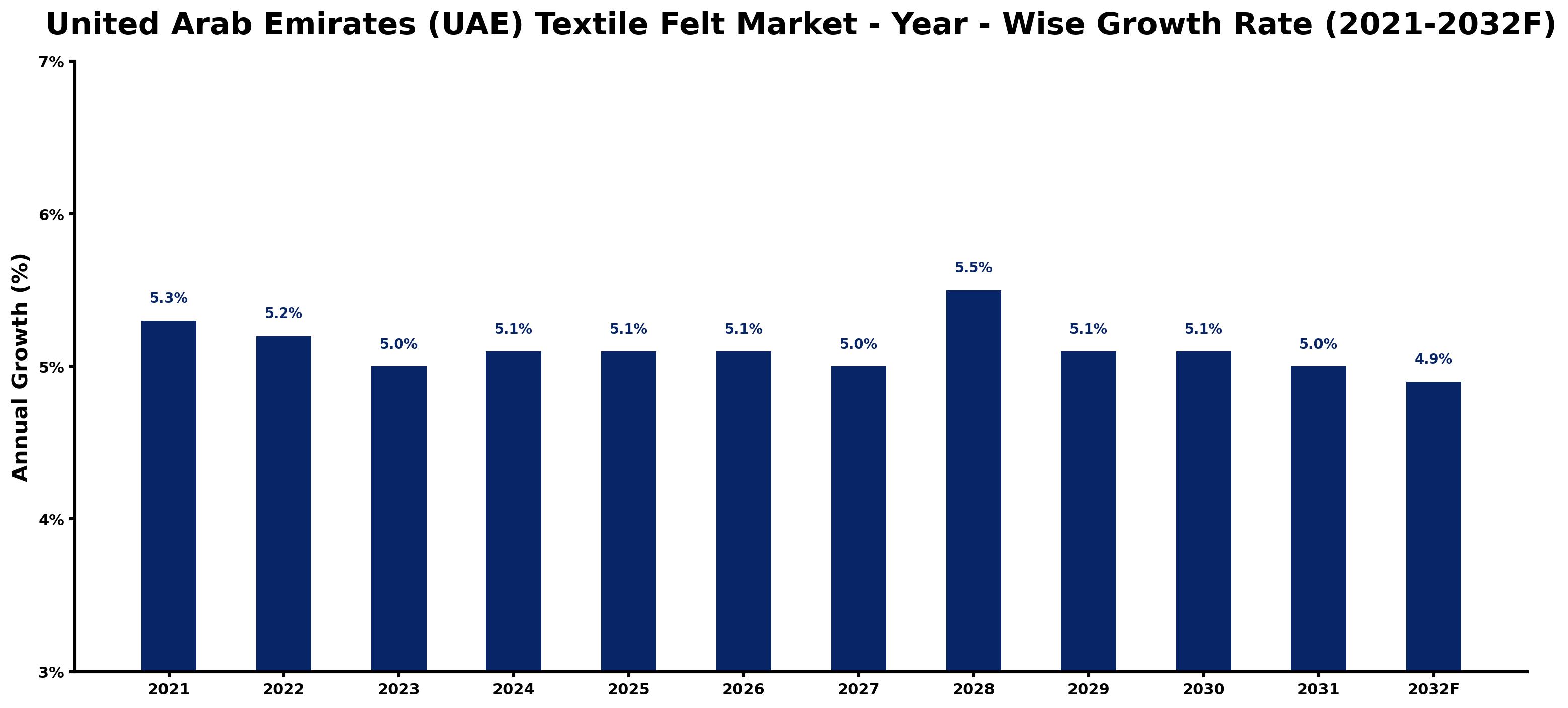
The table below presents the year‑wise growth rates along with the key drivers influencing the market
| Year | Growth Rate | Major Drivers |
| 2021 | 5.3% | Government infrastructure modernization initiatives |
| 2022 | 5.2% | Rising electricity demand across industries |
| 2023 | 5.0% | Increasing industrial infrastructure investments |
| 2024 | 5.1% | Expansion of transportation and logistics networks |
| 2025 | 5.1% | Expansion of commercial construction activities |
| 2026 | 5.1% | Increasing industrial automation investments |
| 2027 | 5.0% | Rising electricity demand across industries |
| 2028 | 5.5% | Increasing industrial infrastructure investments |
| 2029 | 5.1% | Increasing industrial automation investments |
| 2030 | 5.1% | Increasing smart city development projects |
| 2031 | 5.0% | Growing renewable energy integration projects |
| 2032 | 4.9% | Increasing smart city development projects |
Note - Market size estimations and growth projections presented in this report are based on 6Wresearch’s advanced forecasting approach, validated with industry datasets as of June 2026.
United Arab Emirates (UAE) Textile Felt Market Synopsis
The UAE textile felt market is at a transformative juncture, witnessing robust growth due to industrial advancements and urban development initiatives. An essential non-woven fabric, textile felt is utilized in a myriad of sectors, reflecting its versatility and adaptability to different needs.
As the construction industry continues to thrive, demand for textile felt in applications such as thermal insulation and acoustic management surges. Additionally, with the expansion of the automotive sector, manufacturers increasingly favor high-performance textile felts for vehicle interiors, thereby solidifying their importance in the market.
United Arab Emirates (UAE) Textile Felt Market Key Takeaways
- The market is experiencing steady growth driven by increasing industrial activities.
- Applications in construction and automotive sectors are primary demand drivers.
- Rising disposable incomes lead to higher consumption of quality textile products.
- Key market players are focused on innovation and high-quality production standards.
- Government initiatives are positively influencing infrastructure development and market expansion.
Evaluation of Restraints in United Arab Emirates (UAE) Textile Felt Market
Despite the promising growth prospects, the UAE textile felt market faces notable constraints. One of the primary concerns is the fluctuating costs of raw materials essential for manufacturing textile felt. As the industry heavily depends on both natural and synthetic fibers, any volatility in the pricing of these inputs can significantly affect profitability margins for manufacturers. Additionally, the emergence of alternative materials poses competitive pressure, while the need to adhere to stringent environmental regulations demands that companies adapt quickly, requiring investments in sustainable practices and technologies.
United Arab Emirates (UAE) Textile Felt Market Trends
Several trends are emerging that are poised to shape the future of the UAE textile felt market. Notably, there's an increasing emphasis on sustainability and eco-friendly manufacturing processes, driven by both consumer preference and regulatory pressures. Innovations in material science are also leading to the development of advanced textile felts with enhanced performance characteristics, such as improved durability and moisture resistance. Moreover, the digital transformation in production processes is streamlining operations and reducing costs, further driving market competitiveness.
United Arab Emirates (UAE) Textile Felt Market Opportunities
The UAE textile felt market presents significant growth and investment opportunities, particularly in sustainable product development. Companies that invest in eco-friendly manufacturing technologies are likely to gain a competitive edge. Furthermore, the ongoing expansion of the UAE's infrastructure sector provides ample avenues for textile felt applications, particularly in building materials and automotive components. There is also a growing trend toward customization in textile products, presenting an opportunity for manufacturers to cater to specific industry needs.
Government Initiatives in the United Arab Emirates (UAE) Textile Felt Market
The UAE government is actively supporting the textile felt market through various initiatives aimed at enhancing industrial capabilities and infrastructure. Public spending on large-scale construction projects is bolstering demand for textile felts across multiple sectors. Furthermore, the government's focus on promoting sustainability and environmentally friendly practices encourages investments in innovative technologies. These initiatives are creating a favorable business environment, enabling market players to thrive in an increasingly competitive landscape.
Future Insights of the United Arab Emirates (UAE) Textile Felt Market
Looking ahead to 2026-2032, the UAE textile felt market is poised for continued expansion driven by sustained industrial growth. As urbanization progresses, the demand for high-quality, functional textile products will likely increase across various sectors. Furthermore, the anticipated rise in government infrastructure projects and the automotive industry's evolution toward electric vehicles will create new opportunities for textile felt applications. Strategic partnerships and investments in technology will be essential for companies seeking to capitalize on the market's potential in the coming years.
United Arab Emirates (UAE) Textile Felt Market Latest Developments (May 2025 - June 2026)
Recent developments in the UAE textile felt market indicate a strong inclination toward innovation and quality enhancement. Companies are increasingly focusing on sustainability, integrating eco-friendly materials into their production processes. Moreover, the automotive sector is witnessing a surge in demand for specialized textile felts, highlighting the need for suppliers to diversify their product offerings. As market dynamics continue to evolve, manufacturers are also exploring digitalization to enhance operational efficiencies.
United Arab Emirates (UAE) Textile Felt Market - Key Attractiveness of the Report
- 10 Years of Market Numbers
- Historical Data Starting from 2022 to 2025
- Base Year: 2025
- Forecast Data until 2032
- Key Performance Indicators Impacting the Market
- Major Upcoming Developments and Projects
Key Highlights of the Report:
- United Arab Emirates (UAE) Textile Felt Market Outlook
- Market Size of United Arab Emirates (UAE) Textile Felt Market, 2025
- Forecast of United Arab Emirates (UAE) Textile Felt Market, 2032
- Historical Data and Forecast of United Arab Emirates (UAE) Textile Felt Revenues & Volume for the Period 2022-2032F
- United Arab Emirates (UAE) Textile Felt Market Trend Evolution
- United Arab Emirates (UAE) Textile Felt Market Drivers and Challenges
- United Arab Emirates (UAE) Textile Felt Price Trends
- United Arab Emirates (UAE) Textile Felt Porter's Five Forces
- United Arab Emirates (UAE) Textile Felt Industry Life Cycle
- Historical Data and Forecast of United Arab Emirates (UAE) Textile Felt Market Revenues & Volume By Raw Material for the Period 2022-2032F
- Historical Data and Forecast of United Arab Emirates (UAE) Textile Felt Market Revenues & Volume By Natural Raw Material for the Period 2022-2032F
- Historical Data and Forecast of United Arab Emirates (UAE) Textile Felt Market Revenues & Volume By Synthetic Raw Material for the Period 2022-2032F
- Historical Data and Forecast of United Arab Emirates (UAE) Textile Felt Market Revenues & Volume By Applications for the Period 2022-2032F
- Historical Data and Forecast of United Arab Emirates (UAE) Textile Felt Market Revenues & Volume By Clothing for the Period 2022-2032F
- Historical Data and Forecast of United Arab Emirates (UAE) Textile Felt Market Revenues & Volume By Footwear for the Period 2022-2032F
- Historical Data and Forecast of United Arab Emirates (UAE) Textile Felt Market Revenues & Volume By Rugs for the Period 2022-2032F
- Historical Data and Forecast of United Arab Emirates (UAE) Textile Felt Market Revenues & Volume By Tents for the Period 2022-2032F
- Historical Data and Forecast of United Arab Emirates (UAE) Textile Felt Market Revenues & Volume By Craft Projects for the Period 2022-2032F
- Historical Data and Forecast of United Arab Emirates (UAE) Textile Felt Market Revenues & Volume By Others for the Period 2022-2032F
- United Arab Emirates (UAE) Textile Felt Import Export Trade Statistics
- Market Opportunity Assessment By Raw Material
- Market Opportunity Assessment By Applications
- United Arab Emirates (UAE) Textile Felt Top Companies Market Share
- United Arab Emirates (UAE) Textile Felt Competitive Benchmarking By Technical and Operational Parameters
- United Arab Emirates (UAE) Textile Felt Company Profiles
- United Arab Emirates (UAE) Textile Felt Key Strategic Recommendations






































