United Arab Emirates (UAE) Watch Straps Market Size, Share & Growth Rate
The United Arab Emirates (UAE) Watch Straps Market was estimated at USD 345 Million in 2025 and is projected to reach USD 467 Million by 2032, growing at a CAGR of 4.4% from 2026 to 2032. This trajectory is fueled by an increasingly affluent population that prioritizes luxury accessories and personalization. Additionally, the burgeoning retail sector, particularly in urban areas, continues to elevate demand for stylish and high-quality watch straps that resonate with contemporary fashion trends.
United Arab Emirates (UAE) Watch Straps Market Year-wise Growth Rate and Key Drivers
This graph highlights how the United Arab Emirates (UAE) Watch Straps Market has steadily grown over the years, supported by major growth factors.
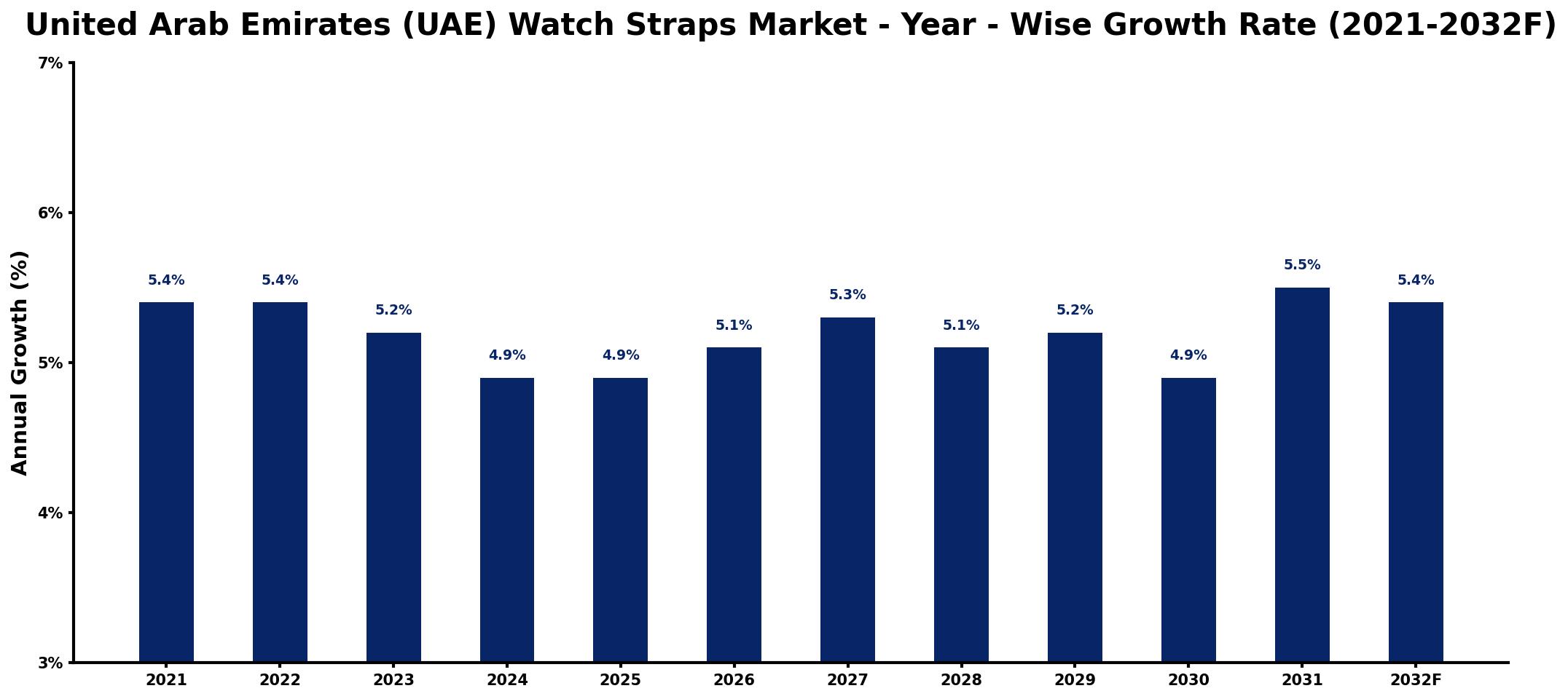
The table below presents the year‑wise growth rates along with the key drivers influencing the market
| Year | Growth Rate | Major Drivers |
| 2021 | 5.4% | Increased consumer disposable income |
| 2022 | 5.4% | Growing trend of personalization |
| 2023 | 5.2% | Rising demand for fashion accessories |
| 2024 | 4.9% | Expansion of online retail platforms |
| 2025 | 4.9% | Enhanced focus on sustainability initiatives |
| 2026 | 5.1% | Technological advancements in materials |
| 2027 | 5.3% | Surge in active lifestyle participation |
| 2028 | 5.1% | Growth of luxury segment investments |
| 2029 | 5.2% | Emergence of smart technology integration |
| 2030 | 4.9% | Boost in regional tourism activities |
| 2031 | 5.5% | Increase in gifting occasions popularity |
| 2032 | 5.4% | Development of innovative marketing strategies |
Note: Market size estimations and growth projections presented in this report are based on 6Wresearch's proprietary forecasting methodology, utilizing the latest available industry data, government publications, and primary research inputs.
United Arab Emirates (UAE) Watch Straps Market Synopsis
The primary force currently shaping the UAE watch straps market is the growing desire for personalization among consumers. As watch enthusiasts seek to express their individuality through their timepieces, the demand for diverse styles and materials has skyrocketed, creating a vibrant marketplace.
In addition to personalization, the market is significantly influenced by the UAE's cultural affinity for luxury and premium products. The combination of high disposable income and a sophisticated consumer base fuels the continuous evolution of watch strap designs, pushing brands to innovate and deliver products that meet the latest fashion standards.
United Arab Emirates (UAE) Watch Straps Market Key Takeaways
- The UAE watch straps market is experiencing robust growth driven by a fashion-conscious consumer base.
- Personalization and style diversity are key factors in consumer purchasing decisions.
- Quality and durability remain critical in maintaining customer loyalty and brand reputation.
- The market shows resilience post-COVID-19, with a steady return of consumer confidence.
- Government initiatives promoting luxury goods and retail innovation are expected to further enhance market dynamics.
Evaluation of Restraints in United Arab Emirates (UAE) Watch Straps Market
Despite the market's promising growth, challenges persist that may inhibit progress. Innovation in materials and designs is paramount, yet the industry's capacity to adapt can be constrained by the slow pace of research and development. Furthermore, consumer expectations for sustainability and ethical sourcing of materials are increasing, demanding that manufacturers invest in eco-friendly practices. Ensuring quality control in a competitive landscape adds to the complexity of market operations, necessitating rigorous standards and ongoing investment to maintain brand trust.
United Arab Emirates (UAE) Watch Straps Market Trends
Current trends in the UAE watch straps market indicate a rising preference for materials like leather, silicone, and metal, reflecting both luxury and practicality. Additionally, smartwatches are reshaping consumer perceptions, leading to an integration of technology within traditional watch strap designs. Customization options, such as interchangeable straps, are becoming increasingly popular, allowing consumers to switch styles according to occasion or mood. Eco-conscious products also garner attention as consumers seek brands that prioritize sustainability.
United Arab Emirates (UAE) Watch Straps Market Opportunities
The UAE watch straps market holds significant growth and investment opportunities, particularly in the realm of eco-friendly materials. Brands that can effectively harness sustainable production methods are likely to attract a growing segment of environmentally conscious consumers. Additionally, expanding e-commerce platforms present a chance for companies to reach a broader audience, enhancing visibility and sales potential. Collaborations with fashion designers and influencers can further bolster brand appeal in this competitive landscape.
Government Initiatives in the United Arab Emirates (UAE) Watch Straps Market
The UAE government has implemented various initiatives to promote luxury goods and bolster the retail sector, recognizing its impact on the economy. These initiatives include support for e-commerce growth, investment in retail infrastructure, and campaigns encouraging tourism, which often emphasizes luxury shopping experiences. Furthermore, sustainability initiatives are being encouraged to align with global trends, facilitating a more eco-conscious approach within the luxury accessories sector.
Future Insights of the United Arab Emirates (UAE) Watch Straps Market
Looking ahead to 2026-2032, the UAE watch straps market is poised for steady growth, driven by the dual forces of consumer demand for personalization and ongoing fashion innovations. As the market adapts to include more sustainable practices and technology integration, brands that successfully navigate these shifts are likely to thrive. Increased urbanization and high disposable incomes suggest that luxury accessories will continue to be an integral part of the UAE lifestyle, paving the way for continuous market expansion.
United Arab Emirates (UAE) Watch Straps Market Latest Developments (2025 - 2026)
Recent developments in the UAE watch straps market indicate a heightened focus on digital innovation and online sales channels. Brands are increasingly launching new collections tailored to the preferences of younger consumers, utilizing social media platforms for marketing. Collaborations with local artisans and designers have also been trending, aiming to produce unique offerings that resonate with cultural heritage and modern aesthetics, further enhancing the appeal of watch straps among discerning buyers.
United Arab Emirates (UAE) Watch Straps Market - Key Attractiveness of the Report
- 10 Years of Market Numbers
- Historical Data Starting from 2022 to 2025
- Base Year: 2025
- Forecast Data until 2032
- Key Performance Indicators Impacting the Market
- Major Upcoming Developments and Projects
Key Highlights of the Report:
- United Arab Emirates (UAE) Watch Straps Market Outlook
- Market Size of United Arab Emirates (UAE) Watch Straps Market, 2025
- Forecast of United Arab Emirates (UAE) Watch Straps Market, 2032
- Historical Data and Forecast of United Arab Emirates (UAE) Watch Straps Revenues & Volume for the Period 2022-2032F
- United Arab Emirates (UAE) Watch Straps Market Trend Evolution
- United Arab Emirates (UAE) Watch Straps Market Drivers and Challenges
- United Arab Emirates (UAE) Watch Straps Price Trends
- United Arab Emirates (UAE) Watch Straps Porter's Five Forces
- United Arab Emirates (UAE) Watch Straps Industry Life Cycle
- Historical Data and Forecast of United Arab Emirates (UAE) Watch Straps Market Revenues & Volume By Product Type for the Period 2022-2032F
- Historical Data and Forecast of United Arab Emirates (UAE) Watch Straps Market Revenues & Volume By Type for the Period 2022-2032F
- Historical Data and Forecast of United Arab Emirates (UAE) Watch Straps Market Revenues & Volume By Ceramic for the Period 2022-2032F
- Historical Data and Forecast of United Arab Emirates (UAE) Watch Straps Market Revenues & Volume By Fabric for the Period 2022-2032F
- Historical Data and Forecast of United Arab Emirates (UAE) Watch Straps Market Revenues & Volume By Leather for the Period 2022-2032F
- Historical Data and Forecast of United Arab Emirates (UAE) Watch Straps Market Revenues & Volume By Metal for the Period 2022-2032F
- Historical Data and Forecast of United Arab Emirates (UAE) Watch Straps Market Revenues & Volume By Plastic for the Period 2022-2032F
- Historical Data and Forecast of United Arab Emirates (UAE) Watch Straps Market Revenues & Volume By Rubber for the Period 2022-2032F
- Historical Data and Forecast of United Arab Emirates (UAE) Watch Straps Market Revenues & Volume By Distribution Channel Outlook (Revenue, USD Million, 2022-2032F) for the Period 2022-2032F
- Historical Data and Forecast of United Arab Emirates (UAE) Watch Straps Market Revenues & Volume By Online for the Period 2022-2032F
- Historical Data and Forecast of United Arab Emirates (UAE) Watch Straps Market Revenues & Volume By Offline for the Period 2022-2032F
- Historical Data and Forecast of United Arab Emirates (UAE) Watch Straps Market Revenues & Volume By Application for the Period 2022-2032F
- Historical Data and Forecast of United Arab Emirates (UAE) Watch Straps Market Revenues & Volume By Women for the Period 2022-2032F
- Historical Data and Forecast of United Arab Emirates (UAE) Watch Straps Market Revenues & Volume By Men for the Period 2022-2032F
- United Arab Emirates (UAE) Watch Straps Import Export Trade Statistics
- Market Opportunity Assessment By Product Type
- Market Opportunity Assessment By Distribution Channel Outlook (Revenue, USD Million, 2022-2032F)
- Market Opportunity Assessment By Application
- United Arab Emirates (UAE) Watch Straps Top Companies Market Share
- United Arab Emirates (UAE) Watch Straps Competitive Benchmarking By Technical and Operational Parameters
- United Arab Emirates (UAE) Watch Straps Company Profiles
- United Arab Emirates (UAE) Watch Straps Key Strategic Recommendations






































