United Kingdom (UK) Algorithmic Trading Market Size & Growth Rate (2026-2032)
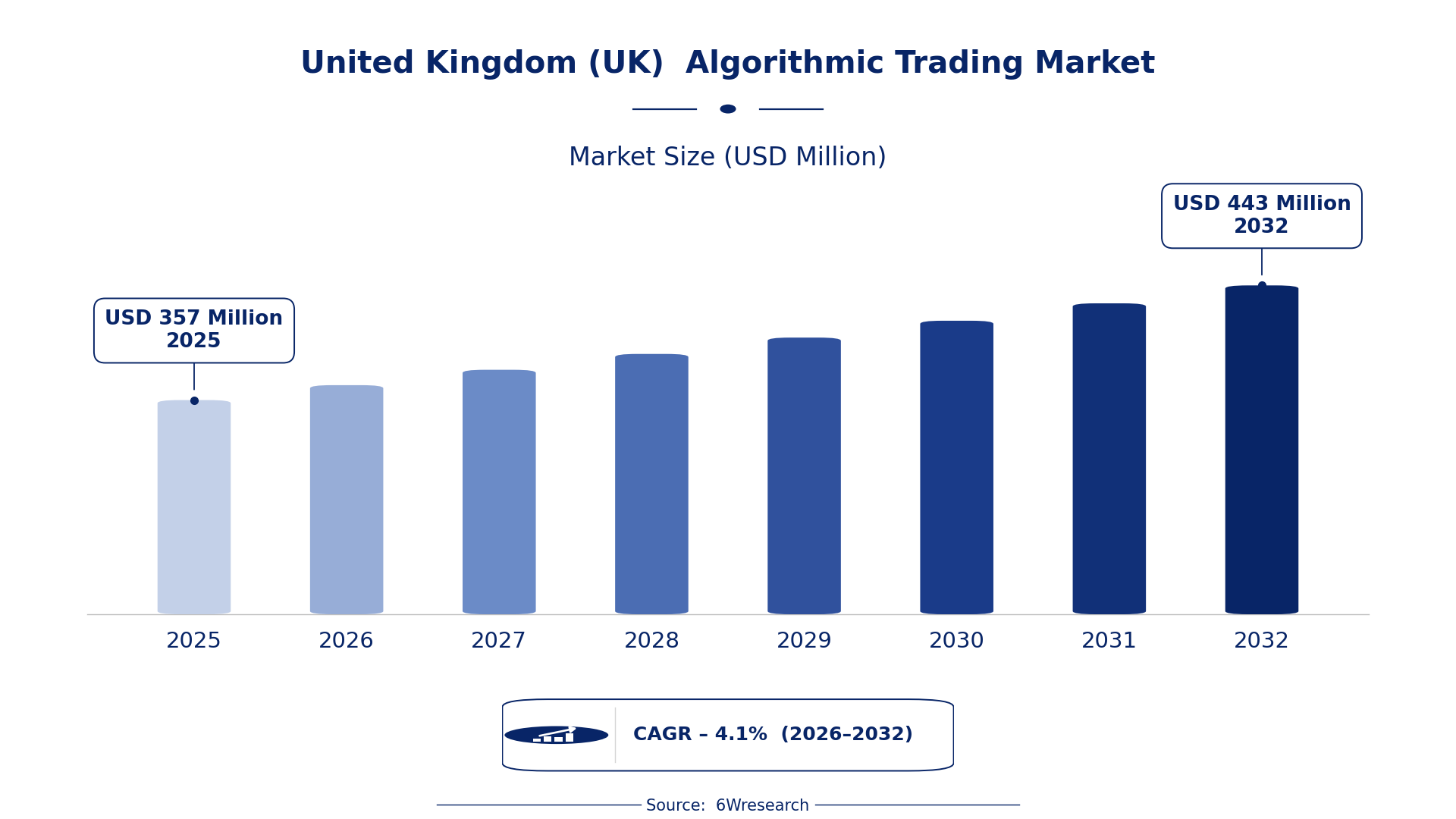
The United Kingdom (UK) Algorithmic Trading Market was estimated at USD 357 Million in 2025 and is projected to reach USD 443 Million by 2032, growing at a CAGR of 4.1% from 2026 to 2032.
United Kingdom (UK) Algorithmic Trading Market Synopsis
The UK algorithmic trading market has seen a surge in momentum, driven by technological advancements and the increasing integration of artificial intelligence. However, the sector faces ongoing challenges, particularly regarding regulatory compliance and market volatility, which may temper its growth trajectory in the near term.
As we look ahead, the market is expected to evolve, with a greater emphasis on innovative trading strategies and enhanced risk management. This evolution will be crucial for firms seeking to maintain competitiveness in a sector that is becoming increasingly complex and dynamic.
United Kingdom (UK) Algorithmic Trading Market Year-wise Growth Rate and Key Drivers
This graph illustrates the annual growth rates of the United Kingdom (UK) Algorithmic Trading Market from 2021 to 2032, highlighting a steady upward trajectory and projected expansion over the forecast period.
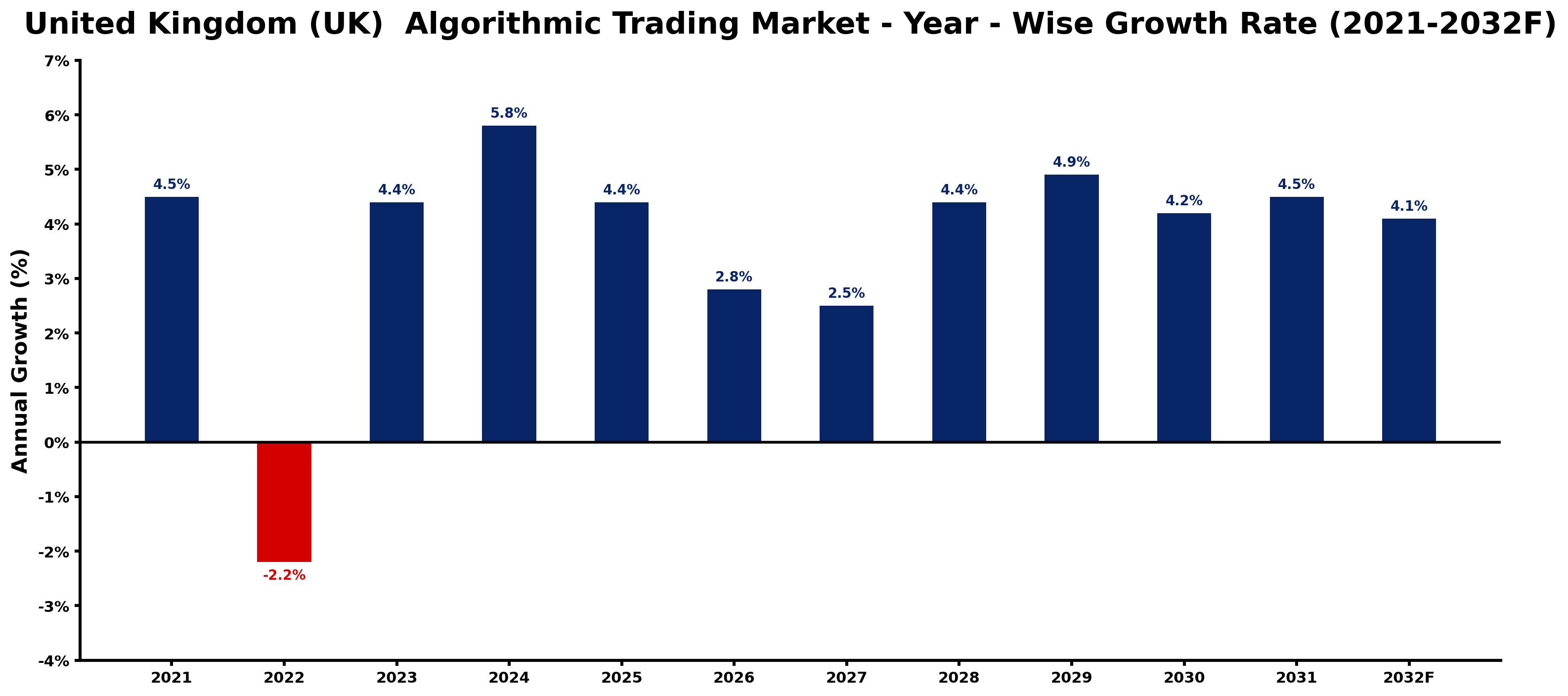
The table below presents the year‑wise growth rates along with the key drivers influencing the market
| Year | Growth Rate | Major Drivers |
| 2021 | 4.5% | Increased regulatory support from FCA for fintech innovation. |
| 2022 | -2.2% | FCA regulations increased compliance costs for traders. |
| 2023 | 4.4% | Rising adoption of machine learning in trading algorithms. |
| 2024 | 5.8% | Brexit fostering demand for advanced trading platforms. |
| 2025 | 4.4% | Growing interest in ESG investments enhancing algorithm applications. |
| 2026 | 2.8% | Institutional investors seeking efficient trading strategies post-pandemic. |
| 2027 | 2.5% | Development of high-frequency trading regulations by FCA. |
| 2028 | 4.4% | Surge in retail investor participation driving algorithmic solutions. |
| 2029 | 4.9% | Technological advancements in data analytics boosting trading efficiency. |
| 2030 | 4.2% | Entry of new fintech startups into algorithmic trading space. |
| 2031 | 4.5% | Increased collaboration between banks and tech firms on algorithms. |
| 2032 | 4.1% | Enhanced cybersecurity measures fostering confidence in trading systems. |
Note: Market size estimations and growth projections presented in this report are based on 6Wresearch's proprietary forecasting methodology, utilizing the latest available industry data, government publications, and primary research inputs.
United Kingdom (UK) Algorithmic Trading Market Key Takeaways
Below are some of the specific key takeaways from the market, including:
- The algorithmic trading market in the UK is characterized by a high level of automation and sophisticated technology.
- Investment opportunities are proliferating, particularly in AI-driven trading solutions.
- Regulatory frameworks, such as MiFID II, are shaping the operational landscape for algorithmic trading firms.
- Market volatility remains a critical challenge, influencing trading strategies and risk assessments.
- Future growth is anticipated as firms adapt to technological advancements and regulatory changes.
Evaluation of Restraints in United Kingdom (UK) Algorithmic Trading Market
The UK algorithmic trading market is not without its limitations. Regulatory compliance poses a significant barrier, with firms required to navigate complex rules established by the Financial Conduct Authority. Additionally, the impact of market volatility cannot be overstated; fluctuations can undermine the efficacy of trading algorithms. Technological infrastructure must also be maintained to ensure reliability and speed, all while guarding against increasing cyber threats. These factors collectively present challenges that firms must strategically address to thrive.
United Kingdom (UK) Algorithmic Trading Market Trends
Several key trends are currently shaping the UK algorithmic trading market. Firstly, the adoption of artificial intelligence and machine learning algorithms is on the rise, enabling more nuanced trading strategies. High-frequency trading continues to grow, pushing the boundaries of execution speed. on top of that, the integration of alternative data sources is becoming essential for informed decision-making, as firms seek to enhance their competitive edge. A greater focus on risk management and compliance is also evident, as market participants prioritize regulatory adherence amidst changing regulations.
United Kingdom (UK) Algorithmic Trading Market Opportunities
The algorithmic trading market in the UK is ripe with investment opportunities. Companies involved in the development of algorithmic trading software and platforms are seeing increased demand. on top of that, advancements in AI and machine learning are enhancing the performance of trading algorithms, making them attractive options for investors. The supportive regulatory environment adds an extra layer of appeal for those looking to invest in algorithmic trading funds and services. As the market matures, the potential for innovative solutions will continue to expand.
Government Initiatives in the United Kingdom (UK) Algorithmic Trading Market
Government policy plays a crucial role in the development of the algorithmic trading market in the UK. The regulatory framework, primarily governed by the Financial Conduct Authority (FCA), emphasizes transparency, accountability, and market integrity. This regulatory focus is essential for fostering a secure trading environment while supporting innovation within the sector.
- A regulatory framework under MiFID II was recently completed, enhancing transparency and accountability in algorithmic trading practices.
- The FCA is currently conducting ongoing reviews of algorithmic trading regulations to adapt to new technologies and market dynamics.
- A planned public-private initiative aims to bolster cybersecurity measures for trading platforms by 2027.
- The FCA has launched a consultation program to gather insights from market participants on proposed regulatory changes expected in 2026.
- A national strategy focused on fintech innovation is underway, promoting investment in advanced trading technologies.
Future Insights of the United Kingdom (UK) Algorithmic Trading Market
Looking ahead to 2026-2032, the UK algorithmic trading market is expected to experience steady growth fueled by technological advancements and a commitment to regulatory compliance. As firms increasingly integrate AI and machine learning into their trading strategies, the complexity and effectiveness of trading algorithms will rise. However, challenges such as regulatory changes and cybersecurity threats will require ongoing attention. Those who can adapt to these evolving dynamics will find ample opportunities for innovation and profitability in the years to come.
United Kingdom (UK) Algorithmic Trading Market Latest Developments
In the past year, the United Kingdom's algorithmic trading market has seen a flurry of activity, with firms actively seeking to innovate and refine their trading strategies. A focus on regulatory compliance has driven many participants to enhance their trading infrastructures and adopt new technologies.
- A major technology vendor launched a new algorithmic trading platform in early 2025, designed to improve execution speed and reduce latency.
- A leading regional operator initiated an ongoing project to integrate machine learning capabilities into their existing trading algorithms in mid-2025.
- A partnership between several investment firms and a fintech startup is planned for Q3 2025, aimed at developing advanced data analytics tools for trading.
- A service upgrade that enhances risk management protocols was completed by late 2025, ensuring compliance with new regulatory standards.
- An initiative to promote the use of alternative data in trading strategies is currently underway, expected to yield results by early 2026.
United Kingdom (UK) Algorithmic Trading Market - Key Attractiveness of the Report
- 10 Years of Market Numbers
- Historical Data Starting from 2022 to 2025
- Base Year: 2025
- Forecast Data until 2032
- Key Performance Indicators Impacting the Market
- Major Upcoming Developments and Projects
Key Highlights of the Report:
- United Kingdom (UK) Algorithmic Trading Market Outlook
- Market Size of United Kingdom (UK) Algorithmic Trading Market, 2025
- Forecast of United Kingdom (UK) Algorithmic Trading Market, 2032
- Historical Data and Forecast of United Kingdom (UK) Algorithmic Trading Revenues & Volume for the Period 2022-2032F
- United Kingdom (UK) Algorithmic Trading Market Trend Evolution
- United Kingdom (UK) Algorithmic Trading Market Drivers and Challenges
- United Kingdom (UK) Algorithmic Trading Price Trends
- United Kingdom (UK) Algorithmic Trading Porter's Five Forces
- United Kingdom (UK) Algorithmic Trading Industry Life Cycle
- Historical Data and Forecast of United Kingdom (UK) Algorithmic Trading Market Revenues & Volume By Trading Type for the Period 2022-2032F
- Historical Data and Forecast of United Kingdom (UK) Algorithmic Trading Market Revenues & Volume By Foreign Exchange (FOREX) for the Period 2022-2032F
- Historical Data and Forecast of United Kingdom (UK) Algorithmic Trading Market Revenues & Volume By Stock Markets for the Period 2022-2032F
- Historical Data and Forecast of United Kingdom (UK) Algorithmic Trading Market Revenues & Volume By Exchange-Traded Fund (ETF) for the Period 2022-2032F
- Historical Data and Forecast of United Kingdom (UK) Algorithmic Trading Market Revenues & Volume By Bonds for the Period 2022-2032F
- Historical Data and Forecast of United Kingdom (UK) Algorithmic Trading Market Revenues & Volume By Cryptocurrencies for the Period 2022-2032F
- Historical Data and Forecast of United Kingdom (UK) Algorithmic Trading Market Revenues & Volume By Others for the Period 2022-2032F
- Historical Data and Forecast of United Kingdom (UK) Algorithmic Trading Market Revenues & Volume By Deployment Mode for the Period 2022-2032F
- Historical Data and Forecast of United Kingdom (UK) Algorithmic Trading Market Revenues & Volume By Cloud for the Period 2022-2032F
- Historical Data and Forecast of United Kingdom (UK) Algorithmic Trading Market Revenues & Volume By On-premises for the Period 2022-2032F
- Historical Data and Forecast of United Kingdom (UK) Algorithmic Trading Market Revenues & Volume By Component for the Period 2022-2032F
- Historical Data and Forecast of United Kingdom (UK) Algorithmic Trading Market Revenues & Volume By Solutions for the Period 2022-2032F
- Historical Data and Forecast of United Kingdom (UK) Algorithmic Trading Market Revenues & Volume By Services for the Period 2022-2032F
- Historical Data and Forecast of United Kingdom (UK) Algorithmic Trading Market Revenues & Volume By Enterprise Size for the Period 2022-2032F
- Historical Data and Forecast of United Kingdom (UK) Algorithmic Trading Market Revenues & Volume By Small and Medium-sized Enterprises (SMEs) for the Period 2022-2032F
- Historical Data and Forecast of United Kingdom (UK) Algorithmic Trading Market Revenues & Volume By Large Enterprises for the Period 2022-2032F
- United Kingdom (UK) Algorithmic Trading Import Export Trade Statistics
- Market Opportunity Assessment By Trading Type
- Market Opportunity Assessment By Deployment Mode
- Market Opportunity Assessment By Component
- Market Opportunity Assessment By Enterprise Size
- United Kingdom (UK) Algorithmic Trading Top Companies Market Share
- United Kingdom (UK) Algorithmic Trading Competitive Benchmarking By Technical and Operational Parameters
- United Kingdom (UK) Algorithmic Trading Company Profiles
- United Kingdom (UK) Algorithmic Trading Key Strategic Recommendations






































