United Kingdom (UK) Digital Insurance Platform Market Size & Growth Rate (2026-2032)
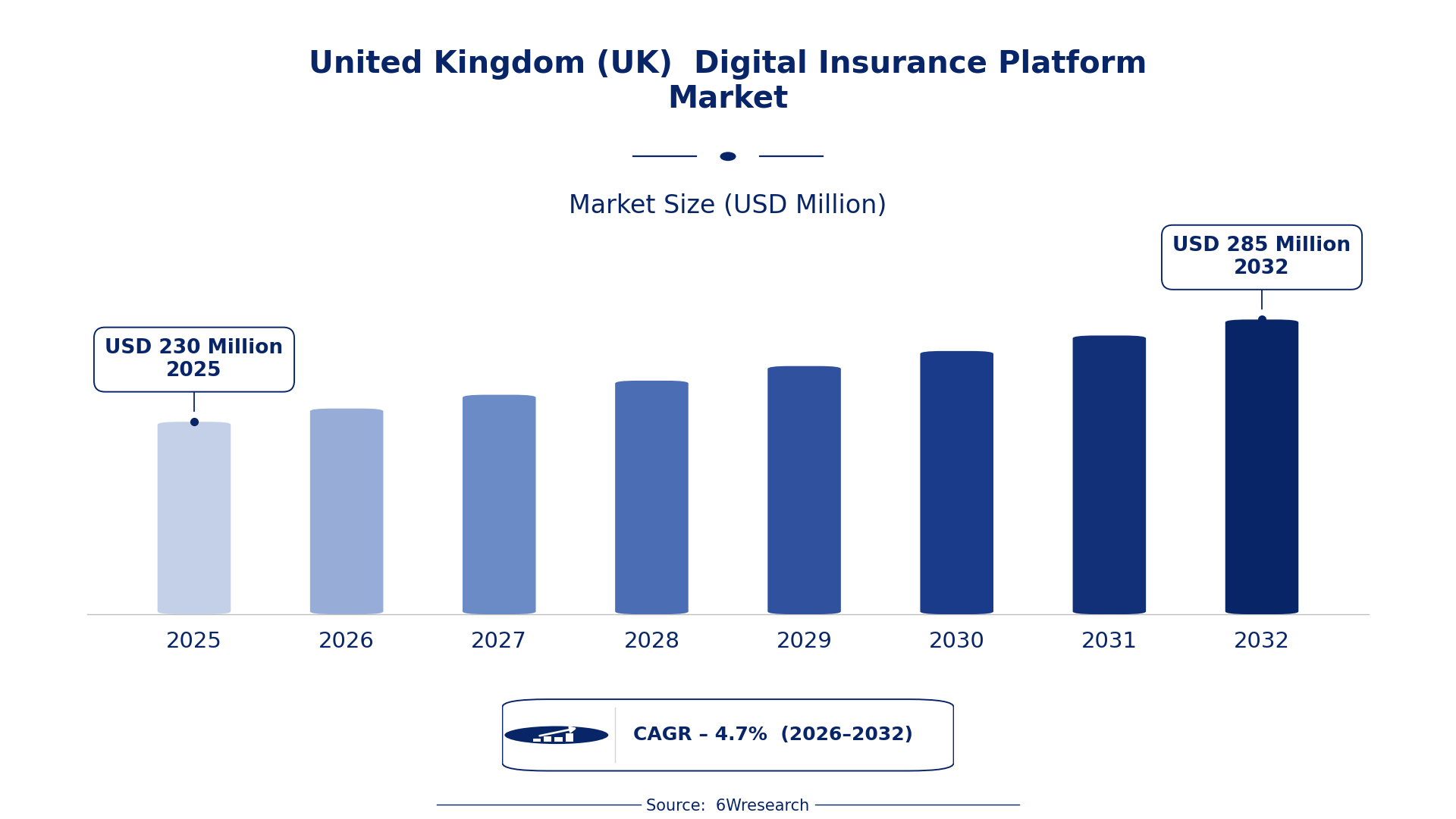
The United Kingdom (UK) Digital Insurance Platform Market was estimated at USD 230 Million in 2025 and is projected to reach USD 285 Million by 2032, growing at a CAGR of 4.7% from 2026 to 2032.
United Kingdom (UK) Digital Insurance Platform Market Synopsis
The digital insurance platform market in the UK is on a clear upward trajectory, fueled by a growing demand for efficiency and enhanced customer engagement. Insurers are increasingly adopting these platforms to modernize operations and deliver tailored insurance products that resonate with today’s consumers.
Technological advancements play a central role in this market. Innovations such as artificial intelligence, blockchain, and the Internet of Things (IoT) are not just buzzwords; they are reshaping the way insurance is underwritten, marketed, and sold. This digital shift is critical for firms looking to stay competitive in a landscape where customer expectations continue to evolve.
United Kingdom (UK) Digital Insurance Platform Market Year-wise Growth Rate and Key Drivers
This graph illustrates the annual growth rates of the United Kingdom (UK) Digital Insurance Platform Market from 2021 to 2032, highlighting a steady upward trajectory and projected expansion over the forecast period.
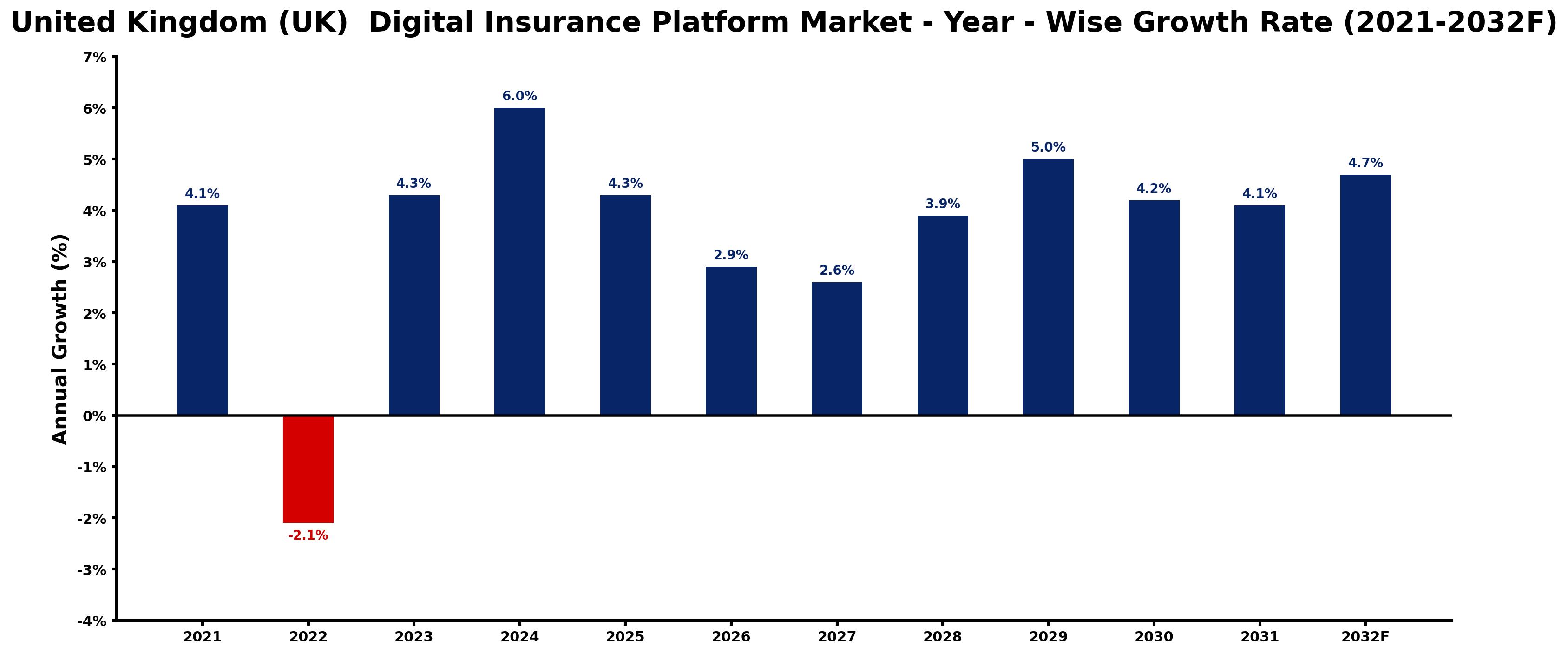
The table below presents the year‑wise growth rates along with the key drivers influencing the market
| Year | Growth Rate | Major Drivers |
| 2021 | 4.1% | UK regulatory support for insurtech innovation programs. |
| 2022 | -2.1% | FCA's delay in open banking implementation stifled innovation. |
| 2023 | 4.3% | Rising consumer confidence in digital insurance transactions. |
| 2024 | 6.0% | Increased smartphone penetration boosting digital insurance usage. |
| 2025 | 4.3% | UK Financial Conduct Authority promoting digital insurance standards. |
| 2026 | 2.9% | Emerging fintech collaborations enhancing insurance product offerings. |
| 2027 | 2.6% | Scotland's growing tech hubs fostering insurtech development. |
| 2028 | 3.9% | Government initiatives targeting financial inclusion through tech. |
| 2029 | 5.0% | Young population driving demand for digital insurance services. |
| 2030 | 4.2% | Evolving data privacy regulations encouraging tech advancements. |
| 2031 | 4.1% | Insurance companies investing in user-friendly digital platforms. |
| 2032 | 4.7% | Rising competition leading to innovative insurance technology solutions. |
Note: Market size estimations and growth projections presented in this report are based on 6Wresearch's proprietary forecasting methodology, utilizing the latest available industry data, government publications, and primary research inputs.
United Kingdom (UK) Digital Insurance Platform Market Key Takeaways
Below are some of the specific key takeaways from the market, including:
- The digital transformation among insurers is driving significant investments in technology.
- AI integration is enhancing risk assessment and customer service capabilities.
- Data privacy and cybersecurity are increasingly central to operational strategies.
- Regulatory frameworks are evolving to promote innovation while ensuring consumer protection.
- IoT adoption is enabling real-time data analytics for better underwriting processes.
Evaluation of Restraints in United Kingdom (UK) Digital Insurance Platform Market
The UK digital insurance platform market is currently stunted by several pressing challenges. Regulatory compliance remains a complex labyrinth that insurers must navigate carefully. The evolving nature of cybersecurity threats places a heavy burden on companies to invest in robust defenses, all while trying to integrate their existing legacy systems with modern solutions. These factors create hurdles that can slow down the adoption of digital platforms, limiting their full potential in streamlining operations and enhancing customer experiences.
United Kingdom (UK) Digital Insurance Platform Market Trends
The landscape of digital insurance is evolving rapidly, with several key trends emerging. A notable shift towards personalization in product offerings is evident, as insurers seek to tailor policies based on individual customer data. The application of AI technologies is not just about efficiency; it’s also about crafting better user experiences through predictive analytics.
Blockchain technology is gaining traction for its ability to enhance transaction security and improve trust between parties. on top of that, the integration of IoT devices is providing insurers with real-time data, enabling more accurate risk assessments and tailored premium pricing. These trends point to a future where insurance is not just a product, but a service that adapts to the customer's life.
United Kingdom (UK) Digital Insurance Platform Market Opportunities
Opportunities abound in the UK digital insurance platform market as companies look to harness the power of technology. The growing interest in insurtech startups presents a fertile ground for innovation, with new entrants bringing fresh ideas and disruptive technologies. Additionally, as regulatory frameworks continue to evolve, there is a clear opening for platforms that can ensure compliance while enhancing operational efficiency.
There’s also a significant push towards eco-friendly insurance products, with consumers increasingly valuing sustainability. Insurers that invest in green technologies and practices will likely find themselves ahead of the curve. Collaborations between traditional insurers and tech providers are expected to amplify these opportunities, driving the market forward.
Government Initiatives in the United Kingdom (UK) Digital Insurance Platform Market
The UK government is actively shaping the digital insurance platform market through a framework that prioritizes data security and innovation. Regulatory bodies, such as the Financial Conduct Authority (FCA), are introducing guidelines that not only ensure consumer protection but also encourage technological advancements. These policies are crucial for fostering a competitive environment where both established insurers and new entrants can thrive.
- A regulatory framework introduced in 2025 mandating enhanced transparency in digital operations to protect consumer rights.
- Current initiatives promote collaboration between insurers and technology providers to improve digital infrastructure.
- A national cybersecurity strategy launched in late 2025 to bolster defenses against increasing cyber threats.
- Planned public-private partnerships aimed at developing smart insurance solutions expected to commence in 2026.
- A national digital infrastructure upgrade programme now in its rollout phase to support better connectivity for insurance services.
Future Insights of the United Kingdom (UK) Digital Insurance Platform Market
Looking ahead to 2026-2032, the UK digital insurance platform market is set for transformation. With ongoing advancements in technology, insurers will increasingly adopt data-driven strategies that enhance risk assessment and customer satisfaction. As regulatory frameworks adapt to technological changes, companies that embrace innovation will likely gain competitive advantages.
The integration of artificial intelligence and machine learning will become commonplace, allowing for more accurate underwriting and claims processing. As consumer preferences shift towards personalized products, the market will witness a surge in tailored offerings that cater to specific needs, solidifying the role of digital platforms in the insurance sector.
United Kingdom (UK) Digital Insurance Platform Market Latest Developments
In recent months, the UK digital insurance platform market has seen a flurry of activity as firms push to innovate and meet evolving consumer expectations. The emphasis on technology integration is palpable, with many insurers prioritizing digital upgrades to enhance service delivery.
- A major technology vendor launched an AI-driven underwriting solution in early 2025, which has already demonstrated improved risk assessment capabilities.
- An ongoing initiative focuses on developing a blockchain-based claims processing system, expected to streamline operations by mid-2026.
- A partnership between insurers and IoT companies was formed in Q3 2025 to leverage real-time data for personalized insurance offerings.
- Upcoming regulatory changes anticipated in late 2026 aim to further enhance data protection measures for consumers.
- A pilot project for a customer-centric digital insurance platform is currently underway, with results expected by early 2027.
United Kingdom (UK) Digital Insurance Platform Market - Key Attractiveness of the Report
- 10 Years of Market Numbers
- Historical Data Starting from 2022 to 2025
- Base Year: 2025
- Forecast Data until 2032
- Key Performance Indicators Impacting the Market
- Major Upcoming Developments and Projects
Key Highlights of the Report:
- United Kingdom (UK) Digital Insurance Platform Market Outlook
- Market Size of United Kingdom (UK) Digital Insurance Platform Market, 2025
- Forecast of United Kingdom (UK) Digital Insurance Platform Market, 2032
- Historical Data and Forecast of United Kingdom (UK) Digital Insurance Platform Revenues & Volume for the Period 2022-2032F
- United Kingdom (UK) Digital Insurance Platform Market Trend Evolution
- United Kingdom (UK) Digital Insurance Platform Market Drivers and Challenges
- United Kingdom (UK) Digital Insurance Platform Price Trends
- United Kingdom (UK) Digital Insurance Platform Porter's Five Forces
- United Kingdom (UK) Digital Insurance Platform Industry Life Cycle
- Historical Data and Forecast of United Kingdom (UK) Digital Insurance Platform Market Revenues & Volume By Component for the Period 2022-2032F
- Historical Data and Forecast of United Kingdom (UK) Digital Insurance Platform Market Revenues & Volume By Tools for the Period 2022-2032F
- Historical Data and Forecast of United Kingdom (UK) Digital Insurance Platform Market Revenues & Volume By Services for the Period 2022-2032F
- Historical Data and Forecast of United Kingdom (UK) Digital Insurance Platform Market Revenues & Volume By Service for the Period 2022-2032F
- Historical Data and Forecast of United Kingdom (UK) Digital Insurance Platform Market Revenues & Volume By Managed services for the Period 2022-2032F
- Historical Data and Forecast of United Kingdom (UK) Digital Insurance Platform Market Revenues & Volume By Professional services for the Period 2022-2032F
- Historical Data and Forecast of United Kingdom (UK) Digital Insurance Platform Market Revenues & Volume By End-user for the Period 2022-2032F
- Historical Data and Forecast of United Kingdom (UK) Digital Insurance Platform Market Revenues & Volume By Insurance companies for the Period 2022-2032F
- Historical Data and Forecast of United Kingdom (UK) Digital Insurance Platform Market Revenues & Volume By Third-party administrators and brokers for the Period 2022-2032F
- Historical Data and Forecast of United Kingdom (UK) Digital Insurance Platform Market Revenues & Volume By Aggregators for the Period 2022-2032F
- Historical Data and Forecast of United Kingdom (UK) Digital Insurance Platform Market Revenues & Volume By Insurance Application for the Period 2022-2032F
- Historical Data and Forecast of United Kingdom (UK) Digital Insurance Platform Market Revenues & Volume By Automotive and transportation for the Period 2022-2032F
- Historical Data and Forecast of United Kingdom (UK) Digital Insurance Platform Market Revenues & Volume By Home and commercial buildings for the Period 2022-2032F
- Historical Data and Forecast of United Kingdom (UK) Digital Insurance Platform Market Revenues & Volume By Life and health for the Period 2022-2032F
- Historical Data and Forecast of United Kingdom (UK) Digital Insurance Platform Market Revenues & Volume By Business and enterprise for the Period 2022-2032F
- Historical Data and Forecast of United Kingdom (UK) Digital Insurance Platform Market Revenues & Volume By Consumer electronics and industrial machines for the Period 2022-2032F
- Historical Data and Forecast of United Kingdom (UK) Digital Insurance Platform Market Revenues & Volume By Travel for the Period 2022-2032F
- Historical Data and Forecast of United Kingdom (UK) Digital Insurance Platform Market Revenues & Volume By Organization Size for the Period 2022-2032F
- Historical Data and Forecast of United Kingdom (UK) Digital Insurance Platform Market Revenues & Volume By Small and Medium-sized Enterprises (SMEs) for the Period 2022-2032F
- Historical Data and Forecast of United Kingdom (UK) Digital Insurance Platform Market Revenues & Volume By Large enterprises for the Period 2022-2032F
- United Kingdom (UK) Digital Insurance Platform Import Export Trade Statistics
- Market Opportunity Assessment By Component
- Market Opportunity Assessment By Service
- Market Opportunity Assessment By End-user
- Market Opportunity Assessment By Insurance Application
- Market Opportunity Assessment By Organization Size
- United Kingdom (UK) Digital Insurance Platform Top Companies Market Share
- United Kingdom (UK) Digital Insurance Platform Competitive Benchmarking By Technical and Operational Parameters
- United Kingdom (UK) Digital Insurance Platform Company Profiles
- United Kingdom (UK) Digital Insurance Platform Key Strategic Recommendations






































