United Kingdom (UK) Electrical Equipment Market Summary
The united kingdom (uk) electrical equipment market was estimated at USD 241 Million in 2025 and is projected to reach USD 300 Million by 2032, growing at a CAGR of 2.4% from 2026 to 2032.
United Kingdom (UK) Electrical Equipment Market Year-wise Growth Rate and Key Drivers
This graph highlights how the United Kingdom (UK) Electrical Equipment Market has steadily grown over the past five years, supported by major growth factors.
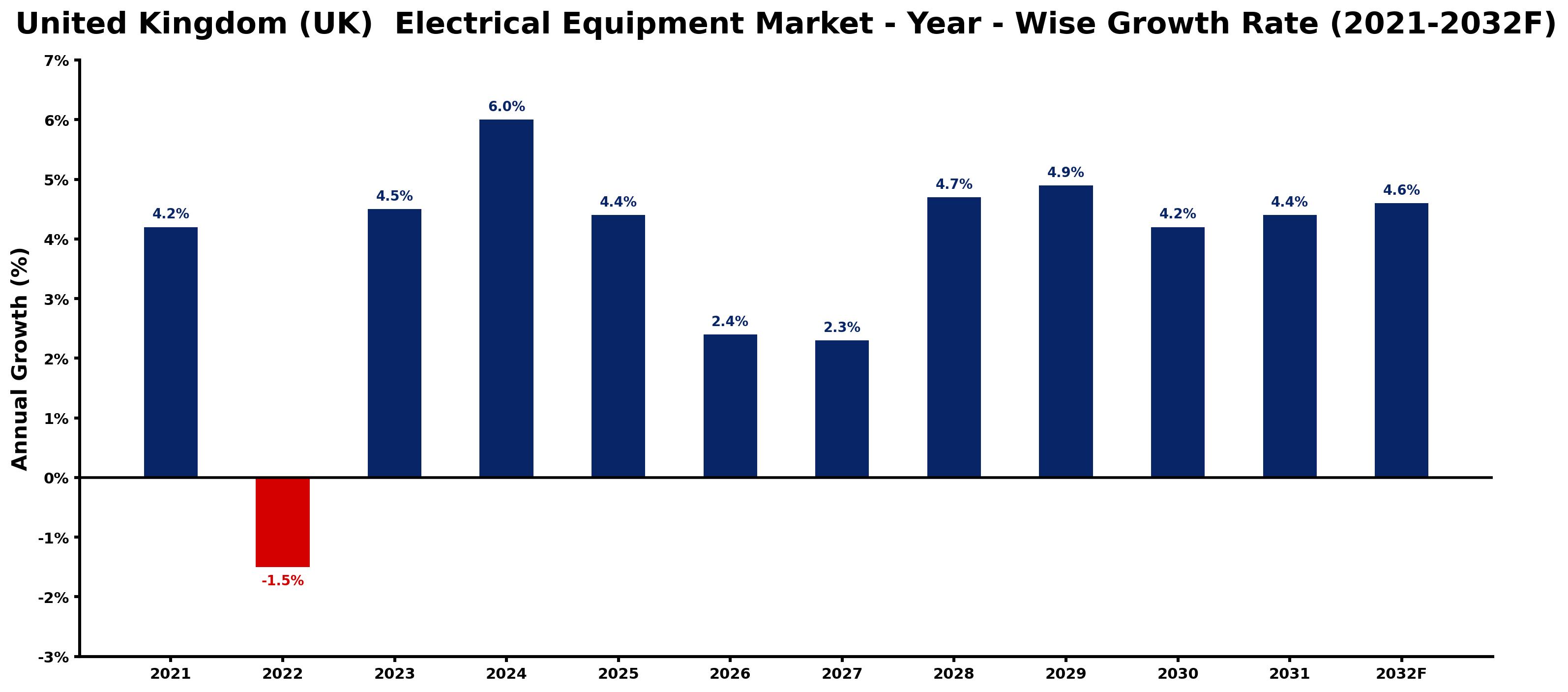
The table below presents the year wise growth rates along with the key drivers influencing the market
| Year | Growth Rate | Major Drivers |
| 2021 | 4.2% | Post-lockdown retail projects prompted increased investment in electrical equipment sectors. |
| 2022 | -1.5% | Supply chain disruptions led to delayed deliveries and increased costs, stifling demand for electrical equipment. |
| 2023 | 4.5% | Corporate budgets prioritizing energy efficiency created opportunities for innovative electrical solutions. |
| 2024 | 6.0% | Emerging smart home technologies boosted demand for advanced electrical equipment installations. |
| 2025 | 4.4% | Sustainability commitments from corporations drove interest in eco-friendly electrical products. |
| 2026 | 2.4% | Expansion of electric vehicle infrastructure necessitated significant upgrades to electrical networks. |
| 2027 | 2.3% | Increased urbanization trends stimulated residential electrical equipment market expansion across major cities. |
| 2028 | 4.7% | Construction pipelines expanded, creating new opportunities for electrical equipment in commercial projects. |
| 2029 | 4.9% | The focus on renewable energy sources intensified the need for specialized electrical technologies. |
| 2030 | 4.2% | Data center expansions required advanced electrical systems to support growing technology demands. |
| 2031 | 4.4% | Consumer awareness of energy efficiency influenced purchasing decisions towards smarter electrical options. |
| 2032 | 4.6% | Technological convergence in IoT solutions underscored the relevance of integrated electrical equipment. |
Note - Market size estimations and growth projections presented in this report are based on 6Wresearch's advanced forecasting approach, validated with industry datasets as of June 2026.
United Kingdom (UK) Electrical Equipment Market Synopsis
The United Kingdom (UK) Electrical Equipment Market is projected to reach 2.4% and witness significant growth during the forecast period (2026-2032). This market encompasses a broad spectrum of products, including consumer electronics, electrical components, and industrial machinery. The growth trajectory of this sector is largely driven by technological advancements, heightened demand for energy-efficient solutions, and an increasing trend towards automation across various industries.
United Kingdom (UK) Electrical Equipment Market Growth Drivers
The dynamics of the United Kingdom (UK) Electrical Equipment Market are heavily influenced by several growth drivers:
- Technological innovation is at the forefront, with companies continuously improving product features and functionality to meet consumer expectations.
- The growing emphasis on energy efficiency has spurred demand for products that minimize electricity consumption, aligning with sustainability goals.
- Automation and digital transformation in industrial processes are significantly increasing the adoption of advanced electrical machinery and control systems.
- Government initiatives aimed at reducing carbon emissions and promoting renewable energy sources are creating opportunities for market expansion.
- A surge in consumer interest for smart home technologies is further driving the development of innovative electrical solutions.
United Kingdom (UK) Electrical Equipment Market Trends and Opportunities
The United Kingdom (UK) Electrical Equipment Market is currently navigating through several prominent trends:
- The increasing prevalence of smart home devices indicates a significant shift towards interconnected systems, allowing consumers to manage their electrical equipment more efficiently.
- The rise of electric vehicles (EVs) is propelling demand for charging infrastructure and related electrical components, creating a burgeoning market segment.
- Advancements in Internet of Things (IoT) connectivity are reshaping product development, leading to a new generation of smart appliances and industrial equipment.
- The ongoing focus on sustainability is pushing manufacturers to enhance the energy efficiency of their products, addressing environmental concerns.
- As industries increasingly integrate automation technologies, there is substantial demand for innovative solutions that improve operational efficiency and productivity.
United Kingdom (UK) Electrical Equipment Market Challenges and Restraints
Despite its growth potential, the United Kingdom (UK) Electrical Equipment Market faces several challenges:
- Rapid technological changes have resulted in shorter product life cycles, compelling companies to innovate continuously to remain competitive.
- Intense competition from international manufacturers is pressuring local businesses to enhance their value propositions and operational efficiencies.
- Rising raw material costs are impacting profit margins across the supply chain, necessitating strategic sourcing and cost management initiatives.
- Compliance with stringent regulatory frameworks and standards is crucial, requiring ongoing investment in quality assurance and product safety.
- Brexit-induced uncertainties have introduced complexities in trading relationships, affecting supply chains and market operations.
United Kingdom (UK) Electrical Equipment Market Investment Opportunities
The landscape of the United Kingdom (UK) Electrical Equipment Market is ripe for investment in several key areas:
- Renewable energy initiatives present lucrative opportunities for companies focused on the design and production of solar and wind power technologies.
- The burgeoning market for smart technologies indicates a compelling avenue for investment in IoT-enabled devices and automation solutions.
- As electric vehicles gain traction, developing infrastructure to support charging stations and components is increasingly vital.
- Investments in research and development will be crucial for companies aiming to create more efficient and sustainable electrical solutions.
- The need for energy-efficient appliances opens a market for manufacturers committed to sustainability and innovative design.
United Kingdom (UK) Electrical Equipment Market Government Investment and Initiatives
The UK government plays a pivotal role in shaping the Electrical Equipment Market through various policies and initiatives:
- Regulations such as the Electrical Equipment (Safety) Regulations ensure manufacturers adhere to safety standards, fostering consumer confidence.
- The Waste Electrical and Electronic Equipment (WEEE) Directive promotes recycling and responsible disposal practices for electrical products.
- Energy-related Products (ErP) Directive encourages the manufacturing of energy-efficient electrical equipment, aligning with national sustainability objectives.
- The government's commitment to net-zero carbon emissions by 2050 drives public investment in clean energy technologies and infrastructure.
- Support for research and innovation through funding programs stimulates advancements in electrical equipment technology and enhances market competitiveness.
United Kingdom (UK) Electrical Equipment Market Latest Developments (May 2025 - June 2026)
In the period from May 2025 to June 2026, several developments are shaping the trajectory of the United Kingdom (UK) Electrical Equipment Market:
- Increased investment in renewable energy projects has been seen, with a focus on the expansion of wind and solar power capabilities.
- The integration of smart technologies in industrial operations is accelerating as companies adopt IoT-based solutions to enhance efficiency.
- Policy frameworks have been updated to better support the development of electric vehicle infrastructure across the UK.
- Research and development activities are gaining momentum, driven by competitive pressures and evolving consumer preferences.
- The UK has seen rising public awareness regarding sustainability, influencing consumer behavior and preferences for energy-efficient products.
United Kingdom (UK) Electrical Equipment Market - Key Attractiveness of the Report
- 10 Years of Market Numbers
- Historical Data Starting from 2022 to 2025
- Base Year: 2025
- Forecast Data until 2032
- Key Performance Indicators Impacting the Market
- Major Upcoming Developments and Projects
Key Highlights of the Report:
- United Kingdom (UK) Electrical Equipment Market Outlook
- Market Size of United Kingdom (UK) Electrical Equipment Market, 2025
- Forecast of United Kingdom (UK) Electrical Equipment Market, 2032F
- Historical Data and Forecast of United Kingdom (UK) Electrical Equipment Revenues & Volume for the Period 2022-2032F
- United Kingdom (UK) Electrical Equipment Market Trend Evolution
- United Kingdom (UK) Electrical Equipment Market Drivers and Challenges
- United Kingdom (UK) Electrical Equipment Price Trends
- United Kingdom (UK) Electrical Equipment Porter's Five Forces
- United Kingdom (UK) Electrical Equipment Industry Life Cycle
- Historical Data and Forecast of United Kingdom (UK) Electrical Equipment Market Revenues & Volume By Types for the Period 2022-2032F
- Historical Data and Forecast of United Kingdom (UK) Electrical Equipment Market Revenues & Volume By Electronic and electrical wires and cables for the Period 2022-2032F
- Historical Data and Forecast of United Kingdom (UK) Electrical Equipment Market Revenues & Volume By Batteries and accumulators for the Period 2022-2032F
- Historical Data and Forecast of United Kingdom (UK) Electrical Equipment Market Revenues & Volume By Wiring devices for the Period 2022-2032F
- Historical Data and Forecast of United Kingdom (UK) Electrical Equipment Market Revenues & Volume By Electric lighting equipment for the Period 2022-2032F
- Historical Data and Forecast of United Kingdom (UK) Electrical Equipment Market Revenues & Volume By Others for the Period 2022-2032F
- Historical Data and Forecast of United Kingdom (UK) Electrical Equipment Market Revenues & Volume By Applications for the Period 2022-2032F
- Historical Data and Forecast of United Kingdom (UK) Electrical Equipment Market Revenues & Volume By Residential end-users for the Period 2022-2032F
- Historical Data and Forecast of United Kingdom (UK) Electrical Equipment Market Revenues & Volume By Non-residential end-users for the Period 2022-2032F
- United Kingdom (UK) Electrical Equipment Import Export Trade Statistics
- Market Opportunity Assessment By Types
- Market Opportunity Assessment By Applications
- United Kingdom (UK) Electrical Equipment Top Companies Market Share
- United Kingdom (UK) Electrical Equipment Competitive Benchmarking By Technical and Operational Parameters
- United Kingdom (UK) Electrical Equipment Company Profiles
- United Kingdom (UK) Electrical Equipment Key Strategic Recommendations






































