United Kingdom (UK) Endpoint Security Market Size & Growth Rate (2026-2032)
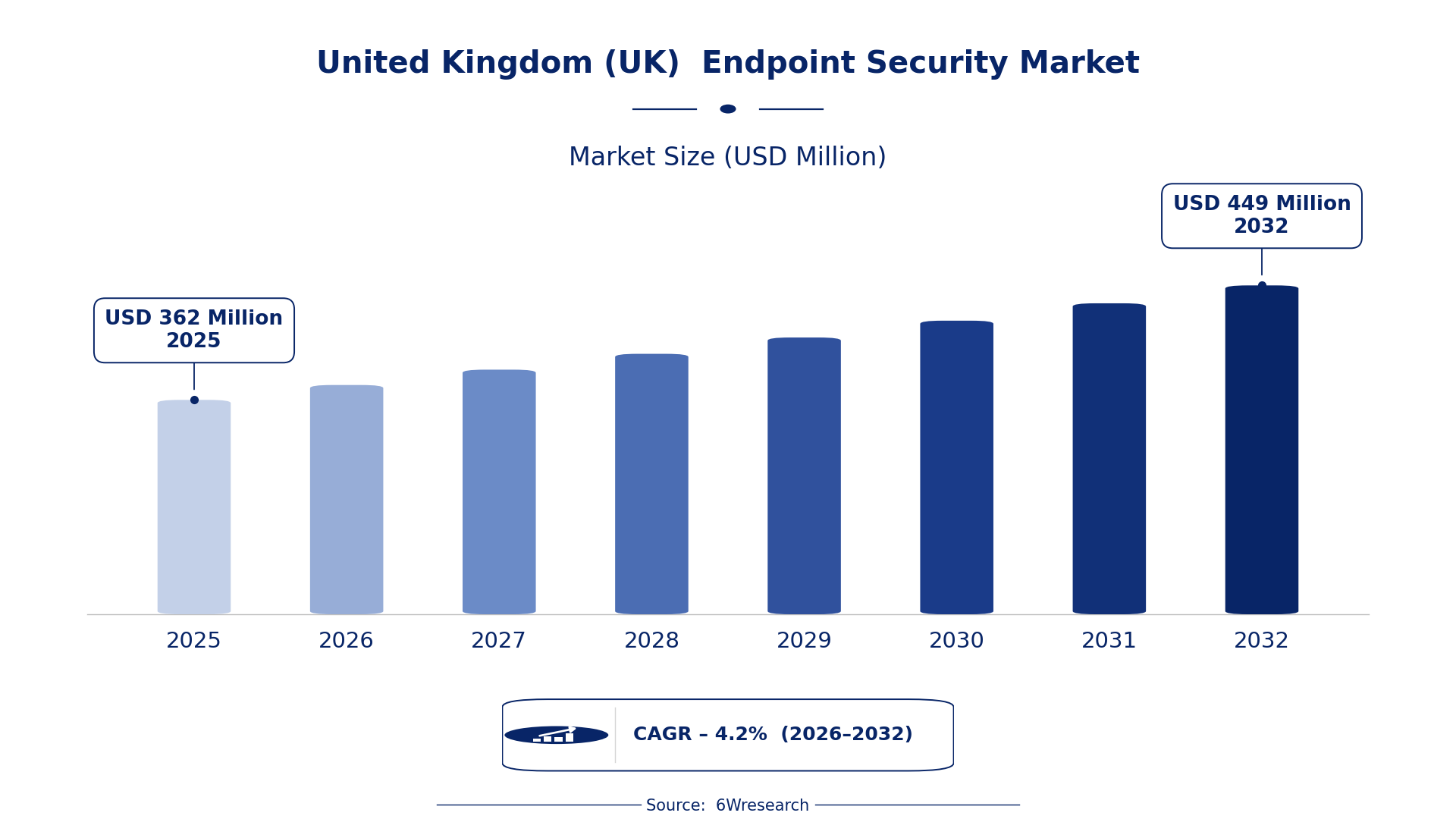
The United Kingdom (UK) Endpoint Security Market was estimated at USD 362 Million in 2025 and is projected to reach USD 449 Million by 2032, growing at a CAGR of 4.2% from 2026 to 2032.
United Kingdom (UK) Endpoint Security Market Synopsis
The primary driver of the United Kingdom (UK) Endpoint Security Market is the growing recognition of cyber threats coupled with the shift towards digital platforms. Organizations across sectors are increasingly prioritizing the protection of endpoint devices—laptops, tablets, and smartphones—as the risks escalate.
This market is also being shaped by the rise in remote work and Bring Your Own Device (BYOD) policies, compelling businesses to adopt sophisticated security solutions. New technologies, including threat intelligence and endpoint detection and response (EDR), are emerging as critical components in safeguarding sensitive information.
United Kingdom (UK) Endpoint Security Market Year-wise Growth Rate and Key Drivers
This graph illustrates the annual growth rates of the United Kingdom (UK) Endpoint Security Market from 2021 to 2032, highlighting a steady upward trajectory and projected expansion over the forecast period.
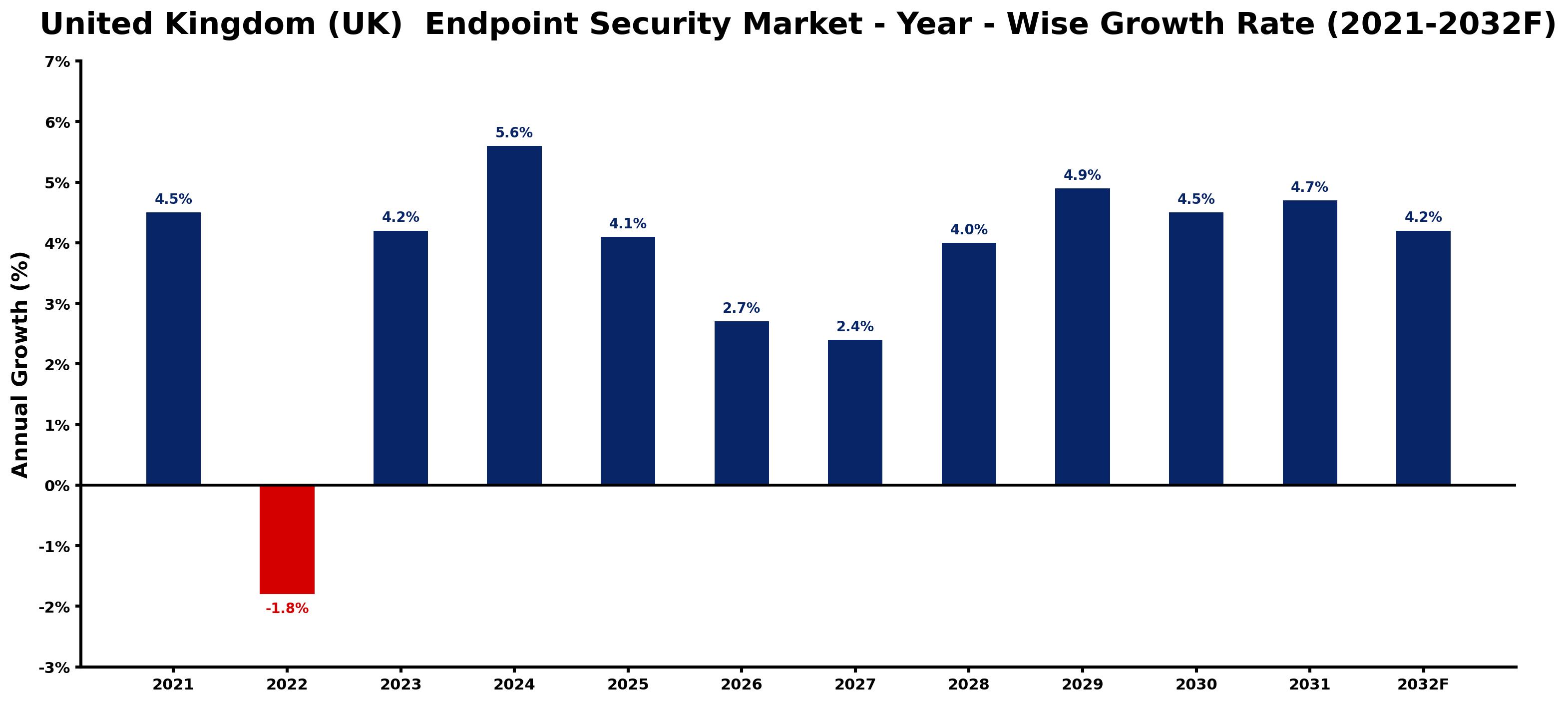
The table below presents the year‑wise growth rates along with the key drivers influencing the market
| Year | Growth Rate | Major Drivers |
| 2021 | 4.5% | NCSC guidelines driving cybersecurity emphasis across UK businesses |
| 2022 | -1.8% | Increased scrutiny from ICO on data protection compliance. |
| 2023 | 4.2% | UK Cyber Strategy boosting funding for endpoint protection tools |
| 2024 | 5.6% | Government cybersecurity mandates supporting sector growth opportunities |
| 2025 | 4.1% | Increased ransomware attacks prompting enhanced security investments |
| 2026 | 2.7% | Brexit fostering demand for local compliance and security |
| 2027 | 2.4% | Cyber insurance uptake increasing focus on endpoint security |
| 2028 | 4.0% | Emerging digital identity solutions enhancing user authentication security |
| 2029 | 4.9% | Regulatory pressures stimulating advanced threat detection technologies |
| 2030 | 4.5% | UK schools investing in cybersecurity awareness and tools |
| 2031 | 4.7% | Telehealth services requiring stringent endpoint security measures |
| 2032 | 4.2% | Financial sector adaptations heightening demand for protective solutions |
Note: Market size estimations and growth projections presented in this report are based on 6Wresearch's proprietary forecasting methodology, utilizing the latest available industry data, government publications, and primary research inputs.
United Kingdom (UK) Endpoint Security Market Key Takeaways
Below are some of the specific key takeaways from the market, including:
- The UK endpoint security market is experiencing consistent growth driven by the rise in cyber threats.
- Advanced solutions that include AI and machine learning are becoming essential for effective threat detection.
- Compliance with regulations like GDPR is prompting organizations to invest heavily in endpoint security.
- The demand for cloud-based endpoint security solutions is increasing due to their flexibility and scalability.
- Remote work has expanded the attack surface, necessitating more robust endpoint protection strategies.
Evaluation of Restraints in United Kingdom (UK) Endpoint Security Market
Despite the market's promising growth trajectory, several challenges hinder its progress. The escalating complexity of cyber threats presents an ongoing struggle for organizations trying to keep their defenses up-to-date. Many businesses find themselves overwhelmed and under-resourced in tackling these evolving threats. on top of that, a fragmented device landscape complicates endpoint management, as employees utilize diverse operating systems and hardware. Additionally, the shortage of skilled cybersecurity professionals poses a significant challenge for implementing and maintaining effective endpoint security measures.
United Kingdom (UK) Endpoint Security Market Trends
Several trends are influencing the United Kingdom Endpoint Security Market. Advanced threat detection capabilities are gaining traction as organizations require faster responses to sophisticated attacks. Seamless integration of endpoint security solutions with existing IT infrastructures is becoming a priority. Companies are also increasingly favoring cloud-based solutions that provide flexibility in safeguarding endpoints beyond traditional office environments. The necessity for compliance with stringent data protection regulations continues to propel investment into innovative endpoint security technologies.
United Kingdom (UK) Endpoint Security Market Opportunities
Investment opportunities in the UK Endpoint Security Market are abundant as organizations shift focus towards securing endpoint devices. Advanced technologies such as behavioral analytics, threat intelligence, and EDR are paving the way for innovative solutions. on top of that, the growing emphasis on compliance with data protection regulations presents additional avenues for growth. Businesses seeking to enhance their cybersecurity measures will find ample opportunities within this evolving landscape.
Government Initiatives in the United Kingdom (UK) Endpoint Security Market
The UK government is actively working to bolster cybersecurity measures, significantly impacting the Endpoint Security Market. Through various initiatives, the government aims to enhance the security posture of organizations across all sectors. These policies not only promote best practices but also establish frameworks that guide organizations in strengthening their cybersecurity defenses.
- A recently completed initiative includes the Cyber Essentials certification scheme, aimed at improving basic security measures within organizations.
- A currently ongoing initiative is the Active Cyber Defence program, which provides guidance and tools to mitigate cyber threats.
- Upcoming plans involve enhancing partnerships between public and private sectors to develop new frameworks for securing critical infrastructure.
- The introduction of more stringent data protection regulations, such as GDPR, continues to guide organizations toward adopting robust endpoint security solutions.
- The UK National Cyber Security Centre (NCSC) regularly updates its guidelines to reflect the latest threat landscapes and security measures.
Future Insights of the United Kingdom (UK) Endpoint Security Market
Looking ahead to 2026-2032, the United Kingdom Endpoint Security Market is set to expand as organizations confront a more sophisticated cyber threat landscape. The ongoing transition to remote work and the growing prevalence of Internet of Things (IoT) devices will continue to drive demand for advanced endpoint security solutions. Awareness of the potential repercussions of data breaches and ransomware attacks will ensure that security measures remain a top priority for organizations across various sectors.
United Kingdom (UK) Endpoint Security Market Latest Developments
In recent months, the United Kingdom Endpoint Security Market has witnessed a flurry of activity aimed at enhancing security measures and technologies. Companies are ramping up efforts to implement cutting-edge solutions that address the rising tide of cyber threats.
- A major technology vendor launched an advanced threat detection service in early 2025, offering enhanced capabilities for real-time monitoring.
- A partnership between leading cybersecurity firms announced in mid-2025 aims to develop new endpoint protection solutions utilizing AI technologies.
- A regulatory framework mandating improved cybersecurity practices across public sector organizations is currently underway, set to be implemented by late 2025.
- Upcoming initiatives include a nationwide campaign to raise awareness about endpoint security risks, expected to kick off in early 2026.
- An upgrade to existing endpoint protection software is expected to begin in Q3 2025, integrating behavioral analytics features to improve threat detection.
United Kingdom (UK) Endpoint Security Market - Key Attractiveness of the Report
- 10 Years of Market Numbers
- Historical Data Starting from 2022 to 2025
- Base Year: 2025
- Forecast Data until 2032
- Key Performance Indicators Impacting the Market
- Major Upcoming Developments and Projects
Key Highlights of the Report:
- United Kingdom (UK) Endpoint Security Market Outlook
- Market Size of United Kingdom (UK) Endpoint Security Market, 2025
- Forecast of United Kingdom (UK) Endpoint Security Market, 2032
- Historical Data and Forecast of United Kingdom (UK) Endpoint Security Revenues & Volume for the Period 2022-2032F
- United Kingdom (UK) Endpoint Security Market Trend Evolution
- United Kingdom (UK) Endpoint Security Market Drivers and Challenges
- United Kingdom (UK) Endpoint Security Price Trends
- United Kingdom (UK) Endpoint Security Porter's Five Forces
- United Kingdom (UK) Endpoint Security Industry Life Cycle
- Historical Data and Forecast of United Kingdom (UK) Endpoint Security Market Revenues & Volume By Solution for the Period 2022-2032F
- Historical Data and Forecast of United Kingdom (UK) Endpoint Security Market Revenues & Volume By Endpoint Protection Platform for the Period 2022-2032F
- Historical Data and Forecast of United Kingdom (UK) Endpoint Security Market Revenues & Volume By Endpoint Detection for the Period 2022-2032F
- Historical Data and Forecast of United Kingdom (UK) Endpoint Security Market Revenues & Volume By Response for the Period 2022-2032F
- Historical Data and Forecast of United Kingdom (UK) Endpoint Security Market Revenues & Volume By Vertical for the Period 2022-2032F
- Historical Data and Forecast of United Kingdom (UK) Endpoint Security Market Revenues & Volume By Healthcare for the Period 2022-2032F
- Historical Data and Forecast of United Kingdom (UK) Endpoint Security Market Revenues & Volume By Retail for the Period 2022-2032F
- Historical Data and Forecast of United Kingdom (UK) Endpoint Security Market Revenues & Volume By eCommerce for the Period 2022-2032F
- Historical Data and Forecast of United Kingdom (UK) Endpoint Security Market Revenues & Volume By Government for the Period 2022-2032F
- Historical Data and Forecast of United Kingdom (UK) Endpoint Security Market Revenues & Volume By Organization Size for the Period 2022-2032F
- Historical Data and Forecast of United Kingdom (UK) Endpoint Security Market Revenues & Volume By Small and Medium-Sized Enterprises (SMEs) for the Period 2022-2032F
- Historical Data and Forecast of United Kingdom (UK) Endpoint Security Market Revenues & Volume By Large Enterprises for the Period 2022-2032F
- Historical Data and Forecast of United Kingdom (UK) Endpoint Security Market Revenues & Volume By Deployment Mode for the Period 2022-2032F
- Historical Data and Forecast of United Kingdom (UK) Endpoint Security Market Revenues & Volume By On-premises for the Period 2022-2032F
- Historical Data and Forecast of United Kingdom (UK) Endpoint Security Market Revenues & Volume By Cloud for the Period 2022-2032F
- Historical Data and Forecast of United Kingdom (UK) Endpoint Security Market Revenues & Volume By Service for the Period 2022-2032F
- Historical Data and Forecast of United Kingdom (UK) Endpoint Security Market Revenues & Volume By Professional Services for the Period 2022-2032F
- Historical Data and Forecast of United Kingdom (UK) Endpoint Security Market Revenues & Volume By Managed Services for the Period 2022-2032F
- United Kingdom (UK) Endpoint Security Import Export Trade Statistics
- Market Opportunity Assessment By Solution
- Market Opportunity Assessment By Vertical
- Market Opportunity Assessment By Organization Size
- Market Opportunity Assessment By Deployment Mode
- Market Opportunity Assessment By Service
- United Kingdom (UK) Endpoint Security Top Companies Market Share
- United Kingdom (UK) Endpoint Security Competitive Benchmarking By Technical and Operational Parameters
- United Kingdom (UK) Endpoint Security Company Profiles
- United Kingdom (UK) Endpoint Security Key Strategic Recommendations






































