United Kingdom (UK) Food Colors Market: Import Trend Analysis
In 2024, the United Kingdom import trend for food colors experienced a decline, with a growth rate of -12.48% compared to the previous year. The compound annual growth rate (CAGR) for the period 2020-2024 stood at -12.08%. This negative momentum may be attributed to shifting consumer preferences, regulatory changes, or evolving market dynamics impacting demand for food colors within the UK market.
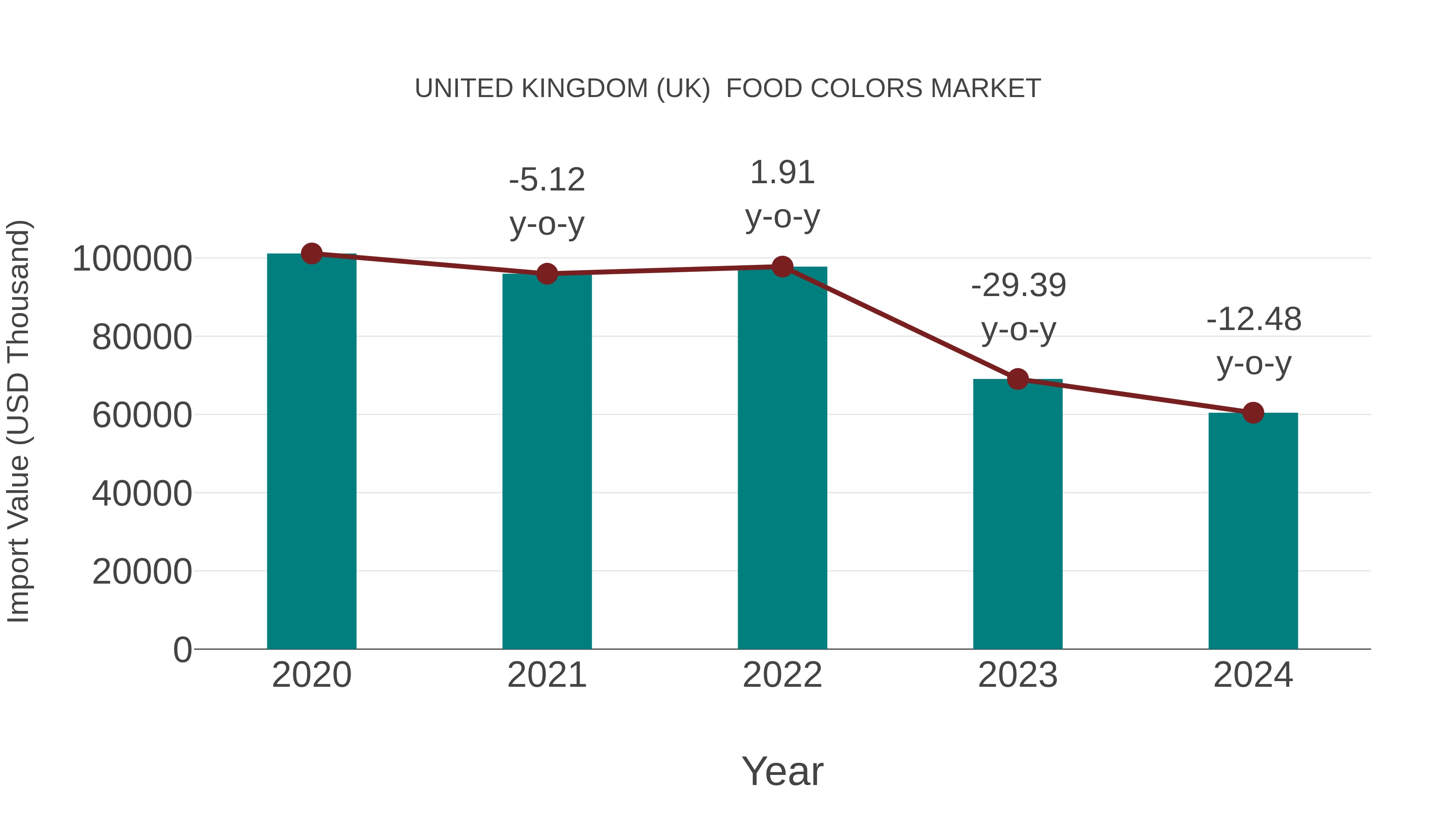
United Kingdom (UK) Export Potential Assessment For Food Colors Market (Values in USD Thousand)
United Kingdom (UK) Food Colors Market Overview
Food colors play a vital role in enhancing visual appeal and consumer acceptance of food products in the UK market. Growth is driven by innovation in natural and clean-label colors, reflecting consumer preferences for healthier options. Challenges include regulatory scrutiny and formulation stability in varying food processing conditions.
Drivers of the market
The UK food colors market is driven by changing consumer preferences towards visually appealing and natural food products. Food colors enhance the aesthetic appeal of food and beverage items and play a crucial role in product differentiation and brand identity. Growing demand for clean-label products and natural food colors derived from plant-based sources drive innovation and market growth. Regulatory approvals for new food color formulations and advancements in microencapsulation technologies to improve color stability further stimulate market expansion.
Challenges of the market
The UK food colors market faces challenges related to regulatory compliance and consumer preferences for natural ingredients. Regulatory scrutiny on synthetic dyes and their potential health risks has driven demand for natural alternatives derived from fruits, vegetables, and other botanical sources. However, the limited stability and availability of natural colorants present formulation challenges for manufacturers, impacting product shelf life and sensory appeal. Balancing regulatory requirements with consumer expectations for vibrant and visually appealing food products requires ongoing research, innovation in extraction techniques, and partnerships with sustainable suppliers.
Government Policy of the market
Regulations in the UK food colors market prioritize consumer safety and product quality. Government policies mandate strict limits on synthetic colors and promote the use of natural alternatives derived from plant and mineral sources. Regulatory authorities ensure compliance with labeling requirements to inform consumers about the ingredients used in food coloring.
Key Highlights of the Report:
- United Kingdom (UK) Food Colors Market Outlook
- Market Size of United Kingdom (UK) Food Colors Market, 2025
- Forecast of United Kingdom (UK) Food Colors Market, 2032
- Historical Data and Forecast of United Kingdom (UK) Food Colors Revenues & Volume for the Period 2022-2032F
- United Kingdom (UK) Food Colors Market Trend Evolution
- United Kingdom (UK) Food Colors Market Drivers and Challenges
- United Kingdom (UK) Food Colors Price Trends
- United Kingdom (UK) Food Colors Porter's Five Forces
- United Kingdom (UK) Food Colors Industry Life Cycle
- Historical Data and Forecast of United Kingdom (UK) Food Colors Market Revenues & Volume By Type for the Period 2022-2032F
- Historical Data and Forecast of United Kingdom (UK) Food Colors Market Revenues & Volume By Natural for the Period 2022-2032F
- Historical Data and Forecast of United Kingdom (UK) Food Colors Market Revenues & Volume By Synthetic for the Period 2022-2032F
- Historical Data and Forecast of United Kingdom (UK) Food Colors Market Revenues & Volume By Nature Identical for the Period 2022-2032F
- Historical Data and Forecast of United Kingdom (UK) Food Colors Market Revenues & Volume By Application for the Period 2022-2032F
- Historical Data and Forecast of United Kingdom (UK) Food Colors Market Revenues & Volume By Food Products for the Period 2022-2032F
- Historical Data and Forecast of United Kingdom (UK) Food Colors Market Revenues & Volume By Beverages for the Period 2022-2032F
- Historical Data and Forecast of United Kingdom (UK) Food Colors Market Revenues & Volume By Form for the Period 2022-2032F
- Historical Data and Forecast of United Kingdom (UK) Food Colors Market Revenues & Volume By Liquid for the Period 2022-2032F
- Historical Data and Forecast of United Kingdom (UK) Food Colors Market Revenues & Volume By Powder for the Period 2022-2032F
- Historical Data and Forecast of United Kingdom (UK) Food Colors Market Revenues & Volume By Gel for the Period 2022-2032F
- Historical Data and Forecast of United Kingdom (UK) Food Colors Market Revenues & Volume By Solubility for the Period 2022-2032F
- Historical Data and Forecast of United Kingdom (UK) Food Colors Market Revenues & Volume By Dyes for the Period 2022-2032F
- Historical Data and Forecast of United Kingdom (UK) Food Colors Market Revenues & Volume By Lakes for the Period 2022-2032F
- United Kingdom (UK) Food Colors Import Export Trade Statistics
- Market Opportunity Assessment By Type
- Market Opportunity Assessment By Application
- Market Opportunity Assessment By Form
- Market Opportunity Assessment By Solubility
- United Kingdom (UK) Food Colors Top Companies Market Share
- United Kingdom (UK) Food Colors Competitive Benchmarking By Technical and Operational Parameters
- United Kingdom (UK) Food Colors Company Profiles
- United Kingdom (UK) Food Colors Key Strategic Recommendations






































