United Kingdom (UK) Foot Care Products Market Size, Share & Growth Rate
The United Kingdom (UK) Foot Care Products Market was estimated at USD 348 Million in 2025 and is projected to reach USD 430 Million by 2032, growing at a CAGR of 3.1% from 2026 to 2032. This growth is propelled by a rising awareness of foot health, especially among aging populations and individuals managing chronic conditions like diabetes. The markets expansion is also supported by an increasing focus on self-care and wellness, as consumers prioritize proactive approaches to foot health.
United Kingdom (UK) Foot Care Products Market Year-wise Growth Rate and Key Drivers
This graph highlights how the United Kingdom (UK) Foot Care Products Market has steadily grown over the years, supported by major growth factors.
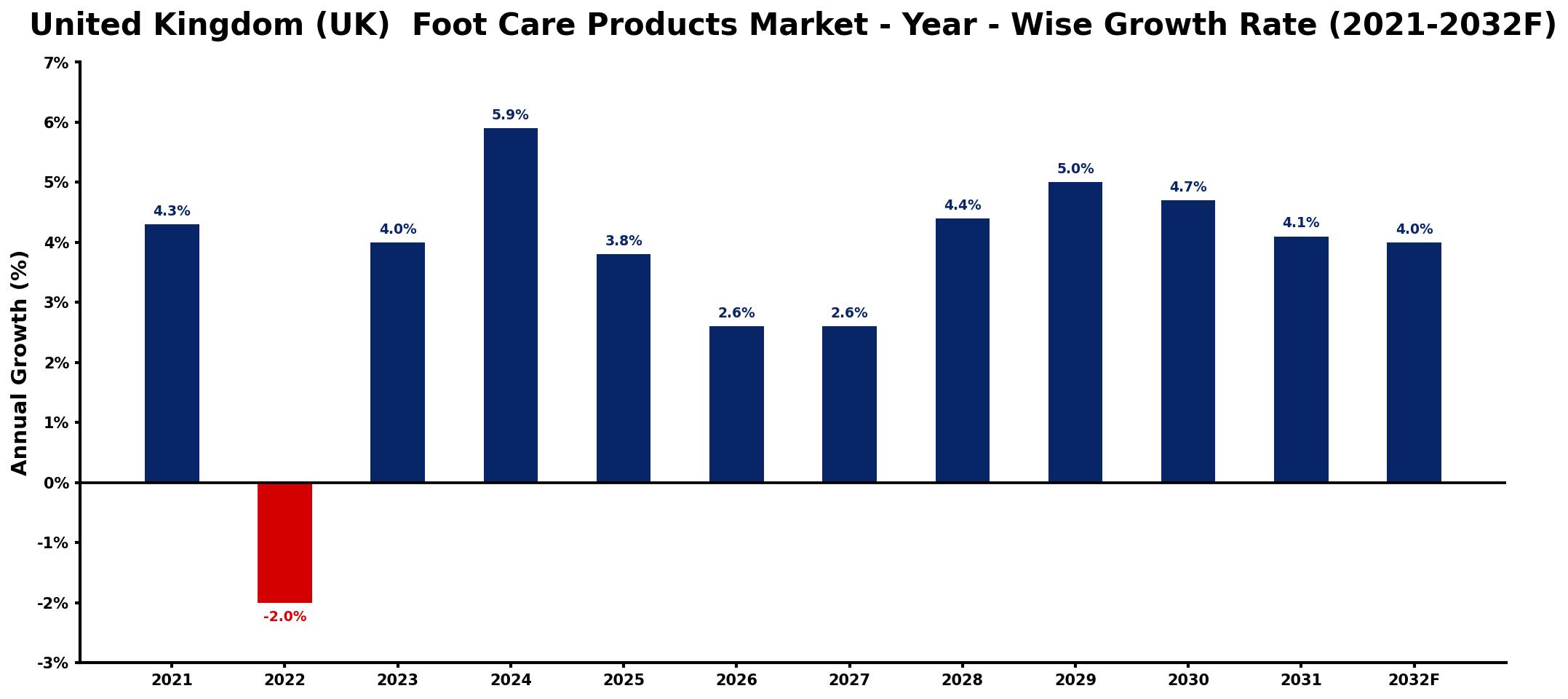
The table below presents the year‑wise growth rates along with the key drivers influencing the market
| Year | Growth Rate | Major Drivers |
| 2021 | 4.3% | Rising consumer health awareness |
| 2022 | -2.0% | Decreased disposable income spending |
| 2023 | 4.0% | Growth in online retail channels |
| 2024 | 5.9% | Increased investment in wellness |
| 2025 | 3.8% | Expansion of natural ingredients usage |
| 2026 | 2.6% | increased capital investment inflows |
| 2027 | 2.6% | Growing elderly population base |
| 2028 | 4.4% | Enhanced marketing strategies adopted |
| 2029 | 5.0% | Emergence of innovative technologies |
| 2030 | 4.7% | Increased focus on sustainability initiatives |
| 2031 | 4.1% | Strengthening retail partnerships formed |
| 2032 | 4.0% | Rising demand for personalized solutions |
Note: Market size estimations and growth projections presented in this report are based on 6Wresearch's proprietary forecasting methodology, utilizing the latest available industry data, government publications, and primary research inputs.
United Kingdom (UK) Foot Care Products Market Synopsis
The United Kingdom Foot Care Products Market has been witnessing robust growth, reflecting a heightened awareness of foot health among consumers. This momentum is expected to evolve into a more focused demand for innovative and specialized products that cater to a variety of foot-related ailments, especially as the population ages.
While traditional foot care solutions such as creams and balms remain popular, the market is pivoting towards more advanced offerings. There is a noticeable increase in demand for natural ingredients and technological innovations like electric foot massagers and callus removers, indicative of a broader consumer shift toward convenience and sustainability.
United Kingdom (UK) Foot Care Products Market Key Takeaways
- The market is projected to grow from USD 348 Million in 2025 to USD 430 Million by 2032.
- There is a strong consumer shift towards natural and organic foot care products.
- Technological innovations are reshaping the product offerings in the market.
- Retail channels are diversifying, with online platforms gaining significant traction.
- Specialized products, particularly for diabetic foot care, are experiencing heightened demand.
Evaluation of Restraints in United Kingdom (UK) Foot Care Products Market
Despite the promising growth trajectory of the UK Foot Care Products Market, certain restraints can impact its expansion. The competitive landscape is increasingly saturated, presenting challenges for both established brands and new entrants. This intensifying rivalry often leads to pricing pressures as consumers seek budget-friendly options, which can squeeze profit margins. Furthermore, keeping pace with evolving consumer preferences necessitates ongoing innovation—a constant challenge that requires investment in research and development. Regulatory compliance also presents hurdles, as brands must navigate stringent guidelines to ensure product safety and efficacy.
United Kingdom (UK) Foot Care Products Market Trends
Emerging trends in the UK Foot Care Products Market highlight a significant consumer shift towards products that align with wellness and sustainability. The growing interest in natural and organic ingredients reflects a broader trend in personal care, with consumers actively seeking out cleaner formulations. Additionally, the rise of innovative technologies, including smart devices and advanced foot care tools, speaks to a demand for enhanced convenience and efficiency in foot care routines.
The increased focus on self-care and preventive health measures is also driving demand for specialized foot care products, such as those designed specifically for diabetic individuals. This trend indicates a growing recognition of the critical role that foot health plays in overall wellbeing, especially within older demographics.
United Kingdom (UK) Foot Care Products Market Opportunities
Investment opportunities in the UK Foot Care Products Market are expanding, driven by a confluence of factors including an aging population and rising incidences of foot-related health issues. Segments such as foot creams, orthotic inserts, and specialized footwear are poised for significant growth. Brands that innovate with natural ingredients and focus on effective marketing strategies can tap into the growing consumer demand for sustainable and high-quality products. The potential for growth in e-commerce is another avenue for market expansion, as online retailing continues to provide convenience and a broader range of options for consumers.
Government Initiatives in the United Kingdom (UK) Foot Care Products Market
The regulatory landscape governing foot care products in the UK is primarily shaped by the EU Cosmetics Regulation, which classifies these products as cosmetics. Manufacturers must adhere to strict labeling requirements to ensure consumer safety. Additionally, medical devices, including orthotics and insoles, are subject to regulation under the Medical Devices Regulations. Public health initiatives, particularly through the NHS, aim to improve foot health among various populations, indirectly influencing the foot care products market.
Future Insights of the United Kingdom (UK) Foot Care Products Market
Looking ahead to 2026-2032, the UK Foot Care Products Market is set to experience sustained growth. Factors such as the increasing incidence of foot-related ailments, a growing elderly population, and heightened consumer awareness of the importance of foot health will drive this expansion. Furthermore, trends towards holistic wellness and self-care will continue to shape product development and marketing strategies. Companies that adapt to these changing dynamics while maintaining a focus on innovation are likely to thrive in this evolving marketplace.
United Kingdom (UK) Foot Care Products Market Latest Developments (2025 - 2026)
Recent developments in the UK Foot Care Products Market indicate a shift towards more innovative and consumer-friendly products. Advances in technology are being integrated into foot care, with new tools aimed at enhancing user experience and efficacy. Additionally, brands are placing greater emphasis on sustainability, with many launching eco-friendly packaging solutions and formulations that utilize natural ingredients. The growing popularity of online shopping is also reshaping the market landscape, prompting companies to enhance their digital presence and streamline e-commerce operations.
United Kingdom (UK) Foot Care Products Market - Key Attractiveness of the Report
- 10 Years of Market Numbers
- Historical Data Starting from 2022 to 2025
- Base Year: 2025
- Forecast Data until 2032
- Key Performance Indicators Impacting the Market
- Major Upcoming Developments and Projects
Key Highlights of the Report:
- United Kingdom (UK) Foot Care Products Market Outlook
- Market Size of United Kingdom (UK) Foot Care Products Market, 2025
- Forecast of United Kingdom (UK) Foot Care Products Market, 2032
- Historical Data and Forecast of United Kingdom (UK) Foot Care Products Revenues & Volume for the Period 2022-2032F
- United Kingdom (UK) Foot Care Products Market Trend Evolution
- United Kingdom (UK) Foot Care Products Market Drivers and Challenges
- United Kingdom (UK) Foot Care Products Price Trends
- United Kingdom (UK) Foot Care Products Porter's Five Forces
- United Kingdom (UK) Foot Care Products Industry Life Cycle
- Historical Data and Forecast of United Kingdom (UK) Foot Care Products Market Revenues & Volume By Application for the Period 2022-2032F
- Historical Data and Forecast of United Kingdom (UK) Foot Care Products Market Revenues & Volume By Sports & Athletics for the Period 2022-2032F
- Historical Data and Forecast of United Kingdom (UK) Foot Care Products Market Revenues & Volume By Medical for the Period 2022-2032F
- Historical Data and Forecast of United Kingdom (UK) Foot Care Products Market Revenues & Volume By Personal Comfort for the Period 2022-2032F
- Historical Data and Forecast of United Kingdom (UK) Foot Care Products Market Revenues & Volume By Distribution Channel for the Period 2022-2032F
- Historical Data and Forecast of United Kingdom (UK) Foot Care Products Market Revenues & Volume By Drug Stores & Pharmacies for the Period 2022-2032F
- Historical Data and Forecast of United Kingdom (UK) Foot Care Products Market Revenues & Volume By Hospitals & Specialty Clinics for the Period 2022-2032F
- Historical Data and Forecast of United Kingdom (UK) Foot Care Products Market Revenues & Volume By Online Stores for the Period 2022-2032F
- Historical Data and Forecast of United Kingdom (UK) Foot Care Products Market Revenues & Volume By Others for the Period 2022-2032F
- United Kingdom (UK) Foot Care Products Import Export Trade Statistics
- Market Opportunity Assessment By Application
- Market Opportunity Assessment By Distribution Channel
- United Kingdom (UK) Foot Care Products Top Companies Market Share
- United Kingdom (UK) Foot Care Products Competitive Benchmarking By Technical and Operational Parameters
- United Kingdom (UK) Foot Care Products Company Profiles
- United Kingdom (UK) Foot Care Products Key Strategic Recommendations






































