United Kingdom (UK) Hepatitis Vaccine Market Size, Share & Growth Rate
The United Kingdom (UK) Hepatitis Vaccine Market was estimated at USD 450 Million in 2025 and is projected to reach USD 556 Million by 2032, growing at a CAGR of 3.1% from 2026 to 2032. This positive trajectory is primarily driven by increasing public awareness surrounding hepatitis risks and the pressing need for effective vaccination strategies. Additionally, supportive government initiatives aimed at boosting vaccination uptake among at-risk populations are further propelling market growth.
United Kingdom (UK) Hepatitis Vaccine Market Year-wise Growth Rate and Key Drivers
This graph highlights how the United Kingdom (UK) Hepatitis Vaccine Market has steadily grown over the years, supported by major growth factors.
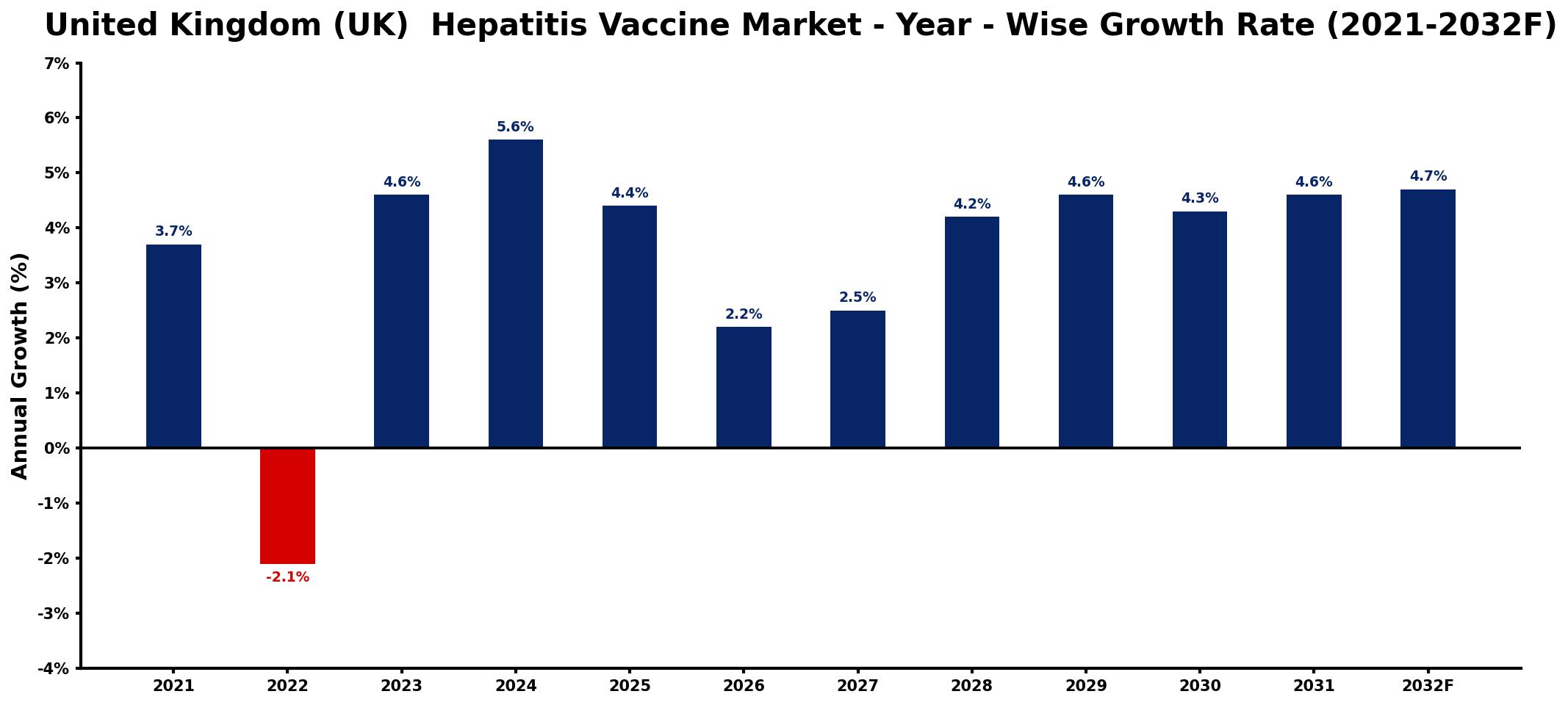
The table below presents the year‑wise growth rates along with the key drivers influencing the market
| Year | Growth Rate | Major Drivers |
| 2021 | 3.7% | Rising awareness of preventive healthcare |
| 2022 | -2.1% | Decreased funding for health initiatives |
| 2023 | 4.6% | Increased government healthcare spending |
| 2024 | 5.6% | Growth in healthcare infrastructure investment |
| 2025 | 4.4% | Expansion of immunization programs nationwide |
| 2026 | 2.2% | Emergence of new healthcare technologies |
| 2027 | 2.5% | Higher public health campaign visibility |
| 2028 | 4.2% | Surge in global health collaboration |
| 2029 | 4.6% | Enhanced research and development funding |
| 2030 | 4.3% | Growing emphasis on preventive measures |
| 2031 | 4.6% | Strengthened partnerships with healthcare providers |
| 2032 | 4.7% | stronger distribution network expansion |
Note: Market size estimations and growth projections presented in this report are based on 6Wresearch's proprietary forecasting methodology, utilizing the latest available industry data, government publications, and primary research inputs.
United Kingdom (UK) Hepatitis Vaccine Market Synopsis
In the UK, the demand for hepatitis vaccines is significantly influenced by rising reports of hepatitis cases, which have heightened the urgency for preventive healthcare measures. Government-backed initiatives play a crucial role in facilitating access to these vaccines, especially among vulnerable populations.
Moreover, the collaboration between healthcare providers and public health agencies fosters a comprehensive approach to vaccination campaigns, aiming to reduce the incidence of hepatitis infections. With growing attention towards preventive healthcare, the market is positioned for sustained growth as new vaccines are developed and distributed.
United Kingdom (UK) Hepatitis Vaccine Market Key Takeaways
- The market reflects a strong growth trajectory fueled by heightened public awareness and vaccination initiatives.
- Technological advancements in vaccine development are enhancing the efficacy and uptake of hepatitis vaccines.
- Collaboration among government agencies and healthcare providers is pivotal for the success of vaccination campaigns.
- Investment opportunities are expected to rise due to increased funding for public health initiatives.
- Challenges remain in educating the public about vaccination importance and addressing procurement complexities.
Evaluation of Restraints in United Kingdom (UK) Hepatitis Vaccine Market
Despite the encouraging outlook, several restraints persist in the UK hepatitis vaccine market. Limited awareness among the general populace often results in lower vaccination rates, particularly in underprivileged communities. Moreover, budgetary constraints within the National Health Service can lead to access issues, impacting the overall distribution of vaccines. The regulatory landscape, characterized by intricate procurement processes, may also deter efficient vaccine supply, creating bottlenecks. These challenges necessitate a concerted effort from all stakeholders involved to ensure effective vaccine rollout and education.
United Kingdom (UK) Hepatitis Vaccine Market Trends
Current trends in the UK hepatitis vaccine market highlight a growing emphasis on vaccination for all age groups, bolstered by enhanced public health campaigns. The introduction of combination vaccines is on the rise, promising improved convenience and coverage. Furthermore, technological advancements are increasingly shaping vaccine efficacy, making them more appealing to both healthcare providers and patients. Public health awareness campaigns have been crucial in shifting perceptions towards preventive healthcare, thus increasing the demand for hepatitis vaccines.
United Kingdom (UK) Hepatitis Vaccine Market Opportunities
Investment opportunities abound in the UK hepatitis vaccine market, particularly due to the increasing focus on preventative measures and immunization programs. Companies involved in the research, development, and distribution of innovative vaccines stand to gain significantly from this burgeoning market. The landscape is ripe for innovation, with a pressing need for more effective vaccine solutions to meet public health objectives. Additionally, partnerships with healthcare organizations and government agencies can pave the way for broader vaccination coverage and community outreach.
Government Initiatives in the United Kingdom (UK) Hepatitis Vaccine Market
The UK government has established a robust vaccination framework that includes the hepatitis B vaccine, particularly targeting at-risk groups. Vaccination is provided free of charge to healthcare workers, people with chronic liver diseases, and those who inject drugs, thus ensuring the protection of vulnerable populations. By setting clear guidelines and promoting the importance of vaccination, the UK Department of Health aims to significantly reduce the prevalence of hepatitis infections through strategic public health campaigns and educational efforts.
Future Insights of the United Kingdom (UK) Hepatitis Vaccine Market
Looking ahead to the period between 2026 and 2032, the UK hepatitis vaccine market is projected to continue its steady growth trajectory. This is largely attributed to ongoing efforts by the government to enhance awareness about vaccination and address rising infection rates. Innovations in vaccine development, coupled with increased healthcare funding, are expected to stimulate market expansion. However, ongoing challenges such as vaccine hesitancy and the need for public education must be addressed to fully realize the market's potential.
United Kingdom (UK) Hepatitis Vaccine Market Latest Developments (2025 - 2026)
Recent industry developments indicate a continued commitment to enhancing the accessibility and effectiveness of hepatitis vaccines within the UK. Public health initiatives are increasingly utilizing technology-driven approaches to facilitate vaccine awareness and uptake. Collaborations among healthcare institutions have intensified, aimed at improving vaccination coverage across diverse demographics. The introduction of newer vaccine formulations is anticipated, further bolstering the efforts to combat hepatitis effectively.
United Kingdom (UK) Hepatitis Vaccine Market - Key Attractiveness of the Report
- 10 Years of Market Numbers
- Historical Data Starting from 2022 to 2025
- Base Year: 2025
- Forecast Data until 2032
- Key Performance Indicators Impacting the Market
- Major Upcoming Developments and Projects
Key Highlights of the Report:
- United Kingdom (UK) Hepatitis Vaccine Market Outlook
- Market Size of United Kingdom (UK) Hepatitis Vaccine Market, 2025
- Forecast of United Kingdom (UK) Hepatitis Vaccine Market, 2032
- Historical Data and Forecast of United Kingdom (UK) Hepatitis Vaccine Revenues & Volume for the Period 2022-2032F
- United Kingdom (UK) Hepatitis Vaccine Market Trend Evolution
- United Kingdom (UK) Hepatitis Vaccine Market Drivers and Challenges
- United Kingdom (UK) Hepatitis Vaccine Price Trends
- United Kingdom (UK) Hepatitis Vaccine Porter's Five Forces
- United Kingdom (UK) Hepatitis Vaccine Industry Life Cycle
- Historical Data and Forecast of United Kingdom (UK) Hepatitis Vaccine Market Revenues & Volume By Indication for the Period 2022-2032F
- Historical Data and Forecast of United Kingdom (UK) Hepatitis Vaccine Market Revenues & Volume By Hepatitis A for the Period 2022-2032F
- Historical Data and Forecast of United Kingdom (UK) Hepatitis Vaccine Market Revenues & Volume By Hepatitis B for the Period 2022-2032F
- Historical Data and Forecast of United Kingdom (UK) Hepatitis Vaccine Market Revenues & Volume By Vaccine Type for the Period 2022-2032F
- Historical Data and Forecast of United Kingdom (UK) Hepatitis Vaccine Market Revenues & Volume By Recombinant Vaccine for the Period 2022-2032F
- Historical Data and Forecast of United Kingdom (UK) Hepatitis Vaccine Market Revenues & Volume By Inactivated Vaccine for the Period 2022-2032F
- Historical Data and Forecast of United Kingdom (UK) Hepatitis Vaccine Market Revenues & Volume By Distribution Channel for the Period 2022-2032F
- Historical Data and Forecast of United Kingdom (UK) Hepatitis Vaccine Market Revenues & Volume By Hospitals for the Period 2022-2032F
- Historical Data and Forecast of United Kingdom (UK) Hepatitis Vaccine Market Revenues & Volume By Retail Pharmacy for the Period 2022-2032F
- Historical Data and Forecast of United Kingdom (UK) Hepatitis Vaccine Market Revenues & Volume By Online Pharmacy for the Period 2022-2032F
- United Kingdom (UK) Hepatitis Vaccine Import Export Trade Statistics
- Market Opportunity Assessment By Indication
- Market Opportunity Assessment By Vaccine Type
- Market Opportunity Assessment By Distribution Channel
- United Kingdom (UK) Hepatitis Vaccine Top Companies Market Share
- United Kingdom (UK) Hepatitis Vaccine Competitive Benchmarking By Technical and Operational Parameters
- United Kingdom (UK) Hepatitis Vaccine Company Profiles
- United Kingdom (UK) Hepatitis Vaccine Key Strategic Recommendations






































