United Kingdom (UK) Natural Fragrance Market Size, Share & Growth Rate
The United Kingdom (UK) Natural Fragrance Market was estimated at USD 226 Million in 2025 and is projected to reach USD 281 Million by 2032, growing at a CAGR of 3.2% from 2026 to 2032. This growth trajectory is fueled by a notable shift in consumer preferences towards natural and sustainable products, particularly in the beauty and personal care segments. The rise in awareness regarding the adverse effects of synthetic fragrances and a heightened interest in clean beauty practices are expected to further catalyze market expansion.
United Kingdom (UK) Natural Fragrance Market Year-wise Growth Rate and Key Drivers
This graph highlights how the United Kingdom (UK) Natural Fragrance Market has steadily grown over the years, supported by major growth factors.
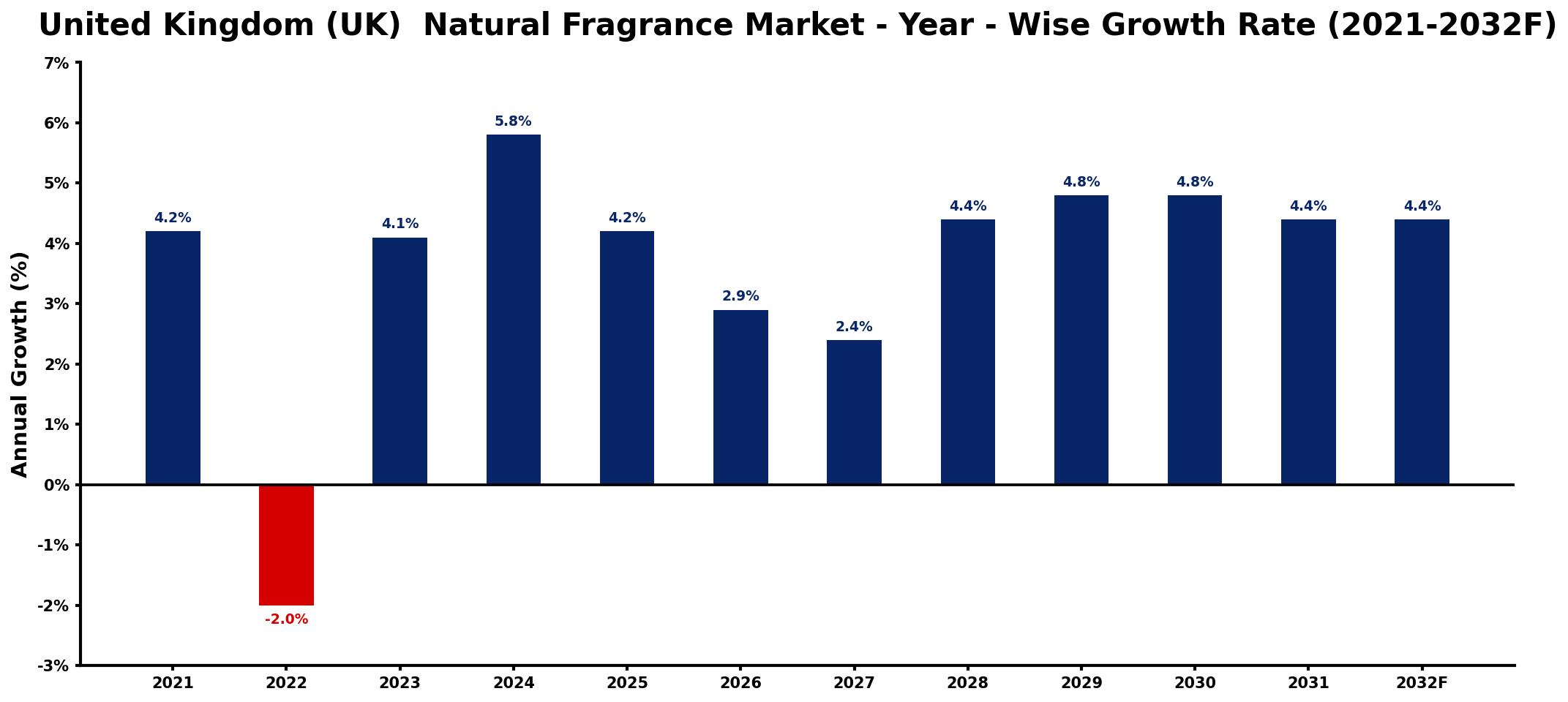
The table below presents the year‑wise growth rates along with the key drivers influencing the market
| Year | Growth Rate | Major Drivers |
| 2021 | 4.2% | Rising consumer interest in wellness |
| 2022 | -2.0% | Decline in retail foot traffic |
| 2023 | 4.1% | Increased focus on sustainability initiatives |
| 2024 | 5.8% | Expansion of online shopping platforms |
| 2025 | 4.2% | Growth in eco-friendly packaging solutions |
| 2026 | 2.9% | Enhanced marketing strategies for engagement |
| 2027 | 2.4% | Surge in niche market segments |
| 2028 | 4.4% | Investments in artisanal production methods |
| 2029 | 4.8% | Collaboration with wellness influencers |
| 2030 | 4.8% | Emergence of personalized scent experiences |
| 2031 | 4.4% | Focus on holistic lifestyle integration |
| 2032 | 4.4% | Development of innovative sourcing techniques |
Note: Market size estimations and growth projections presented in this report are based on 6Wresearch's proprietary forecasting methodology, utilizing the latest available industry data, government publications, and primary research inputs.
United Kingdom (UK) Natural Fragrance Market Synopsis
The most significant force shaping the UK natural fragrance market is the rising consumer demand for clean, eco-friendly products. As awareness around the benefits of using botanical-derived fragrances increases, consumers are actively seeking options that align with their values of sustainability and health.
Moreover, the innovations in fragrance formulations—including vegan-friendly and organic alternatives—are expanding the market's reach. As companies invest in sustainable extraction methods and transparent ingredient sourcing, they are enhancing consumer trust and driving sales in this evolving landscape.
United Kingdom (UK) Natural Fragrance Market Key Takeaways
- The UK natural fragrance market is experiencing robust growth, driven by increased consumer interest in sustainable and organic products.
- Heightened awareness of synthetic fragrance allergies is pushing consumers towards natural alternatives.
- Innovations in formulations are catering to a broader demographic seeking vegan and non-toxic options.
- Transparency in sourcing and safety standards is becoming a critical factor for consumer trust.
- Government policies are encouraging sustainable practices and ethical sourcing within the industry.
Evaluation of Restraints in United Kingdom (UK) Natural Fragrance Market
Despite its growth potential, the UK natural fragrance market faces certain restraints that could limit its expansion. Sourcing sustainable raw materials poses a significant challenge, as it requires adherence to both ethical and environmental standards. Additionally, navigating the intricate landscape of regulatory requirements for organic certification can deter smaller brands. Consumer expectations for transparency demand robust systems in ingredient sourcing, which can impose further operational challenges.
United Kingdom (UK) Natural Fragrance Market Trends
Current trends highlight a shift towards personalization in fragrance offerings, as consumers increasingly seek unique scents that resonate with their individual preferences. Furthermore, the integration of technology, such as AI in fragrance formulation and online customization platforms, is gaining momentum. Brands are also embracing transparency by disclosing sourcing practices and ingredient origins, which caters to the discerning consumer.
United Kingdom (UK) Natural Fragrance Market Opportunities
There are substantial opportunities for growth in the UK natural fragrance market, particularly within the organic and vegan segments. Brands that prioritize sustainable practices and ethical sourcing can capitalize on the growing consumer base that values environmentally friendly products. Additionally, the rise of e-commerce platforms provides an avenue for brands to reach a wider audience, enhancing accessibility to natural fragrance offerings.
Government Initiatives in the United Kingdom (UK) Natural Fragrance Market
The UK government is actively supporting the natural fragrance market through policies that emphasize sustainable and ethical sourcing of raw materials. These regulations ensure that products meet stringent safety and quality standards, which bolster consumer confidence. Furthermore, initiatives promoting environmentally friendly practices and fair trade are helping to create a more sustainable industry, aligning government objectives with market growth.
Future Insights of the United Kingdom (UK) Natural Fragrance Market
Looking ahead to 2026-2032, the UK natural fragrance market is set to evolve significantly, driven by consumer advocacy for clean beauty and eco-conscious products. The increasing incorporation of natural ingredients into mainstream offerings is likely to attract new consumers, while innovations in scent technology promise to enhance personalization options. As brands continue to navigate regulatory landscapes and consumer expectations, the emphasis on transparency will remain crucial, shaping the future landscape of this burgeoning market.
United Kingdom (UK) Natural Fragrance Market Latest Developments (2025 - 2026)
Recent developments in the UK natural fragrance market indicate a growing trend towards sustainable production practices, with several brands launching initiatives aimed at reducing their carbon footprints. Additionally, collaborations between fragrance houses and botanical farms are emerging, enhancing the traceability of ingredients. The demand for personalized fragrance experiences is also leading to increased investments in technology to facilitate consumer customization and engagement.
United Kingdom (UK) Natural Fragrance Market - Key Attractiveness of the Report
- 10 Years of Market Numbers
- Historical Data Starting from 2022 to 2025
- Base Year: 2025
- Forecast Data until 2032
- Key Performance Indicators Impacting the Market
- Major Upcoming Developments and Projects
Key Highlights of the Report:
- United Kingdom (UK) Natural Fragrance Market Outlook
- Market Size of United Kingdom (UK) Natural Fragrance Market, 2025
- Forecast of United Kingdom (UK) Natural Fragrance Market, 2032
- Historical Data and Forecast of United Kingdom (UK) Natural Fragrance Revenues & Volume for the Period 2022-2032F
- United Kingdom (UK) Natural Fragrance Market Trend Evolution
- United Kingdom (UK) Natural Fragrance Market Drivers and Challenges
- United Kingdom (UK) Natural Fragrance Price Trends
- United Kingdom (UK) Natural Fragrance Porter's Five Forces
- United Kingdom (UK) Natural Fragrance Industry Life Cycle
- Historical Data and Forecast of United Kingdom (UK) Natural Fragrance Market Revenues & Volume By Ingredient for the Period 2022-2032F
- Historical Data and Forecast of United Kingdom (UK) Natural Fragrance Market Revenues & Volume By Essential Oils for the Period 2022-2032F
- Historical Data and Forecast of United Kingdom (UK) Natural Fragrance Market Revenues & Volume By Natural Extracts for the Period 2022-2032F
- Historical Data and Forecast of United Kingdom (UK) Natural Fragrance Market Revenues & Volume By Type for the Period 2022-2032F
- Historical Data and Forecast of United Kingdom (UK) Natural Fragrance Market Revenues & Volume By Top note for the Period 2022-2032F
- Historical Data and Forecast of United Kingdom (UK) Natural Fragrance Market Revenues & Volume By Middle Note for the Period 2022-2032F
- Historical Data and Forecast of United Kingdom (UK) Natural Fragrance Market Revenues & Volume By Base Note for the Period 2022-2032F
- Historical Data and Forecast of United Kingdom (UK) Natural Fragrance Market Revenues & Volume By Application for the Period 2022-2032F
- Historical Data and Forecast of United Kingdom (UK) Natural Fragrance Market Revenues & Volume By Fine Fragrances for the Period 2022-2032F
- Historical Data and Forecast of United Kingdom (UK) Natural Fragrance Market Revenues & Volume By Personal Care & Cosmetics for the Period 2022-2032F
- Historical Data and Forecast of United Kingdom (UK) Natural Fragrance Market Revenues & Volume By Household Care for the Period 2022-2032F
- United Kingdom (UK) Natural Fragrance Import Export Trade Statistics
- Market Opportunity Assessment By Ingredient
- Market Opportunity Assessment By Type
- Market Opportunity Assessment By Application
- United Kingdom (UK) Natural Fragrance Top Companies Market Share
- United Kingdom (UK) Natural Fragrance Competitive Benchmarking By Technical and Operational Parameters
- United Kingdom (UK) Natural Fragrance Company Profiles
- United Kingdom (UK) Natural Fragrance Key Strategic Recommendations






































