United Kingdom (UK) Organic Poultry Market Size, Share & Growth Rate
The United Kingdom (UK) Organic Poultry Market was estimated at USD 221 Million in 2025 and is projected to reach USD 274 Million by 2032, growing at a CAGR of 3.1% from 2026 to 2032. This growth trajectory is primarily driven by the increasing consumer preference for organic and ethically sourced food products, as well as heightened awareness around health and sustainability issues. As consumers become more discerning about their food choices, the demand for organic poultry continues to gain traction.
United Kingdom (UK) Organic Poultry Market Year-wise Growth Rate and Key Drivers
This graph highlights how the United Kingdom (UK) Organic Poultry Market has steadily grown over the years, supported by major growth factors.
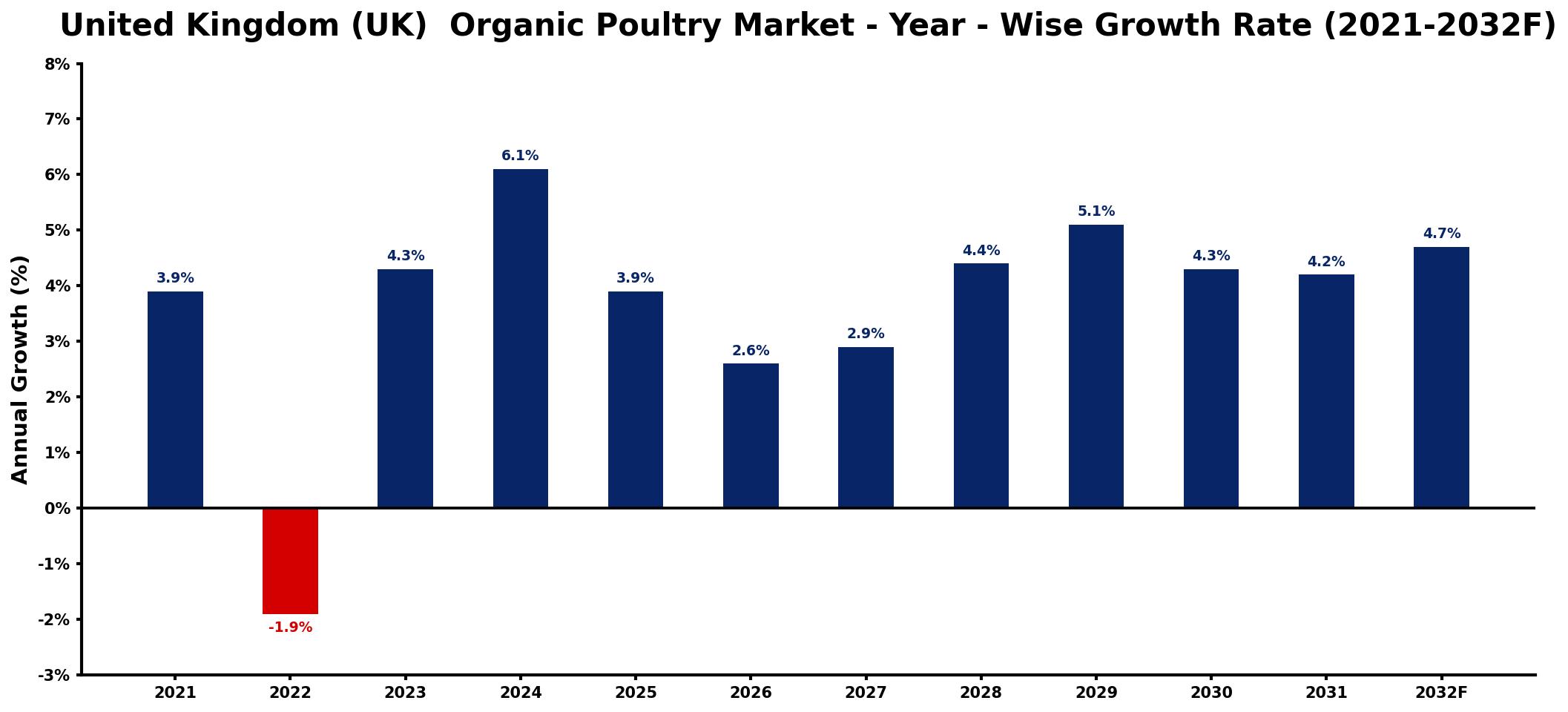
The table below presents the year‑wise growth rates along with the key drivers influencing the market
| Year | Growth Rate | Major Drivers |
| 2021 | 3.9% | Increased consumer health awareness |
| 2022 | -1.9% | Supply chain disruptions impact availability |
| 2023 | 4.3% | Rising demand for ethical sourcing |
| 2024 | 6.1% | Expansion of premium product lines |
| 2025 | 3.9% | Growing interest in local sourcing |
| 2026 | 2.6% | Enhanced marketing strategies boost visibility |
| 2027 | 2.9% | Innovation in sustainable farming practices |
| 2028 | 4.4% | Increased export opportunities for products |
| 2029 | 5.1% | Collaborations with health-focused retailers |
| 2030 | 4.3% | Emergence of new consumer segments |
| 2031 | 4.2% | Higher investments in production technology |
| 2032 | 4.7% | Strengthened online sales channels |
Note: Market size estimations and growth projections presented in this report are based on 6Wresearch's proprietary forecasting methodology, utilizing the latest available industry data, government publications, and primary research inputs.
United Kingdom (UK) Organic Poultry Market Synopsis
The UK organic poultry market is witnessing a significant shift towards free-range and organic products, prompted by a growing consumer inclination towards transparency and quality. With increasing awareness of the benefits associated with organic farming practices, consumers are prioritizing products that uphold stringent welfare standards.
The market landscape is shaped by a variety of players, including dedicated organic poultry farms, supermarkets, and specialty stores that cater to the rising demand for organic chicken, turkey, and other poultry options. Stringent regulations and certifications foster consumer trust, enabling the market to flourish amid the current demand for ethically produced food.
United Kingdom (UK) Organic Poultry Market Key Takeaways
- The UK organic poultry market is set to expand as health-conscious consumers prioritize organic options.
- Growth is driven by increasing awareness of animal welfare and sustainable farming practices.
- Product innovation is critical, with demand for ready-to-cook and convenient organic poultry options on the rise.
- Stringent regulations ensure high-quality standards and enhance consumer trust.
- Investment opportunities abound in value-added organic poultry products and farming operations.
Evaluation of Restraints in United Kingdom (UK) Organic Poultry Market
While the UK organic poultry market shows promising growth, it faces certain inherent restraints that can hinder its progression. The cost of production remains significantly higher compared to conventional poultry due to stringent organic farming standards. This translates to elevated prices for organic products, which may limit accessibility for some consumers. Furthermore, the fluctuating availability of organic feed ingredients complicates profit margins for farmers, as does the cumbersome certification process required for organic status. This confluence of factors creates a challenging landscape, necessitating strategic innovations to enhance competitive positioning.
United Kingdom (UK) Organic Poultry Market Trends
Current trends in the UK organic poultry market reveal a strong consumer preference for free-range and organic products, influenced by increasing knowledge surrounding the ethical implications of food sourcing. The demand for transparency throughout the supply chain compels producers to adopt more sustainable practices. Additionally, convenience is becoming a focal point for consumers, leading to a rise in ready-to-eat organic poultry meals and innovative packaging solutions that cater to busy lifestyles. These trends illustrate the evolving dynamics of the market, as producers adapt to meet changing consumer preferences.
United Kingdom (UK) Organic Poultry Market Opportunities
The organic poultry market in the UK presents a myriad of investment opportunities driven by the escalating demand for ethically sourced food. There is significant potential for growth in organic poultry farming, as consumers increasingly seek out products devoid of antibiotics, hormones, and GMOs. Value-added products such as organic sausages, ready-to-eat meals, and deli meats are emerging as lucrative segments within this market. As government support for sustainable agriculture continues to bolster the industry, stakeholders have the chance to seize the momentum and innovate in this rapidly evolving landscape.
Government Initiatives in the United Kingdom (UK) Organic Poultry Market
The UK government has undertaken various initiatives to bolster the organic poultry sector through regulations and support measures. Established standards and certification requirements ensure the organic status of poultry products, thereby promoting consumer confidence. Financial incentives and subsidies aim to encourage sustainable farming practices among organic poultry producers. Additionally, regular inspections and audits reinforce compliance with organic regulations, further enhancing the integrity of the market. Overall, these government policies play a pivotal role in promoting the growth and sustainability of the organic poultry industry in the UK.
Future Insights of the United Kingdom (UK) Organic Poultry Market
Looking ahead to 2026-2032, the UK organic poultry market is positioned for continued expansion driven by a robust demand for health-oriented and ethically produced food products. The increasing awareness surrounding health implications tied to conventional poultry farming, coupled with a greater emphasis on sustainability, will support market growth. Furthermore, the introduction of innovative products and improved distribution channels will enhance accessibility for consumers. As the market continues to mature, strategic investments in product development and marketing initiatives will be crucial for maintaining competitiveness in this evolving food landscape.
United Kingdom (UK) Organic Poultry Market Latest Developments (2025 - 2026)
In recent months, the UK organic poultry market has seen notable developments, including a rise in partnerships between organic farms and retailers aimed at expanding product availability. Innovations in packaging designed to extend shelf life while maintaining organic integrity are becoming more prevalent. Additionally, several organic poultry producers have introduced new lines of ready-to-eat meals, reflecting the consumer trend towards convenience. The ongoing dialogue around sustainability has also led to increased collaboration between government bodies and organic producers to support environmentally friendly practices.
United Kingdom (UK) Organic Poultry Market - Key Attractiveness of the Report
- 10 Years of Market Numbers
- Historical Data Starting from 2022 to 2025
- Base Year: 2025
- Forecast Data until 2032
- Key Performance Indicators Impacting the Market
- Major Upcoming Developments and Projects
Key Highlights of the Report:
- United Kingdom (UK) Organic Poultry Market Outlook
- Market Size of United Kingdom (UK) Organic Poultry Market, 2025
- Forecast of United Kingdom (UK) Organic Poultry Market, 2032
- Historical Data and Forecast of United Kingdom (UK) Organic Poultry Revenues & Volume for the Period 2022-2032F
- United Kingdom (UK) Organic Poultry Market Trend Evolution
- United Kingdom (UK) Organic Poultry Market Drivers and Challenges
- United Kingdom (UK) Organic Poultry Price Trends
- United Kingdom (UK) Organic Poultry Porter's Five Forces
- United Kingdom (UK) Organic Poultry Industry Life Cycle
- Historical Data and Forecast of United Kingdom (UK) Organic Poultry Market Revenues & Volume By Type for the Period 2022-2032F
- Historical Data and Forecast of United Kingdom (UK) Organic Poultry Market Revenues & Volume By Organic Eggs for the Period 2022-2032F
- Historical Data and Forecast of United Kingdom (UK) Organic Poultry Market Revenues & Volume By Organic Meat for the Period 2022-2032F
- Historical Data and Forecast of United Kingdom (UK) Organic Poultry Market Revenues & Volume By Sales Channel for the Period 2022-2032F
- Historical Data and Forecast of United Kingdom (UK) Organic Poultry Market Revenues & Volume By Business To Business for the Period 2022-2032F
- Historical Data and Forecast of United Kingdom (UK) Organic Poultry Market Revenues & Volume By Business To Consumer for the Period 2022-2032F
- United Kingdom (UK) Organic Poultry Import Export Trade Statistics
- Market Opportunity Assessment By Type
- Market Opportunity Assessment By Sales Channel
- United Kingdom (UK) Organic Poultry Top Companies Market Share
- United Kingdom (UK) Organic Poultry Competitive Benchmarking By Technical and Operational Parameters
- United Kingdom (UK) Organic Poultry Company Profiles
- United Kingdom (UK) Organic Poultry Key Strategic Recommendations






































