United Kingdom (UK) Personal Computers Market Size, Share & Growth Rate
The United Kingdom (UK) Personal Computers Market was estimated at USD 164 Million in 2025 and is projected to reach USD 201 Million by 2032, growing at a CAGR of 2.9% from 2026 to 2032. This upward trajectory is driven by a robust demand for portable computing solutions, particularly as remote work and online learning continue to solidify their presence in everyday life. Additionally, the surge in gaming and a growing emphasis on sustainability are fostering a new wave of innovation within the market, reinforcing its competitive landscape.
United Kingdom (UK) Personal Computers Market Year-wise Growth Rate and Key Drivers
This graph highlights how the United Kingdom (UK) Personal Computers Market has steadily grown over the years, supported by major growth factors.
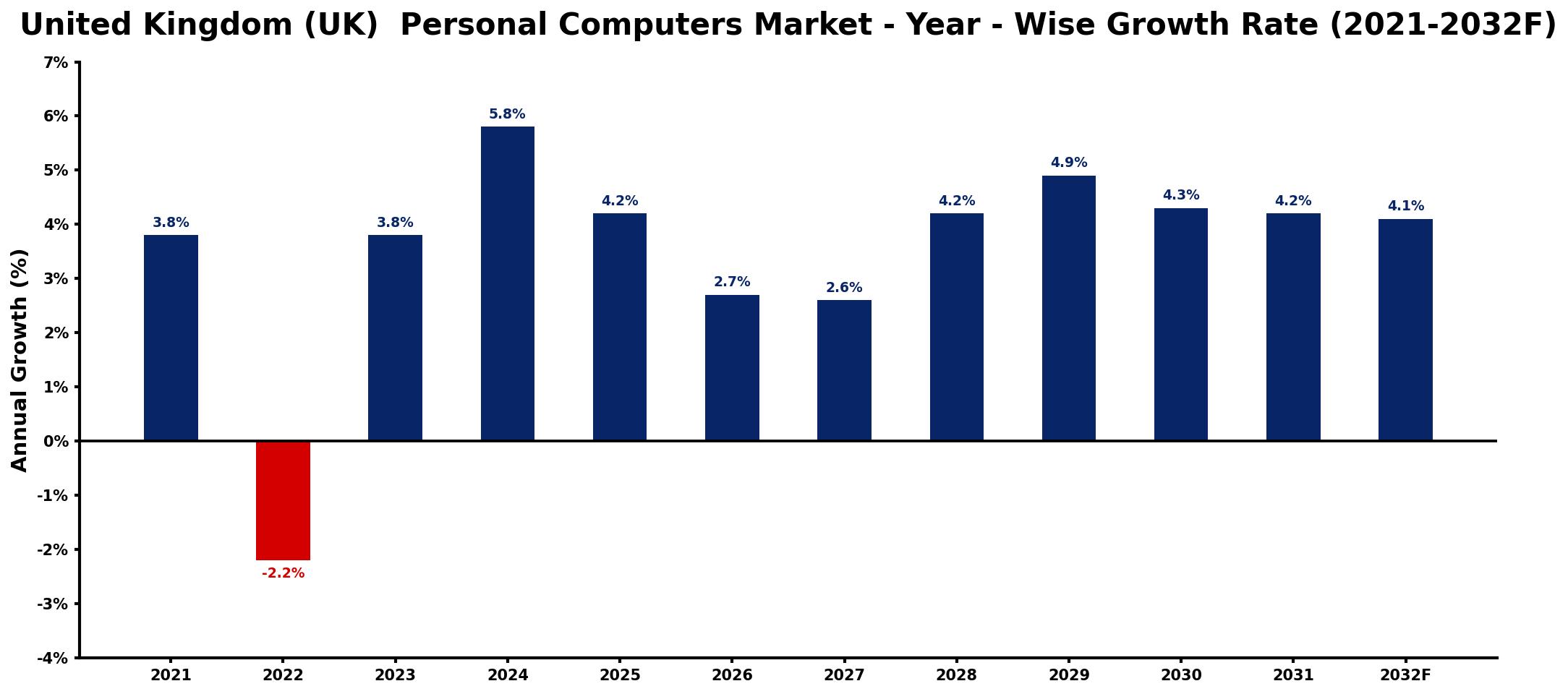
The table below presents the year‑wise growth rates along with the key drivers influencing the market
| Year | Growth Rate | Major Drivers |
| 2021 | 3.8% | Rising remote work adoption rates |
| 2022 | -2.2% | Decreased consumer spending trends |
| 2023 | 3.8% | Increased demand for home offices |
| 2024 | 5.8% | Growth in gaming and eSports |
| 2025 | 4.2% | Surge in educational technology investments |
| 2026 | 2.7% | Expansion of cloud computing services |
| 2027 | 2.6% | growing downstream application demand |
| 2028 | 4.2% | Increased interest in AI applications |
| 2029 | 4.9% | Rising popularity of telehealth solutions |
| 2030 | 4.3% | increased domestic production output |
| 2031 | 4.2% | growing emerging market penetration |
| 2032 | 4.1% | Increased focus on sustainability initiatives |
Note: Market size estimations and growth projections presented in this report are based on 6Wresearch's proprietary forecasting methodology, utilizing the latest available industry data, government publications, and primary research inputs.
United Kingdom (UK) Personal Computers Market Synopsis
The UK Personal Computers Market is currently thriving, fueled by the dynamic interplay of technological advancement and shifting consumer habits. Notably, an increased focus on remote work has led to an uptick in demand for reliable computing devices, further propelling market evolution.
As businesses, educational institutions, and individuals adapt to changing work and learning environments, the market for personal computers is broadening. The rise of gaming as a prevalent form of entertainment is also driving the demand for high-performance machines, adding another layer of complexity to this mature industry.
United Kingdom (UK) Personal Computers Market Key Takeaways
- The market is experiencing steady growth, driven by increasing demand for laptops and gaming PCs.
- Environmental sustainability is influencing product design and consumer purchasing decisions.
- Remote work and online learning trends continue to drive significant sales in the personal computer segment.
- Competitive pressure from mobile devices is reshaping the traditional PC landscape.
- Technological advancements are paving the way for innovative features and enhanced user experiences.
Evaluation of Restraints in United Kingdom (UK) Personal Computers Market
Despite a generally positive outlook, the UK Personal Computers Market faces several challenges that could hinder its growth. The increasing preference for mobile devices, such as smartphones and tablets, poses a direct threat to traditional PCs. Economic fluctuations, particularly those stemming from Brexit, have created a layer of uncertainty affecting both consumer and business spending on technology. Furthermore, rapid technological advancements have resulted in shorter product life cycles, compelling manufacturers to innovate continually. Together, these factors create an intricate landscape where adaptation and flexibility are paramount for success.
United Kingdom (UK) Personal Computers Market Trends
Several trends are currently shaping the UK Personal Computers Market. The demand for lightweight and portable laptops is on the rise, driven by flexible work arrangements that prioritize mobility. Gaming PCs have surged in popularity, with consumers increasingly seeking machines capable of delivering high-performance graphics and speed. Moreover, sustainability has become a prominent factor, leading to a greater availability of energy-efficient PCs crafted from recycled materials. Finally, as educational paradigms shift toward digital classrooms, the demand for reliable desktop and laptop solutions is further solidified.
United Kingdom (UK) Personal Computers Market Opportunities
Investment opportunities within the UK Personal Computers Market are abundant. Companies focusing on ergonomic designs, advanced gaming capabilities, and high-performance computing devices are well-positioned for growth. The software sector also presents promising avenues, particularly in cybersecurity solutions and cloud-based services tailored for remote work environments. Additionally, investing in e-commerce platforms that specialize in PC sales could yield significant returns, especially with the continued rise in digital device reliance. As consumer needs evolve, opportunities abound for innovative and forward-thinking enterprises.
Government Initiatives in the United Kingdom (UK) Personal Computers Market
The UK government has enacted various policies to bolster competition and foster innovation within the Personal Computers Market. The Consumer Rights Act empowers consumers by guaranteeing the right to repair or replace faulty devices, which includes personal computers. Furthermore, initiatives aimed at enhancing digital literacy and improving technology access in educational institutions are critical in bridging the digital divide. Regulations pertaining to data protection and cybersecurity also play an essential role in safeguarding users, thereby contributing to a secure market environment.
Future Insights of the United Kingdom (UK) Personal Computers Market
Looking ahead to the years 2026 through 2032, the UK Personal Computers Market is projected to sustain its growth trajectory. The increasing demand for powerful computing devices amid a shift toward hybrid work models will significantly boost laptop and desktop sales. As innovations continue to evolve, particularly in gaming and content creation technologies, consumer expectations will drive further market expansion. However, potential disruptions in supply chains and economic uncertainties could pose risks to this optimistic outlook. Overall, continuous adaptation and innovation will be essential for companies aiming to thrive in this dynamic environment.
United Kingdom (UK) Personal Computers Market Latest Developments (2025 - 2026)
Recent developments in the UK Personal Computers Market indicate a strong focus on enhancing user experience through innovative technologies. Companies are increasingly prioritizing sustainable practices, incorporating recycled materials into new products. Additionally, there has been a noticeable uptick in partnerships between hardware manufacturers and software providers to deliver integrated solutions that cater to remote work and gaming needs. Furthermore, e-commerce platforms are optimizing their operations to enhance customer accessibility and service quality, reflecting the competitive nature of the landscape.
United Kingdom (UK) Personal Computers Market - Key Attractiveness of the Report
- 10 Years of Market Numbers
- Historical Data Starting from 2022 to 2025
- Base Year: 2025
- Forecast Data until 2032
- Key Performance Indicators Impacting the Market
- Major Upcoming Developments and Projects
Key Highlights of the Report:
- United Kingdom (UK) Personal Computers Market Outlook
- Market Size of United Kingdom (UK) Personal Computers Market, 2025
- Forecast of United Kingdom (UK) Personal Computers Market, 2032
- Historical Data and Forecast of United Kingdom (UK) Personal Computers Revenues & Volume for the Period 2022-2032F
- United Kingdom (UK) Personal Computers Market Trend Evolution
- United Kingdom (UK) Personal Computers Market Drivers and Challenges
- United Kingdom (UK) Personal Computers Price Trends
- United Kingdom (UK) Personal Computers Porter's Five Forces
- United Kingdom (UK) Personal Computers Industry Life Cycle
- Historical Data and Forecast of United Kingdom (UK) Personal Computers Market Revenues & Volume By Product Type for the Period 2022-2032F
- Historical Data and Forecast of United Kingdom (UK) Personal Computers Market Revenues & Volume By Desktop for the Period 2022-2032F
- Historical Data and Forecast of United Kingdom (UK) Personal Computers Market Revenues & Volume By Notebook for the Period 2022-2032F
- Historical Data and Forecast of United Kingdom (UK) Personal Computers Market Revenues & Volume By Workstation for the Period 2022-2032F
- Historical Data and Forecast of United Kingdom (UK) Personal Computers Market Revenues & Volume By Others for the Period 2022-2032F
- Historical Data and Forecast of United Kingdom (UK) Personal Computers Market Revenues & Volume By Distribution Channel for the Period 2022-2032F
- Historical Data and Forecast of United Kingdom (UK) Personal Computers Market Revenues & Volume By Business-To-Business (B2B) for the Period 2022-2032F
- Historical Data and Forecast of United Kingdom (UK) Personal Computers Market Revenues & Volume By Business-To-Consumer (B2C) for the Period 2022-2032F
- Historical Data and Forecast of United Kingdom (UK) Personal Computers Market Revenues & Volume By Application for the Period 2022-2032F
- Historical Data and Forecast of United Kingdom (UK) Personal Computers Market Revenues & Volume By Consumer for the Period 2022-2032F
- Historical Data and Forecast of United Kingdom (UK) Personal Computers Market Revenues & Volume By Commercial for the Period 2022-2032F
- Historical Data and Forecast of United Kingdom (UK) Personal Computers Market Revenues & Volume By Industrial for the Period 2022-2032F
- United Kingdom (UK) Personal Computers Import Export Trade Statistics
- Market Opportunity Assessment By Product Type
- Market Opportunity Assessment By Distribution Channel
- Market Opportunity Assessment By Application
- United Kingdom (UK) Personal Computers Top Companies Market Share
- United Kingdom (UK) Personal Computers Competitive Benchmarking By Technical and Operational Parameters
- United Kingdom (UK) Personal Computers Company Profiles
- United Kingdom (UK) Personal Computers Key Strategic Recommendations






































