United Kingdom (UK) Plastic Waste Management Market Size, Share & Growth Rate
The United Kingdom (UK) Plastic Waste Management Market was estimated at USD 224 Million in 2025 and is projected to reach USD 276 Million by 2032, growing at a CAGR of 3.0% from 2026 to 2032. This growth trajectory is fueled by increased public awareness regarding plastic pollution and robust governmental policies aimed at waste reduction. As businesses increasingly adopt sustainable practices, the market is set to expand rapidly in response to both consumer demand and regulatory changes.
United Kingdom (UK) Plastic Waste Management Market Year-wise Growth Rate and Key Drivers
This graph highlights how the United Kingdom (UK) Plastic Waste Management Market has steadily grown over the years, supported by major growth factors.
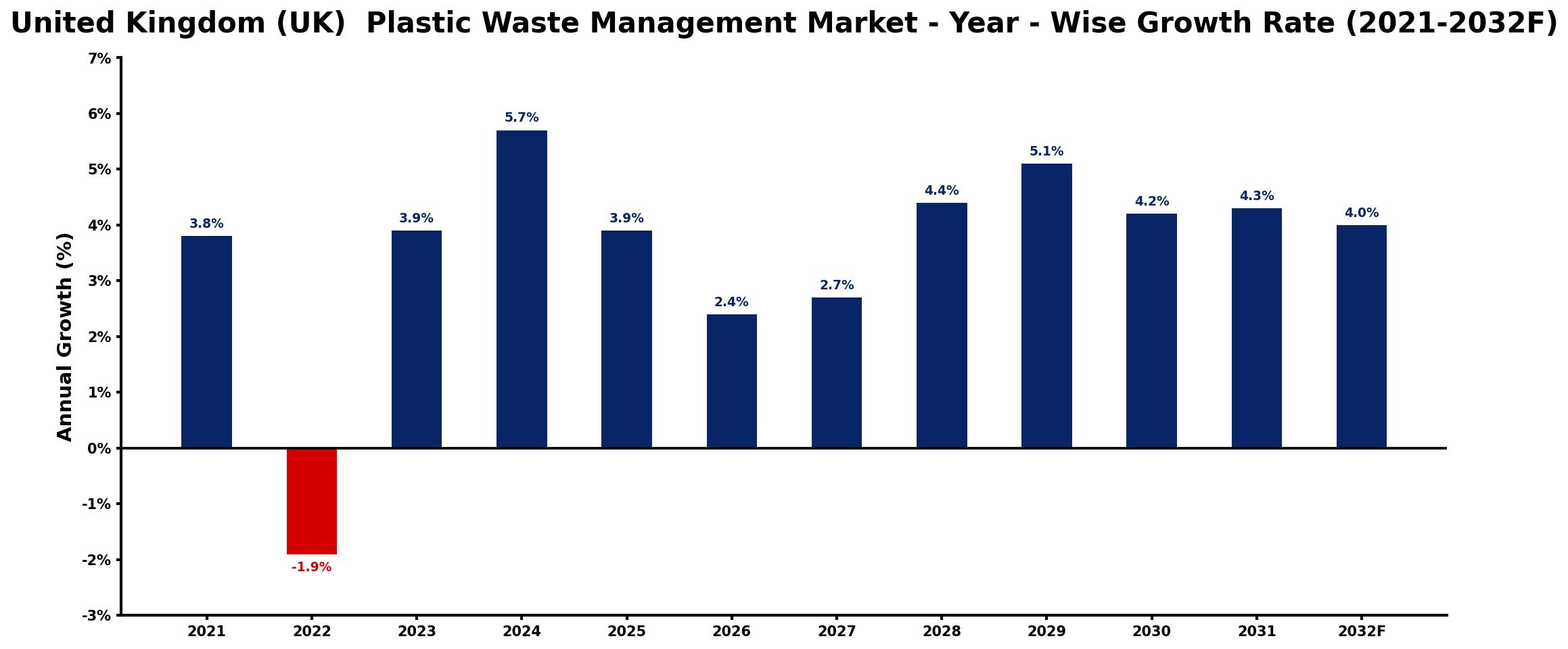
The table below presents the year‑wise growth rates along with the key drivers influencing the market
| Year | Growth Rate | Major Drivers |
| 2021 | 3.8% | Rising consumer recycling awareness |
| 2022 | -1.9% | Decreased industrial recycling initiatives |
| 2023 | 3.9% | Increased corporate sustainability investments |
| 2024 | 5.7% | Growing demand for eco-friendly solutions |
| 2025 | 3.9% | Expansion of recycling infrastructure projects |
| 2026 | 2.4% | Heightened regulatory compliance requirements |
| 2027 | 2.7% | Emergence of innovative recycling technologies |
| 2028 | 4.4% | Surge in public-private partnerships |
| 2029 | 5.1% | increased capital investment inflows |
| 2030 | 4.2% | Increased governmental support programs |
| 2031 | 4.3% | strengthening underlying market demand |
| 2032 | 4.0% | increased pharmaceutical industry usage |
Note: Market size estimations and growth projections presented in this report are based on 6Wresearch's proprietary forecasting methodology, utilizing the latest available industry data, government publications, and primary research inputs.
United Kingdom (UK) Plastic Waste Management Market Synopsis
The UK plastic waste management market is currently experiencing a surge in momentum, driven by an evolving regulatory landscape and heightened environmental awareness among consumers. As the nation grapples with the pressing challenges of plastic waste, it is steadily transitioning towards more sustainable practices, including enhanced recycling initiatives and waste-to-energy solutions.
Looking ahead, the market is expected to embrace a comprehensive shift towards a circular economy model, with stakeholders across various sectors working collaboratively to devise innovative solutions. As the government seeks to achieve zero avoidable plastic waste by 2042, the focus on accountability and sustainability will intensify, paving the way for new opportunities in plastic waste management.
United Kingdom (UK) Plastic Waste Management Market Key Takeaways
- The UK government is committed to eliminating avoidable plastic waste by 2042, driving regulatory changes.
- Investment in advanced recycling technologies is paramount to improving efficiency and increasing recycling rates.
- Collaboration among public and private sectors is essential for developing effective waste management solutions.
- Consumer demand for sustainable products is significantly influencing market dynamics and innovation.
- Extended producer responsibility (EPR) schemes are increasingly holding manufacturers accountable for waste management.
Evaluation of Restraints in United Kingdom (UK) Plastic Waste Management Market
Despite its growth potential, the UK plastic waste management market faces certain restraints that challenge its progress. One primary limitation is the fragmentation of recycling infrastructure, which leads to inadequate recycling rates and a substantial volume of plastic waste being diverted to landfills or incinerated. Furthermore, the complexity of various plastic types and their recyclability complicates efforts toward effective waste management. In light of public pressure and heightened regulatory scrutiny, businesses must navigate these challenges while adapting to evolving policies, particularly following Brexit, which introduces uncertainty into waste management regulations and cross-border collaborations.
United Kingdom (UK) Plastic Waste Management Market Trends
Current trends in the UK plastic waste management market reflect a decisive pivot toward sustainability and innovation. Key areas of focus include the development of advanced recycling technologies that enhance plastic recovery rates and the integration of waste-to-energy solutions that transform plastic waste into renewable energy sources. The rise of extended producer responsibility (EPR) initiatives signals a shift in accountability, compelling manufacturers to prioritize recyclability in product design.
Additionally, consumer demand is driving the creation of innovative biodegradable and compostable packaging solutions, as businesses seek to align with eco-friendly practices. The collaboration among various stakeholders—including government bodies, businesses, and non-profit organizations—continues to shape the landscape, fostering a more effective response to the growing concerns surrounding plastic pollution.
United Kingdom (UK) Plastic Waste Management Market Opportunities
The UK plastic waste management market is ripe with investment opportunities, particularly in areas such as recycling technologies, waste-to-energy facilities, and sustainable packaging innovations. The pressing need for improved recycling systems invites investment in cutting-edge technologies that can efficiently process diverse types of plastic waste. Furthermore, waste-to-energy projects represent a dual benefit, converting unwanted plastic into valuable energy while addressing waste management challenges.
With the demand for eco-friendly packaging solutions on the rise, there is substantial potential for companies focusing on sustainable material development and innovative designs. As awareness and regulatory frameworks surrounding plastic waste continue to strengthen, stakeholders in the UK market can capitalize on these trends to drive growth and profitability.
Government Initiatives in the United Kingdom (UK) Plastic Waste Management Market
The UK government has implemented a range of initiatives to combat plastic waste, reflecting a strong commitment to sustainable practices. Policies such as the Plastic Packaging Tax encourage the use of recycled materials in packaging while discouraging single-use plastics. The Extended Producer Responsibility (EPR) scheme mandates that producers take financial responsibility for the collection and recycling of their products, prompting them to design more recyclable products. Additional measures include a ban on certain single-use plastics, signaling a strong policy alignment aimed at fostering a circular economy in the UK plastic waste management market.
Future Insights of the United Kingdom (UK) Plastic Waste Management Market
Looking ahead, the UK plastic waste management market is set to experience transformative growth from 2026 to 2032. The confluence of regulatory measures and heightened public awareness will catalyze increased investments in innovative waste management solutions. The market is likely to see significant advancements in recycling technologies, including chemical recycling and pyrolysis methods, further driving the efficiency of waste processing.
Moreover, the rising demand for sustainable packaging will continue to shape industry dynamics, with companies increasingly embracing circular economy principles. As partnerships between the public and private sectors deepen, a more integrated and effective plastic waste management system is on the horizon, poised to meet the challenges of plastic pollution head-on.
United Kingdom (UK) Plastic Waste Management Market Latest Developments (2025 - 2026)
Recent developments in the UK plastic waste management sector have focused on enhancing recycling capabilities and advancing collaborative initiatives. Significant strides have been made in establishing partnerships between governmental agencies and private enterprises aimed at developing innovative waste management solutions. Additionally, new technologies are emerging that enhance the efficiency of plastic sorting and recycling processes, marking a pivotal shift in how plastic waste is handled across the UK.
United Kingdom (UK) Plastic Waste Management Market - Key Attractiveness of the Report
- 10 Years of Market Numbers
- Historical Data Starting from 2022 to 2025
- Base Year: 2025
- Forecast Data until 2032
- Key Performance Indicators Impacting the Market
- Major Upcoming Developments and Projects
Key Highlights of the Report:
- United Kingdom (UK) Plastic Waste Management Market Outlook
- Market Size of United Kingdom (UK) Plastic Waste Management Market, 2025
- Forecast of United Kingdom (UK) Plastic Waste Management Market, 2032
- Historical Data and Forecast of United Kingdom (UK) Plastic Waste Management Revenues & Volume for the Period 2022-2032F
- United Kingdom (UK) Plastic Waste Management Market Trend Evolution
- United Kingdom (UK) Plastic Waste Management Market Drivers and Challenges
- United Kingdom (UK) Plastic Waste Management Price Trends
- United Kingdom (UK) Plastic Waste Management Porter's Five Forces
- United Kingdom (UK) Plastic Waste Management Industry Life Cycle
- Historical Data and Forecast of United Kingdom (UK) Plastic Waste Management Market Revenues & Volume By Source for the Period 2022-2032F
- Historical Data and Forecast of United Kingdom (UK) Plastic Waste Management Market Revenues & Volume By Industrial Waste for the Period 2022-2032F
- Historical Data and Forecast of United Kingdom (UK) Plastic Waste Management Market Revenues & Volume By Municipal Waste for the Period 2022-2032F
- Historical Data and Forecast of United Kingdom (UK) Plastic Waste Management Market Revenues & Volume By Material for the Period 2022-2032F
- Historical Data and Forecast of United Kingdom (UK) Plastic Waste Management Market Revenues & Volume By Polyethylene for the Period 2022-2032F
- Historical Data and Forecast of United Kingdom (UK) Plastic Waste Management Market Revenues & Volume By Polypropylene for the Period 2022-2032F
- Historical Data and Forecast of United Kingdom (UK) Plastic Waste Management Market Revenues & Volume By Polyethylene Terephthalate for the Period 2022-2032F
- Historical Data and Forecast of United Kingdom (UK) Plastic Waste Management Market Revenues & Volume By Polystyrene for the Period 2022-2032F
- Historical Data and Forecast of United Kingdom (UK) Plastic Waste Management Market Revenues & Volume By Others for the Period 2022-2032F
- Historical Data and Forecast of United Kingdom (UK) Plastic Waste Management Market Revenues & Volume By Product Type for the Period 2022-2032F
- Historical Data and Forecast of United Kingdom (UK) Plastic Waste Management Market Revenues & Volume By Packaging for the Period 2022-2032F
- Historical Data and Forecast of United Kingdom (UK) Plastic Waste Management Market Revenues & Volume By Construction for the Period 2022-2032F
- Historical Data and Forecast of United Kingdom (UK) Plastic Waste Management Market Revenues & Volume By Automotive for the Period 2022-2032F
- Historical Data and Forecast of United Kingdom (UK) Plastic Waste Management Market Revenues & Volume By Electrical & Electronics for the Period 2022-2032F
- Historical Data and Forecast of United Kingdom (UK) Plastic Waste Management Market Revenues & Volume By Others for the Period 2022-2032F
- Historical Data and Forecast of United Kingdom (UK) Plastic Waste Management Market Revenues & Volume By Treatment Method for the Period 2022-2032F
- Historical Data and Forecast of United Kingdom (UK) Plastic Waste Management Market Revenues & Volume By Collection for the Period 2022-2032F
- Historical Data and Forecast of United Kingdom (UK) Plastic Waste Management Market Revenues & Volume By Recycling for the Period 2022-2032F
- Historical Data and Forecast of United Kingdom (UK) Plastic Waste Management Market Revenues & Volume By Disposal for the Period 2022-2032F
- United Kingdom (UK) Plastic Waste Management Import Export Trade Statistics
- Market Opportunity Assessment By Source
- Market Opportunity Assessment By Material
- Market Opportunity Assessment By Product Type
- Market Opportunity Assessment By Treatment Method
- United Kingdom (UK) Plastic Waste Management Top Companies Market Share
- United Kingdom (UK) Plastic Waste Management Competitive Benchmarking By Technical and Operational Parameters
- United Kingdom (UK) Plastic Waste Management Company Profiles
- United Kingdom (UK) Plastic Waste Management Key Strategic Recommendations






































