United Kingdom (UK) Polymer Clay Market Size, Share & Growth Rate
The United Kingdom (UK) Polymer Clay Market was estimated at USD 452 Million in 2025 and is projected to reach USD 562 Million by 2032, growing at a CAGR of 3.2% from 2026 to 2032. This growth trajectory is primarily fueled by the surging interest in arts and crafts, particularly in the realm of DIY projects. As more consumers embrace creativity through hobbies such as jewelry making and model construction, the demand for versatile and high-quality polymer clay continues to rise.
United Kingdom (UK) Polymer Clay Market Year-wise Growth Rate and Key Drivers
This graph highlights how the United Kingdom (UK) Polymer Clay Market has steadily grown over the years, supported by major growth factors.
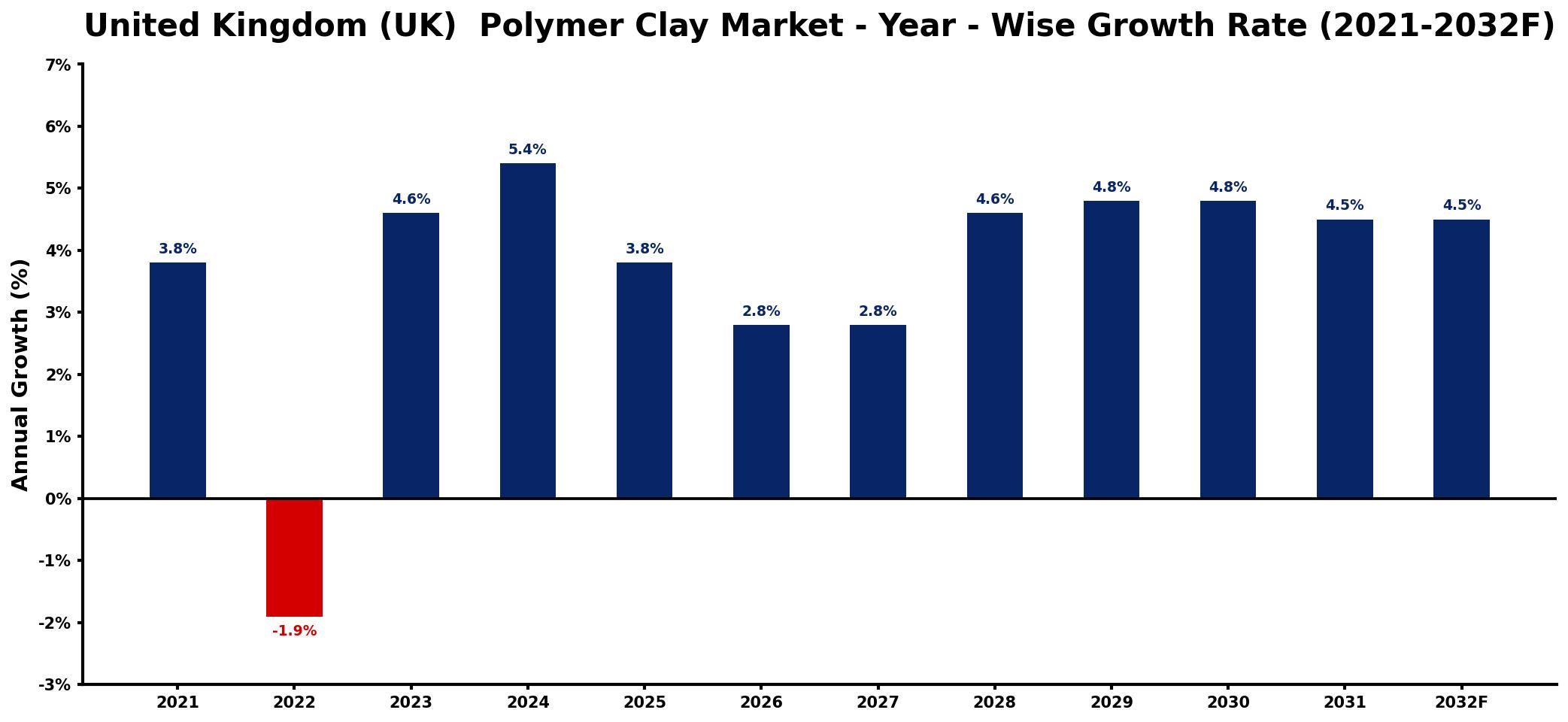
The table below presents the year‑wise growth rates along with the key drivers influencing the market
| Year | Growth Rate | Major Drivers |
| 2021 | 3.8% | Rising interest in crafting hobbies |
| 2022 | -1.9% | Supply chain disruptions affecting production |
| 2023 | 4.6% | Increased online sales channels |
| 2024 | 5.4% | Growth in DIY project popularity |
| 2025 | 3.8% | Expansion of educational workshops |
| 2026 | 2.8% | Emergence of eco-friendly materials |
| 2027 | 2.8% | Rising demand from art communities |
| 2028 | 4.6% | Increased collaboration with influencers |
| 2029 | 4.8% | Surge in home-based activities |
| 2030 | 4.8% | expanding industrial usage applications |
| 2031 | 4.5% | growing downstream application demand |
| 2032 | 4.5% | Increased investment in innovative technologies |
Note: Market size estimations and growth projections presented in this report are based on 6Wresearch's proprietary forecasting methodology, utilizing the latest available industry data, government publications, and primary research inputs.
United Kingdom (UK) Polymer Clay Market Synopsis
Recently, the UK polymer clay market has experienced significant momentum, driven by a resurgence in creative activities among consumers. However, as we look forward, the market is poised for steady growth, thanks to innovations in product formulations and a greater variety of colors and finishes, catering to the diverse preferences of artists and hobbyists.
The ongoing DIY trend is not only a key driver but also shapes consumer expectations regarding product quality and versatility. As enthusiasts seek materials that inspire creativity and allow for unique personal expression, the market is adapting to meet these evolving demands, which supports its continued expansion in the coming years.
United Kingdom (UK) Polymer Clay Market Key Takeaways
- The polymer clay market is benefiting from the rising popularity of DIY projects and creative hobbies across the UK.
- Innovations in color and formulation are enhancing consumer engagement and product appeal.
- Education and marketing initiatives aimed at creative communities are becoming increasingly important for brand differentiation.
- Regulatory compliance around product safety and consumer protection is critical for market players.
- The market is set to grow steadily, driven by sustained interest in arts and crafts.
Evaluation of Restraints in United Kingdom (UK) Polymer Clay Market
While the UK polymer clay market is on a positive trajectory, there are genuine restraints that could impact growth. One significant challenge is the need for continuous product innovation to keep pace with changing artistic trends. Consumers expect versatile, colorfast, and durable materials, which necessitates investment in research and development. Moreover, effectively engaging with creative communities and enhancing product durability while maintaining ease of use presents ongoing hurdles for brands aiming to differentiate themselves in a competitive landscape.
United Kingdom (UK) Polymer Clay Market Trends
Several trends are emerging within the UK polymer clay market that are shaping demand and technology. The influence of social media and online platforms has fostered a vibrant community of crafters, driving the sharing of innovative techniques and ideas. Additionally, the introduction of eco-friendly formulations is gaining traction as consumers become increasingly aware of sustainability issues. This shift not only meets consumer demand but also positions brands favorably in a market that prioritizes environmental responsibility.
United Kingdom (UK) Polymer Clay Market Opportunities
The opportunities for growth and investment in the UK polymer clay market are robust. Expanding product lines to include specialized colors, finishes, and eco-friendly options can attract a broader audience. Additionally, partnerships with educational institutions for workshops and events can enhance brand visibility and foster community engagement. By leveraging online sales channels and marketing directly to niche segments, brands can significantly increase their market presence.
Government Initiatives in the United Kingdom (UK) Polymer Clay Market
Government policies in the UK regarding product safety and consumer protection are pivotal for the polymer clay market. Compliance with chemical safety standards is mandated to ensure that all products are safe for use in arts, crafts, and educational materials. Furthermore, regulatory frameworks promote transparency through labeling requirements, enabling consumers to make informed decisions about the composition and safety of polymer clay products.
Future Insights of the United Kingdom (UK) Polymer Clay Market
Looking ahead to 2026-2032, the UK polymer clay market is anticipated to flourish as a result of continuous consumer interest in arts and crafts. The integration of innovative technologies in product development and marketing will play a crucial role in responding to evolving consumer needs. As brands prioritize sustainability and quality, the market is likely to attract a more diverse customer base, thus driving further growth in the years to come.
United Kingdom (UK) Polymer Clay Market Latest Developments (2025 - 2026)
Recent developments in the UK polymer clay market indicate a growing focus on community engagement and educational initiatives. Brands are increasingly organizing workshops and online tutorials to connect with crafters, fostering a sense of community. In addition, innovations in product formulations are being highlighted, with many companies introducing new colors and finishes to cater to the unique preferences of consumers. This evolving landscape suggests a dynamic market environment poised for growth.
United Kingdom (UK) Polymer Clay Market - Key Attractiveness of the Report
- 10 Years of Market Numbers
- Historical Data Starting from 2022 to 2025
- Base Year: 2025
- Forecast Data until 2032
- Key Performance Indicators Impacting the Market
- Major Upcoming Developments and Projects
Key Highlights of the Report:
- United Kingdom (UK) Polymer Clay Market Outlook
- Market Size of United Kingdom (UK) Polymer Clay Market, 2025
- Forecast of United Kingdom (UK) Polymer Clay Market, 2032
- Historical Data and Forecast of United Kingdom (UK) Polymer Clay Revenues & Volume for the Period 2022-2032F
- United Kingdom (UK) Polymer Clay Market Trend Evolution
- United Kingdom (UK) Polymer Clay Market Drivers and Challenges
- United Kingdom (UK) Polymer Clay Price Trends
- United Kingdom (UK) Polymer Clay Porter's Five Forces
- United Kingdom (UK) Polymer Clay Industry Life Cycle
- Historical Data and Forecast of United Kingdom (UK) Polymer Clay Market Revenues & Volume By Product Form for the Period 2022-2032F
- Historical Data and Forecast of United Kingdom (UK) Polymer Clay Market Revenues & Volume By Solid for the Period 2022-2032F
- Historical Data and Forecast of United Kingdom (UK) Polymer Clay Market Revenues & Volume By Liquid for the Period 2022-2032F
- Historical Data and Forecast of United Kingdom (UK) Polymer Clay Market Revenues & Volume By Application for the Period 2022-2032F
- Historical Data and Forecast of United Kingdom (UK) Polymer Clay Market Revenues & Volume By Jewelry Making for the Period 2022-2032F
- Historical Data and Forecast of United Kingdom (UK) Polymer Clay Market Revenues & Volume By Manufacturing of Toys and Novelty Items for the Period 2022-2032F
- Historical Data and Forecast of United Kingdom (UK) Polymer Clay Market Revenues & Volume By Arts and Sculpture Making for the Period 2022-2032F
- Historical Data and Forecast of United Kingdom (UK) Polymer Clay Market Revenues & Volume By Crockery and Ceramic Products for the Period 2022-2032F
- Historical Data and Forecast of United Kingdom (UK) Polymer Clay Market Revenues & Volume By Others for the Period 2022-2032F
- Historical Data and Forecast of United Kingdom (UK) Polymer Clay Market Revenues & Volume By End Use for the Period 2022-2032F
- Historical Data and Forecast of United Kingdom (UK) Polymer Clay Market Revenues & Volume By Residential for the Period 2022-2032F
- Historical Data and Forecast of United Kingdom (UK) Polymer Clay Market Revenues & Volume By Commercial for the Period 2022-2032F
- Historical Data and Forecast of United Kingdom (UK) Polymer Clay Market Revenues & Volume By Industrial for the Period 2022-2032F
- United Kingdom (UK) Polymer Clay Import Export Trade Statistics
- Market Opportunity Assessment By Product Form
- Market Opportunity Assessment By Application
- Market Opportunity Assessment By End Use
- United Kingdom (UK) Polymer Clay Top Companies Market Share
- United Kingdom (UK) Polymer Clay Competitive Benchmarking By Technical and Operational Parameters
- United Kingdom (UK) Polymer Clay Company Profiles
- United Kingdom (UK) Polymer Clay Key Strategic Recommendations






































