United Kingdom (UK) Public Cloud Market Size & Growth Rate (2026-2032)
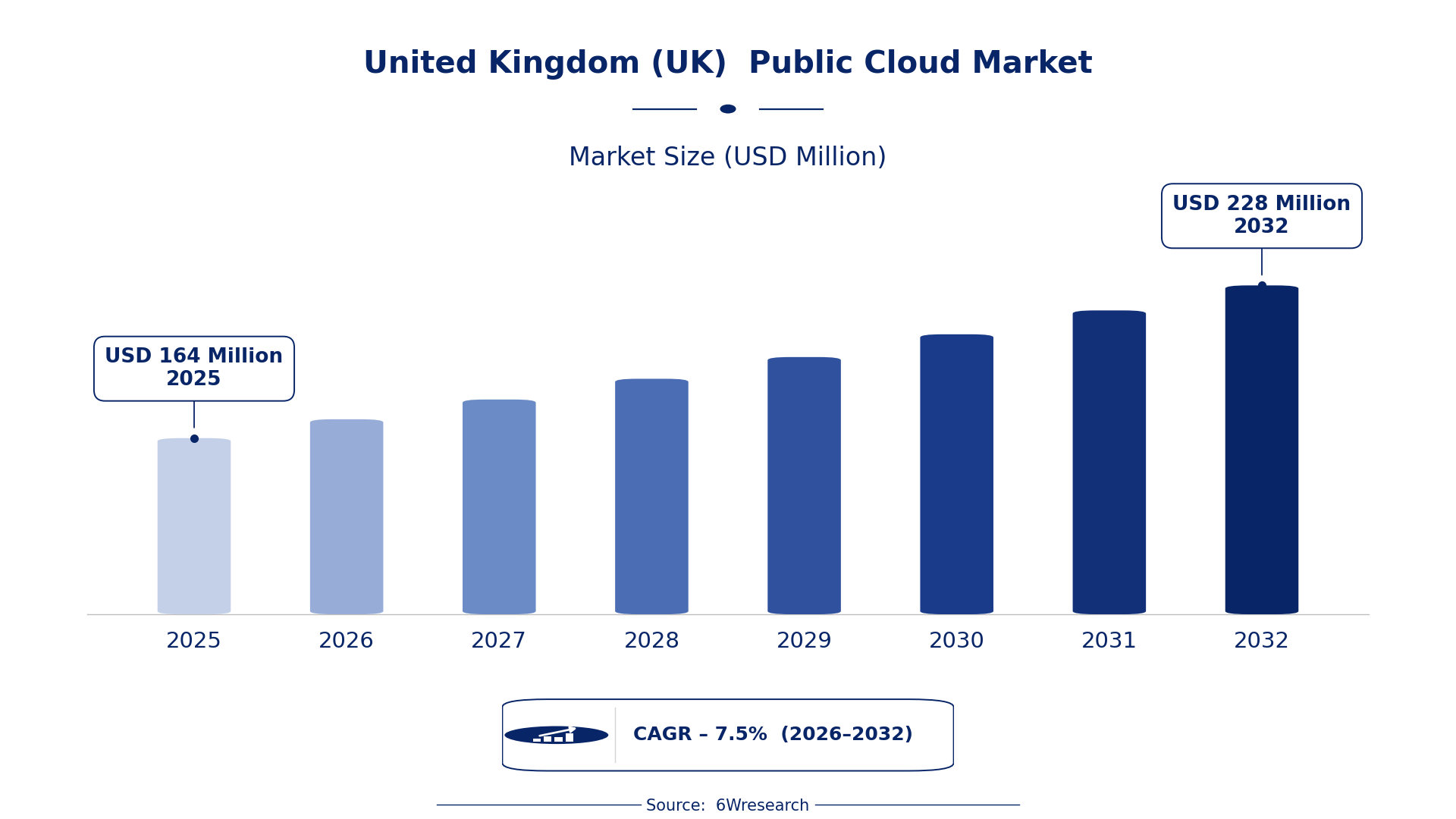
The United Kingdom (UK) Public Cloud Market was estimated at USD 164 Million in 2025 and is projected to reach USD 228 Million by 2032, growing at a CAGR of 7.5% from 2026 to 2032.
United Kingdom (UK) Public Cloud Market Synopsis
The UK public cloud market is experiencing a notable surge, driven by a mix of digital transformation efforts and the increased necessity for remote work solutions. Organizations across various sectors are embracing cloud services to enhance operational efficiency and foster innovation.
As companies prioritize flexibility and scalability, the demand for Infrastructure as a Service (IaaS), Platform as a Service (PaaS), and Software as a Service (SaaS) is climbing. This shift is supported by both market players and government initiatives aimed at bolstering cloud adoption.
United Kingdom (UK) Public Cloud Market Year-wise Growth Rate and Key Drivers
This graph illustrates the annual growth rates of the United Kingdom (UK) Public Cloud Market from 2021 to 2032, highlighting a steady upward trajectory and projected expansion over the forecast period.
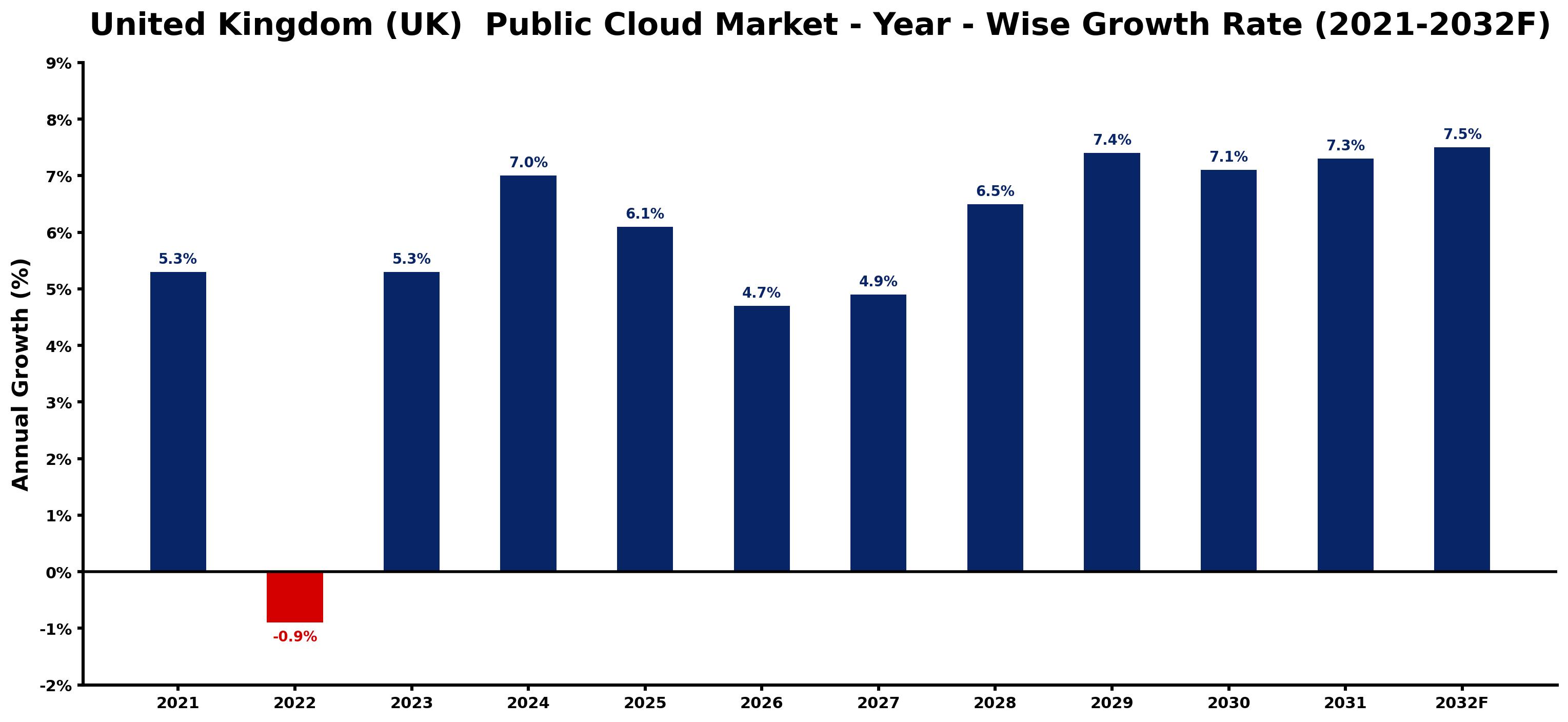
The table below presents the year‑wise growth rates along with the key drivers influencing the market
| Year | Growth Rate | Major Drivers |
| 2021 | 5.3% | National Cyber Strategy boosting cloud security investments. |
| 2022 | -0.9% | UK government cloud policy delays adoption of services |
| 2023 | 5.3% | Increased digitization driven by UK Digital Strategy initiatives. |
| 2024 | 7.0% | Rise of hybrid work models enhancing cloud adoption. |
| 2025 | 6.1% | Government funding for cloud startups fostering innovation. |
| 2026 | 4.7% | Ongoing Brexit transition shifting businesses to cloud solutions. |
| 2027 | 4.9% | Demand for data sovereignty influencing local cloud offerings. |
| 2028 | 6.5% | Climate targets incentivizing energy-efficient cloud infrastructure. |
| 2029 | 7.4% | Public sector cloud-first policy driving government cloud migration. |
| 2030 | 7.1% | Rising e-commerce trends boosting cloud scalability needs. |
| 2031 | 7.3% | Growth in digital media content requiring robust cloud storage. |
| 2032 | 7.5% | Increased focus on AI applications leveraging cloud capabilities. |
Note: Market size estimations and growth projections presented in this report are based on 6Wresearch's proprietary forecasting methodology, utilizing the latest available industry data, government publications, and primary research inputs.
United Kingdom (UK) Public Cloud Market Key Takeaways
Below are some of the specific key takeaways from the market, including:
- The UK public cloud market is projected to grow steadily, fueled by digital transformation initiatives.
- Companies are increasingly adopting multi-cloud strategies to optimize their IT environments.
- Regulatory concerns around data privacy and compliance are influencing cloud provider selection.
- Investment in specialized cloud services, such as AI capabilities, is on the rise.
- The government is actively promoting cloud usage in the public sector through various initiatives.
Evaluation of Restraints in United Kingdom (UK) Public Cloud Market
Despite its growth, the UK public cloud market faces several significant restraints. Data privacy remains a pressing concern, especially with stringent regulations such as GDPR dictating how organizations handle sensitive information. This has led to hesitancy among some businesses to fully embrace cloud solutions, fearing non-compliance.
on top of that, uncertainties stemming from Brexit add another layer of complexity, particularly regarding data sovereignty and cross-border data flows. The demand for skilled professionals to manage cloud environments effectively is also high, creating a talent gap that companies must address to fully capitalize on cloud opportunities.
United Kingdom (UK) Public Cloud Market Trends
Several trends are shaping the UK public cloud market. A prominent shift toward multi-cloud strategies is evident, as organizations seek to balance performance, cost, and security by leveraging multiple service providers. This trend not only enhances flexibility but also mitigates vendor lock-in risks.
In addition, the focus on data privacy compliance is intensifying, prompting organizations to prioritize cloud providers that demonstrate robust data protection measures. The COVID-19 pandemic has further accelerated cloud adoption, with many firms investing in cloud solutions to facilitate remote work and ensure business continuity.
United Kingdom (UK) Public Cloud Market Opportunities
The UK public cloud market presents a wealth of investment opportunities. As businesses continue to shift towards digital solutions, demand for cloud infrastructure, SaaS, and PaaS offerings is expected to grow significantly. Providers focusing on innovative technologies, including advanced data analytics and artificial intelligence, will attract considerable interest from investors.
Strategic partnerships and collaborations with established cloud service providers can also pave the way for new market entrants, enhancing their market presence and service offerings.
Government Initiatives in the United Kingdom (UK) Public Cloud Market
The UK government plays a crucial role in shaping the public cloud market through various initiatives aimed at fostering cloud adoption, especially within the public sector. By implementing supportive policies and frameworks, the government seeks to enhance efficiency and drive innovation across public services.
- A recently completed initiative, the G-Cloud framework, simplifies the procurement of cloud services for public sector organizations.
- A current ongoing program, the Digital Marketplace, facilitates easier access to cloud solutions from pre-approved suppliers, encouraging public sector entities to adopt cloud technologies.
- Planned initiatives include a national cloud strategy expected to be launched in 2026, focusing on improving digital infrastructure and enhancing data security.
- The UK government has introduced data protection regulations mandating compliance for cloud service providers, ensuring the security of stored data.
- Another ongoing initiative aims to promote digital skills training in cloud technologies to address the skills gap in the workforce.
Future Insights of the United Kingdom (UK) Public Cloud Market
Looking ahead to 2026-2032, the UK public cloud market is set for considerable expansion. The continued push for digital transformation across industries will drive organizations to migrate their IT infrastructures to the cloud in search of cost efficiency and scalability. Enhanced government policies, such as the Cloud First initiative, will further catalyze this shift.
Technological advancements, particularly in artificial intelligence and machine learning, will also fuel demand as businesses look to leverage these tools for competitive advantages. Consequently, we expect the public cloud market to flourish as it adapts to the changing needs of enterprises.
United Kingdom (UK) Public Cloud Market Latest Developments
Recent developments in the UK public cloud market reflect a vigorous push towards innovation and efficiency. Over the last year, organizations have accelerated their adoption of cloud technologies, driven by a growing recognition of their strategic importance in modern business operations.
- In early 2025, a major technology vendor launched a new suite of cloud-based solutions tailored for the public sector, enhancing service delivery and operational efficiency.
- An ongoing initiative, which began in mid-2025, focuses on integrating AI capabilities into cloud platforms to provide more intelligent data management solutions.
- A partnership was formed between several leading cloud providers in late 2025 to develop a shared infrastructure aimed at reducing costs for SMEs.
- Plans for a cloud service upgrade are set to begin in Q3 2026, aimed at enhancing security and compliance features across platforms.
- A pilot program for cloud-based remote work solutions is currently underway, with expected results to be published by the end of 2025.
United Kingdom (UK) Public Cloud Market - Key Attractiveness of the Report
- 10 Years of Market Numbers
- Historical Data Starting from 2022 to 2025
- Base Year: 2025
- Forecast Data until 2032
- Key Performance Indicators Impacting the Market
- Major Upcoming Developments and Projects
Key Highlights of the Report:
- United Kingdom (UK) Public Cloud Market Outlook
- Market Size of United Kingdom (UK) Public Cloud Market, 2025
- Forecast of United Kingdom (UK) Public Cloud Market, 2032
- Historical Data and Forecast of United Kingdom (UK) Public Cloud Revenues & Volume for the Period 2022-2032F
- United Kingdom (UK) Public Cloud Market Trend Evolution
- United Kingdom (UK) Public Cloud Market Drivers and Challenges
- United Kingdom (UK) Public Cloud Price Trends
- United Kingdom (UK) Public Cloud Porter's Five Forces
- United Kingdom (UK) Public Cloud Industry Life Cycle
- Historical Data and Forecast of United Kingdom (UK) Public Cloud Market Revenues & Volume By Service Model for the Period 2022-2032F
- Historical Data and Forecast of United Kingdom (UK) Public Cloud Market Revenues & Volume By Infrastructure as a Service for the Period 2022-2032F
- Historical Data and Forecast of United Kingdom (UK) Public Cloud Market Revenues & Volume By Platform as a Service for the Period 2022-2032F
- Historical Data and Forecast of United Kingdom (UK) Public Cloud Market Revenues & Volume By Software as a Service for the Period 2022-2032F
- Historical Data and Forecast of United Kingdom (UK) Public Cloud Market Revenues & Volume By Organization Size Large enterprises for the Period 2022-2032F
- Historical Data and Forecast of United Kingdom (UK) Public Cloud Market Revenues & Volume By Small for the Period 2022-2032F
- Historical Data and Forecast of United Kingdom (UK) Public Cloud Market Revenues & Volume By Medium Enterprises SMEs for the Period 2022-2032F
- Historical Data and Forecast of United Kingdom (UK) Public Cloud Market Revenues & Volume By Verticals for the Period 2022-2032F
- Historical Data and Forecast of United Kingdom (UK) Public Cloud Market Revenues & Volume By BFSI for the Period 2022-2032F
- Historical Data and Forecast of United Kingdom (UK) Public Cloud Market Revenues & Volume By Telecommunication for the Period 2022-2032F
- Historical Data and Forecast of United Kingdom (UK) Public Cloud Market Revenues & Volume By IT & ITeS for the Period 2022-2032F
- Historical Data and Forecast of United Kingdom (UK) Public Cloud Market Revenues & Volume By Government & Public Sector for the Period 2022-2032F
- Historical Data and Forecast of United Kingdom (UK) Public Cloud Market Revenues & Volume By Retail & Consumer Goods for the Period 2022-2032F
- Historical Data and Forecast of United Kingdom (UK) Public Cloud Market Revenues & Volume By Manufacturing for the Period 2022-2032F
- Historical Data and Forecast of United Kingdom (UK) Public Cloud Market Revenues & Volume By Energy & Utility for the Period 2022-2032F
- Historical Data and Forecast of United Kingdom (UK) Public Cloud Market Revenues & Volume By Media & Entertainment for the Period 2022-2032F
- United Kingdom (UK) Public Cloud Import Export Trade Statistics
- Market Opportunity Assessment By Service Model
- Market Opportunity Assessment By Organization Size Large enterprises
- Market Opportunity Assessment By Verticals
- United Kingdom (UK) Public Cloud Top Companies Market Share
- United Kingdom (UK) Public Cloud Competitive Benchmarking By Technical and Operational Parameters
- United Kingdom (UK) Public Cloud Company Profiles
- United Kingdom (UK) Public Cloud Key Strategic Recommendations






































