United Kingdom (UK) Publishing Market Summary
The united kingdom (uk) publishing market was estimated at USD 471 Million in 2025 and is projected to reach USD 581 Million by 2032, growing at a CAGR of 2.8% from 2026 to 2032.
United Kingdom (UK) Publishing Market Year-wise Growth Rate and Key Drivers
This graph highlights how the United Kingdom (UK) Publishing Market has steadily grown over the past five years, supported by major growth factors.
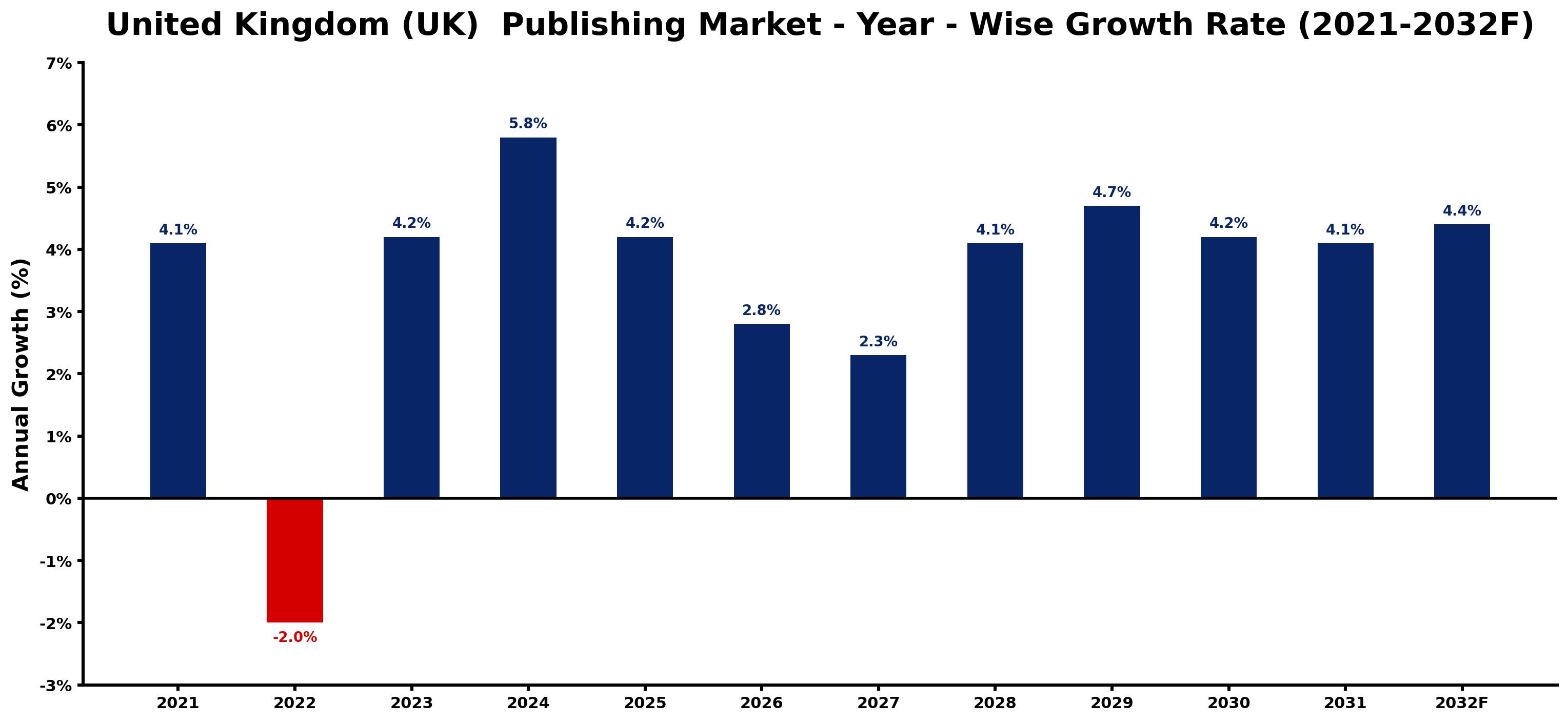
The table below presents the year wise growth rates along with the key drivers influencing the market
| Year | Growth Rate | Major Drivers |
| 2021 | 4.1% | Post-lockdown trends showcased a remarkable pivot to digital content consumption among readers. |
| 2022 | -2.0% | Digital content consumption shifted dramatically, diminishing demand for traditional print publications in the UK market. |
| 2023 | 4.2% | Innovative subscription models attracted dedicated readers, enhancing revenue stability for publishers. |
| 2024 | 5.8% | Audiobook formats gained traction, shifting traditional publishing landscapes towards audio content. |
| 2025 | 4.2% | Sustainability concerns prompted eco-friendly practices, influencing consumer choices in publishing. |
| 2026 | 2.8% | Collaboration between traditional and digital platforms created diverse avenues for content delivery. |
| 2027 | 2.3% | Increased personalization in marketing campaigns effectively catered to niche reader preferences. |
| 2028 | 4.1% | Technological integration in publishing streamlined production processes and reduced operational costs. |
| 2029 | 4.7% | Cultural diversity in content became recognized, enriching offerings and expanding readership demographics. |
| 2030 | 4.2% | User-generated content platforms emerged, empowering readers to influence publishing trends directly. |
| 2031 | 4.1% | Artificial intelligence tools enhanced editorial processes, optimizing content creation and curation. |
| 2032 | 4.4% | Global market integration facilitated cross-border collaborations, diversifying UK publishing opportunities. |
Note - Market size estimations and growth projections presented in this report are based on 6Wresearch's advanced forecasting approach, validated with industry datasets as of June 2026.
United Kingdom (UK) Publishing Market Synopsis
The United Kingdom (UK) Publishing Market is projected to reach 2.8% and witness significant growth during the forecast period (2026-2032). This market comprises traditional print mediums such as books, magazines, and newspapers, alongside an expanding digital landscape that includes e-books, audiobooks, and digital content. The ongoing transformation within this sector is significant, as the rapid adoption of digital platforms reshapes consumer habits and preferences.
United Kingdom (UK) Publishing Market Growth Drivers
The growth of the United Kingdom (UK) Publishing Market is being driven by several key factors:
- The significant surge in digital content consumption is a primary catalyst, reflecting changing consumer preferences towards e-books and online subscriptions.
- Technological advancements in digital publishing tools have facilitated easier content creation and distribution, enabling publishers to adapt more swiftly to market demands.
- Increased interest in audiobooks and multimedia content fosters market expansion, appealing to diverse reader preferences.
- Expanding e-learning trends are pushing educational institutions to seek engaging and accessible content, further driving demand in the publishing sector.
- Global distribution channels have been enhanced by digital platforms, providing publishers with broader audiences and sales opportunities.
United Kingdom (UK) Publishing Market Challenges and Restraints
While the United Kingdom (UK) Publishing Market shows promising growth, it also faces several challenges:
- Adapting to the swift pace of digital transformation poses a significant hurdle for traditional publishers, requiring them to rethink their business models.
- The complexity of managing distribution logistics becomes apparent as retail landscapes evolve, necessitating innovative solutions to address these changes.
- Copyright issues related to digital content distribution present legal challenges that can hinder market expansion and innovation.
- The competition from free online content platforms may impact the sales of traditional publications, compelling publishers to differentiate their offerings.
- Consumer expectations for immediate access and high-quality digital experiences require continuous investment in technology and content creation.
United Kingdom (UK) Publishing Market Trends and Opportunities
The United Kingdom (UK) Publishing Market presents several emerging trends and opportunities:
- The rising popularity of subscription models for digital content provides new revenue streams for publishers, enabling them to build more sustainable business practices.
- Integration of artificial intelligence in content creation and personalization is opening avenues for tailored reader experiences, enhancing customer engagement.
- Collaborations with educational institutions are fostering innovative approaches to learning materials, leveraging multimedia and interactive formats.
- Sustainability initiatives in print materials are becoming more significant, with consumers increasingly favoring eco-friendly publications.
- Expansion into international markets through digital platforms allows UK publishers to reach a global audience, maximizing their growth potential.
United Kingdom (UK) Publishing Market Government Investment and Initiatives
The United Kingdom (UK) Publishing Market is significantly influenced by government policies and initiatives aimed at fostering growth and innovation:
- The government promotes cultural diversity and literacy, establishing programs that support independent authors and diverse publishing initiatives.
- Incentives for digital publishing innovation are crafted to encourage the development of new technologies within the sector.
- Regulations governing copyright protections ensure that intellectual property rights are upheld while facilitating fair competition among publishers.
- Support for literacy programs is evident in public spending, which aims to increase access to a wide range of literary and scholarly works.
- Policies aim to enhance public access to educational resources, which directly benefits the publishing market by promoting collaboration between publishers and educational institutions.
United Kingdom (UK) Publishing Market Latest Developments (May 2025 - June 2026)
In the recent period from May 2025 to June 2026, the United Kingdom (UK) Publishing Market has experienced notable developments that reflect its dynamic nature:
- There has been a pronounced shift towards digital-first strategies across the publishing industry, with many firms prioritizing online platforms for content distribution.
- Increased collaboration between technology firms and publishers has resulted in innovative tools that streamline the content creation process.
- Publishing houses are actively exploring new monetization strategies, adapting their business models to leverage the growing demand for subscription-based content.
- The incorporation of immersive media, such as augmented reality, into educational materials is gaining traction, offering novel learning experiences.
- Regulatory adjustments are being made to copyright laws, facilitating a better environment for digital content sharing while ensuring creator protections.
United Kingdom (UK) Publishing Market - Key Attractiveness of the Report
- 10 Years of Market Numbers
- Historical Data Starting from 2022 to 2025
- Base Year: 2025
- Forecast Data until 2032
- Key Performance Indicators Impacting the Market
- Major Upcoming Developments and Projects
Key Highlights of the Report:
- United Kingdom (UK) Publishing Market Outlook
- Market Size of United Kingdom (UK) Publishing Market, 2025
- Forecast of United Kingdom (UK) Publishing Market, 2032
- Historical Data and Forecast of United Kingdom (UK) Publishing Revenues & Volume for the Period 2022-2032F
- United Kingdom (UK) Publishing Market Trend Evolution
- United Kingdom (UK) Publishing Market Drivers and Challenges
- United Kingdom (UK) Publishing Price Trends
- United Kingdom (UK) Publishing Porter's Five Forces
- United Kingdom (UK) Publishing Industry Life Cycle
- Historical Data and Forecast of United Kingdom (UK) Publishing Market Revenues & Volume By Types for the Period 2022-2032F
- Historical Data and Forecast of United Kingdom (UK) Publishing Market Revenues & Volume By Newspaper for the Period 2022-2032F
- Historical Data and Forecast of United Kingdom (UK) Publishing Market Revenues & Volume By Journals for the Period 2022-2032F
- Historical Data and Forecast of United Kingdom (UK) Publishing Market Revenues & Volume By Catalogues for the Period 2022-2032F
- Historical Data and Forecast of United Kingdom (UK) Publishing Market Revenues & Volume By Magazine for the Period 2022-2032F
- Historical Data and Forecast of United Kingdom (UK) Publishing Market Revenues & Volume By Books for the Period 2022-2032F
- Historical Data and Forecast of United Kingdom (UK) Publishing Market Revenues & Volume By E-Books for the Period 2022-2032F
- Historical Data and Forecast of United Kingdom (UK) Publishing Market Revenues & Volume By Platform for the Period 2022-2032F
- Historical Data and Forecast of United Kingdom (UK) Publishing Market Revenues & Volume By Digital? for the Period 2022-2032F
- Historical Data and Forecast of United Kingdom (UK) Publishing Market Revenues & Volume By Paper for the Period 2022-2032F
- United Kingdom (UK) Publishing Import Export Trade Statistics
- Market Opportunity Assessment By Types
- Market Opportunity Assessment By Platform
- United Kingdom (UK) Publishing Top Companies Market Share
- United Kingdom (UK) Publishing Competitive Benchmarking By Technical and Operational Parameters
- United Kingdom (UK) Publishing Company Profiles
- United Kingdom (UK) Publishing Key Strategic Recommendations






































