Topics Covered in the UK Residential Water Purifier Market Report
UK Residential Water Purifier Market Report thoroughly covers the market by Technology, Filtration Type, Distribution Channel and Type. UK Residential Water Purifier Market Outlook report provides an unbiased and detailed analysis of the ongoing UK Residential Water Purifier Market trends, opportunities/high-growth areas, and market drivers. This would help stakeholders devise and align their market strategies according to the current and future market dynamics.
UK Residential Water Purifier Market Synopsis
The UK market remains resilient, underpinned by demand for RO, UV, and hybrid systems that tackle hard water, microbial contamination, and trace chemical pollutants. Retail expansion via e‑commerce and modern trade has supported distribution, although consumer preference for sustainable, low‑maintenance models presents ongoing challenges. As regulations tighten—such as the Private Water Supplies Regulations—the market is expected to sustain this trajectory, with incremental adoption as households balance health, convenience, and environmental impact.

According to 6Wresearch, the UK Residential Water Purifier Market is projected to grow at a CAGR of 4.2% from 2025-2031F. Rising public concern over tap water safety has driven renewed interest in residential water purifiers, primarily due to the growing contamination from PFAs and high-profile waterborne disease outbreaks. By 2023, PFAs-contaminated sites had been identified across the UK, in different locations showing PFAs levels. In January 2025, the UK revised its PFAs threshold for individual compounds, a move still considered lenient by many experts, given that the Drinking Water Inspectorate (DWI) warns of medium-to-high health risks.

Further triggering consumer anxiety were incidents such as Yorkshire Water's "do not drink" order affecting postcodes in May 2025 due to coliform contamination, and Southwest Water’s July 2025 boil notice impacting properties after cryptosporidium detection, which led to so many confirmed cases. These events are expected to have an impact on the public confidence in tap water, prompting a surge in demand for home filtration solutions.
Market Segmentation By Technology
By Technology, Reverse osmosis is projected to retain the largest market share and witness the fastest growth in the residential water purifier market by 2031 due to rising consumer preference for multi-contaminant removal. Advancements in membrane efficiency and water-saving technologies are reducing water wastage, addressing earlier concerns. Manufacturers are also offering compact, integrated RO systems suitable for modern homes.
Market Segmentation By Filtration Type
By Filtration Type, point-of-use is projected to maintain the largest revenue share in the residential water purifier market by 2031, due to continued demand for low-cost, low-maintenance options in urban housing. However, point-of-entry systems are set to grow fastest as more households prioritize whole-home water quality amid rising awareness of contaminants in bathing and laundry water. Growth will be driven by both premium housing and retrofits.
Market Segmentation By Distribution Channel
By Distribution Channel, offline sales are projected to maintain the largest revenue share in the residential water purifier market by 2031, due to the strong presence of established stores and national retail chains, enabling wide physical accessibility and trusted installation partnerships. However, online sales are projected to grow at the fastest rate, fueled by improved delivery logistics and rising digital adoption. Moreover, online platforms are increasingly offering AR-based product visualization and virtual consultations.
Market Segmentation By Type
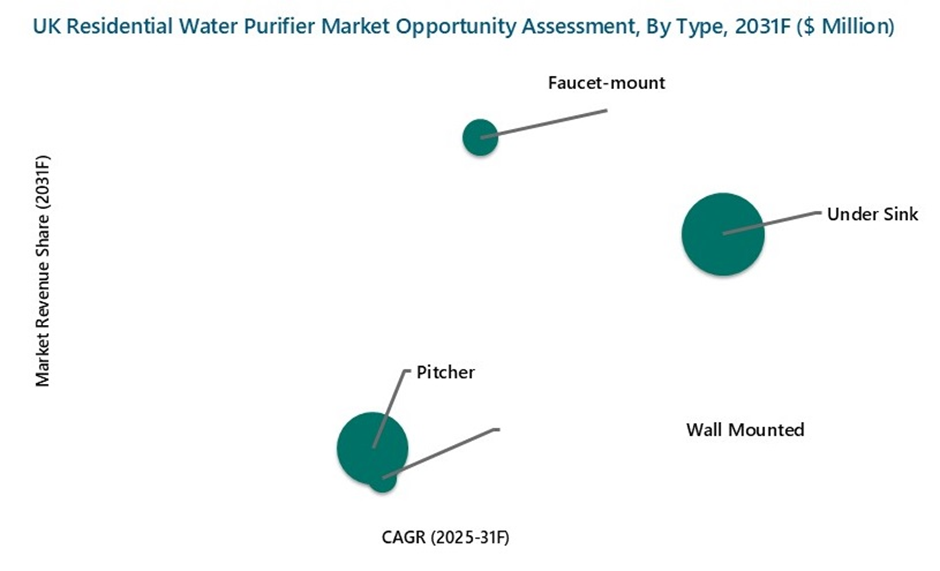
By Type, under-sink is projected to retain the largest market share and witness the fastest growth in the residential water purifier market by 2031, propelled by increasing adoption in new-build homes and kitchen renovations. Their compatibility with smart-home integration, such as app-controlled monitoring, is attracting younger homeowners. Their role in supporting dual-stage purification for instance, RO+UV enhances their value proposition.
Key Attractiveness of the Report
- 10 Years Market Numbers.
- Historical Data Starting from 2021 to 2024
- Base Year: 2024
- Forecast Data until 2031
- Key Performance Indicators Impacting the Market.
- Major Upcoming Developments and Projects.
Key Highlights of the Report:
- UK Residential Water Purifier Market Overview
- UK Residential Water Purifier Market Outlook
- UK Residential Water Purifier Market Forecast
- Historical Data and Forecast of UK Residential Water Purifier Market Revenues for the Period 2021-2031F
- Historical Data and Forecast of UK Residential Water Purifier Market Revenues, By Technology for the Period 2021-2031F
- Historical Data and Forecast of UK Residential Water Purifier Market Revenues, By Filtration Type for the Period 2021-2031F
- Historical Data and Forecast of UK Residential Water Purifier Market Revenues, By Distribution Channel for the Period 2021-2031F
- Historical Data and Forecast of UK Residential Water Purifier Market Revenues, By Type for the Period 2021-2031F
- Porter’s Five Force Analysis
- UK Residential Water Purifier Market Drivers and Restraints
- UK Residential Water Purifier Market Trends and Evolution
- Market Opportunity Assessment, By Technology
- Market Opportunity Assessment, By Filtration Type
- Market Opportunity Assessment, By Distribution Channel
- Market Opportunity Assessment, By Type
- UK Residential Water Purifier Market Revenue Ranking, By Top 3 Companies
- Market Competitive Benchmarking
- Company Profiles
- Key Strategic Recommendations
Market Scope and Segmentation
The report provides a detailed analysis of the following market segments:
By Technology
- Activated Carbon
- Ultra Filtration
- Reverse Osmosis
- Others
By Filtration Type
- Point of Use
- Point of Entry
By Distribution Channel
- Online
- Offline
By Type
- Pitcher
- Faucet-mount
- Under Sink
- Wall Mounted






































