United Kingdom (UK) Smart Doorbell Market Size, Share & Growth Rate
The United Kingdom (UK) Smart Doorbell Market was estimated at USD 217 Million in 2025 and is projected to reach USD 297 Million by 2032, growing at a CAGR of 4.6% from 2026 to 2032. This growth trajectory is fueled primarily by the rising concerns surrounding home security and a heightened interest in smart home technologies. As homeowners increasingly prioritize connectivity and safety, smart doorbells have become an essential component of home security systems across the UK.
United Kingdom (UK) Smart Doorbell Market Year-wise Growth Rate and Key Drivers
This graph highlights how the United Kingdom (UK) Smart Doorbell Market has steadily grown over the years, supported by major growth factors.
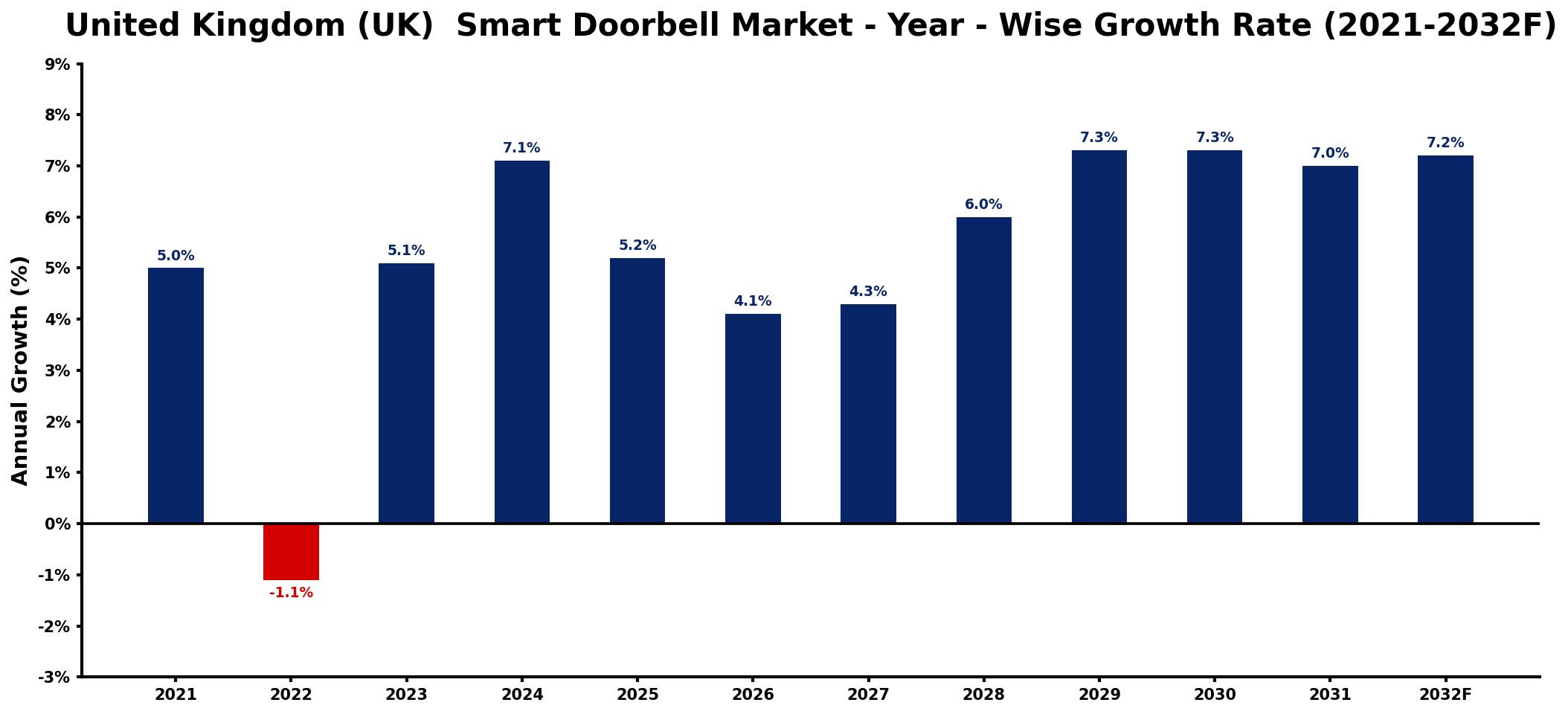
The table below presents the year‑wise growth rates along with the key drivers influencing the market
| Year | Growth Rate | Major Drivers |
| 2021 | 5.0% | Rising security technology investments |
| 2022 | -1.1% | Decreased consumer spending trends |
| 2023 | 5.1% | Growing demand for home automation |
| 2024 | 7.1% | Increased interest in remote monitoring |
| 2025 | 5.2% | Surge in home renovation projects |
| 2026 | 4.1% | Expansion of online retail channels |
| 2027 | 4.3% | Enhanced integration with mobile devices |
| 2028 | 6.0% | Popularity of connected home solutions |
| 2029 | 7.3% | Growth in urban living spaces |
| 2030 | 7.3% | Emerging trends in energy efficiency |
| 2031 | 7.0% | Heightened focus on residential safety |
| 2032 | 7.2% | Advancements in wireless technology |
Note: Market size estimations and growth projections presented in this report are based on 6Wresearch's proprietary forecasting methodology, utilizing the latest available industry data, government publications, and primary research inputs.
United Kingdom (UK) Smart Doorbell Market Synopsis
A major force shaping the United Kingdom Smart Doorbell Market is the escalating awareness around home security needs. As consumers become more conscious of safety and surveillance, smart doorbells equipped with advanced features like video streaming and motion detection are seeing a surge in demand.
Moreover, the integration of smart doorbells with existing smart home ecosystems continues to enhance their appeal. This innovation fosters seamless connectivity, making it simpler for users to monitor their properties, thereby solidifying their role in modern home security solutions.
United Kingdom (UK) Smart Doorbell Market Key Takeaways
- The demand for smart doorbells is primarily driven by rising consumer concerns about home security.
- Integration with other smart home devices is enhancing the functionality and adoption of smart doorbells.
- Key features like two-way audio and motion detection are becoming standard in the market.
- COVID-19 has accelerated the trend towards contactless solutions, boosting smart doorbell adoption.
- Market growth is anticipated due to ongoing innovations and technological advancements in smart home systems.
Evaluation of Restraints in United Kingdom (UK) Smart Doorbell Market
Despite the positive outlook for the United Kingdom Smart Doorbell Market, several restraints could impede growth. Data privacy remains a significant concern, particularly given the nature of smart doorbells in capturing audio and video footage. As consumers express apprehensions about how this sensitive data is handled, manufacturers face increasing pressure to implement robust data protection measures. Furthermore, compatibility issues with existing home security systems can complicate user integration, hindering a smoother adoption process. Finally, a general lack of consumer awareness regarding the functionalities and benefits of smart doorbells can limit market penetration, posing a challenge that must be addressed through effective marketing strategies.
United Kingdom (UK) Smart Doorbell Market Trends
Current trends in the United Kingdom Smart Doorbell Market illustrate a shift towards sophisticated features that enhance user experience. Increasingly, smart doorbells are being equipped with AI capabilities, allowing for advanced facial recognition and activity alerts. Additionally, the growing popularity of home automation is driving consumer interest in doorbells that seamlessly integrate with existing smart home devices. The focus on enhanced video quality, such as HD and even 4K, is becoming a standard expectation among consumers. As contactless deliveries become commonplace, consumers are seeking solutions that provide an extra layer of security and convenience, further solidifying the role of smart doorbells in modern households.
United Kingdom (UK) Smart Doorbell Market Opportunities
The United Kingdom Smart Doorbell Market presents lucrative opportunities for investment as demand for smart home technology escalates. Companies focusing on innovative product development, particularly those incorporating features such as video analytics and AI-powered enhancements, are well-positioned for growth. Additionally, service providers offering installation, maintenance, and integration solutions for smart doorbells are likely to find a fertile market landscape. As consumers continue to demand greater convenience and security, the ongoing advancements in IoT technology provide fertile ground for new entrants and existing players looking to expand their market footprint.
Government Initiatives in the United Kingdom (UK) Smart Doorbell Market
In the United Kingdom, the Smart Doorbell Market is influenced by various government policies aimed at enhancing consumer protection. The implementation of the General Data Protection Regulation (GDPR) has established strict guidelines governing the collection, processing, and storage of personal data by smart doorbell manufacturers. Furthermore, the UK government has introduced regulations regarding the deployment of smart doorbells in residential areas to ensure compliance with privacy laws, thereby fostering trust among consumers and encouraging responsible use of technology.
Future Insights of the United Kingdom (UK) Smart Doorbell Market
Looking ahead to 2026-2032, the United Kingdom Smart Doorbell Market is poised for sustained growth driven by increasing consumer demand for home security solutions and smart home integration. The evolution of technology promises even more advanced features and functionalities, as companies strive to meet the expectations of tech-savvy consumers. Moreover, as awareness regarding the benefits of smart home technologies spreads, the market is likely to see a wider adoption rate. Emphasizing security, convenience, and seamless connectivity, the smart doorbell will become an indispensable element of modern homes.
United Kingdom (UK) Smart Doorbell Market Latest Developments (2025 - 2026)
In recent months, the United Kingdom Smart Doorbell Market has seen a flurry of activity, characterized by advancements in technology and feature sets. There has been a notable uptick in product launches that focus on improved integration capabilities with smart home ecosystems. Additionally, consumer feedback has prompted manufacturers to emphasize enhanced video quality and user-friendly interfaces. The market is also witnessing a shift towards providing value-added services, such as subscription models for cloud storage of recorded footage, catering to the evolving preferences of consumers.
United Kingdom (UK) Smart Doorbell Market - Key Attractiveness of the Report
- 10 Years of Market Numbers
- Historical Data Starting from 2022 to 2025
- Base Year: 2025
- Forecast Data until 2032
- Key Performance Indicators Impacting the Market
- Major Upcoming Developments and Projects
Key Highlights of the Report:
- United Kingdom (UK) Smart Doorbell Market Outlook
- Market Size of United Kingdom (UK) Smart Doorbell Market, 2025
- Forecast of United Kingdom (UK) Smart Doorbell Market, 2032
- Historical Data and Forecast of United Kingdom (UK) Smart Doorbell Revenues & Volume for the Period 2022-2032F
- United Kingdom (UK) Smart Doorbell Market Trend Evolution
- United Kingdom (UK) Smart Doorbell Market Drivers and Challenges
- United Kingdom (UK) Smart Doorbell Price Trends
- United Kingdom (UK) Smart Doorbell Porter's Five Forces
- United Kingdom (UK) Smart Doorbell Industry Life Cycle
- Historical Data and Forecast of United Kingdom (UK) Smart Doorbell Market Revenues & Volume By Product Type for the Period 2022-2032F
- Historical Data and Forecast of United Kingdom (UK) Smart Doorbell Market Revenues & Volume By Wired Doorbell for the Period 2022-2032F
- Historical Data and Forecast of United Kingdom (UK) Smart Doorbell Market Revenues & Volume By Wireless Doorbell for the Period 2022-2032F
- Historical Data and Forecast of United Kingdom (UK) Smart Doorbell Market Revenues & Volume By Distribution Channel for the Period 2022-2032F
- Historical Data and Forecast of United Kingdom (UK) Smart Doorbell Market Revenues & Volume By Online for the Period 2022-2032F
- Historical Data and Forecast of United Kingdom (UK) Smart Doorbell Market Revenues & Volume By Offline for the Period 2022-2032F
- Historical Data and Forecast of United Kingdom (UK) Smart Doorbell Market Revenues & Volume By End User for the Period 2022-2032F
- Historical Data and Forecast of United Kingdom (UK) Smart Doorbell Market Revenues & Volume By Residential for the Period 2022-2032F
- Historical Data and Forecast of United Kingdom (UK) Smart Doorbell Market Revenues & Volume By Commercial for the Period 2022-2032F
- United Kingdom (UK) Smart Doorbell Import Export Trade Statistics
- Market Opportunity Assessment By Product Type
- Market Opportunity Assessment By Distribution Channel
- Market Opportunity Assessment By End User
- United Kingdom (UK) Smart Doorbell Top Companies Market Share
- United Kingdom (UK) Smart Doorbell Competitive Benchmarking By Technical and Operational Parameters
- United Kingdom (UK) Smart Doorbell Company Profiles
- United Kingdom (UK) Smart Doorbell Key Strategic Recommendations






































