United Kingdom (UK) Smart Locks Market Size, Share & Growth Rate
The United Kingdom (UK) Smart Locks Market was estimated at USD 271 Million in 2025 and is projected to reach USD 370 Million by 2032, growing at a CAGR of 4.5% from 2026 to 2032. This robust growth trajectory is underpinned by a marked increase in the adoption of smart home technology, alongside a rising demand for enhanced security solutions. Furthermore, the integration of smart locks within comprehensive home automation systems is fostering consumer confidence and facilitating broader acceptance in both residential and commercial sectors.
United Kingdom (UK) Smart Locks Market Year-wise Growth Rate and Key Drivers
This graph highlights how the United Kingdom (UK) Smart Locks Market has steadily grown over the years, supported by major growth factors.
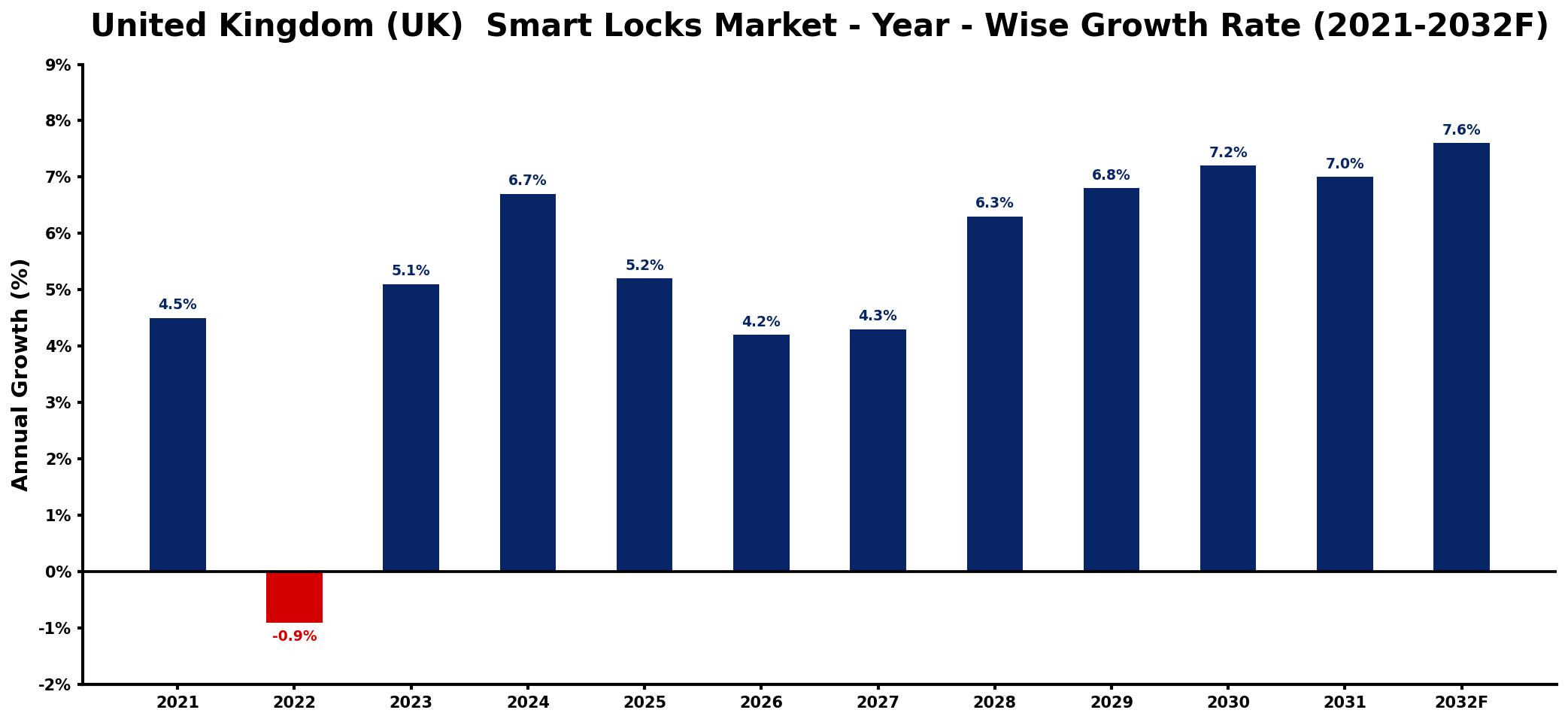
The table below presents the year‑wise growth rates along with the key drivers influencing the market
| Year | Growth Rate | Major Drivers |
| 2021 | 4.5% | Rising home security investments |
| 2022 | -0.9% | Decreased construction activity observed |
| 2023 | 5.1% | Increased consumer technology adoption |
| 2024 | 6.7% | Growing demand for automation solutions |
| 2025 | 5.2% | Expansion of residential renovation projects |
| 2026 | 4.2% | Surge in property technology investments |
| 2027 | 4.3% | Enhanced focus on energy efficiency |
| 2028 | 6.3% | Growing urbanization and development trends |
| 2029 | 6.8% | Increased integration with IoT systems |
| 2030 | 7.2% | Rising consumer awareness of safety |
| 2031 | 7.0% | rising end-use demand growth |
| 2032 | 7.6% | Growing interest in sustainable innovations |
Note: Market size estimations and growth projections presented in this report are based on 6Wresearch's proprietary forecasting methodology, utilizing the latest available industry data, government publications, and primary research inputs.
United Kingdom (UK) Smart Locks Market Synopsis
In recent years, the UK Smart Locks Market has transformed rapidly, reflecting the evolving landscape of home security technology. Consumers are increasingly inclined towards solutions that provide both convenience and robust security, thereby driving the market for smart locks forward.
The demand for keyless entry systems, coupled with a strong focus on home automation, has contributed to the growth of this market. With features like remote access control and integration with existing smart home systems, smart locks are becoming integral to modern living.
United Kingdom (UK) Smart Locks Market Key Takeaways
- The increasing trend of connected homes is propelling smart lock adoption.
- Consumers prioritize convenience, security, and seamless integration with smart home ecosystems.
- Keyless entry systems and biometric authentication are gaining popularity among end-users.
- Consumer education on smart lock benefits remains critical for market penetration.
- The market is characterized by a mix of competitive product offerings catering to varied consumer preferences.
Evaluation of Restraints in United Kingdom (UK) Smart Locks Market
The UK Smart Locks Market is grappling with several key limitations that could impede its growth. One prominent challenge is the rising apprehension concerning cybersecurity and data privacy among potential users. As smart locks are inherently connected devices, they expose consumers to potential hacking risks and security breaches, undermining confidence in their efficacy. Moreover, issues related to compatibility with existing home infrastructures and the necessity for a stable internet connection can deter consumers from making the shift to smart locking solutions. This is compounded by the high initial costs associated with smart locks, which may alienate price-sensitive customers. To realize its full potential, the market must actively address these concerns, enhancing consumer education and confidence in smart lock technology.
United Kingdom (UK) Smart Locks Market Trends
The current landscape of the UK Smart Locks Market is defined by several noteworthy trends that are shaping consumer preferences and technological advancements. The rise of aesthetically pleasing designs underscores the importance of seamless integration with modern home decor, while the demand for biometric features and real-time monitoring capabilities indicates a shift towards higher security standards. Connectivity technologies such as Bluetooth and Wi-Fi are enabling smart locks to offer unparalleled convenience and functionality, further propelling their market presence. As consumers continue to prioritize ease of use alongside security, innovative solutions that enhance the smart home experience will undoubtedly take center stage in the coming years.
United Kingdom (UK) Smart Locks Market Opportunities
The UK Smart Locks Market is ripe with investment opportunities, driven by an escalating interest in smart home technology and an increased focus on security measures. Investors can look toward emerging smart lock technologies that not only enhance security but also prioritize user convenience and connectivity. Collaborations with industry leaders to develop groundbreaking solutions could foster unique market propositions. Additionally, governmental initiatives promoting energy efficiency and sustainable living can further accelerate the integration of smart locks within broader smart home systems. These dynamics present a compelling case for investment in an ever-evolving market landscape.
Government Initiatives in the United Kingdom (UK) Smart Locks Market
The UK government has played a pivotal role in fostering the growth of the Smart Locks Market through various policies geared towards innovation and sustainability. Regulations aimed at enhancing building security have spurred the demand for advanced locking technologies. Furthermore, initiatives promoting energy-efficient solutions and smart home living align seamlessly with the capabilities offered by smart locks. With ongoing investments in smart city projects, the government is not only facilitating technological advancements but also enhancing the infrastructure necessary for the widespread adoption of smart lock systems throughout urban areas.
Future Insights of the United Kingdom (UK) Smart Locks Market
Looking ahead to the period from 2026 to 2032, the United Kingdom Smart Locks Market is poised for substantial growth. The increasing embrace of smart home technologies will be a principal driver, coupled with consumers' rising expectations for security and connectivity. Enhancements in wireless communication technologies promise to streamline the user experience, facilitating the seamless integration of smart locks with other smart devices. As consumer demands continue to evolve, the market is likely to see a greater emphasis on innovative features, usability, and design, ensuring the smart lock solutions remain at the forefront of home security advancements.
United Kingdom (UK) Smart Locks Market Latest Developments (2025 - 2026)
In the past year, the UK Smart Locks Market has observed significant innovations and shifts in industry direction. New product launches focused on enhanced security features and user-friendly designs are increasingly common. Companies are also exploring partnerships with smart home platforms to enhance compatibility and integration. Sustainability has taken center stage, with several players committing to eco-friendly production processes. The overall trend indicates a vibrant market dynamic, focusing on integrating advanced technology with practical user needs.
United Kingdom (UK) Smart Locks Market - Key Attractiveness of the Report
- 10 Years of Market Numbers
- Historical Data Starting from 2022 to 2025
- Base Year: 2025
- Forecast Data until 2032
- Key Performance Indicators Impacting the Market
- Major Upcoming Developments and Projects
Key Highlights of the Report:
- United Kingdom (UK) Smart Locks Market Outlook
- Market Size of United Kingdom (UK) Smart Locks Market, 2025
- Forecast of United Kingdom (UK) Smart Locks Market, 2032
- Historical Data and Forecast of United Kingdom (UK) Smart Locks Revenues & Volume for the Period 2022-2032F
- United Kingdom (UK) Smart Locks Market Trend Evolution
- United Kingdom (UK) Smart Locks Market Drivers and Challenges
- United Kingdom (UK) Smart Locks Price Trends
- United Kingdom (UK) Smart Locks Porter's Five Forces
- United Kingdom (UK) Smart Locks Industry Life Cycle
- Historical Data and Forecast of United Kingdom (UK) Smart Locks Market Revenues & Volume By Product for the Period 2022-2032F
- Historical Data and Forecast of United Kingdom (UK) Smart Locks Market Revenues & Volume By Deadbolts for the Period 2022-2032F
- Historical Data and Forecast of United Kingdom (UK) Smart Locks Market Revenues & Volume By Lever Handles for the Period 2022-2032F
- Historical Data and Forecast of United Kingdom (UK) Smart Locks Market Revenues & Volume By Padlocks for the Period 2022-2032F
- Historical Data and Forecast of United Kingdom (UK) Smart Locks Market Revenues & Volume By Others for the Period 2022-2032F
- Historical Data and Forecast of United Kingdom (UK) Smart Locks Market Revenues & Volume By Technology for the Period 2022-2032F
- Historical Data and Forecast of United Kingdom (UK) Smart Locks Market Revenues & Volume By Bluetooth for the Period 2022-2032F
- Historical Data and Forecast of United Kingdom (UK) Smart Locks Market Revenues & Volume By Wi-Fi for the Period 2022-2032F
- Historical Data and Forecast of United Kingdom (UK) Smart Locks Market Revenues & Volume By End User for the Period 2022-2032F
- Historical Data and Forecast of United Kingdom (UK) Smart Locks Market Revenues & Volume By Residential for the Period 2022-2032F
- Historical Data and Forecast of United Kingdom (UK) Smart Locks Market Revenues & Volume By Commercial for the Period 2022-2032F
- United Kingdom (UK) Smart Locks Import Export Trade Statistics
- Market Opportunity Assessment By Product
- Market Opportunity Assessment By Technology
- Market Opportunity Assessment By End User
- United Kingdom (UK) Smart Locks Top Companies Market Share
- United Kingdom (UK) Smart Locks Competitive Benchmarking By Technical and Operational Parameters
- United Kingdom (UK) Smart Locks Company Profiles
- United Kingdom (UK) Smart Locks Key Strategic Recommendations






































