United Kingdom (UK) Smart Mirror Market Size, Share & Growth Rate
The United Kingdom (UK) Smart Mirror Market was estimated at USD 283 Million in 2025 and is projected to reach USD 388 Million by 2032, growing at a CAGR of 4.6% from 2026 to 2032. This growth is primarily fueled by the increasing integration of smart technologies into everyday life, with consumers seeking enhanced convenience and aesthetic appeal in their homes. Moreover, rising awareness regarding energy efficiency and sustainability, coupled with the evolution of connected devices, underscores the market's robust trajectory.
United Kingdom (UK) Smart Mirror Market Year-wise Growth Rate and Key Drivers
This graph highlights how the United Kingdom (UK) Smart Mirror Market has steadily grown over the years, supported by major growth factors.
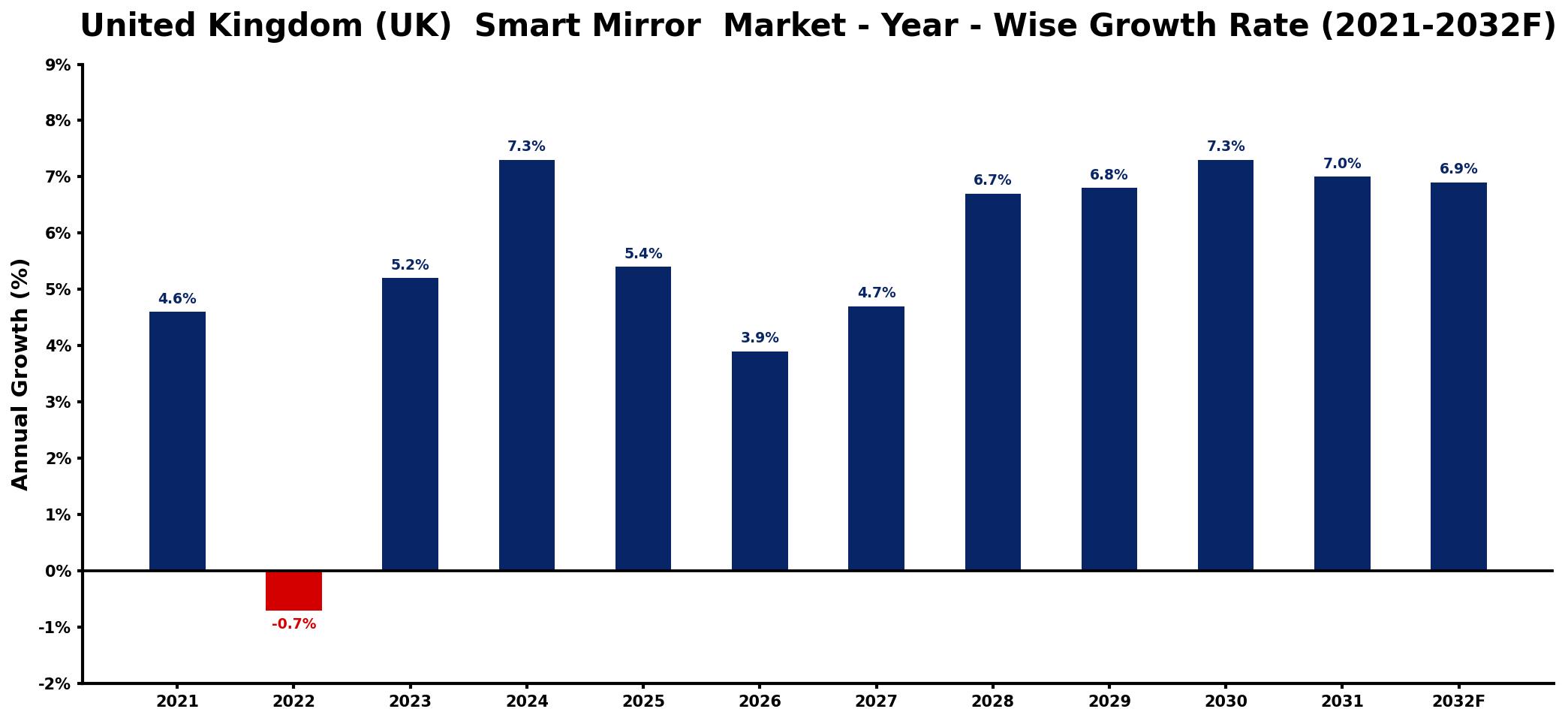
The table below presents the year‑wise growth rates along with the key drivers influencing the market
| Year | Growth Rate | Major Drivers |
| 2021 | 4.6% | Rising consumer health awareness |
| 2022 | -0.7% | reduced domestic production levels |
| 2023 | 5.2% | Increase in home automation demand |
| 2024 | 7.3% | Growing interest in wellness technology |
| 2025 | 5.4% | Expansion of luxury home markets |
| 2026 | 3.9% | Enhanced functionality in devices |
| 2027 | 4.7% | Increased investment in tech startups |
| 2028 | 6.7% | Growing trend of personalized products |
| 2029 | 6.8% | Surge in fitness technology integration |
| 2030 | 7.3% | Heightened focus on digital lifestyle |
| 2031 | 7.0% | Boost in home renovation projects |
| 2032 | 6.9% | Emerging trends in interactive technology |
Note: Market size estimations and growth projections presented in this report are based on 6Wresearch's proprietary forecasting methodology, utilizing the latest available industry data, government publications, and primary research inputs.
United Kingdom (UK) Smart Mirror Market Synopsis
The most significant force shaping the UK Smart Mirror Market is the escalating demand for personalized and interactive home technologies. As households embrace smart devices, the desire for multifunctional solutions that offer everything from fitness tracking to beauty tutorials is on the rise.
Furthermore, the integration of voice control features and connectivity with smart home ecosystems has made smart mirrors a sought-after addition to modern residences. Consumers are increasingly inclined to invest in technology that not only enhances daily routines but also aligns with their aspirations for a connected and efficient lifestyle.
United Kingdom (UK) Smart Mirror Market Key Takeaways
- The market is experiencing strong growth driven by the adoption of smart home technologies.
- Smart mirrors are increasingly equipped with features such as voice control and personalized interfaces.
- Consumer interest in wellness and self-care is fueling demand for advanced functionalities.
- Challenges related to cost and privacy concerns may slow adoption rates among budget-conscious consumers.
- Investment opportunities abound as technology and lifestyle trends continue to converge.
Evaluation of Restraints in United Kingdom (UK) Smart Mirror Market
While the UK Smart Mirror Market showcases impressive growth potential, several restraints hinder more rapid adoption. The high initial investment required for these advanced devices can deter price-sensitive consumers, leading to limited market penetration. Furthermore, privacy and data security concerns loom large as consumers remain hesitant about incorporating devices with built-in cameras and microphones into their private spaces. There is also a general lack of awareness surrounding smart mirror technology, which can slow down market acceptance. Finally, the necessity for regular software updates and ongoing maintenance may dissuade less tech-savvy individuals from purchasing these devices.
United Kingdom (UK) Smart Mirror Market Trends
The market is currently experiencing transformative trends that shape both demand and technological capabilities. The integration of advanced voice assistants, such as Amazon's Alexa and Google Assistant, enhances user experience and convenience, allowing for seamless interactions. Moreover, as consumers focus on wellness, features like skin analysis and mood lighting in smart mirrors are becoming increasingly popular. This trend towards holistic self-care experiences is further driving innovation, as manufacturers strive to incorporate augmented reality and AI to provide real-time personalized information.
United Kingdom (UK) Smart Mirror Market Opportunities
Given the rapid advancement in smart technologies, significant growth and investment opportunities lie within the UK Smart Mirror Market. Key areas include partnerships with manufacturers to develop tailored solutions and the creation of unique software applications that cater to consumer needs. Retail channels that focus on smart home products are also prime avenues for investment, as they facilitate the introduction of cutting-edge technology to a wider audience. With the consistent emphasis on energy efficiency and smart homes, the market presents a dynamic landscape ripe for exploration.
Government Initiatives in the United Kingdom (UK) Smart Mirror Market
The UK government is actively promoting innovation and the adoption of smart technologies through various initiatives. Policies such as the Digital Strategy and Industrial Strategy emphasize the need for digital transformation in homes and businesses. Additionally, government support for sustainable development aligns with the growing trend of integrating smart mirrors into residential and commercial spaces. The implementation of regulations like the General Data Protection Regulation (GDPR) further enhances consumer trust, ensuring that privacy considerations are prioritized as the market evolves.
Future Insights of the United Kingdom (UK) Smart Mirror Market
Looking ahead, the UK Smart Mirror Market is poised for significant evolution from 2026 to 2032. The demand for connected devices will likely intensify, as consumers increasingly seek solutions that enhance convenience and streamline daily routines. Continued technological advancements, particularly in augmented reality and artificial intelligence, will further enrich the functionality and appeal of smart mirrors. Ongoing product innovations will cater to the diverse and evolving needs of consumers, ensuring that the market continues to thrive in the coming years.
United Kingdom (UK) Smart Mirror Market Latest Developments (2025 - 2026)
In recent months, the UK Smart Mirror Market has seen a surge in innovative product launches that emphasize user experience and advanced functionalities. Manufacturers are increasingly focusing on integrating health and wellness features, responding to consumer trends that prioritize self-care. Additionally, partnerships between technology firms and retail outlets are becoming more common, as businesses look to leverage the growing interest in smart home solutions. Furthermore, consumer education campaigns are emerging to bridge the knowledge gap and promote awareness of the benefits and capabilities of smart mirrors.
United Kingdom (UK) Smart Mirror Market - Key Attractiveness of the Report
- 10 Years of Market Numbers
- Historical Data Starting from 2022 to 2025
- Base Year: 2025
- Forecast Data until 2032
- Key Performance Indicators Impacting the Market
- Major Upcoming Developments and Projects
Key Highlights of the Report:
- United Kingdom (UK) Smart Mirror Market Outlook
- Market Size of United Kingdom (UK) Smart Mirror Market, 2025
- Forecast of United Kingdom (UK) Smart Mirror Market, 2032
- Historical Data and Forecast of United Kingdom (UK) Smart Mirror Revenues & Volume for the Period 2022-2032F
- United Kingdom (UK) Smart Mirror Market Trend Evolution
- United Kingdom (UK) Smart Mirror Market Drivers and Challenges
- United Kingdom (UK) Smart Mirror Price Trends
- United Kingdom (UK) Smart Mirror Porter's Five Forces
- United Kingdom (UK) Smart Mirror Industry Life Cycle
- Historical Data and Forecast of United Kingdom (UK) Smart Mirror Market Revenues & Volume By Component for the Period 2022-2032F
- Historical Data and Forecast of United Kingdom (UK) Smart Mirror Market Revenues & Volume By Hardware for the Period 2022-2032F
- Historical Data and Forecast of United Kingdom (UK) Smart Mirror Market Revenues & Volume By Software for the Period 2022-2032F
- Historical Data and Forecast of United Kingdom (UK) Smart Mirror Market Revenues & Volume By Services for the Period 2022-2032F
- Historical Data and Forecast of United Kingdom (UK) Smart Mirror Market Revenues & Volume By End User for the Period 2022-2032F
- Historical Data and Forecast of United Kingdom (UK) Smart Mirror Market Revenues & Volume By Automotive for the Period 2022-2032F
- Historical Data and Forecast of United Kingdom (UK) Smart Mirror Market Revenues & Volume By Healthcare for the Period 2022-2032F
- Historical Data and Forecast of United Kingdom (UK) Smart Mirror Market Revenues & Volume By Residential for the Period 2022-2032F
- Historical Data and Forecast of United Kingdom (UK) Smart Mirror Market Revenues & Volume By Others for the Period 2022-2032F
- United Kingdom (UK) Smart Mirror Import Export Trade Statistics
- Market Opportunity Assessment By Component
- Market Opportunity Assessment By End User
- United Kingdom (UK) Smart Mirror Top Companies Market Share
- United Kingdom (UK) Smart Mirror Competitive Benchmarking By Technical and Operational Parameters
- United Kingdom (UK) Smart Mirror Company Profiles
- United Kingdom (UK) Smart Mirror Key Strategic Recommendations






































