United Kingdom (UK) Television Market Summary
The united kingdom (uk) television market was estimated at USD 490 Million in 2025 and is projected to reach USD 690 Million by 2032, growing at a CAGR of 4.3% from 2026 to 2032.
United Kingdom (UK) Television Market Year-wise Growth Rate and Key Drivers
This graph highlights how the United Kingdom (UK) Television Market has steadily grown over the past five years, supported by major growth factors.
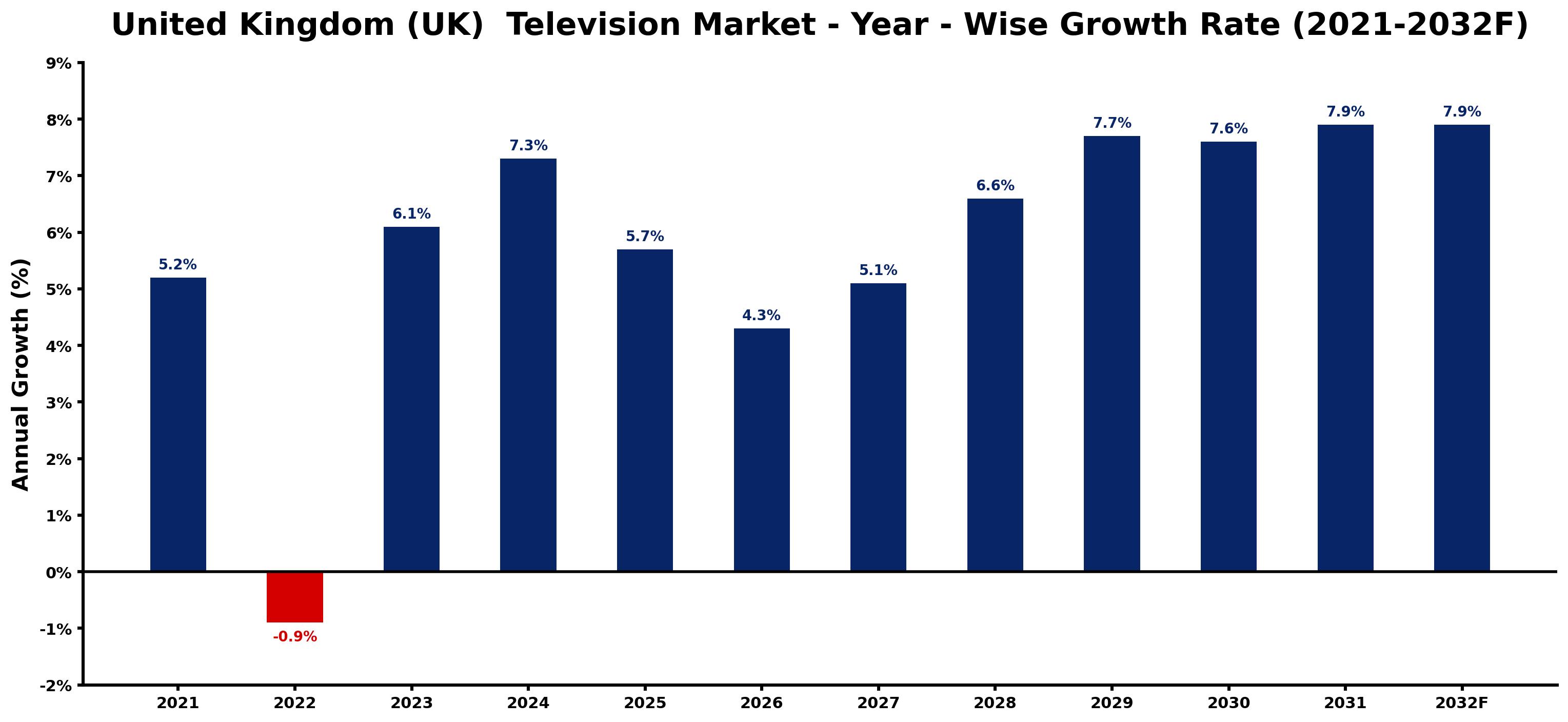
The table below presents the year wise growth rates along with the key drivers influencing the market
| Year | Growth Rate | Major Drivers |
| 2021 | 5.2% | Consumer habits shifted towards on-demand content platforms during pandemic restrictions. |
| 2022 | -0.9% | Shifting viewer preferences towards streaming services diminished traditional television subscription revenues significantly. |
| 2023 | 6.1% | Local content production gained momentum, enhancing viewer engagement across diverse demographics. |
| 2024 | 7.3% | Smart TV penetration increased significantly, offering advanced viewing experiences and capabilities. |
| 2025 | 5.7% | Competitive pricing strategies fueled viewer subscriptions to diverse streaming services. |
| 2026 | 4.3% | Innovative advertising formats attracted brands, shifting investment from traditional media channels. |
| 2027 | 5.1% | Sustainability in production practices became a focal point for industry players and audiences. |
| 2028 | 6.6% | Collaboration between telecom and media companies created bundled offerings for consumers. |
| 2029 | 7.7% | Augmented reality integration in broadcasts provided immersive experiences for sports viewers. |
| 2030 | 7.6% | Audience fragmentation necessitated personalized content curation to maintain viewer loyalty. |
| 2031 | 7.9% | Regulatory changes influenced content availability, impacting both broadcasting and streaming platforms. |
| 2032 | 7.9% | Emerging technologies like AI reshaped content creation and delivery, enhancing viewer satisfaction. |
Note - Market size estimations and growth projections presented in this report are based on 6Wresearch's advanced forecasting approach, validated with industry datasets as of June 2026.
United Kingdom (UK) Television Market Synopsis
The United Kingdom (UK) Television Market is projected to reach 4.3% and witness significant growth during the forecast period (2026-2032). This market represents a complex and dynamic landscape characterized by a robust mix of public service broadcasters and commercial networks. The sector has matured significantly, with major entities shaping the industry through diverse programming and innovative delivery mechanisms.
United Kingdom (UK) Television Market Overview
The UK television market stands out as one of the most advanced in the world, characterized by an extensive array of viewing options for consumers. Digital television penetration is notably high, encompassing cable, satellite, and digital terrestrial offerings. This diversity of platforms accommodates various demographics and interests, making the market not only inclusive but also highly competitive.
In recent years, the integration of streaming services into the British viewing experience has intensified competition. Players like Netflix and Amazon Prime Video provide on-demand content that challenges traditional broadcasters, who are now compelled to innovate continuously. The emphasis on high-quality programming, particularly in genres such as news, drama, entertainment, and sports, remains critical for maintaining audience engagement and market relevance.
United Kingdom (UK) Television Market Trends and Opportunities
Several trends are emerging prominently within the United Kingdom (UK) Television Market. The rise of on-demand streaming has considerably shifted consumer viewing habits, favoring subscription-based models over traditional scheduled programming. Key trends include:
- The proliferation of streaming services is reshaping viewer preferences, with many opting for platforms that offer flexibility and convenience.
- Traditional broadcasters are responding by launching their own streaming platforms, thereby attempting to reclaim viewership lost to these agile competitors.
- Smart TVs and connected devices are facilitating easier access to online content, which further drives consumer demand for high-quality, original programming.
- Investments in technology to enhance user experience and content delivery mechanisms are pivotal for both traditional and new players in the market.
- There is an increasing focus on creating original content tailored to diverse audience segments, which serves as a significant opportunity for content creators and producers.
United Kingdom (UK) Television Market Challenges and Restraints
Despite its strengths, the United Kingdom (UK) Television Market faces considerable challenges. The intense competition posed by streaming services has put traditional broadcasters under pressure to innovate and adapt. Key challenges include:
- The aggressive pricing strategies of streaming platforms provide consumers with compelling alternatives to traditional television, leading to an erosion of viewership.
- The shift towards on-demand content complicates advertising strategies for traditional broadcasters, requiring a reevaluation of their business models.
- Regulatory challenges, including compliance with content standards and advertising restrictions, add layers of complexity to operations within the market.
- Technological advancements require continual investment, and failure to keep pace could result in further loss of audience share to more adaptive entities.
- Consumer preferences are evolving rapidly, which necessitates an agile response from broadcasters to remain relevant in a changing landscape.
United Kingdom (UK) Television Market Investment Opportunities
The United Kingdom (UK) Television Market represents a wealth of investment opportunities across numerous segments. Key avenues for potential investments include:
- Content production companies that specialize in high-quality television programming are well-positioned for investment, catering to a growing demand for original content.
- Technology firms that develop innovative solutions for content streaming and broadcasting are attractive targets, particularly given the increasing reliance on digital delivery mechanisms.
- Advertising agencies focusing on television commercials and sponsorships provide opportunities for investment, especially as brands continue to leverage the medium for broad outreach.
- Digital content delivery platforms that enhance user experience and engagement can offer significant returns to investors in this evolving landscape.
- Collaborative ventures between traditional networks and new media entities present intriguing prospects for investors looking to capitalize on convergence trends in the television space.
United Kingdom (UK) Television Market Government Investment and Initiatives
Government policy plays a crucial role in shaping the United Kingdom (UK) Television Market. Regulatory frameworks are established to ensure fair competition and protect consumer interests, while also promoting diversity and high standards of quality in broadcasting. Key government initiatives include:
- Ofcom serves as the regulatory authority, overseeing industry compliance with standards related to content quality, advertising practices, and competitive fairness.
- The Communications Act 2003 set foundational regulations emphasizing the relevance of public service broadcasting in maintaining a diverse media landscape.
- The Digital Economy Act 2017 introduced critical measures focused on safeguarding children from harmful online content, thereby reinforcing consumer protection efforts.
- Strategies supporting local content production have been implemented, fostering creativity and supporting the UK's cultural identity within the media sphere.
- Public funding initiatives aim to support the development of innovative programming, thereby enhancing the industry's capacity to adapt to evolving viewer demands.
United Kingdom (UK) Television Market Latest Developments (May 2025 - June 2026)
Recent industry developments indicate a shift in focus towards interactive and personalized viewing experiences, aligning with evolving consumer expectations. This period has seen traditional broadcasters investing more heavily in original content creation, looking to compete effectively with the plethora of on-demand options available. There has been a noticeable increase in the collaboration between content creators and technology providers, enhancing the overall viewing experience through advancements in streaming technology and user interface design. Additionally, ongoing regulatory discussions aim to address the rapid changes in content consumption, with a focus on sustaining fair competition amidst a backdrop of increasing consolidation in the sector.
United Kingdom (UK) Television Market - Key Attractiveness of the Report
- 10 Years of Market Numbers
- Historical Data Starting from 2022 to 2025
- Base Year: 2025
- Forecast Data until 2032
- Key Performance Indicators Impacting the Market
- Major Upcoming Developments and Projects
Key Highlights of the Report:
- United Kingdom (UK) Television Market Outlook
- Market Size of United Kingdom (UK) Television Market, 2025
- Forecast of United Kingdom (UK) Television Market, 2032F
- Historical Data and Forecast of United Kingdom (UK) Television Revenues & Volume for the Period 2022-2032F
- United Kingdom (UK) Television Market Trend Evolution
- United Kingdom (UK) Television Market Drivers and Challenges
- United Kingdom (UK) Television Price Trends
- United Kingdom (UK) Television Porter's Five Forces
- United Kingdom (UK) Television Industry Life Cycle
- Historical Data and Forecast of United Kingdom (UK) Television Market Revenues & Volume By Resolution for the Period 2022-2032F
- Historical Data and Forecast of United Kingdom (UK) Television Market Revenues & Volume By LCD TVs for the Period 2022-2032F
- Historical Data and Forecast of United Kingdom (UK) Television Market Revenues & Volume By OLED TVs for the Period 2022-2032F
- Historical Data and Forecast of United Kingdom (UK) Television Market Revenues & Volume By Types for the Period 2022-2032F
- Historical Data and Forecast of United Kingdom (UK) Television Market Revenues & Volume By 2D TVs for the Period 2022-2032F
- Historical Data and Forecast of United Kingdom (UK) Television Market Revenues & Volume By 3D TVs for the Period 2022-2032F
- United Kingdom (UK) Television Import Export Trade Statistics
- Market Opportunity Assessment By Resolution
- Market Opportunity Assessment By Types
- United Kingdom (UK) Television Top Companies Market Share
- United Kingdom (UK) Television Competitive Benchmarking By Technical and Operational Parameters
- United Kingdom (UK) Television Company Profiles
- United Kingdom (UK) Television Key Strategic Recommendations






































