United Kingdom (UK) Textile Finishing Chemicals Market: Import Trend Analysis
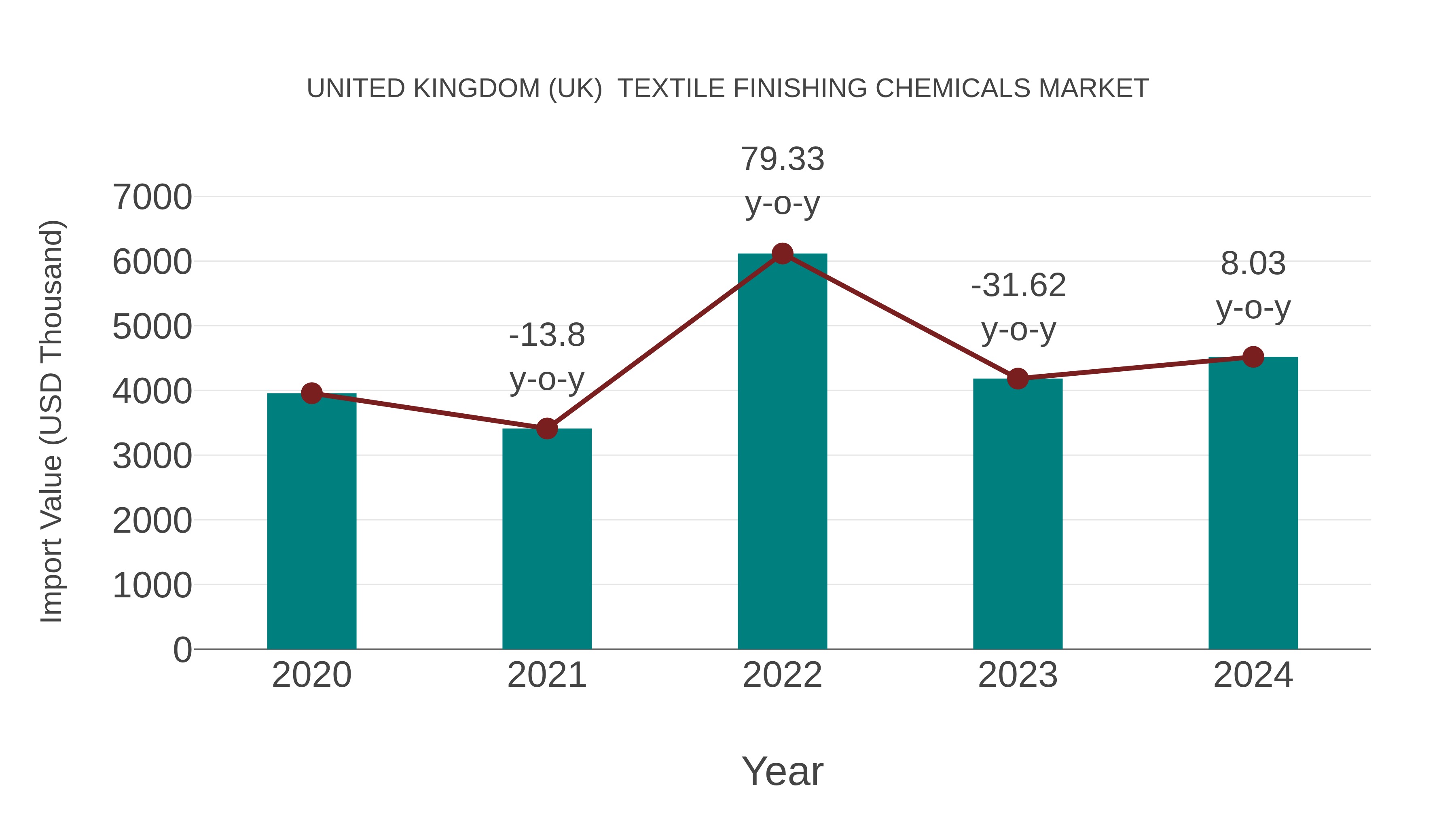
In 2024, the United Kingdom import trend for textile finishing chemicals showed a growth rate of 8.03% compared to the previous year. The compound annual growth rate (CAGR) for 2020-2024 stood at 3.38%. This increase in imports can be attributed to a shift in demand towards higher-quality finishing chemicals, reflecting a potential market recovery or evolving industry standards.
United Kingdom (UK) Textile Finishing Chemicals Market Overview
The United Kingdom (UK) Textile Finishing Chemicals Market is a thriving sector within the country`s textile industry. The market is primarily driven by the increasing demand for high-quality finished textiles in various end-user industries such as apparel, home textiles, and technical textiles. Textile finishing chemicals play a crucial role in enhancing the overall aesthetics, functionality, and performance of textiles. Key trends in the UK market include a growing focus on sustainable and eco-friendly finishing chemicals to meet consumer demands for environmentally conscious products. Major players in the market are investing in research and development to introduce innovative solutions that cater to changing industry requirements. The UK Textile Finishing Chemicals Market is expected to witness steady growth in the coming years due to the continuous evolution of textile manufacturing processes and consumer preferences.
United Kingdom (UK) Textile Finishing Chemicals Market Trends and Opportunities
The United Kingdom (UK) Textile Finishing Chemicals Market is currently experiencing a shift towards sustainable and eco-friendly solutions due to increasing environmental concerns. With a growing emphasis on reducing water and energy consumption in textile production processes, there is a rising demand for innovative finishing chemicals that offer improved performance while being environmentally friendly. Opportunities exist for companies that can provide bio-based, non-toxic, and biodegradable textile finishing chemicals to cater to the evolving needs of the market. Additionally, digitalization and automation technologies are being adopted to optimize production processes and enhance efficiency in the textile finishing sector. Companies investing in research and development to create innovative, sustainable solutions are well-positioned to capitalize on the emerging trends in the UK textile finishing chemicals market.
United Kingdom (UK) Textile Finishing Chemicals Market Challenges
In the UK Textile Finishing Chemicals Market, challenges primarily revolve around regulatory pressures related to environmental sustainability and health concerns. Compliance with stringent regulations on chemical usage and waste disposal poses a significant challenge for manufacturers in the industry. Additionally, the increasing demand for eco-friendly and non-toxic finishing chemicals further complicates the market landscape, requiring companies to invest in research and development to innovate sustainable solutions. Economic uncertainties, fluctuating raw material prices, and competition from overseas suppliers also contribute to the challenges faced by UK textile finishing chemicals companies. Adapting to these evolving market dynamics while maintaining product quality and competitiveness is crucial for businesses operating in this sector.
United Kingdom (UK) Textile Finishing Chemicals Market Drivers
The United Kingdom Textile Finishing Chemicals market is primarily driven by the increasing demand for sustainable and eco-friendly chemicals in textile manufacturing processes. With growing awareness about environmental issues, textile companies in the UK are shifting towards greener solutions to reduce their carbon footprint. Additionally, advancements in textile technology and increasing focus on quality and performance enhancement of textiles are also driving the market growth. The demand for innovative finishing chemicals that offer functionalities such as wrinkle resistance, moisture management, and UV protection is further propelling the market. Moreover, stringent regulations regarding the use of chemicals in textile production are encouraging manufacturers to adopt safer and more sustainable alternatives, thereby boosting the market for textile finishing chemicals in the UK.
United Kingdom (UK) Textile Finishing Chemicals Market Government Policy
The United Kingdom (UK) government has implemented strict regulations and policies related to the use and handling of textile finishing chemicals in the market. The UK follows the European Union`s REACH (Registration, Evaluation, Authorization and Restriction of Chemicals) regulations, which require companies to register and provide safety data for chemicals used in various industries, including textiles. Additionally, the UK government has introduced initiatives to promote the use of sustainable and eco-friendly chemicals in textile finishing processes to reduce environmental impact and ensure consumer safety. Companies operating in the UK textile finishing chemicals market are required to comply with these regulations to ensure the quality and safety of their products while minimizing adverse effects on the environment and public health.
United Kingdom (UK) Textile Finishing Chemicals Market Future Outlook
The United Kingdom`s Textile Finishing Chemicals Market is expected to witness steady growth in the coming years. Factors such as increasing demand for high-quality textiles, technological advancements in textile manufacturing processes, and growing awareness about sustainable practices are likely to drive market growth. The UK`s emphasis on innovation and sustainability in the textile industry will further boost the demand for eco-friendly and innovative finishing chemicals. Additionally, the rising trend of customization and personalization in textiles is expected to create new opportunities for market players. However, challenges such as stringent regulations on chemical usage and increasing competition from emerging markets may pose some hindrances to market growth. Overall, the UK Textile Finishing Chemicals Market is poised for moderate growth with a focus on sustainability and innovation driving the industry forward.
Key Highlights of the Report:
- United Kingdom (UK) Textile Finishing Chemicals Market Outlook
- Market Size of United Kingdom (UK) Textile Finishing Chemicals Market, 2025
- Forecast of United Kingdom (UK) Textile Finishing Chemicals Market, 2032
- Historical Data and Forecast of United Kingdom (UK) Textile Finishing Chemicals Revenues & Volume for the Period 2022 - 2032F
- United Kingdom (UK) Textile Finishing Chemicals Market Trend Evolution
- United Kingdom (UK) Textile Finishing Chemicals Market Drivers and Challenges
- United Kingdom (UK) Textile Finishing Chemicals Price Trends
- United Kingdom (UK) Textile Finishing Chemicals Porter's Five Forces
- United Kingdom (UK) Textile Finishing Chemicals Industry Life Cycle
- Historical Data and Forecast of United Kingdom (UK) Textile Finishing Chemicals Market Revenues & Volume By Type for the Period 2022 - 2032F
- Historical Data and Forecast of United Kingdom (UK) Textile Finishing Chemicals Market Revenues & Volume By Softening Finishes for the Period 2022 - 2032F
- Historical Data and Forecast of United Kingdom (UK) Textile Finishing Chemicals Market Revenues & Volume By Repellent Finishes for the Period 2022 - 2032F
- Historical Data and Forecast of United Kingdom (UK) Textile Finishing Chemicals Market Revenues & Volume By Wrinkle Free Finishes for the Period 2022 - 2032F
- Historical Data and Forecast of United Kingdom (UK) Textile Finishing Chemicals Market Revenues & Volume By Coating Finishes for the Period 2022 - 2032F
- Historical Data and Forecast of United Kingdom (UK) Textile Finishing Chemicals Market Revenues & Volume By Mothproofing Finishes for the Period 2022 - 2032F
- Historical Data and Forecast of United Kingdom (UK) Textile Finishing Chemicals Market Revenues & Volume By Process for the Period 2022 - 2032F
- Historical Data and Forecast of United Kingdom (UK) Textile Finishing Chemicals Market Revenues & Volume By Pad-Dry Cure Process for the Period 2022 - 2032F
- Historical Data and Forecast of United Kingdom (UK) Textile Finishing Chemicals Market Revenues & Volume By Exhaust Dyeing Process for the Period 2022 - 2032F
- United Kingdom (UK) Textile Finishing Chemicals Import Export Trade Statistics
- Market Opportunity Assessment By Type
- Market Opportunity Assessment By Process
- United Kingdom (UK) Textile Finishing Chemicals Top Companies Market Share
- United Kingdom (UK) Textile Finishing Chemicals Competitive Benchmarking By Technical and Operational Parameters
- United Kingdom (UK) Textile Finishing Chemicals Company Profiles
- United Kingdom (UK) Textile Finishing Chemicals Key Strategic Recommendations






































