United Kingdom (UK) Toys and Games Market Size, Share & Growth Rate
The United Kingdom (UK) Toys and Games Market was estimated at USD 234 Million in 2025 and is projected to reach USD 291 Million by 2032, growing at a CAGR of 3.2% from 2026 to 2032. This steady growth trajectory is primarily driven by the increasing consumer appetite for innovative and educational products, along with the burgeoning demand for interactive digital toys. As parents seek to enhance their children's play experiences, the trend towards STEM toys and eco-friendly options is expected to solidify, further propelling market expansion.
United Kingdom (UK) Toys and Games Market Year-wise Growth Rate and Key Drivers
This graph highlights how the United Kingdom (UK) Toys and Games Market has steadily grown over the years, supported by major growth factors.
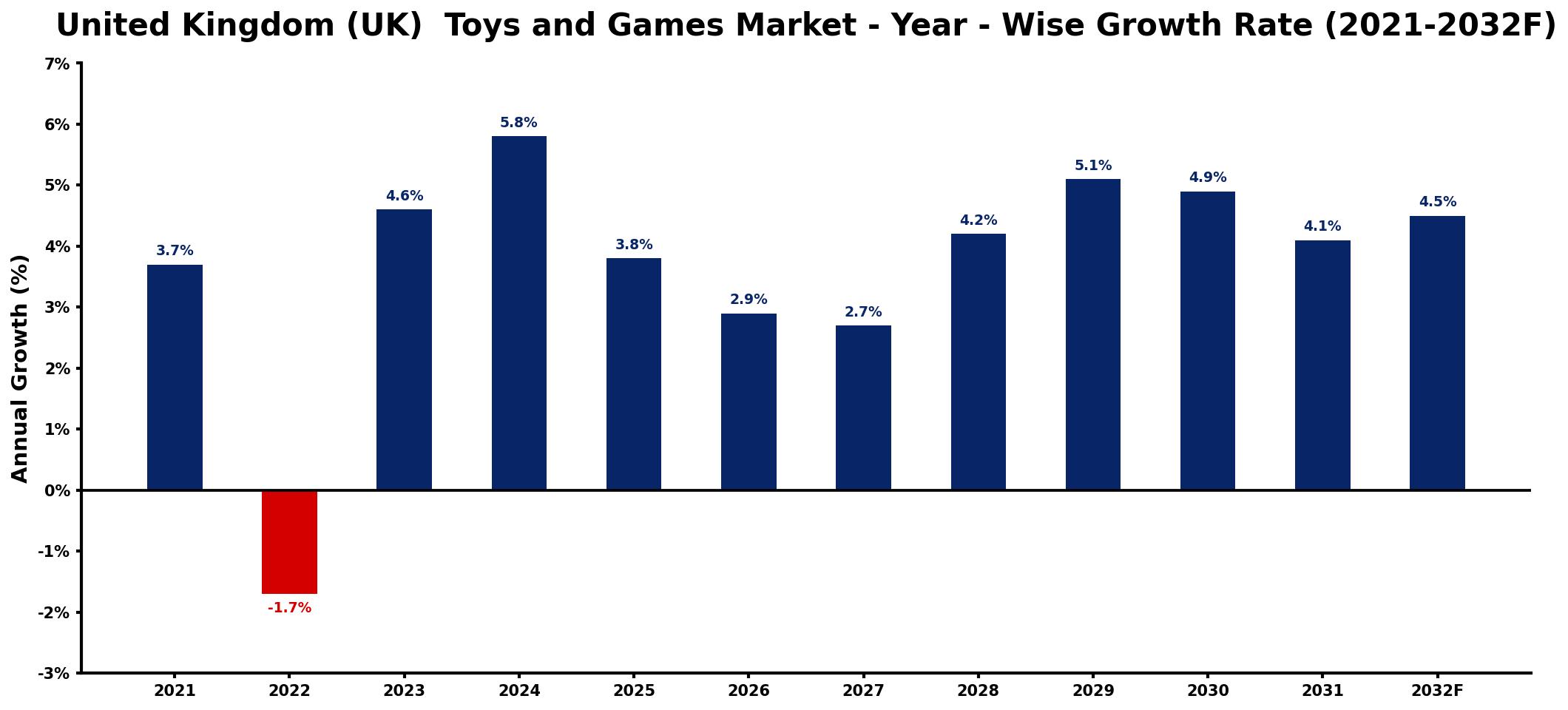
The table below presents the year‑wise growth rates along with the key drivers influencing the market
| Year | Growth Rate | Major Drivers |
| 2021 | 3.7% | Increased consumer spending habits |
| 2022 | -1.7% | Reduced disposable income availability |
| 2023 | 4.6% | Rise in online shopping preferences |
| 2024 | 5.8% | Expansion of retail distribution channels |
| 2025 | 3.8% | Growing popularity of eco-friendly products |
| 2026 | 2.9% | Increase in family entertainment options |
| 2027 | 2.7% | rising end-use demand growth |
| 2028 | 4.2% | Growth in experiential retail environments |
| 2029 | 5.1% | Rising interest in educational products |
| 2030 | 4.9% | growing emerging market penetration |
| 2031 | 4.1% | growing downstream application demand |
| 2032 | 4.5% | rising infrastructure development spending |
Note: Market size estimations and growth projections presented in this report are based on 6Wresearch's proprietary forecasting methodology, utilizing the latest available industry data, government publications, and primary research inputs.
United Kingdom (UK) Toys and Games Market Synopsis
In the UK Toys and Games Market, a significant shift towards educational toys has been noted, with parents valuing products that combine play with learning. The emphasis on STEM toys is resonating well with consumers, reflecting an evolving understanding of play as a critical element in child development.
Additionally, the surge in licensed merchandise from popular franchises continues to play a pivotal role in driving sales. The presence of various distribution channels, including online platforms and brick-and-mortar retailers, enhances accessibility, thereby catering to diverse consumer preferences.
United Kingdom (UK) Toys and Games Market Key Takeaways
- The market is valued at over £3 billion annually, showcasing its robustness and growth potential.
- Educational and STEM toys are at the forefront of consumer demand, reflecting changing parental priorities.
- Sustainability is increasingly significant, with eco-friendly toys gaining traction in consumer preferences.
- The competitive landscape includes both global brands and independent manufacturers, enhancing diversity in product offerings.
- Online shopping continues to reshape the buying experience, pushing traditional retailers to innovate.
Evaluation of Restraints in United Kingdom (UK) Toys and Games Market
Despite its growth, the UK Toys and Games Market faces several constraints. One of the most pressing issues is the intense competition from e-commerce platforms, which has significantly impacted traditional retail channels. Many brick-and-mortar stores are struggling to maintain relevance in the face of online giants that offer vast selections and convenience. Moreover, the increasing shift towards digital gaming and mobile apps presents a challenge to traditional toys, leading to fluctuating demand as consumer preferences evolve. Lastly, external economic factors and regulatory compliance issues can further complicate the market landscape, necessitating agility and adaptability from industry players.
United Kingdom (UK) Toys and Games Market Trends
Several key trends are currently shaping the UK Toys and Games Market. A notable increase in the popularity of interactive and digital toys is evident, as technological integration becomes a core component of modern play experiences. Additionally, there is a growing consciousness surrounding sustainability, with consumers actively seeking eco-friendly alternatives. The influence of entertainment franchises remains strong, driving consumer interest towards licensed products. Furthermore, the shift towards online shopping is transforming purchasing habits, pushing brands to enhance their digital presence and offering.
United Kingdom (UK) Toys and Games Market Opportunities
The UK Toys and Games Market presents numerous opportunities for growth and investment. The increasing focus on educational toys, particularly STEM-related products, provides a significant avenue for innovation. Moreover, niche markets like eco-friendly toys offer lucrative potential as consumer awareness grows. The rise of e-commerce also opens doors for partnerships with online platforms, allowing brands to reach a broader audience. Collaboration with entertainment franchises and influencers can further amplify brand visibility and product appeal, establishing a competitive edge in the evolving marketplace.
Government Initiatives in the United Kingdom (UK) Toys and Games Market
The UK Toys and Games Market operates within a framework of stringent government regulations aimed at ensuring product safety and quality. The British Toy and Hobby Association (BTHA) plays a key role in setting industry standards, encompassing toy safety and compliance with labeling requirements. Additionally, the UK government enforces the European Union's Toy Safety Directive, mandating rigorous safety checks for toys. Regulatory bodies like the UK Competition and Markets Authority (CMA) ensure fair market practices, safeguarding consumers and promoting healthy competition.
Future Insights of the United Kingdom (UK) Toys and Games Market
Looking forward to 2026-2032, the UK Toys and Games Market is poised for continued growth and innovation. The increasing demand for educational and interactive toys will likely shape product development strategies. The rise of digital gaming and virtual reality experiences will also redefine play dynamics, potentially drawing in a younger demographic. Consumer interest in sustainability is expected to drive the popularity of eco-friendly products, while online retailing will remain a critical component of the purchasing landscape. Adapting to these trends will be essential for maintaining competitiveness and meeting the evolving preferences of consumers.
United Kingdom (UK) Toys and Games Market Latest Developments (2025 - 2026)
Recent developments within the UK Toys and Games Market have been characterized by an increasing emphasis on digital integration. Companies are investing in smart toys that blend physical play with augmented reality experiences. There has also been a noticeable shift towards sustainable materials in product manufacturing as brands respond to consumer demand for environmentally friendly options. Collaborations with entertainment franchises are on the rise, as these partnerships continue to drive consumer interest. The market is witnessing a greater focus on safety and compliance, reflecting ongoing regulatory scrutiny.
United Kingdom (UK) Toys and Games Market - Key Attractiveness of the Report
- 10 Years of Market Numbers
- Historical Data Starting from 2022 to 2025
- Base Year: 2025
- Forecast Data until 2032
- Key Performance Indicators Impacting the Market
- Major Upcoming Developments and Projects
Key Highlights of the Report:
- United Kingdom (UK) ToysandGames Market Outlook
- Market Size of United Kingdom (UK) ToysandGames Market, 2025
- Forecast of United Kingdom (UK) ToysandGames Market, 2032
- Historical Data and Forecast of United Kingdom (UK) ToysandGames Revenues & Volume for the Period 2022-2032F
- United Kingdom (UK) ToysandGames Market Trend Evolution
- United Kingdom (UK) ToysandGames Market Drivers and Challenges
- United Kingdom (UK) ToysandGames Price Trends
- United Kingdom (UK) ToysandGames Porter's Five Forces
- United Kingdom (UK) ToysandGames Industry Life Cycle
- Historical Data and Forecast of United Kingdom (UK) ToysandGames Market Revenues & Volume By Product Type for the Period 2022-2032F
- Historical Data and Forecast of United Kingdom (UK) ToysandGames Market Revenues & Volume By Games and Puzzles for the Period 2022-2032F
- Historical Data and Forecast of United Kingdom (UK) ToysandGames Market Revenues & Volume By Video Games for the Period 2022-2032F
- Historical Data and Forecast of United Kingdom (UK) ToysandGames Market Revenues & Volume By Construction Toys for the Period 2022-2032F
- Historical Data and Forecast of United Kingdom (UK) ToysandGames Market Revenues & Volume By Dolls and Accessories for the Period 2022-2032F
- Historical Data and Forecast of United Kingdom (UK) ToysandGames Market Revenues & Volume By Outdoor and Sports Toys for the Period 2022-2032F
- Historical Data and Forecast of United Kingdom (UK) ToysandGames Market Revenues & Volume By Other for the Period 2022-2032F
- Historical Data and Forecast of United Kingdom (UK) ToysandGames Market Revenues & Volume By Distribution Channel for the Period 2022-2032F
- Historical Data and Forecast of United Kingdom (UK) ToysandGames Market Revenues & Volume By Online Channel for the Period 2022-2032F
- Historical Data and Forecast of United Kingdom (UK) ToysandGames Market Revenues & Volume By Offline Channel for the Period 2022-2032F
- United Kingdom (UK) ToysandGames Import Export Trade Statistics
- Market Opportunity Assessment By Product Type
- Market Opportunity Assessment By Distribution Channel
- United Kingdom (UK) ToysandGames Top Companies Market Share
- United Kingdom (UK) ToysandGames Competitive Benchmarking By Technical and Operational Parameters
- United Kingdom (UK) ToysandGames Company Profiles
- United Kingdom (UK) ToysandGames Key Strategic Recommendations






































