UK Transformer Market (2026-2032) | Trends, Analysis, Forecast, Industry, Growth, Share, Companies, Size, Value & Revenue
Market Forecast By Core (Closed, Shell, Berry), By Product (Power transformer, Distribution transformer, Instrument transformer, Others), By Winding (Two-winding, Auto-transformer), By Application (Residential & Commercial, Utility, Industrial), By Cooling (Dry type, Oil Immersed), By Phase (Single phase, 3 - phase), By Rating (10 MVA, 11 MVA to 60 MVA, 61 MVA to 600 MVA, > 600 MVA) And Competitive Landscape
| Product Code: ETC014249 | Publication Date: Dec 2023 | Updated Date: Mar 2026 | Product Type: Report | |
| Publisher: 6Wresearch | Author: Ravi Bhandari | No. of Pages: 70 | No. of Figures: 35 | No. of Tables: 5 |
United Kingdom (UK) Transformer Market: Import Trend Analysis
The United Kingdom import trend for the transformer market showed a growth rate of 3.78% from 2023 to 2024, with a compound annual growth rate (CAGR) of 37.21% for the period 2020-2024. This significant increase in imports can be attributed to the rising demand for energy-efficient transformers and the country`s efforts to upgrade its power infrastructure to meet sustainability goals.
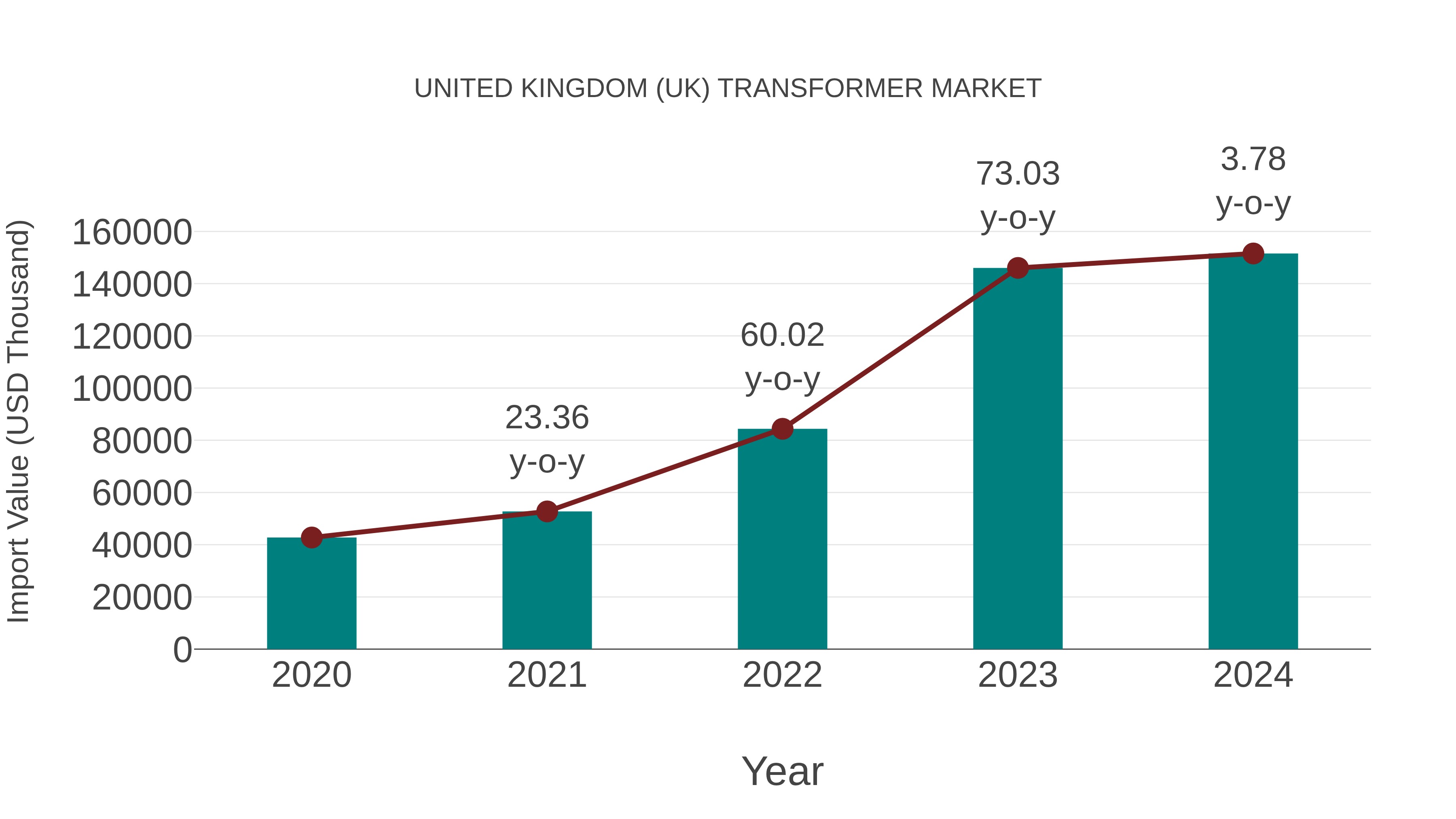
United Kingdom (UK) Transformer Market Growth Rate
According to 6Wresearch internal database and Industry insights, the United Kingdom (UK) Transformer Market is projected to grow at a compound annual growth rate (CAGR) of 5.92% during the forecast period (2025-2031).
Ukraine Transformer Market Highlights
| Report Name | United Kingdom (UK) Transformer Market |
| Forecast period | 2025-2031 |
| CAGR | 5.92% |
| Growing Sector | Utility & Renewable |
Topics Covered in the United Kingdom (UK) Transformer Market Report
The United Kingdom (UK) Transformer Market report thoroughly covers the Market by core, product, winding, application, cooling, phase, rating, and regions. The Market report provides an unbiased and detailed analysis of ongoing Market trends, opportunities/high growth areas, and Market drivers, which would help stakeholders devise and align their strategies according to the current and future Market dynamics, with emphasis on Market Growth, Industry Size, Share, and Revenue.
United Kingdom (UK) Transformer Market Synopsis
The UK Transformer Market has been witnessing a massive growth, driven by various factors, such as the country’s strong commitment to renewable energy integration and grid modernization. Additionally, the UK has been investing in offshore wind, solar energy, and nuclear power with the plan to reduce carbon footprints, which is estimated to boost the demand for high-efficiency transformers for power generation and distribution. Lastly, the demand for robust, large-capacity transformers is on the rise, as the growing industrial growth in sectors like electric vehicles (EV), data centers, and technology.
Evaluation of Growth Drivers in the United Kingdom (UK) Transformer Market
Below mentioned are some prominent drivers and their influence to the market dynamics:
|
Driver |
Primary Segments Affected |
Why it matters (evidence) |
|
Renewable Energy Expansion (Offshore Wind & Solar) |
Distribution & Instrument; Utility |
The UK's commitment to becoming a net-zero emissions country drives the demand for renewable-ready transformers. |
|
Grid Modernization and Smart Grids |
Power & Distribution; Utility |
Upgrades to the national grid require advanced transformers to support digital monitoring. |
|
Electric Vehicle (EV) Growth |
Power Transformers; Industrial |
The increase in EV infrastructure and manufacturing boosts demand for high-capacity transformers. |
|
Data Center Growth |
Power Transformers; Industrial |
Growing demand for data storage and cloud computing services increases the need for large MVA transformers. |
|
Cross-Border Energy Interconnection |
Power Transformers; Utility |
The UK’s interconnected energy system with France, the Netherlands, and Ireland requires high-capacity transformers. |
United Kingdom (UK) Transformer Market is projected to grow strongly, recording a CAGR of 5.92% during the forecast period 2025-2031. The market growth drivers boosting the expansion of the marker include country’s ambitious offshore wind projects in the North Sea and growing solar power initiatives. Also, the need for digital and highly efficient transformers have become necessary for integrating renewable energy sources into the grid, with the growing grid modernization, particularly the implementation of smart grids in the country. Additionally, the demand for power transformers in the industrial sector is on the rise, as the deployment of electric vehicles is increasing. The rising expansion of EV charging infrastructure is another major factor that will proliferate the demand for transformers. Additionally, the data center boom in the UK, fueled by increased cloud computing services, is driving significant growth for large-capacity power transformers.
Evaluation of Restraints in the United Kingdom (UK) Transformer Market
Below mentioned are some major restraints and their influence to the market dynamics:
|
Restraint |
Primary Segments Affected |
What this means (evidence) |
|
Import Dependency on High-Tech Units |
Smart Transformers; Utility |
The UK depends on imports for advanced smart and high-voltage transformers, which increases costs and delays in procurement. |
|
High Costs of Renewable Integration |
Utility & Industrial |
The transition to renewable energy involves high initial capital investment, which impacts transformer procurement budgets for utilities. |
|
Regulatory and Bureaucratic Delays |
Utility & Industrial |
Complex permitting processes for large infrastructure projects lead to delays in transformer deployment for grid upgrades. |
|
Currency & Inflation Volatility |
Utility & Industrial |
Exchange rate fluctuations and rising raw material costs, such as copper and steel, increase transformer affect budget forecasting. |
|
Skilled Workforce Shortage in Smart Tech |
Smart Transformers |
The lack of skilled workers for handling IoT-based transformers slows the adoption of advanced transformer technologies. |
United Kingdom (UK) Transformer Market Challenges
Despite of the positive outlook, the UK Transformer Market deals with several challenges that can affect its growth. These challenges include a dependency on imported technology and the high costs associated with integrating renewable sources. The market growth is hampered by the volatile exchange rates and rising material costs also affect long-term investment and procurement.
United Kingdom (UK) Transformer Market Trends
Several prominent trends reshaping the United Kingdom (UK) Transformer Market Growth include:
- Smart Grids: Increasing demand for digitally monitored transformers with IoT capabilities to integrate renewable energy and enhance grid management
- Green Transformers: Growing preference for ester-based oils and eco-friendly designs in line with the UK’s sustainability goals
- Modular Transformers: The rise of quick-install, modular transformer packages for urban infrastructure projects like metro stations and EV charging hubs
Investment Opportunities in the United Kingdom (UK) Transformer Industry
Some major investment opportunities in the market are:
- Smart Grid Solutions: Growing market for smart transformers and monitoring systems to enhance grid reliability and manage renewable energy integration
- Electric Vehicle Infrastructure: Growing need for transformers in the expansion of EV charging networks and manufacturing facilities
- Energy Storage Systems: Integration of transformers with energy storage solutions as part of a transition to decentralized energy production
Top 5 Leading Players in the United Kingdom (UK) Transformer Market
Leading players contributing to United Kingdom (UK) Transformer Market Share are: -
1. Siemens Energy AG
| Company Name | Siemens Energy AG |
| Headquarters | Munich, Germany |
| Official Website | Click Here |
Leading supplier of smart transformers and power equipment for grid modernization and renewable energy integration projects in the UK.
2. ABB Ltd.
| Company Name | ABB Ltd. |
| Headquarters | Zurich, Switzerland |
| Official Website | Click Here |
Provides power and distribution transformers, offering advanced solutions for renewable energy, industrial, and residential applications.
3. Schneider Electric SE
| Company Name | Schneider Electric SE |
| Headquarters | Rueil-Malmaison, France |
| Official Website | - |
Supplier of eco-friendly and smart transformers, with increasing presence in UK’s energy and infrastructure projects.
4. GE Grid Solutions
| Company Name | GE Grid Solutions |
| Headquarters | Paris, France & Atlanta, USA |
| Official Website | Click Here |
Offers large-capacity transformers, focusing on utility projects, renewable energy integration, and grid management solutions in the UK.
5. Mitsubishi Electric Corporation
| Company Name | Mitsubishi Electric Corporation |
| Headquarters | Tokyo, Japan |
| Official Website | Click Here |
Provides high-efficiency power transformers for energy infrastructure projects, including renewable energy systems in the UK.
Government Regulations Introduced in the United Kingdom (UK) Transformer Market
The UK government has implemented several rules & regulations to make sure the transformers that used in renewable energy projects are efficient and eco-friendly. Additionally, the UK Clean Growth Strategy, which focuses on integrating low-carbon technologies, including the upgradation of transformers in grid systems to support renewable generation. In addition, the Energy Security Bill encourages modernization of the transmission network, creating further demand for transformers in grid expansion projects.
Future Insights of the United Kingdom (UK) Transformer Market
The future of the UK Transformer Market seems optimistic, influenced by the country’s shift to renewable energy and smart grid developments in the country. Additionally, a rise in the deployment of offshore wind energy and solar power is likely to boost the demand for high-capacity transformers. Additionally, investment in transformers with enhanced monitoring capabilities will continue to increase, as the adoption of digital and smart technologies has been increasing.
Market Segmentation Analysis
The report offers a comprehensive study of the following market segments and their leading categories.
Shell core to Dominate the Market - By Core
According to Shivank Sharma, Senior Research Analyst, 6Wresearch, Shell core transformers are expected to dominate due to their superior reliability and mechanical strength, making them ideal for high-voltage substations and grid applications.
Distribution Transformers to Dominate the Market - By Product
Distribution transformers will lead as they are widely used in urban infrastructure projects, including residential buildings, commercial centers, and EV charging stations.
Utility Sector to Dominate the Market - By Application
The utility sector will dominate, driven by ongoing grid modernization and the push to integrate renewable energy sources. The utility sector will continue to drive the largest share of transformer demand.
Dry-Type Transformers to Dominate the Market - By Cooling
Dry-type transformers will dominate due to their fire safety benefits and suitability for installation in urban environments like metro stations, airports, and hospitals.
11 MVA to 60 MVA Segment to Dominate the Market - By Rating
The 11 MVA to 60 MVA rating segment will dominate, as these transformers are ideal for medium-size substations, renewable energy interconnections, and industrial applications.
Key Attractiveness of the Report
- 10 Years Market Numbers
- Historical Data Starting from 2021 to 2024
- Base Year: 2024
- Forecast Data until 2031
- Key Performance Indicators Impacting the Market
- Major Upcoming Developments and Projects
Key Highlights of the Report:
- UK Transformer Market Outlook
- Market Size of UK Transformer Market, 2025
- Forecast of UK Transformer Market, 2032
- Historical Data and Forecast of UK Transformer Revenues & Volume for the Period 2022 - 2032F
- UK Transformer Market Trend Evolution
- UK Transformer Market Drivers and Challenges
- UK Transformer Price Trends
- UK Transformer Porter's Five Forces
- UK Transformer Industry Life Cycle
- Historical Data and Forecast of UK Transformer Market Revenues & Volume By Core for the Period 2022 - 2032F
- Historical Data and Forecast of UK Transformer Market Revenues & Volume By Closed for the Period 2022 - 2032F
- Historical Data and Forecast of UK Transformer Market Revenues & Volume By Shell for the Period 2022 - 2032F
- Historical Data and Forecast of UK Transformer Market Revenues & Volume By Berry for the Period 2022 - 2032F
- Historical Data and Forecast of UK Transformer Market Revenues & Volume By Product for the Period 2022 - 2032F
- Historical Data and Forecast of UK Transformer Market Revenues & Volume By Power transformer for the Period 2022 - 2032F
- Historical Data and Forecast of UK Transformer Market Revenues & Volume By Distribution transformer for the Period 2022 - 2032F
- Historical Data and Forecast of UK Transformer Market Revenues & Volume By Instrument transformer for the Period 2022 - 2032F
- Historical Data and Forecast of UK Transformer Market Revenues & Volume By Others for the Period 2022 - 2032F
- Historical Data and Forecast of UK Transformer Market Revenues & Volume By Winding for the Period 2022 - 2032F
- Historical Data and Forecast of UK Transformer Market Revenues & Volume By Two-winding for the Period 2022 - 2032F
- Historical Data and Forecast of UK Transformer Market Revenues & Volume By Auto-transformer for the Period 2022 - 2032F
- Historical Data and Forecast of UK Transformer Market Revenues & Volume By Application for the Period 2022 - 2032F
- Historical Data and Forecast of UK Transformer Market Revenues & Volume By Residential & Commercial for the Period 2022 - 2032F
- Historical Data and Forecast of UK Transformer Market Revenues & Volume By Utility for the Period 2022 - 2032F
- Historical Data and Forecast of UK Transformer Market Revenues & Volume By Industrial for the Period 2022 - 2032F
- Historical Data and Forecast of UK Transformer Market Revenues & Volume By Cooling for the Period 2022 - 2032F
- Historical Data and Forecast of UK Transformer Market Revenues & Volume By Dry type for the Period 2022 - 2032F
- Historical Data and Forecast of UK Transformer Market Revenues & Volume By Oil Immersed for the Period 2022 - 2032F
- Historical Data and Forecast of UK Transformer Market Revenues & Volume By Insulation for the Period 2022 - 2032F
- Historical Data and Forecast of UK Transformer Market Revenues & Volume By Gas for the Period 2022 - 2032F
- Historical Data and Forecast of UK Transformer Market Revenues & Volume By Oil for the Period 2022 - 2032F
- Historical Data and Forecast of UK Transformer Market Revenues & Volume By Solid for the Period 2022 - 2032F
- Historical Data and Forecast of UK Transformer Market Revenues & Volume By Air for the Period 2022 - 2032F
- Historical Data and Forecast of UK Transformer Market Revenues & Volume By Others for the Period 2022 - 2032F
- Historical Data and Forecast of UK Transformer Market Revenues & Volume By Phase for the Period 2022 - 2032F
- Historical Data and Forecast of UK Transformer Market Revenues & Volume By Single phase for the Period 2022 - 2032F
- Historical Data and Forecast of UK Transformer Market Revenues & Volume By 3 - phase for the Period 2022 - 2032F
- Historical Data and Forecast of UK Transformer Market Revenues & Volume By Rating for the Period 2022 - 2032F
- Historical Data and Forecast of UK Transformer Market Revenues & Volume By ? 10 MVA for the Period 2022 - 2032F
- Historical Data and Forecast of UK Transformer Market Revenues & Volume By 11 MVA to 60 MVA for the Period 2022 - 2032F
- Historical Data and Forecast of UK Transformer Market Revenues & Volume By 61 MVA to 600 MVA for the Period 2022 - 2032F
- Historical Data and Forecast of UK Transformer Market Revenues & Volume By > 600 MVA for the Period 2022 - 2032F
- UK Transformer Import Export Trade Statistics
- Market Opportunity Assessment By Core
- Market Opportunity Assessment By Product
- Market Opportunity Assessment By Winding
- Market Opportunity Assessment By Application
- Market Opportunity Assessment By Cooling
- Market Opportunity Assessment By Insulation
- Market Opportunity Assessment By Phase
- Market Opportunity Assessment By Rating
- UK Transformer Top Companies Market Share
- UK Transformer Competitive Benchmarking By Technical and Operational Parameters
- UK Transformer Company Profiles
- UK Transformer Key Strategic Recommendations
Market Covered
The report offers a comprehensive study of the subsequent Market segments:
By Core
- Closed
- Shell
- Berry
By Product
- Power Transformer
- Distribution Transformer
- Instrument Transformer
- Others
By Winding
- Two-Winding
- Auto-Transformer
By Application
- Residential & Commercial
- Utility
- Industrial
By Cooling
- Dry Type
- Oil Immersed
By Phase
- Single Phase
- 3-Phase
By Rating
- 10 MVA
- 11 MVA to 60 MVA
- 61 MVA to 600 MVA
- > 600 MVA
UK Transformer Market (2026-2032): FAQs
The United Kingdom Transformer Market is projected to grow at a CAGR of approximately 5.92% during the forecast period.
Key trends include renewable energy integration, smart grid development, the rise of electric vehicles, and the expansion of data centers.
Opportunities lie in offshore wind projects, smart grid technologies, and EV infrastructure.
Challenges include reliance on imported technology, regulatory hurdles, and raw material price volatility.
6Wresearch actively monitors the UK Transformer Market and publishes its comprehensive annual report, highlighting emerging trends, growth drivers, revenue analysis, and forecast outlook. Our insights help businesses to make data-backed strategic decisions with ongoing market dynamics. Our analysts track relevent industries related to the UK Transformer Market, allowing our clients with actionable intelligence and reliable forecasts tailored to emerging regional needs.
Yes, we provide customisation as per your requirements. To learn more, feel free to contact us on sales@6wresearch.com
| 1 Executive Summary |
| 2 Introduction |
| 2.1 Key Highlights of the Report |
| 2.2 Report Description |
| 2.3 Market Scope & Segmentation |
| 2.4 Research Methodology |
| 2.5 Assumptions |
| 3 UK Transformer Market Overview |
| 3.1 UK Country Macro Economic Indicators |
| 3.2 UK Transformer Market Revenues & Volume, 2022 & 2032F |
| 3.3 UK Transformer Market - Industry Life Cycle |
| 3.4 UK Transformer Market - Porter's Five Forces |
| 3.5 UK Transformer Market Revenues & Volume Share, By Core, 2022 & 2032F |
| 3.6 UK Transformer Market Revenues & Volume Share, By Product, 2022 & 2032F |
| 3.7 UK Transformer Market Revenues & Volume Share, By Winding, 2022 & 2032F |
| 3.8 UK Transformer Market Revenues & Volume Share, By Application, 2022 & 2032F |
| 3.9 UK Transformer Market Revenues & Volume Share, By Cooling, 2022 & 2032F |
| 3.10 UK Transformer Market Revenues & Volume Share, By Insulation, 2022 & 2032F |
| 3.11 UK Transformer Market Revenues & Volume Share, By Phase, 2022 & 2032F |
| 4 UK Transformer Market Dynamics |
| 4.1 Impact Analysis |
| 4.2 Market Drivers |
| 4.2.1 Increasing demand for electricity and power infrastructure development in the UK. |
| 4.2.2 Growing focus on renewable energy sources, leading to the need for transformers in the UK. |
| 4.2.3 Technological advancements driving the adoption of smart grid systems in the UK. |
| 4.3 Market Restraints |
| 4.3.1 Regulatory challenges and compliance requirements impacting the transformer market in the UK. |
| 4.3.2 Volatility in raw material prices affecting the manufacturing cost of transformers in the UK. |
| 4.3.3 Competition from alternative energy storage solutions impacting the demand for traditional transformers in the UK. |
| 5 UK Transformer Market Trends |
| 6 UK Transformer Market, By Types |
| 6.1 UK Transformer Market, By Core |
| 6.1.1 Overview and Analysis |
| 6.1.2 UK Transformer Market Revenues & Volume, By Core, 2022-2032F |
| 6.1.3 UK Transformer Market Revenues & Volume, By Closed, 2022-2032F |
| 6.1.4 UK Transformer Market Revenues & Volume, By Shell, 2022-2032F |
| 6.1.5 UK Transformer Market Revenues & Volume, By Berry, 2022-2032F |
| 6.2 UK Transformer Market, By Product |
| 6.2.1 Overview and Analysis |
| 6.2.2 UK Transformer Market Revenues & Volume, By Power transformer, 2022-2032F |
| 6.2.3 UK Transformer Market Revenues & Volume, By Distribution transformer, 2022-2032F |
| 6.2.4 UK Transformer Market Revenues & Volume, By Instrument transformer, 2022-2032F |
| 6.2.5 UK Transformer Market Revenues & Volume, By Others, 2022-2032F |
| 6.3 UK Transformer Market, By Winding |
| 6.3.1 Overview and Analysis |
| 6.3.2 UK Transformer Market Revenues & Volume, By Two-winding, 2022-2032F |
| 6.3.3 UK Transformer Market Revenues & Volume, By Auto-transformer, 2022-2032F |
| 6.4 UK Transformer Market, By Application |
| 6.4.1 Overview and Analysis |
| 6.4.2 UK Transformer Market Revenues & Volume, By Residential & Commercial, 2022-2032F |
| 6.4.3 UK Transformer Market Revenues & Volume, By Utility, 2022-2032F |
| 6.4.4 UK Transformer Market Revenues & Volume, By Industrial, 2022-2032F |
| 6.5 UK Transformer Market, By Cooling |
| 6.5.1 Overview and Analysis |
| 6.5.2 UK Transformer Market Revenues & Volume, By Dry type, 2022-2032F |
| 6.5.3 UK Transformer Market Revenues & Volume, By Oil Immersed, 2022-2032F |
| 6.6 UK Transformer Market, By Insulation |
| 6.6.1 Overview and Analysis |
| 6.6.2 UK Transformer Market Revenues & Volume, By Gas, 2022-2032F |
| 6.6.3 UK Transformer Market Revenues & Volume, By Oil, 2022-2032F |
| 6.6.4 UK Transformer Market Revenues & Volume, By Solid, 2022-2032F |
| 6.6.5 UK Transformer Market Revenues & Volume, By Air, 2022-2032F |
| 6.6.6 UK Transformer Market Revenues & Volume, By Others, 2022-2032F |
| 6.7 UK Transformer Market, By Phase |
| 6.7.1 Overview and Analysis |
| 6.7.2 UK Transformer Market Revenues & Volume, By Single phase, 2022-2032F |
| 6.7.3 UK Transformer Market Revenues & Volume, By 3 - phase, 2022-2032F |
| 6.8 UK Transformer Market, By Rating |
| 6.8.1 Overview and Analysis |
| 6.8.2 UK Transformer Market Revenues & Volume, By ? 10 MVA, 2022-2032F |
| 6.8.3 UK Transformer Market Revenues & Volume, By 11 MVA to 60 MVA, 2022-2032F |
| 6.8.4 UK Transformer Market Revenues & Volume, By > 600 MVA, 2022-2032F |
| 6.8.5 UK Transformer Market Revenues & Volume, By > 600 MVA, 2022-2032F |
| 7 UK Transformer Market Import-Export Trade Statistics |
| 7.1 UK Transformer Market Export to Major Countries |
| 7.2 UK Transformer Market Imports from Major Countries |
| 8 UK Transformer Market Key Performance Indicators |
| 8.1 Average age of transformers in operation in the UK. |
| 8.2 Percentage of transformers equipped with smart grid technology in the UK. |
| 8.3 Investment in grid modernization projects in the UK. |
| 8.4 Adoption rate of renewable energy sources in the UK. |
| 8.5 Number of power outages and their duration in the UK. |
| 9 UK Transformer Market - Opportunity Assessment |
| 9.1 UK Transformer Market Opportunity Assessment, By Core, 2022 & 2032F |
| 9.2 UK Transformer Market Opportunity Assessment, By Product, 2022 & 2032F |
| 9.3 UK Transformer Market Opportunity Assessment, By Winding, 2022 & 2032F |
| 9.4 UK Transformer Market Opportunity Assessment, By Application, 2022 & 2032F |
| 9.5 UK Transformer Market Opportunity Assessment, By Cooling, 2022 & 2032F |
| 9.6 UK Transformer Market Opportunity Assessment, By Insulation, 2022 & 2032F |
| 9.7 UK Transformer Market Opportunity Assessment, By Phase, 2022 & 2032F |
| 9.7 UK Transformer Market Opportunity Assessment, By Rating, 2022 & 2032F |
| 10 UK Transformer Market - Competitive Landscape |
| 10.1 UK Transformer Market Revenue Share, By Companies, 2025 |
| 10.2 UK Transformer Market Competitive Benchmarking, By Operating and Technical Parameters |
| 11 Company Profiles |
| 12 Recommendations |
| 13 Disclaimer |
Market Forecast By Core (Closed, Shell, Berry), By Product (Power transformer, Distribution transformer, Instrument transformer, Others), By Winding (Two-winding, Auto-transformer), By Application (Residential & Commercial, Utility, Industrial), By Cooling (Dry type, Oil Immersed), By Phase (Single phase, 3 - phase), By Rating (10 MVA, 11 MVA to 60 MVA, 61 MVA to 600 MVA, > 600 MVA) And Competitive Landscape
| Product Code: ETC014249 | Publication Date: Oct 2020 | Product Type: Report | |
| Publisher: 6Wresearch | No. of Pages: 70 | No. of Figures: 35 | No. of Tables: 5 |
United Kingdom (UK) Transformer Market is projected to grow over the coming years. United Kingdom (UK) Transformer Market report is a part of our periodical regional publication Europe Transformer Market outlook report. 6W tracks transformer market for over 60 countries with individual country-wise market opportunity assessment and publishes with the report titled Global Transformer Market outlook report annually.
United Kingdom (UK) Transformer Market report thoroughly covers market by Core, Product, Winding, application, Cooling, Rating and Phase. The market report provides an unbiased and detailed analysis of the on-going market trends, opportunities/high growth areas and market drivers which would help the stakeholders to devise and align their market strategies according to the current and future market dynamics.
United Kingdom (UK) Transformer Market Synopsis
United Kingdom (UK) Transformer Market is anticipated to project substantial growth on account of rising industrialization. Surging population backed by rising demand for power is driving the UK Transformer Market Growth. Additionally, favourable government policies towards the adoption of renewable power backed by the usage of electric vehicle are driving the development of the market. Increasing consumer focus towards smart monitoring and sustainable electricity is adding too the UK Transformer Market Share.
According to 6Wresearch, United Kingdom (UK) Transformer Market size is projected to register growth during 2020-2026. Rising integration of energy efficient power supply is driving the development of the market. Moreover, increasing need to refurbish the existing power grid with smart grid owing to its high efficiency is adding to the UK Transformer Market Revenue. However, the market suffered a major setback owing to COVID-19 health emergency that further led to disruption in demand for power in commercial and industrial sector. Nationwide lockdown led to the delay in upcoming projects.
Market Analysis by Product
On the basis of product, distribution transformer segment accounted substantial share and is expected to dominate the market during the upcoming years on account of increasing adoption of smart grid.
Key Attractiveness of the Report
- COVID-19 Impact on the Market.
- 10 Years Market Numbers.
- Historical Data Starting from 2016 to 2019.
- Base Year: 2019.
- Forecast Data until 2026.
- Key Performance Indicators Impacting the Market.
- Major Upcoming Developments and Projects.
Key Highlights of the Report:
- United Kingdom (UK) Transformer Market Outlook
- Market Size of United Kingdom (UK) Transformer Market, 2019
- Forecast of United Kingdom (UK) Transformer Market, 2026
- Historical Data and Forecast of United Kingdom (UK) Transformer Revenues & Volume for the Period 2016 - 2026
- United Kingdom (UK) Transformer Market Trend Evolution
- United Kingdom (UK) Transformer Market Drivers and Challenges
- United Kingdom (UK) Transformer Price Trends
- United Kingdom (UK) Transformer Porter's Five Forces
- United Kingdom (UK) Transformer Industry Life Cycle
- Historical Data and Forecast of United Kingdom (UK) Transformer Market Revenues & Volume By Core for the Period 2016 - 2026
- Historical Data and Forecast of United Kingdom (UK) Transformer Market Revenues & Volume By Closed for the Period 2016 - 2026
- Historical Data and Forecast of United Kingdom (UK) Transformer Market Revenues & Volume By Shell for the Period 2016 - 2026
- Historical Data and Forecast of United Kingdom (UK) Transformer Market Revenues & Volume By Berry for the Period 2016 - 2026
- Historical Data and Forecast of United Kingdom (UK) Transformer Market Revenues & Volume By Product for the Period 2016 - 2026
- Historical Data and Forecast of United Kingdom (UK) Transformer Market Revenues & Volume By Power transformer for the Period 2016 - 2026
- Historical Data and Forecast of United Kingdom (UK) Transformer Market Revenues & Volume By Distribution transformer for the Period 2016 - 2026
- Historical Data and Forecast of United Kingdom (UK) Transformer Market Revenues & Volume By Instrument transformer for the Period 2016 - 2026
- Historical Data and Forecast of United Kingdom (UK) Transformer Market Revenues & Volume By Others for the Period 2016 - 2026
- Historical Data and Forecast of United Kingdom (UK) Transformer Market Revenues & Volume By Winding for the Period 2016 - 2026
- Historical Data and Forecast of United Kingdom (UK) Transformer Market Revenues & Volume By Two-winding for the Period 2016 - 2026
- Historical Data and Forecast of United Kingdom (UK) Transformer Market Revenues & Volume By Auto-transformer for the Period 2016 - 2026
- Historical Data and Forecast of United Kingdom (UK) Transformer Market Revenues & Volume By Application for the Period 2016 - 2026
- Historical Data and Forecast of United Kingdom (UK) Transformer Market Revenues & Volume By Residential & Commercial for the Period 2016 - 2026
- Historical Data and Forecast of United Kingdom (UK) Transformer Market Revenues & Volume By Utility for the Period 2016 - 2026
- Historical Data and Forecast of United Kingdom (UK) Transformer Market Revenues & Volume By Industrial for the Period 2016 - 2026
- Historical Data and Forecast of United Kingdom (UK) Transformer Market Revenues & Volume By Cooling for the Period 2016 - 2026
- Historical Data and Forecast of United Kingdom (UK) Transformer Market Revenues & Volume By Dry type for the Period 2016 - 2026
- Historical Data and Forecast of United Kingdom (UK) Transformer Market Revenues & Volume By Oil Immersed for the Period 2016 - 2026
- Historical Data and Forecast of United Kingdom (UK) Transformer Market Revenues & Volume By Insulation for the Period 2016 - 2026
- Historical Data and Forecast of United Kingdom (UK) Transformer Market Revenues & Volume By Gas for the Period 2016 - 2026
- Historical Data and Forecast of United Kingdom (UK) Transformer Market Revenues & Volume By Oil for the Period 2016 - 2026
- Historical Data and Forecast of United Kingdom (UK) Transformer Market Revenues & Volume By Solid for the Period 2016 - 2026
- Historical Data and Forecast of United Kingdom (UK) Transformer Market Revenues & Volume By Air for the Period 2016 - 2026
- Historical Data and Forecast of United Kingdom (UK) Transformer Market Revenues & Volume By Others for the Period 2016 - 2026
- Historical Data and Forecast of United Kingdom (UK) Transformer Market Revenues & Volume By Phase for the Period 2016 - 2026
- Historical Data and Forecast of United Kingdom (UK) Transformer Market Revenues & Volume By Single phase for the Period 2016 - 2026
- Historical Data and Forecast of United Kingdom (UK) Transformer Market Revenues & Volume By 3 - phase for the Period 2016 - 2026
- Historical Data and Forecast of United Kingdom (UK) Transformer Market Revenues & Volume By Rating for the Period 2016 - 2026
- Historical Data and Forecast of United Kingdom (UK) Transformer Market Revenues & Volume By ? 10 MVA for the Period 2016 - 2026
- Historical Data and Forecast of United Kingdom (UK) Transformer Market Revenues & Volume By 11 MVA to 60 MVA for the Period 2016 - 2026
- Historical Data and Forecast of United Kingdom (UK) Transformer Market Revenues & Volume By 61 MVA to 600 MVA for the Period 2016 - 2026
- Historical Data and Forecast of United Kingdom (UK) Transformer Market Revenues & Volume By > 600 MVA for the Period 2016 - 2026
- United Kingdom (UK) Transformer Import Export Trade Statistics
- Market Opportunity Assessment By Core
- Market Opportunity Assessment By Product
- Market Opportunity Assessment By Winding
- Market Opportunity Assessment By Application
- Market Opportunity Assessment By Cooling
- Market Opportunity Assessment By Insulation
- Market Opportunity Assessment By Phase
- Market Opportunity Assessment By Rating
- United Kingdom (UK) Transformer Top Companies Market Share
- United Kingdom (UK) Transformer Competitive Benchmarking By Technical and Operational Parameters
- United Kingdom (UK) Transformer Company Profiles
- United Kingdom (UK) Transformer Key Strategic Recommendations.
Market Scope and Segmentation
The report provides a detailed analysis of the following Market segments:
- By Core:
- Closed
- Shell
- Berry
- By Product:
- Power Transformer
- Distribution Transformer
- Instrument Transformer
- Others
- By Winding:
- Two-Winding
- Auto-Transformer
- By Application
- Residential & Commercial
- Utility
- Industrial
- By Cooling:
- Dry Type
- Oil Immersed
- By Phase:
- Single Phase
- 3 – Phase
- By Rating
- 10 MVA
- 11 MVA To 60 MVA
- 61 MVA To 600 MVA
- >600 MVA
Global Go To Market Strategy - 2030
Export potential enables firms to identify high-growth global markets with greater confidence by combining advanced trade intelligence with a structured quantitative methodology. The framework analyzes emerging demand trends and country-level import patterns while integrating macroeconomic and trade datasets such as GDP and population forecasts, bilateral import–export flows, tariff structures, elasticity differentials between developed and developing economies, geographic distance, and import demand projections. Using weighted trade values from 2020–2024 as the base period to project country-to-country export potential for 2030, these inputs are operationalized through calculated drivers such as gravity model parameters, tariff impact factors, and projected GDP per-capita growth. Through an analysis of hidden potentials, demand hotspots, and market conditions that are most favorable to success, this method enables firms to focus on target countries, maximize returns, and global expansion with data, backed by accuracy.
By factoring in the projected importer demand gap that is currently unmet and could be potential opportunity, it identifies the potential for the Exporter (Country) among 190 countries, against the general trade analysis, which identifies the biggest importer or exporter.
To discover high-growth global markets and optimize your business strategy:
Click Here
Pricing
- Single User License$ 1,995
- Department License$ 2,400
- Site License$ 3,120
- Global License$ 3,795

Leadership Perspectives from Industry Events
Search
Thought Leadership and Analyst Meet





Our Clients








6WResearch In News
- India Air Conditioner Market Set for Strong Rebound in 2026 After Weather-Led Correction and GST-Driven Recovery: 6Wresearch
- ADAS in India: How Automatic Emergency Braking, Blind Spot Detection & Driver Monitoring are Transforming Road Safety
- Doha a strategic location for EV manufacturing hub: IPA Qatar
- Demand for luxury TVs surging in the GCC, says Samsung
- Empowering Growth: The Thriving Journey of Bangladesh’s Cable Industry
- Demand for luxury TVs surging in the GCC, says Samsung
Latest Reports
- Nicaragua RPG Gaming Market (2026-2032)
- New Zealand RPG Gaming Market (2026-2032)
- Netherlands RPG Gaming Market (2026-2032)
- Nauru RPG Gaming Market (2026-2032)
- Namibia RPG Gaming Market (2026-2032)
- Mozambique RPG Gaming Market (2026-2032)
- Montenegro RPG Gaming Market (2026-2032)
- Mongolia RPG Gaming Market (2026-2032)
- Monaco RPG Gaming Market (2026-2032)
- Micronesia RPG Gaming Market (2026-2032)
Industry Events and Analyst Meet

EV India Expo 2026

HIMTEX 2026

India Refining Summit 2026

India EV Show 2026

EV tech India Expo 2026
Whitepaper
- Middle East & Africa Commercial Security Market Click here to view more.
- Middle East & Africa Fire Safety Systems & Equipment Market Click here to view more.
- GCC Drone Market Click here to view more.
- Middle East Lighting Fixture Market Click here to view more.
- GCC Physical & Perimeter Security Market Click here to view more.


