United Kingdom (UK) Vending machines Market Summary
The united kingdom (uk) vending machines market was estimated at USD 215 Million in 2025 and is projected to reach USD 265 Million by 2032, growing at a CAGR of 2.9% from 2026 to 2032.
United Kingdom (UK) Vending machines Market Year-wise Growth Rate and Key Drivers
This graph highlights how the United Kingdom (UK) Vending machines Market has steadily grown over the past five years, supported by major growth factors.
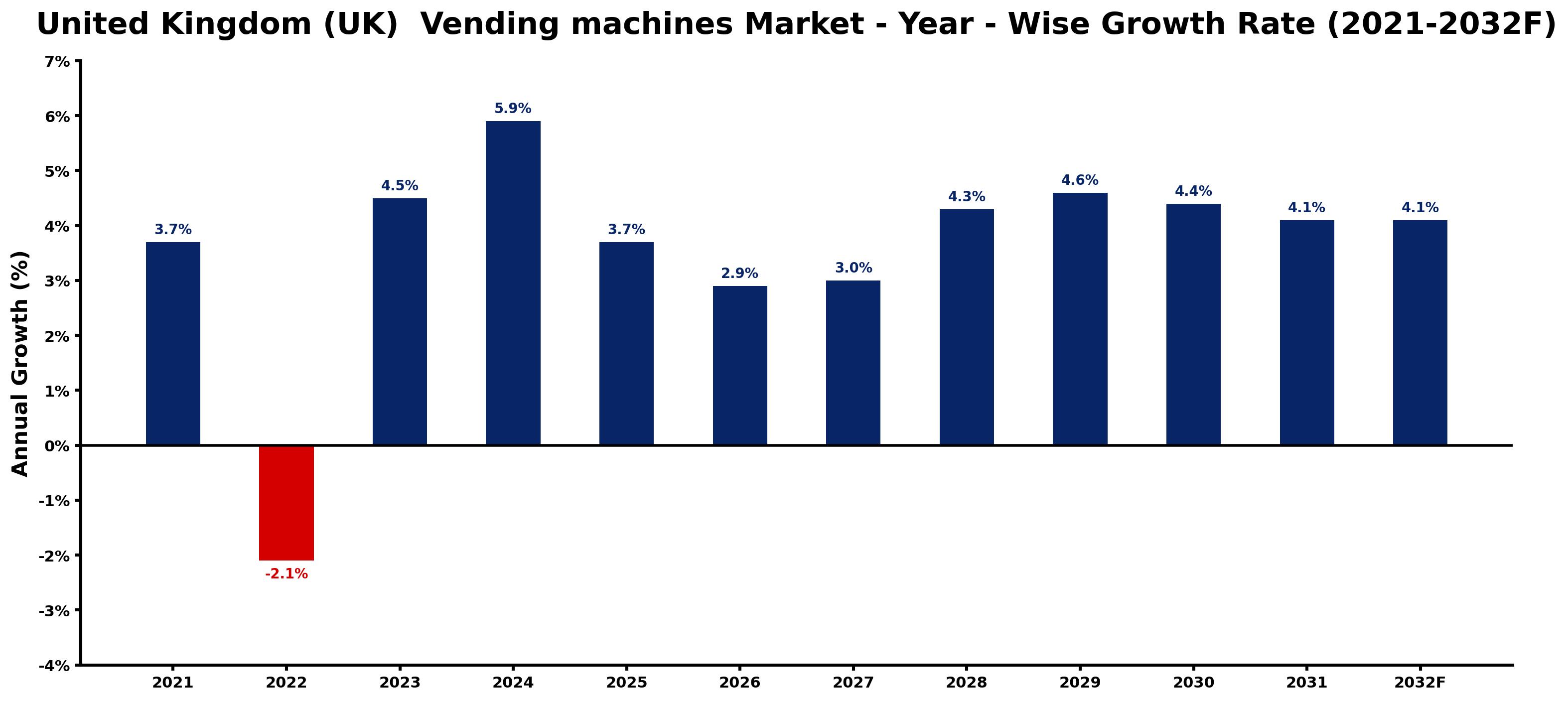
The table below presents the year wise growth rates along with the key drivers influencing the market
| Year | Growth Rate | Major Drivers |
| 2021 | 3.7% | Post-lockdown retail projects highlighted vending as a contactless shopping solution. |
| 2022 | -2.1% | Supply chain disruptions significantly delayed restocking efforts, leading to decreased availability of popular vending machine products. |
| 2023 | 4.5% | Urbanization trends pushed vending machine placements into high-footfall areas like transport hubs. |
| 2024 | 5.9% | Smart technology integration allowed for cashless payments and enhanced user experiences. |
| 2025 | 3.7% | Health-conscious snack options began dominating vending machine offerings across the market. |
| 2026 | 2.9% | Environmental concerns prompted a surge in eco-friendly vending machine designs and operations. |
| 2027 | 3.0% | Corporate wellness programs supported the installation of vending machines in various workplaces. |
| 2028 | 4.3% | Technological developments enabled real-time inventory management and efficient restocking processes. |
| 2029 | 4.6% | Expanding delivery options integrated with vending machines fostered new sales avenues. |
| 2030 | 4.4% | Increased competition among vendors resulted in diversified product offerings and improved services. |
| 2031 | 4.1% | Partnerships with local vendors enhanced product variety, appealing to regional preferences. |
| 2032 | 4.1% | Rising emphasis on automation led to more advanced vending machines with AI features. |
Note - Market size estimations and growth projections presented in this report are based on 6Wresearch's advanced forecasting approach, validated with industry datasets as of June 2026.
United Kingdom (UK) Vending machines Market Synopsis
The United Kingdom (UK) Vending machines Market is projected to reach 2.9% and witness significant growth during the forecast period (2026-2032). This market encompasses automated retail solutions that dispense a variety of products such as snacks, beverages, and convenience items in locations characterized by high foot traffic, including offices, educational institutions, and public areas. Factors driving the demand for vending machines include changing consumer behaviors focused on convenience, initiatives for workplace wellness, and advancements in technology that enhance vending machine functionalities.
United Kingdom (UK) Vending machines Market Growth Drivers
The landscape of the United Kingdom (UK) Vending machines Market is primarily influenced by a mélange of factors that foster market growth. Key drivers include:
- Increasing consumer demand for convenience has led to the proliferation of vending machines in various sectors, making them an essential part of daily life.
- The evolution of technology, including cashless payment systems and smart vending solutions, has improved operational efficiency and customer interaction, further bolstering market demand.
- With a rising focus on workplace wellness, companies are investing in vending machines that offer healthier snack and beverage choices, aligning with consumer preferences for nutritious options.
- The integration of IoT connectivity in vending machines allows for real-time inventory management, enabling operators to optimize stock levels and reduce waste.
- The broadening product range, which now includes electronics and personal care items, is attracting a more diverse group of consumers, thereby expanding the market's reach.
United Kingdom (UK) Vending machines Market Challenges and Restraints
While the United Kingdom (UK) Vending machines Market is positioned for growth, it also contends with several significant challenges. These challenges include:
- The high initial investment and maintenance costs associated with vending machines can deter potential operators, particularly small businesses.
- Ensuring the reliability and security of vending machines in diverse locations, while adapting to consumer demands for a wide variety of products, presents an operational complexity.
- Intensified competition from alternative retail solutions, such as mobile food trucks and online delivery services, poses a threat to the traditional vending model.
- Effective marketing strategies are necessary to capture consumer interest and drive usage, yet many operators struggle with differentiation in a crowded market.
- Regulatory compliance, particularly regarding consumer safety and product labeling, adds another layer of complexity for vending machine operators.
United Kingdom (UK) Vending machines Market Government Investment and Initiatives
The government plays a pivotal role in shaping the United Kingdom (UK) Vending machines Market through various policies and initiatives. Emphasis is placed on retail automation and enhancing convenience services for consumers. Key areas of government focus include:
- Strict regulatory frameworks ensure that vending machines meet safety standards, particularly concerning food hygiene regulations for consumables.
- Support for technological advancements has led to the proliferation of cashless payment systems, facilitating a more seamless consumer experience.
- Environmental regulations encourage the development of energy-efficient vending machines and promote sustainable packaging options, aligning with broader sustainability goals.
- Trade policies are designed to improve market access for UK-based vending machine manufacturers, fostering competitiveness and innovation in the global arena.
- Government funding initiatives aim to support the modernization of vending offerings, encouraging operators to invest in advanced technologies and improve service delivery.
United Kingdom (UK) Vending machines Market Latest Developments (May 2025 - June 2026)
The period from May 2025 to June 2026 has been marked by noteworthy developments in the United Kingdom (UK) Vending machines Market. Recent trends indicate a growing adoption of touchless interfaces in vending machines, driven by heightened health concerns and consumer preferences for hygienic interactions. Furthermore, the introduction of machines featuring localized product offerings has gained traction, addressing specific regional consumer preferences more effectively. The ongoing integration of IoT technology in vending operations has become increasingly prevalent, allowing operators to gather data on consumer behavior and optimize inventory accordingly. In addition, an increased emphasis on sustainability has led many operators to consider eco-friendly supply chains and practices, reflecting a broader commitment to environmental responsibility. Overall, these developments illustrate a dynamic market that is continuously evolving to meet the changing demands of consumers and operators alike.
United Kingdom (UK) Vending machines Market - Key Attractiveness of the Report
- 10 Years of Market Numbers
- Historical Data Starting from 2022 to 2025
- Base Year: 2025
- Forecast Data until 2032
- Key Performance Indicators Impacting the Market
- Major Upcoming Developments and Projects
Key Highlights of the Report:
- United Kingdom (UK) Vending machines Market Outlook
- Market Size of United Kingdom (UK) Vending machines Market, 2025
- Forecast of United Kingdom (UK) Vending machines Market, 2032
- Historical Data and Forecast of United Kingdom (UK) Vending machines Revenues & Volume for the Period 2022-2032F
- United Kingdom (UK) Vending machines Market Trend Evolution
- United Kingdom (UK) Vending machines Market Drivers and Challenges
- United Kingdom (UK) Vending machines Price Trends
- United Kingdom (UK) Vending machines Porter's Five Forces
- United Kingdom (UK) Vending machines Industry Life Cycle
- Historical Data and Forecast of United Kingdom (UK) Vending machines Market Revenues & Volume By Applications for the Period 2022-2032F
- Historical Data and Forecast of United Kingdom (UK) Vending machines Market Revenues & Volume By Commercial Places for the Period 2022-2032F
- Historical Data and Forecast of United Kingdom (UK) Vending machines Market Revenues & Volume By Offices for the Period 2022-2032F
- Historical Data and Forecast of United Kingdom (UK) Vending machines Market Revenues & Volume By Public Places for the Period 2022-2032F
- Historical Data and Forecast of United Kingdom (UK) Vending machines Market Revenues & Volume By Others for the Period 2022-2032F
- Historical Data and Forecast of United Kingdom (UK) Vending machines Market Revenues & Volume By Payment Mode for the Period 2022-2032F
- Historical Data and Forecast of United Kingdom (UK) Vending machines Market Revenues & Volume By Cash for the Period 2022-2032F
- Historical Data and Forecast of United Kingdom (UK) Vending machines Market Revenues & Volume By Cashless for the Period 2022-2032F
- United Kingdom (UK) Vending machines Import Export Trade Statistics
- Market Opportunity Assessment By Applications
- Market Opportunity Assessment By Payment Mode
- United Kingdom (UK) Vending machines Top Companies Market Share
- United Kingdom (UK) Vending machines Competitive Benchmarking By Technical and Operational Parameters
- United Kingdom (UK) Vending machines Company Profiles
- United Kingdom (UK) Vending machines Key Strategic Recommendations






































