United Kingdom (UK) Vetiver Oil Market Size, Share & Growth Rate
The United Kingdom (UK) Vetiver Oil Market was estimated at USD 345 Million in 2025 and is projected to reach USD 428 Million by 2032, growing at a CAGR of 3.1% from 2026 to 2032. This steady growth can be attributed to a surge in consumer interest in natural and organic products, particularly within the wellness and beauty sectors. The ongoing trend towards sustainable sourcing and the increasing popularity of aromatherapy are also key contributors to this upward trajectory.
United Kingdom (UK) Vetiver Oil Market Year-wise Growth Rate and Key Drivers
This graph highlights how the United Kingdom (UK) Vetiver Oil Market has steadily grown over the years, supported by major growth factors.
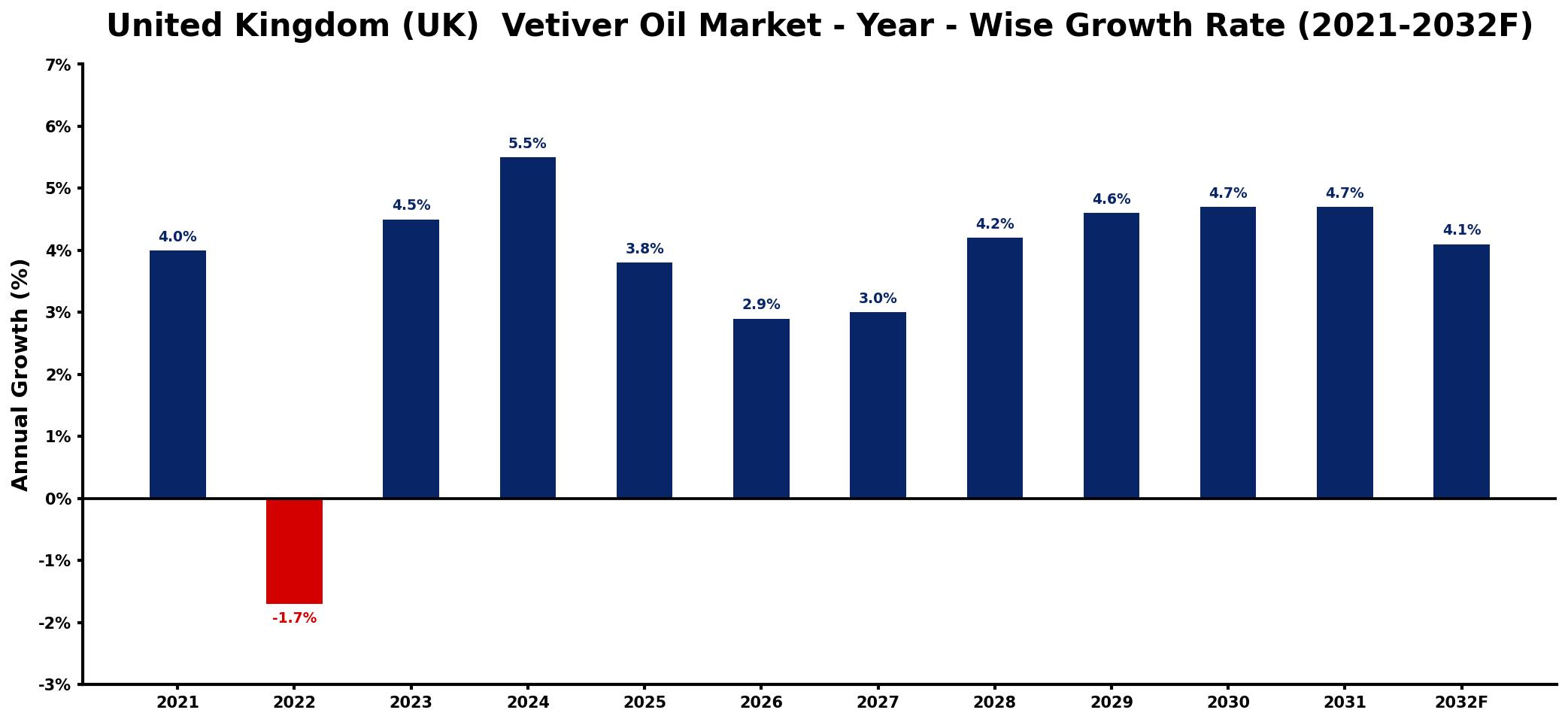
The table below presents the year‑wise growth rates along with the key drivers influencing the market
| Year | Growth Rate | Major Drivers |
| 2021 | 4.0% | Increased demand for natural fragrances |
| 2022 | -1.7% | Lower consumer spending on luxuries |
| 2023 | 4.5% | Expansion of wellness industry offerings |
| 2024 | 5.5% | Growth in aromatherapy market segments |
| 2025 | 3.8% | Rise in organic product popularity |
| 2026 | 2.9% | Strengthening eco-friendly consumer trends |
| 2027 | 3.0% | Investment in sustainable sourcing practices |
| 2028 | 4.2% | Emergence of new market applications |
| 2029 | 4.6% | Growing interest in holistic health |
| 2030 | 4.7% | Enhanced distribution network efficiency |
| 2031 | 4.7% | Rising popularity of natural cosmetics |
| 2032 | 4.1% | Increased collaboration with retailers |
Note: Market size estimations and growth projections presented in this report are based on 6Wresearch's proprietary forecasting methodology, utilizing the latest available industry data, government publications, and primary research inputs.
United Kingdom (UK) Vetiver Oil Market Synopsis
Recently, the UK vetiver oil market has experienced robust momentum driven by rising consumer awareness around natural fragrances and holistic wellness practices. As brands increasingly prioritize transparency in sourcing and production, the market is shifting towards more sustainable and ethically produced vetiver oil.
Looking ahead, the market is set to capitalize on emerging trends such as increased demand for eco-friendly personal care products and innovative extraction technologies. This evolution presents both challenges and opportunities as stakeholders navigate shifting consumer preferences and regulatory requirements.
United Kingdom (UK) Vetiver Oil Market Key Takeaways
- The market is witnessing a growing preference for organic and sustainably sourced vetiver oil.
- Innovations in extraction technology are enhancing product quality and market competitiveness.
- Consumer demand for natural ingredients is reshaping product formulations in the beauty and wellness sectors.
- Regulatory frameworks are evolving to ensure high standards of quality and sustainability.
- Collaboration along supply chains is becoming vital to meet quality and ethical sourcing demands.
Evaluation of Restraints in United Kingdom (UK) Vetiver Oil Market
Despite the positive outlook, several constraints are limiting the growth of the UK vetiver oil market. High production costs present a significant barrier for many producers, necessitating continuous research and development to maintain quality standards. Additionally, ensuring the purity and effectiveness of vetiver oil while adhering to strict regulatory guidelines complicates the market landscape. The presence of competition from alternative essential oils further challenges market growth, necessitating innovative approaches to attract and retain consumers.
United Kingdom (UK) Vetiver Oil Market Trends
Key trends shaping the UK vetiver oil market include a heightened focus on aromatherapy and wellness, reflecting broader societal shifts towards holistic health practices. Additionally, the increasing demand for cruelty-free and organic personal care products is driving innovations in vetiver oil cultivation and extraction methods. As consumers seek more eco-friendly options, brands are responding by integrating sustainable practices into their sourcing and production processes, fostering a positive feedback loop that emphasizes natural ingredients.
United Kingdom (UK) Vetiver Oil Market Opportunities
Opportunities for growth in the UK vetiver oil market lie primarily in the expanding wellness industry and the rise of personalized aromatherapy. Brands that focus on developing new applications for vetiver oil in skincare and perfumery can tap into an eager consumer base looking for unique, high-quality products. Furthermore, investment in organic farming and advanced extraction technologies could yield significant returns, aligning with growing consumer preferences for sustainability and quality.
Government Initiatives in the United Kingdom (UK) Vetiver Oil Market
The UK government is actively fostering a favorable environment for the vetiver oil market through policies aimed at promoting sustainable agriculture and essential oil production. Regulatory frameworks are in place to ensure that vetiver oil meets stringent purity standards and is harvested sustainably. Furthermore, public spending initiatives support technological advancements in extraction and distillation methods, thereby enhancing the overall quality and competitiveness of UK-based essential oil producers.
Future Insights of the United Kingdom (UK) Vetiver Oil Market
From 2026 to 2032, the UK vetiver oil market is expected to continue on its growth trajectory, driven by an enduring consumer shift towards natural and sustainable products. As innovations in cultivation and extraction techniques emerge, product quality is likely to improve significantly. Furthermore, ongoing consumer education about the benefits of vetiver oil will likely enhance market penetration across various sectors, including aromatherapy, cosmetics, and personal care.
United Kingdom (UK) Vetiver Oil Market Latest Developments (2025 - 2026)
Recent developments in the UK vetiver oil market indicate a robust movement towards sustainable sourcing and innovative extraction methods. Industry stakeholders are increasingly collaborating on initiatives to improve the traceability and quality of vetiver oil products, further enhancing consumer trust. Moreover, educational campaigns are gaining traction, aiming to raise awareness about the diverse applications of vetiver oil in personal care and wellness industries.
United Kingdom (UK) Vetiver Oil Market - Key Attractiveness of the Report
- 10 Years of Market Numbers
- Historical Data Starting from 2022 to 2025
- Base Year: 2025
- Forecast Data until 2032
- Key Performance Indicators Impacting the Market
- Major Upcoming Developments and Projects
Key Highlights of the Report:
- United Kingdom (UK) Vetiver Oil Market Outlook
- Market Size of United Kingdom (UK) Vetiver Oil Market, 2025
- Forecast of United Kingdom (UK) Vetiver Oil Market, 2032
- Historical Data and Forecast of United Kingdom (UK) Vetiver Oil Revenues & Volume for the Period 2022-2032F
- United Kingdom (UK) Vetiver Oil Market Trend Evolution
- United Kingdom (UK) Vetiver Oil Market Drivers and Challenges
- United Kingdom (UK) Vetiver Oil Price Trends
- United Kingdom (UK) Vetiver Oil Porter's Five Forces
- United Kingdom (UK) Vetiver Oil Industry Life Cycle
- Historical Data and Forecast of United Kingdom (UK) Vetiver Oil Market Revenues & Volume By Application for the Period 2022-2032F
- Historical Data and Forecast of United Kingdom (UK) Vetiver Oil Market Revenues & Volume By Medical for the Period 2022-2032F
- Historical Data and Forecast of United Kingdom (UK) Vetiver Oil Market Revenues & Volume By Food & Beverage for the Period 2022-2032F
- Historical Data and Forecast of United Kingdom (UK) Vetiver Oil Market Revenues & Volume By Spa & Relaxation for the Period 2022-2032F
- United Kingdom (UK) Vetiver Oil Import Export Trade Statistics
- Market Opportunity Assessment By Application
- United Kingdom (UK) Vetiver Oil Top Companies Market Share
- United Kingdom (UK) Vetiver Oil Competitive Benchmarking By Technical and Operational Parameters
- United Kingdom (UK) Vetiver Oil Company Profiles
- United Kingdom (UK) Vetiver Oil Key Strategic Recommendations






































