United States (US) Ball Bearings Market Summary
The united states (us) ball bearings market was estimated at USD 211 Million in 2025 and is projected to reach USD 248 Million by 2032, growing at a CAGR of 2.8% from 2026 to 2032.
United States (US) Ball Bearings Market Year-wise Growth Rate and Key Drivers
This graph highlights how the United States (US) Ball Bearings Market has steadily grown over the past five years, supported by major growth factors.
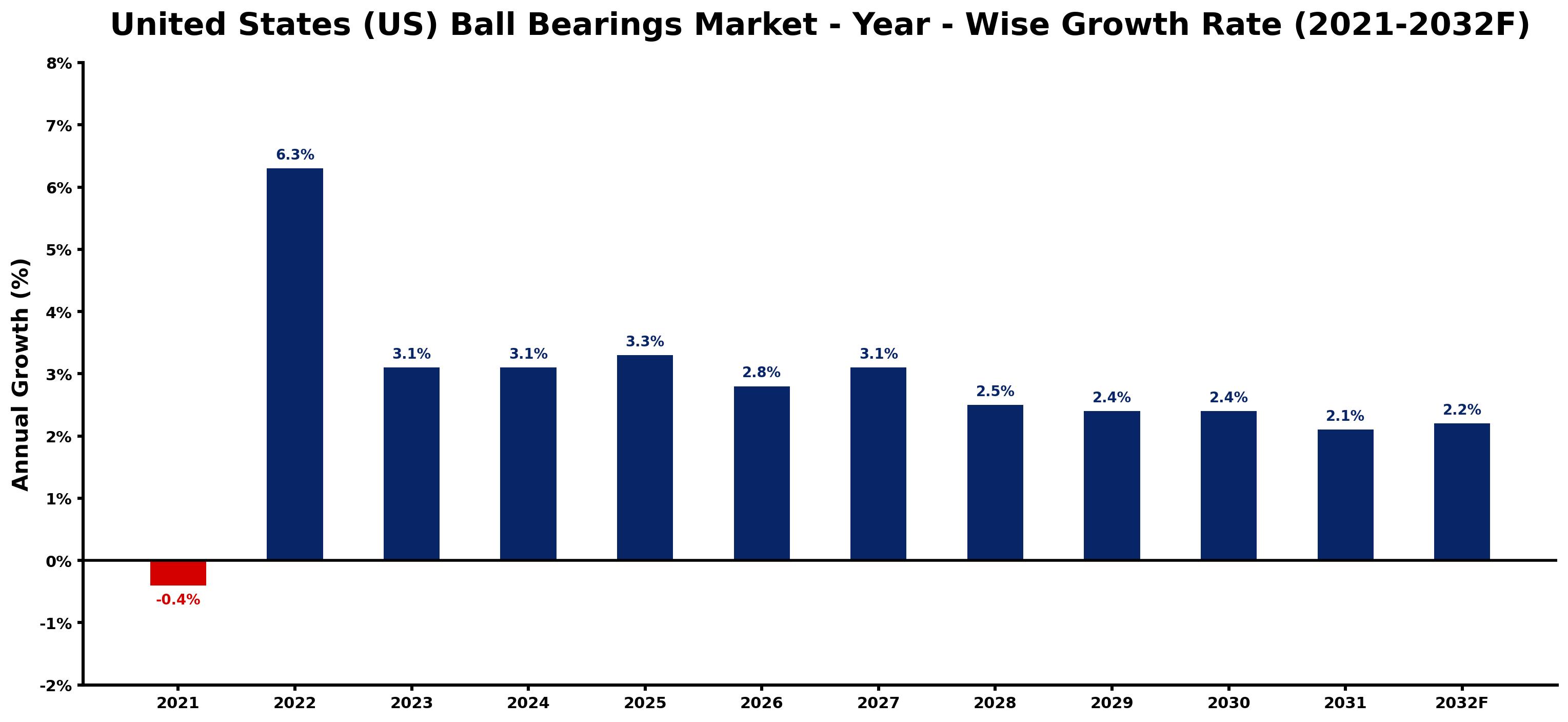
The table below presents the year wise growth rates along with the key drivers influencing the market
| Year | Growth Rate | Major Drivers |
| 2021 | -0.4% | Supply chain disruptions hindered manufacturing efficiency, leading to decreased output and lower market availability. |
| 2022 | 6.3% | Supply chain disruptions highlighted the need for localized ball bearing production strategies. |
| 2023 | 3.1% | Innovations in electric vehicle technology increased reliance on high-performance bearing solutions. |
| 2024 | 3.1% | Infrastructure investments in renewable energy projects boosted demand for durable ball bearings. |
| 2025 | 3.3% | Growing automation in manufacturing processes led to increased ball bearing consumption rates. |
| 2026 | 2.8% | Sustainable manufacturing practices prompted shifts towards eco-friendly ball bearing materials. |
| 2027 | 3.1% | Expanding aerospace sector emphasizes the necessity for advanced ball bearing technologies. |
| 2028 | 2.5% | Rising interest in robotics and automation drives heightened ball bearing usage across sectors. |
| 2029 | 2.4% | Emerging trends in high-speed trains demand advancements in ball bearing efficiency. |
| 2030 | 2.4% | The construction industry's revival increases requirements for heavy-duty ball bearing applications. |
| 2031 | 2.1% | Collaborative manufacturing models require adaptable ball bearing solutions for diverse applications. |
| 2032 | 2.2% | Technological convergence in machinery enhances the demand for specialized ball bearing designs. |
Note - Market size estimations and growth projections presented in this report are based on 6Wresearch's advanced forecasting approach, validated with industry datasets as of June 2026.
United States (US) Ball Bearings Market Synopsis
The United States (US) Ball Bearings Market is projected to reach 2.8% and witness significant growth during the forecast period (2026-2032). The US ball bearings market stands as a pivotal segment of the broader bearings industry, characterized by its maturity and competitiveness. Key industries fueling this growth include automotive, aerospace, and industrial machinery, each demanding high-quality, innovative ball bearing solutions. As technological advancements continue to reshape production processes, a diverse array of products emerges, including radial ball bearings, angular contact ball bearings, and thrust ball bearings.
United States (US) Ball Bearings Market Growth Drivers
Several factors are propelling the growth of the United States (US) Ball Bearings Market. Firstly, the increasing production of electric vehicles (EVs) is a significant catalyst, as these vehicles require specialized bearings that enhance performance and efficiency. Secondly, automation across various industries leads to a greater demand for high-performance ball bearings, contributing to overall operational efficiency and reduced maintenance. Thirdly, the aerospace sector is experiencing growth, with advanced ball bearings integral to ensuring the reliability and performance of aircraft. Additionally, there is a concerted push towards energy efficiency across sectors, driving manufacturers to innovate and produce more sustainable bearing options. Finally, the ongoing industrial modernization efforts reflect a broader trend of investment in advanced machinery, further fueling demand for ball bearings.
United States (US) Ball Bearings Market Trends and Opportunities
The United States (US) Ball Bearings Market is currently witnessing transformative trends reshaping its landscape. A notable trend is the integration of smart technologies such as IoT and AI in the manufacturing of ball bearings. This technological incorporation enhances product quality, performance, and operational efficiency. Moreover, sustainability is becoming a key focus area, as manufacturers increasingly adopt eco-friendly materials and production methods to align with global environmental standards. The shift towards durable and recyclable materials presents significant investment opportunities for companies prioritizing sustainability. Additionally, there is a rising demand for customization in ball bearing designs, allowing manufacturers to cater to specific industry needs and preferences. Finally, as industries continue to pursue operational optimization, the demand for high-performance bearings is expected to rise, particularly in sectors that prioritize precision engineering.
United States (US) Ball Bearings Market Challenges and Restraints
While the United States (US) Ball Bearings Market is poised for growth, it faces several challenges. Intense competition from foreign manufacturers offering lower-priced products places significant pressure on domestic entities to maintain profitability. Additionally, fluctuations in raw material costs can disrupt production schedules and pricing strategies, impacting overall market stability. The rapid pace of technological change necessitates continuous innovation, which can strain resources for manufacturers striving to meet evolving customer demands. Furthermore, concerns regarding intellectual property protection and the prevalence of counterfeit products pose risks to brand reputation and revenue streams. Adapting to shifting regulations and environmental sustainability requirements further complicates the operational landscape for players in the market.
United States (US) Ball Bearings Market Investment Opportunities
The United States (US) Ball Bearings Market presents various investment opportunities driven by demand across multiple industries. The automotive sector, particularly with its increasing focus on electric vehicles, requires high-quality ball bearings that enhance efficiency and reliability. Similarly, the aerospace and industrial machinery sectors are investing in advanced bearing technologies, creating a demand for specialized products. Companies that prioritize innovation, custom design capabilities, and value-added services are likely to attract significant investment. Additionally, the trend toward sustainable manufacturing processes introduces new avenues for investment in eco-friendly bearing solutions. Investors should consider emerging companies dedicated to research and development, as these entities are well-positioned to leverage technological advancements and market trends.
United States (US) Ball Bearings Market Government Investment and Initiatives
Government initiatives play a crucial role in shaping the landscape of the United States (US) Ball Bearings Market. Policies and regulations aimed at promoting domestic manufacturing are pivotal for industry growth. Trade regulations and tariffs on imported bearings are designed to protect local manufacturers from international competition, thereby enhancing the market's stability. Intellectual property laws safeguard innovations in bearing technology, encouraging firms to invest in research and development. Moreover, government-sponsored initiatives aimed at boosting infrastructure development bear potential benefits for the ball bearings industry, as upgraded facilities will likely increase demand for high-performance bearings. Programs promoting energy efficiency within manufacturing processes also signal support for sustainable practices, further aligning with the industry's evolving standards.
United States (US) Ball Bearings Market Latest Developments (May 2025 - June 2026)
Between May 2025 and June 2026, the United States (US) Ball Bearings Market witnessed several significant developments. The momentum of electric vehicle production continued to accelerate, with manufacturers exploring advanced bearing solutions to enhance performance and reduce friction. Meanwhile, the integration of smart technologies in manufacturing processes became more pronounced, with companies leveraging IoT and AI to improve quality control and operational efficiency. Sustainability efforts gained traction, with several firms committing to adopting greener materials and reducing their carbon footprints. Moreover, amidst global supply chain challenges, there was a strategic focus on bolstering local production capabilities to mitigate disruptions. This period also saw increased collaboration between industry stakeholders to address evolving market demands and regulatory changes.
United States (US) Ball Bearings Market - Key Attractiveness of the Report
- 10 Years of Market Numbers
- Historical Data Starting from 2022 to 2025
- Base Year: 2025
- Forecast Data until 2032
- Key Performance Indicators Impacting the Market
- Major Upcoming Developments and Projects
Key Highlights of the Report:
- United States (US) Ball Bearings Market Outlook
- Market Size of United States (US) Ball Bearings Market, 2025
- Forecast of United States (US) Ball Bearings Market, 2032F
- Historical Data and Forecast of United States (US) Ball Bearings Revenues & Volume for the Period 2022-2032F
- United States (US) Ball Bearings Market Trend Evolution
- United States (US) Ball Bearings Market Drivers and Challenges
- United States (US) Ball Bearings Price Trends
- United States (US) Ball Bearings Porter's Five Forces
- United States (US) Ball Bearings Industry Life Cycle
- Historical Data and Forecast of United States (US) Ball Bearings Market Revenues & Volume By Product for the Period 2022-2032F
- Historical Data and Forecast of United States (US) Ball Bearings Market Revenues & Volume By Deep groove for the Period 2022-2032F
- Historical Data and Forecast of United States (US) Ball Bearings Market Revenues & Volume By Angular contact for the Period 2022-2032F
- Historical Data and Forecast of United States (US) Ball Bearings Market Revenues & Volume By Self-aligning for the Period 2022-2032F
- Historical Data and Forecast of United States (US) Ball Bearings Market Revenues & Volume By Others for the Period 2022-2032F
- Historical Data and Forecast of United States (US) Ball Bearings Market Revenues & Volume By End-user for the Period 2022-2032F
- Historical Data and Forecast of United States (US) Ball Bearings Market Revenues & Volume By Automotive industry for the Period 2022-2032F
- Historical Data and Forecast of United States (US) Ball Bearings Market Revenues & Volume By Heavy industry for the Period 2022-2032F
- Historical Data and Forecast of United States (US) Ball Bearings Market Revenues & Volume By Aerospace and railway industry for the Period 2022-2032F
- Historical Data and Forecast of United States (US) Ball Bearings Market Revenues & Volume By Others for the Period 2022-2032F
- United States (US) Ball Bearings Import Export Trade Statistics
- Market Opportunity Assessment By Product
- Market Opportunity Assessment By End-user
- United States (US) Ball Bearings Top Companies Market Share
- United States (US) Ball Bearings Competitive Benchmarking By Technical and Operational Parameters
- United States (US) Ball Bearings Company Profiles
- United States (US) Ball Bearings Key Strategic Recommendations






































