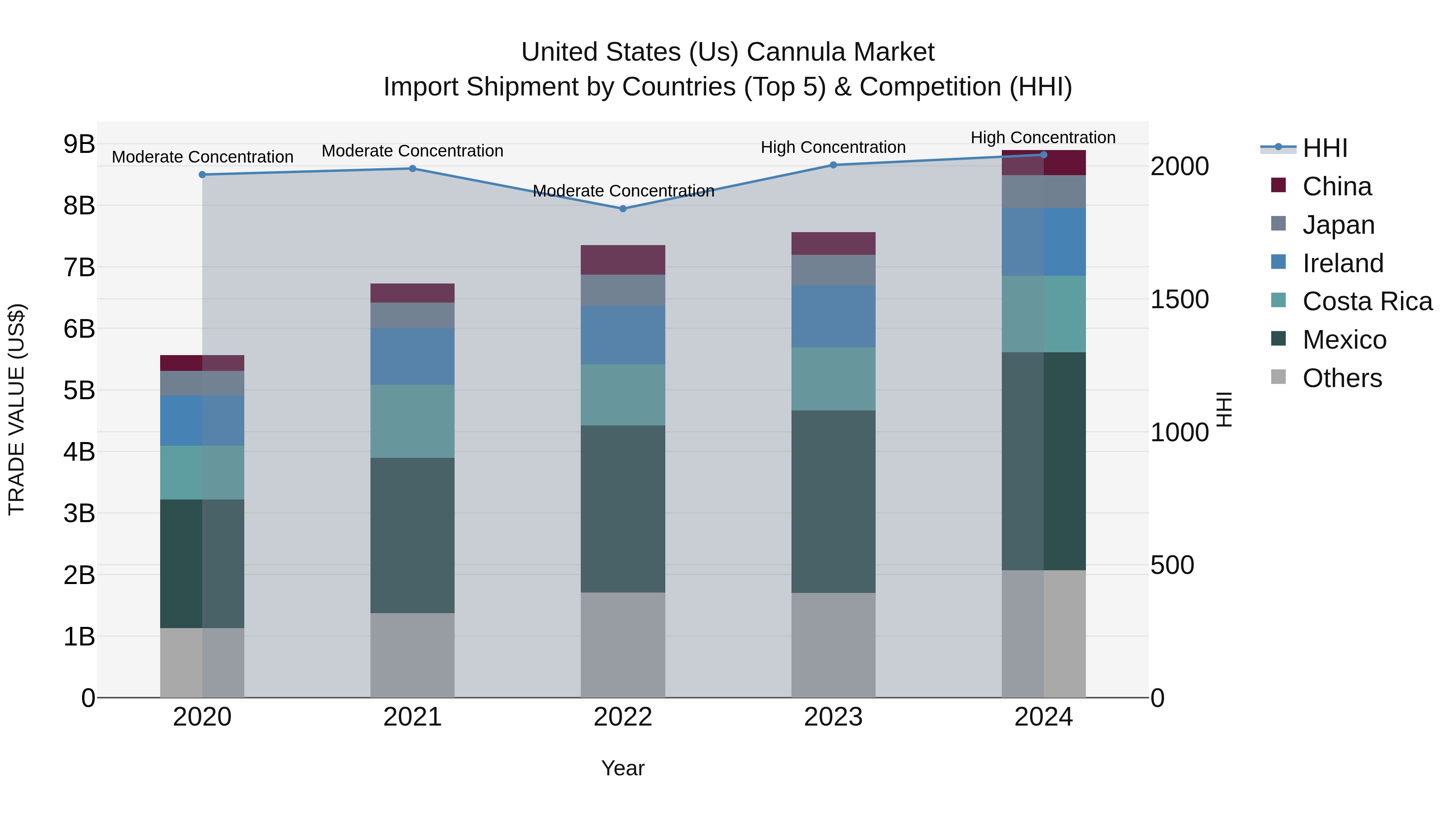
United States (US) Cannula Market Top 5 Importing Countries and Market Competition (HHI) Analysis
The United States continued to see a significant influx of cannula imports in 2024, with top exporting countries including Mexico, Costa Rica, Ireland, Japan, and Malaysia. The market remains highly concentrated, as indicated by the high Herfindahl-Hirschman Index (HHI). The compound annual growth rate (CAGR) from 2020 to 2024 stood at a robust 12.44%, with a notable growth rate of 17.66% from 2023 to 2024. These figures suggest a steady demand for cannulas in the US market, driven by diverse sources of supply and strong growth momentum.
USA Export Potential Assessment For Cannula Market (Values in USD Thousand)
United States (US) Cannula Market Overview
The United States cannula market is experiencing steady growth driven by the increasing prevalence of chronic diseases such as cardiovascular diseases and respiratory disorders. Cannulas are widely used in various medical procedures, including oxygen therapy, cardiopulmonary bypass surgery, and cosmetic surgeries. The market is characterized by the presence of key players offering a wide range of products, including nasal cannulas, oral cannulas, and vented cannulas. Technological advancements, such as the development of soft and flexible cannulas for enhanced patient comfort, are further fueling market growth. Additionally, the rising geriatric population and the growing demand for minimally invasive procedures are contributing to the expansion of the US cannula market. However, pricing pressures and stringent regulatory requirements may pose challenges to market players in this highly competitive landscape.
United States (US) Cannula Market Trends
The US Cannula Market is witnessing several key trends. One prominent trend is the increasing adoption of minimally invasive procedures across various medical specialties, driving the demand for cannulas used in such procedures. Another trend is the growing prevalence of chronic diseases, such as cardiovascular diseases and respiratory disorders, leading to a higher demand for cannulas for therapeutic purposes. Additionally, technological advancements in cannula design and materials are improving patient comfort and outcomes, leading to a shift towards more innovative and specialized cannula products. The market is also being influenced by the rising geriatric population in the US, who require medical interventions that often involve the use of cannulas. Overall, the US Cannula Market is expected to continue growing as healthcare providers seek more efficient and patient-friendly medical devices.
United States (US) Cannula Market Challenges
In the US Cannula Market, several challenges are faced, including intense competition among key players leading to price wars and margin pressures. Regulatory requirements and compliance standards are also strict, increasing the cost of production and hindering market entry for new players. Additionally, the market faces issues related to product recalls and quality control, impacting consumer trust and brand reputation. Limited awareness among healthcare professionals about the benefits of using cannulas for various medical procedures also poses a challenge in market growth. Furthermore, fluctuations in raw material prices and the ongoing COVID-19 pandemic have disrupted supply chains and manufacturing operations, adding to the complexities faced by companies operating in the US Cannula Market.
United States (US) Cannula Market Investment Opportunities
The United States Cannula Market offers several investment opportunities due to the increasing demand for minimally invasive medical procedures. Key areas for investment include the development and manufacturing of innovative cannula designs that improve patient comfort and surgical outcomes, as well as the expansion of distribution networks to reach a wider customer base. Additionally, investing in research and development to create specialized cannulas for specific medical procedures or conditions can be lucrative. With the growing trend towards outpatient surgeries and the rising prevalence of chronic diseases requiring long-term cannula use, there is a significant market potential for companies offering high-quality, cost-effective cannula solutions. Overall, the US Cannula Market presents a promising landscape for investors looking to capitalize on the healthcare industry`s shift towards less invasive medical techniques.
United States (US) Cannula Market Government Policy
Government policies related to the US Cannula Market primarily focus on ensuring the safety, efficacy, and quality of medical devices, including cannulas. The Food and Drug Administration (FDA) regulates the manufacturing, distribution, and marketing of cannulas through premarket approvals, post-market surveillance, and compliance with quality standards such as Good Manufacturing Practices (GMP). Additionally, reimbursement policies under Medicare and Medicaid influence the adoption and utilization of cannulas by healthcare providers and patients. The government also promotes innovation and research in the medical device sector through funding initiatives and collaboration with industry stakeholders. Overall, government policies play a crucial role in shaping the regulatory environment and market dynamics of the US Cannula Market to safeguard public health and promote access to quality healthcare products.
United States (US) Cannula Market Future Outlook
The United States Cannula Market is expected to witness steady growth in the coming years, driven by factors such as the rising prevalence of chronic diseases, increasing surgical procedures, and technological advancements in the healthcare sector. The growing geriatric population and the rising demand for minimally invasive procedures are also contributing to the market expansion. Additionally, the increasing adoption of cannulas in various medical applications, such as oxygen therapy, drug delivery, and cosmetic procedures, is expected to further propel market growth. However, intense competition among market players and stringent regulatory requirements may pose challenges to market development. Overall, the US Cannula Market is anticipated to experience sustained growth, with opportunities for innovation and market expansion in the forecast period.
Key Highlights of the Report:
- United States (US) Cannula Market Outlook
- Market Size of United States (US) Cannula Market, 2021
- Forecast of United States (US) Cannula Market, 2027
- Historical Data and Forecast of United States (US) Cannula Revenues & Volume for the Period 2018 - 2027
- United States (US) Cannula Market Trend Evolution
- United States (US) Cannula Market Drivers and Challenges
- United States (US) Cannula Price Trends
- United States (US) Cannula Porter's Five Forces
- United States (US) Cannula Industry Life Cycle
- Historical Data and Forecast of United States (US) Cannula Market Revenues & Volume By Product Type for the Period 2018 - 2027
- Historical Data and Forecast of United States (US) Cannula Market Revenues & Volume By Nasal cannula for the Period 2018 - 2027
- Historical Data and Forecast of United States (US) Cannula Market Revenues & Volume By Straight cannula for the Period 2018 - 2027
- Historical Data and Forecast of United States (US) Cannula Market Revenues & Volume By Winged cannula for the Period 2018 - 2027
- Historical Data and Forecast of United States (US) Cannula Market Revenues & Volume By Cannulas with wings and ports for the Period 2018 - 2027
- Historical Data and Forecast of United States (US) Cannula Market Revenues & Volume By Cannulas with integrated stop cock for the Period 2018 - 2027
- Historical Data and Forecast of United States (US) Cannula Market Revenues & Volume By Others for the Period 2018 - 2027
- Historical Data and Forecast of United States (US) Cannula Market Revenues & Volume By Material for the Period 2018 - 2027
- Historical Data and Forecast of United States (US) Cannula Market Revenues & Volume By Plastic for the Period 2018 - 2027
- Historical Data and Forecast of United States (US) Cannula Market Revenues & Volume By Silicone for the Period 2018 - 2027
- Historical Data and Forecast of United States (US) Cannula Market Revenues & Volume By Others for the Period 2018 - 2027
- Historical Data and Forecast of United States (US) Cannula Market Revenues & Volume By Patient for the Period 2018 - 2027
- Historical Data and Forecast of United States (US) Cannula Market Revenues & Volume By Adult for the Period 2018 - 2027
- Historical Data and Forecast of United States (US) Cannula Market Revenues & Volume By Paediatric for the Period 2018 - 2027
- Historical Data and Forecast of United States (US) Cannula Market Revenues & Volume By End-use for the Period 2018 - 2027
- Historical Data and Forecast of United States (US) Cannula Market Revenues & Volume By Hospitals for the Period 2018 - 2027
- Historical Data and Forecast of United States (US) Cannula Market Revenues & Volume By Ambulatory surgical centers for the Period 2018 - 2027
- Historical Data and Forecast of United States (US) Cannula Market Revenues & Volume By Diagnostic laboratories for the Period 2018 - 2027
- Historical Data and Forecast of United States (US) Cannula Market Revenues & Volume By Clinics for the Period 2018 - 2027
- Historical Data and Forecast of United States (US) Cannula Market Revenues & Volume By Others for the Period 2018 - 2027
- United States (US) Cannula Import Export Trade Statistics
- Market Opportunity Assessment By Product Type
- Market Opportunity Assessment By Material
- Market Opportunity Assessment By Patient
- Market Opportunity Assessment By End-use
- United States (US) Cannula Top Companies Market Share
- United States (US) Cannula Competitive Benchmarking By Technical and Operational Parameters
- United States (US) Cannula Company Profiles
- United States (US) Cannula Key Strategic Recommendations






































