United States (US) Carbon Credit Market Size, Share & Growth Rate
The United States (US) Carbon Credit Market was estimated at USD 108 Million in 2025 and is projected to reach USD 127 Million by 2032, growing at a CAGR of 2.3% from 2026 to 2032. This growth trajectory is propelled by heightened regulatory focus on emission reductions, coupled with an increasing number of businesses seeking to integrate carbon credits into their sustainability strategies. Furthermore, the alignment of corporate objectives with environmental, social, and governance (ESG) principles is reshaping investment landscapes in favor of carbon credits.
United States (US) Carbon Credit Market Year-wise Growth Rate and Key Drivers
This graph highlights how the United States (US) Carbon Credit Market has steadily grown over the years, supported by major growth factors.
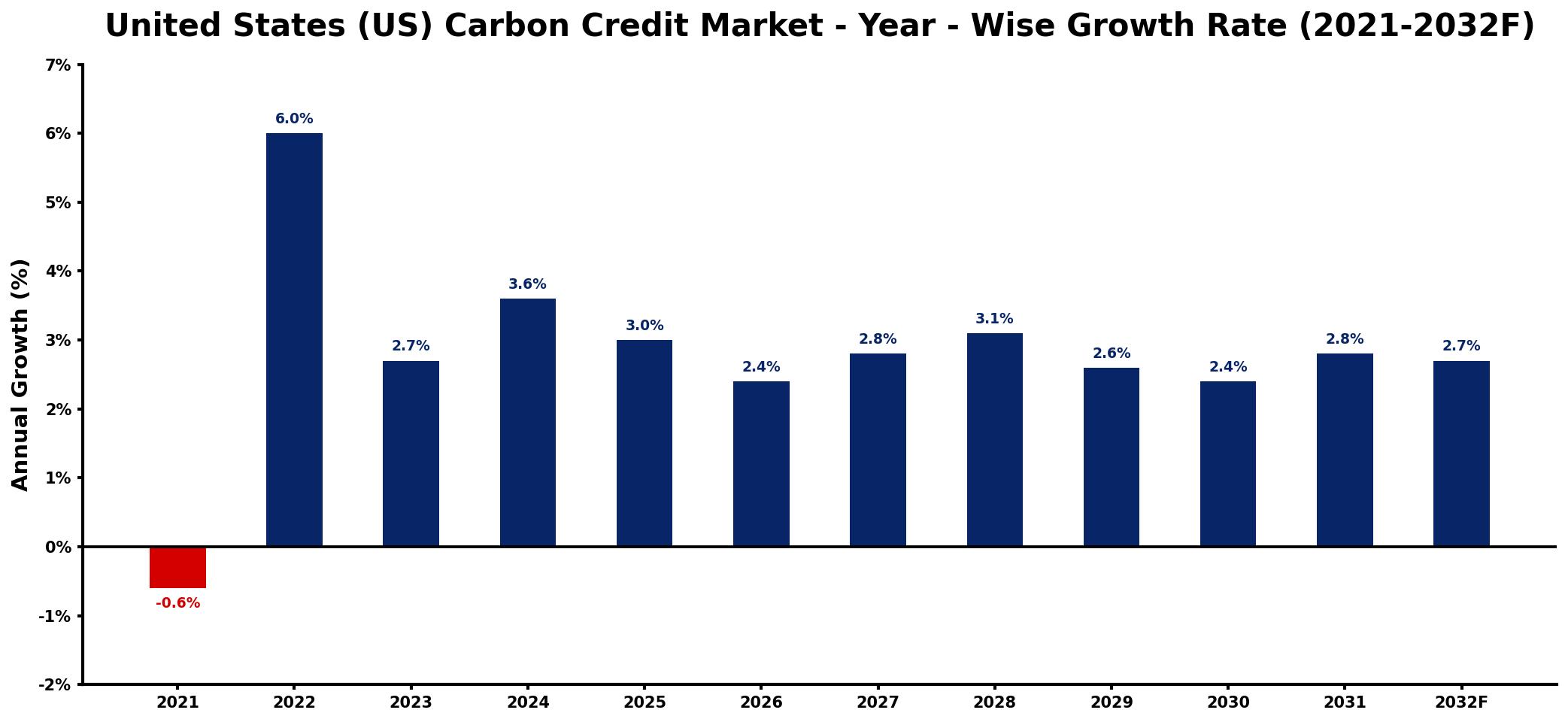
The table below presents the year‑wise growth rates along with the key drivers influencing the market
| Year | Growth Rate | Major Drivers |
| 2021 | -0.6% | Regulatory changes affecting investments |
| 2022 | 6.0% | Rising demand for renewable energy |
| 2023 | 2.7% | Corporate sustainability initiatives expand |
| 2024 | 3.6% | Technological advancements in efficiency |
| 2025 | 3.0% | Increased public awareness campaigns |
| 2026 | 2.4% | Emerging markets adopting sustainability |
| 2027 | 2.8% | Investment in green technology rises |
| 2028 | 3.1% | Partnerships for sustainable practices grow |
| 2029 | 2.6% | Government incentives for green projects |
| 2030 | 2.4% | Corporate commitments to sustainability increase |
| 2031 | 2.8% | Consumer preference for eco-friendly options |
| 2032 | 2.7% | Global collaboration on environmental goals |
Note: Market size estimations and growth projections presented in this report are based on 6Wresearch's proprietary forecasting methodology, utilizing the latest available industry data, government publications, and primary research inputs.
United States (US) Carbon Credit Market Synopsis
The United States Carbon Credit Market is witnessing remarkable dynamism as awareness around climate change continues to escalate. Major corporations are increasingly purchasing carbon credits, not only for compliance but as a fundamental part of their operational ethos, driving demand and innovation in the market.
Operating under a cap-and-trade system, the market is influenced by both federal and state regulations, including pioneering initiatives such as Californias Cap-and-Trade Program. This regulatory landscape enables businesses to buy and sell carbon credits based on their emissions profiles, fostering a competitive yet cooperative environment aimed at reducing overall greenhouse gas emissions.
United States (US) Carbon Credit Market Key Takeaways
- The market is gaining momentum due to escalating corporate commitments to sustainability.
- Regulatory frameworks are evolving, encouraging a cap-and-trade approach to emissions management.
- Voluntary carbon offset initiatives are increasingly appealing to both businesses and consumers.
- Investment interest is rising as carbon credits become recognized as an asset class for diversification.
- Market challenges include regulatory uncertainty and the need for standardized trading mechanisms.
Evaluation of Restraints in United States (US) Carbon Credit Market
While the US Carbon Credit Market offers significant opportunities, several restraints impede its full potential. Regulatory inconsistencies create an unpredictable environment that can deter investment. Moreover, the complexity inherent in carbon trading mechanisms and verification processes often limits participation, particularly among smaller businesses. Additionally, the absence of standardized pricing and trading platforms contributes to market inefficiencies, complicating comparisons across different offerings and hindering broader market adoption.
United States (US) Carbon Credit Market Trends
The current trajectory of the US Carbon Credit Market is marked by several notable trends. Increased corporate responsibility is driving businesses to adopt carbon offset strategies actively, with many viewing carbon credits as integral to their sustainability efforts. Additionally, growing regulatory pressure from both federal and state governments is likely to enhance market activity. Technological advancements in emissions monitoring and verification are further facilitating the efficient functioning of carbon credit trading platforms, making the market more accessible to a wider array of participants.
United States (US) Carbon Credit Market Opportunities
There exists a plethora of investment opportunities within the US Carbon Credit Market. Organizations can consider acquiring carbon credits to meet regulatory obligations or to enhance their sustainability profile. Furthermore, investments directed towards innovative carbon offset projects, renewable energy, or technologies dedicated to emissions reduction stand to be particularly fruitful. As more stakeholders recognize the importance of transitioning to a low-carbon economy, the potential for growth and financial returns in this sector remains substantial.
Government Initiatives in the United States (US) Carbon Credit Market
Government policies play a crucial role in shaping the US Carbon Credit Market. Through initiatives such as the Regional Greenhouse Gas Initiative (RGGI) and the California Cap-and-Trade Program, federal and state governments actively incentivize emission reductions. The Biden administration's renewed commitment to the Paris Agreement and its proposal for climate-centric policies further signify a shift towards rigorous climate action. These frameworks are designed not only to promote compliance among businesses but also to spur innovation in sustainable practices and technologies.
Future Insights of the United States (US) Carbon Credit Market
Looking ahead to 2026-2032, the outlook for the US Carbon Credit Market is promising. The increasing emphasis on environmental sustainability is expected to foster greater demand for carbon credits as organizations strive to meet regulatory mandates and consumer expectations. As the regulatory framework matures and investor interest continues to grow, we anticipate a more robust market, with enhanced integration of carbon credits into corporate strategies and investment portfolios. The interplay between policy, consumer behavior, and technological advancements will be pivotal in defining the market's trajectory.
United States (US) Carbon Credit Market Latest Developments (2025 - 2026)
Recent developments in the US Carbon Credit Market highlight an increasing engagement from both public and private sectors. New initiatives focused on enhancing transparency and efficiency in carbon credit trading are being introduced, aiming to mitigate existing market inefficiencies. Efforts to align with international climate commitments are gaining momentum, with various stakeholders working to establish collaborative frameworks that support the growth and credibility of the market. This evolving landscape suggests a significant shift towards a more organized and competitive carbon credit trading environment.
United States (US) Carbon Credit Market - Key Attractiveness of the Report
- 10 Years of Market Numbers
- Historical Data Starting from 2022 to 2025
- Base Year: 2025
- Forecast Data until 2032
- Key Performance Indicators Impacting the Market
- Major Upcoming Developments and Projects
Key Highlights of the Report:
- United States (US) Carbon Credit Market Outlook
- Market Size of United States (US) Carbon Credit Market, 2025
- Forecast of United States (US) Carbon Credit Market, 2032
- Historical Data and Forecast of United States (US) Carbon Credit Revenues & Volume for the Period 2022-2032F
- United States (US) Carbon Credit Market Trend Evolution
- United States (US) Carbon Credit Market Drivers and Challenges
- United States (US) Carbon Credit Price Trends
- United States (US) Carbon Credit Porter's Five Forces
- United States (US) Carbon Credit Industry Life Cycle
- Historical Data and Forecast of United States (US) Carbon Credit Market Revenues & Volume By Sector for the Period 2022-2032F
- Historical Data and Forecast of United States (US) Carbon Credit Market Revenues & Volume By Energy for the Period 2022-2032F
- Historical Data and Forecast of United States (US) Carbon Credit Market Revenues & Volume By Transportation for the Period 2022-2032F
- Historical Data and Forecast of United States (US) Carbon Credit Market Revenues & Volume By Residential And Commercial Buildings for the Period 2022-2032F
- Historical Data and Forecast of United States (US) Carbon Credit Market Revenues & Volume By Industry for the Period 2022-2032F
- Historical Data and Forecast of United States (US) Carbon Credit Market Revenues & Volume By Agriculture for the Period 2022-2032F
- Historical Data and Forecast of United States (US) Carbon Credit Market Revenues & Volume By Forestry for the Period 2022-2032F
- Historical Data and Forecast of United States (US) Carbon Credit Market Revenues & Volume By Water And Wastewater for the Period 2022-2032F
- United States (US) Carbon Credit Import Export Trade Statistics
- Market Opportunity Assessment By Sector
- United States (US) Carbon Credit Top Companies Market Share
- United States (US) Carbon Credit Competitive Benchmarking By Technical and Operational Parameters
- United States (US) Carbon Credit Company Profiles
- United States (US) Carbon Credit Key Strategic Recommendations






































