United States (US) Catheter Market Top 5 Importing Countries and Market Competition (HHI) Analysis
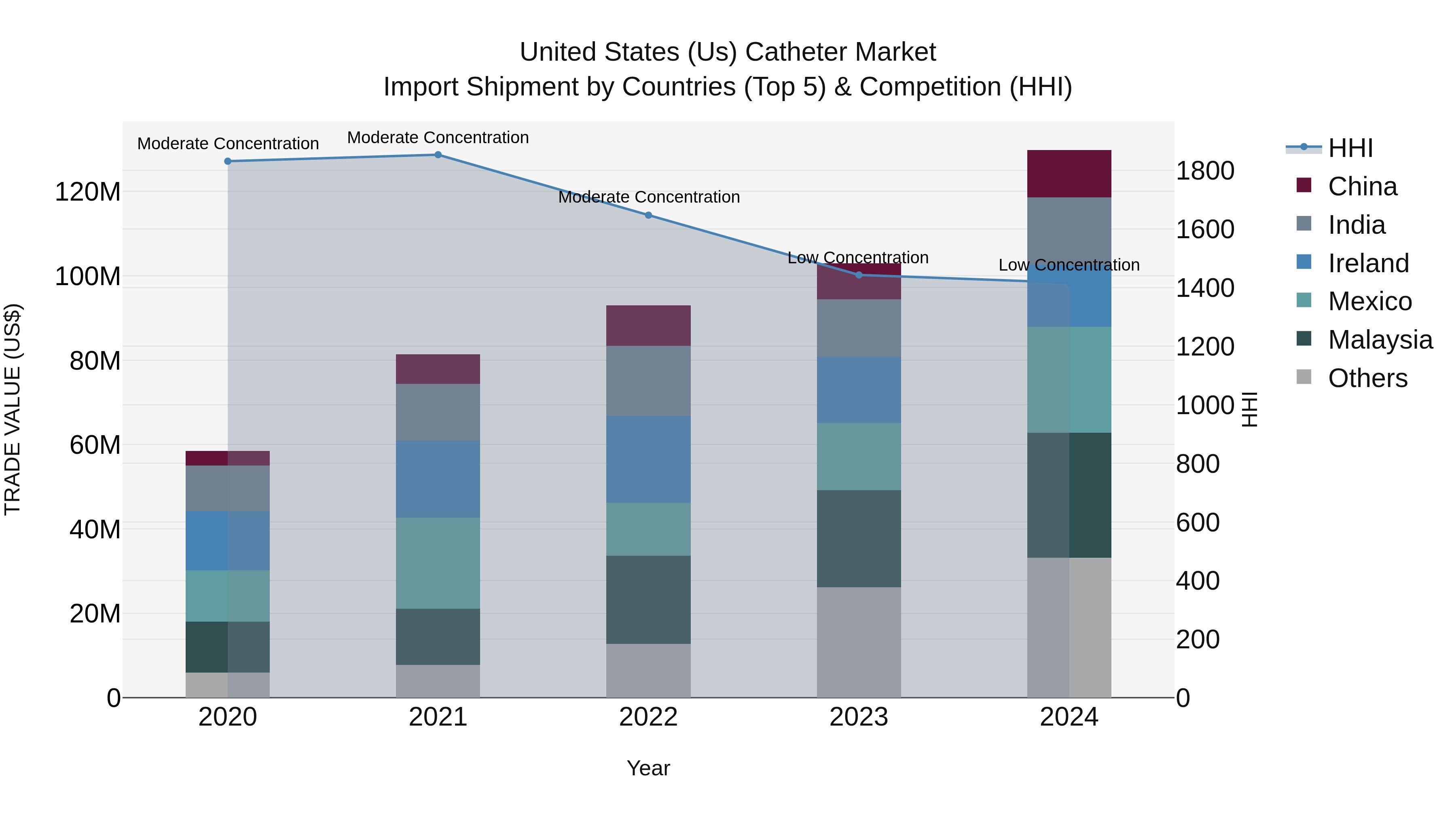
The United States continues to be a key importer of catheters, with Malaysia, Mexico, India, Ireland, and Lithuania emerging as top exporting countries in 2024. The market shows a healthy Compound Annual Growth Rate (CAGR) of 22.04% from 2020 to 2024, with a notable growth rate of 26.1% in 2023-24. Despite this growth, the market remains competitive with low concentration, indicating a diverse range of suppliers catering to the US demand for catheters. This data suggests a robust and dynamic market landscape for catheter imports in the United States.
USA Export Potential Assessment For Catheter Market (Values in USD Thousand)
United States (US) Catheter Market Overview
The United States Catheter Market is a highly competitive and dynamic sector characterized by technological advancements, increasing prevalence of chronic diseases, and a growing aging population. The market encompasses a wide range of catheter types, including urinary catheters, cardiovascular catheters, and intravenous catheters, among others. Key players in the US market include Abbott Laboratories, Boston Scientific Corporation, and Medtronic, among others. The market is driven by factors such as the rising demand for minimally invasive procedures, the increasing incidence of cardiovascular diseases, and the growing emphasis on patient comfort and safety. However, regulatory challenges and concerns related to catheter-associated infections are some of the key restraints impacting market growth. Overall, the US Catheter Market is poised for continued growth, fueled by ongoing technological innovations and increasing healthcare expenditures.
United States (US) Catheter Market Trends
The US Catheter Market is experiencing several key trends. One major trend is the increasing demand for minimally invasive procedures, driving the growth of catheter usage. Technological advancements in catheter design, materials, and functionality are also shaping the market, leading to more innovative and specialized catheters being developed. Additionally, there is a growing focus on reducing healthcare-associated infections, leading to the development of antimicrobial and anti-infective catheters. The shift towards outpatient procedures and home-based healthcare is further driving demand for catheters that are easy to use and maintain. Overall, the US Catheter Market is witnessing a trend towards more patient-centric care with a focus on improving outcomes and quality of life for individuals requiring catheterization.
United States (US) Catheter Market Challenges
The US Catheter Market faces several challenges, including stringent regulatory requirements, increasing competition from domestic and international manufacturers, and pricing pressures due to healthcare cost containment efforts. Additionally, there are concerns related to catheter-associated infections, driving the demand for innovative and infection-resistant catheter materials and technologies. The market also grapples with the need for continuous product advancements to cater to evolving patient needs and preferences. Furthermore, healthcare reforms and changes in reimbursement policies can impact the purchasing decisions of healthcare providers, affecting market growth and profitability for catheter manufacturers and suppliers. Overall, staying competitive, ensuring compliance with regulations, addressing infection risks, and adapting to market dynamics are key challenges faced by players in the US Catheter Market.
United States (US) Catheter Market Investment Opportunities
The United States Catheter Market presents promising investment opportunities due to the increasing prevalence of chronic diseases and the growing aging population requiring medical interventions. The market is driven by technological advancements leading to the development of innovative catheters for various medical procedures. Key segments such as cardiovascular, urology, and neurovascular catheters are witnessing significant growth, with a shift towards minimally invasive procedures driving demand. Additionally, the rising demand for home healthcare services and the expanding healthcare infrastructure in the US further contribute to the market`s growth potential. Investors can explore opportunities in companies developing advanced catheter technologies, expanding distribution networks, and focusing on strategic partnerships to capitalize on the evolving landscape of the US Catheter Market.
United States (US) Catheter Market Government Policy
In the United States, the Catheter Market is subject to various government policies and regulations aimed at ensuring the safety, efficacy, and quality of catheters used in medical procedures. The Food and Drug Administration (FDA) plays a key role in regulating catheters by requiring manufacturers to obtain premarket approval or clearance before marketing their products. Additionally, reimbursement policies from government healthcare programs such as Medicare and Medicaid can influence the adoption and utilization of catheters by healthcare providers. These policies often set guidelines on pricing, coverage, and eligibility criteria for reimbursement, impacting market dynamics. Overall, compliance with FDA regulations and understanding reimbursement policies are crucial factors for manufacturers and stakeholders operating in the US Catheter Market.
United States (US) Catheter Market Future Outlook
The future outlook for the United States Catheter Market appears promising, with continued growth expected due to several factors. These include the increasing prevalence of chronic diseases, such as cardiovascular diseases and urinary disorders, which require catheterization for diagnosis and treatment. Technological advancements in catheter design, materials, and coatings are enhancing the performance and safety of catheters, driving market expansion. Furthermore, the aging population in the US is likely to boost the demand for catheters, as elderly individuals are more susceptible to various medical conditions that necessitate catheter use. The growing trend towards minimally invasive procedures and the rising adoption of catheters for home healthcare settings are also anticipated to contribute to market growth in the coming years.
Key Highlights of the Report:
- United States (US) Catheter Market Outlook
- Market Size of United States (US) Catheter Market, 2021
- Forecast of United States (US) Catheter Market, 2027
- Historical Data and Forecast of United States (US) Catheter Revenues & Volume for the Period 2018 - 2027
- United States (US) Catheter Market Trend Evolution
- United States (US) Catheter Market Drivers and Challenges
- United States (US) Catheter Price Trends
- United States (US) Catheter Porter's Five Forces
- United States (US) Catheter Industry Life Cycle
- Historical Data and Forecast of United States (US) Catheter Market Revenues & Volume By Product Type for the Period 2018 - 2027
- Historical Data and Forecast of United States (US) Catheter Market Revenues & Volume By Cardiovascular Catheters for the Period 2018 - 2027
- Historical Data and Forecast of United States (US) Catheter Market Revenues & Volume By Urology Catheters for the Period 2018 - 2027
- Historical Data and Forecast of United States (US) Catheter Market Revenues & Volume By Intravenous Catheters for the Period 2018 - 2027
- Historical Data and Forecast of United States (US) Catheter Market Revenues & Volume By Neurovascular Catheters for the Period 2018 - 2027
- Historical Data and Forecast of United States (US) Catheter Market Revenues & Volume By Specialty Catheters for the Period 2018 - 2027
- Historical Data and Forecast of United States (US) Catheter Market Revenues & Volume By Distribution Channel for the Period 2018 - 2027
- Historical Data and Forecast of United States (US) Catheter Market Revenues & Volume By Hospital Stores for the Period 2018 - 2027
- Historical Data and Forecast of United States (US) Catheter Market Revenues & Volume By Retail Stores for the Period 2018 - 2027
- Historical Data and Forecast of United States (US) Catheter Market Revenues & Volume By Others for the Period 2018 - 2027
- United States (US) Catheter Import Export Trade Statistics
- Market Opportunity Assessment By Product Type
- Market Opportunity Assessment By Distribution Channel
- United States (US) Catheter Top Companies Market Share
- United States (US) Catheter Competitive Benchmarking By Technical and Operational Parameters
- United States (US) Catheter Company Profiles
- United States (US) Catheter Key Strategic Recommendations






































